Smokeshow69
Well-known member
Oh that’s a good one! What kind is it? Looks to be a Ford?
Here is the configuration to easily reach 60 mph.
-Don

Oh that’s a good one! What kind is it? Looks to be a Ford?
Here is the configuration to easily reach 60 mph.
-Don

 -Don
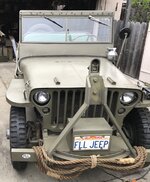
-DonLovely pics, nice Jeep, great restoration. Well done.Hopefully Lugz won’t mind me polluting his thread with a ‘42 Ford GPW rather than an Willys MB, especially if I show one of his excellent tow ropes.
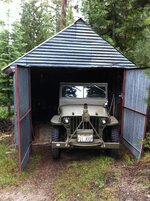
Here is what it looked like the night we picked it up from my brother’s house in Sacramento many years ago.

No worries, Don. I have the means of bringing that back into balance!Hopefully Lugz won’t mind me polluting his thread with a ‘42 Ford GPW...

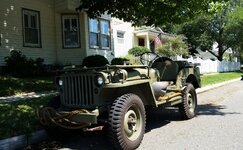
I like the way you wrapped it. Classy.if I show one of his excellent tow ropes.

One GPW and a frankenjeep with 87.5% MB DNA.Nice GPW’s
True, technically 1 Ford and 1 motor pool assembled unitOne GPW and a frankenjeep with 87.5% MB DNA.


I had my 42 GPW up to 53 mph, going downhill, 25 years ago, when it was fresh out of restoration. With a newly machined engine that's 0.030 in the cylinders, and something undersize on the crank. And probably less than 10 miles on the odometer at the time. And it was SCREAMING at that speed!The box says it will go 60mph. Not so much
Nice GPW’s both of you guys! I would love to find a wartime one to fix up with my son. Very cool!

Just to chase a rabbit. When I was a young moldmaker, I worked in a place near Chicago that did a LOT of Avon stuff. One mold I worked on in 1970-71 was for the plastic cap for a motorcycle. Rummaged around in the 'archives' and still had a proof piece of one half of the front end. Molds were tested in natural resin. Color was added for production. (As noted above, the bottle was glass but the cap was usually plastic.)Yup, all the collectibles were Wild Country. There's a Model A and a big blue trike out there, too.

Nice looking rig! Glad you are being a poor influence on your buddyI had my 42 GPW up to 53 mph, going downhill, 25 years ago, when it was fresh out of restoration. With a newly machined engine that's 0.030 in the cylinders, and something undersize on the crank. And probably less than 10 miles on the odometer at the time. And it was SCREAMING at that speed!
Portrayal Press (https://www.youtube.com/c/Portrayalpress/featured) is doing a 10-day father/son restoration of a '43(?) which they bought already disassembled. I think today is Day 9; they've been posting short Tiktok videos and Tiktok lives as they go. But the front axle wasn't painted, or assembled to the frame in the video I just saw. Their YT channel is...several...days behind on posting. They're putting the effort into turning wrenches, with some daily video posts as they go.
To push the GPW/MB balance back in the F'er direction, here's me in khakis, "hooking" a buddy into the MV hobby:
 . We need to save more of these work horses for future generations!
You hooked him pretty good if he restored a weapons carrier! Dodge?Smoke, tossing him the keys that day worked better than I ever could have hoped. He has restored a couple Jeeps and a WC. Sold an 85% MB to another friend of mine, who has worked on it till it’s a really nice motor pool level product, and very reliable, mechanically.
3/4 ton Dodge, WC 51 (no winch), IIRC. All I did was set the hook, he “hook line and sinkered” the rest. Ran a good blog for the duration of a jeep restoration.You hooked him pretty good if he restored a weapons carrier! Dodge?
Now that I think about it, she was all MB, but 42 (L head), 45 (tub), postwar frame with the extra leaf springs. Jeeps are MPH limited, but not going too fast is perfect for turning HPM (heads per minute), as I like to say, as you're double clutching around town, and for veteran passengers parade speed!and 1 motor pool assembled unit
I was going to say it was definitely Wild Country, that one of my brothers had one, but we're in the presence of a true Avon collectible decanter expert now!I suppose the motorcycle also contained Wild Country.
Me neither, but as the purveyor of the 'Automobile Paraphernalia' thread, it should come as no surprise that the Curator loves it!Never thought we would be going down this pathway ...
Lovely background. The nostalgia is as strong as the fragrance in here right now.My grandma was an Avon lady growing up so all of our presents were the collector cars.
The 'Paraphernalia' thread would be graced with their periodic posting from time to time, if you don't mind handling your small fortune. (Have you ever appraised them? You could be sitting on several to tens of thousands. Seriously.)I think I have 40 or so still in the box.
I'm sure this little mini virtual MVPA rally will run out of gas soon, but if it doesn't, or if it gets all correct nuts-and-boltsy or brake bleedingly techniquey I might have to break out the weighted MP thumpers.Don’t want to get further down a rabbit hole he’s not leading the charge on, on his “home thread.”
I did a quick ebay search when my dad passed, and none of his cars were getting even $10 each 10 years ago.
Well, I just did an eBay search on SOLD listings to prove you guys wrong, but..., it looks like prices have dropped for most of the vintage Avon decanter cars. I found...None have any real value.

Here here! Well said. I am glad our collection’s are being shown to have value. It helps me to show the CFO( wifeThe Curator has always had a different, much more understanding and sanguine, much less scornful, and above all a much more sellers' view of the value of collectibles, and he has expressed it enough on other threads when the subject has come up that he may as well express it again here on his own thread.
Collectibles have a value that transcends the utilitarian. Especially old tools and automotive paraphernalia. Or Avon decanters. Nobody is buying a 1970's Avon decanter for the fragrance. They are much closer to being viewed as objets d'art in that respect than a new hammer or a new bottle of after shave on a shelf in a store. They tickle a fancy. They represent a time, place, and culture we admire. Nostalgia plays a very strong role. For some, over time, they become more of a commodity, exchanged with little to no passion, within a realm of collecting where the sole motivation is the collectibility, an abstractness for which the Curator has little to no respect. But judging their prices from the utilitarian view has never made any sense. There is a math to it. There always is. And it, too, plays by the rules of supply and demand. Scarcity is only one half the equation. The other is demand. If that Avon Model A decanter was easily available to everyone for $1, it wouldn't sell for $100. Since most of the other Avon decanters are selling for around $10, the Curator assumes the Coleman lantern is also a little more desirable and a little less commonly found at $30. We can't make the mistake of thinking our hunting grounds, our part of the flea market and estate sale "wilderness" (before a thing has hit a large collectibles market place like eBay or FB etc), is common. Just because we found and bought one for $1, doesn't mean that everyone can.
Sure, the Curator collects things he "likes" (admires and wants), that he places great historical and cultural value in (a value completely separate from and hopefully well above the price the Acquisitions Department paid!), but he has sufficient ego to think that some of the things he likes are things that others "like" (admire and want), too! Having (and not having) has a value.
That's why all good curators are good sellers. And I mean that especially in the Smithsonian sense, at the Smithsonian levels. Historical artifacts is a huge marketplace unto itself, even among institutions. If you think they're above it, you're wrong. Collections are never static and things are being bought and sold all the time. The way they arrive at value is exactly the same way we do. Supply and demand. Scarcity and desirability. Nobody, not even the Smithsonian, wants to buy low and sell low. The goal is to buy low and sell high. The goal is for others to place as much value in the things you collect as you do. The goal is to be so good at collecting, of knowing what things represent a time, place, and culture more admirably than others, pluck harder on the nostalgic heartstrings than others, that the value of the things you collect goes up over time.
The Curator has rare tools. The Curator has some tools that nobody else has. Some of them are too obscure to be of any value to anyone but the Curator and maybe a few other GJ guys I could name on one hand. The Curator is such a good seller in the 'All curators are good sellers' mantra that he hopes his displays for some of these, bolstered by impeccable research and enthusiasm, pays off one day. Maybe at Hershey or somewhere similar where someone says, "Hey, I saw that on GJ!" But probably not. Some of the rare tools are not obscure. They are very much in demand and when the Sales Department sells them, believe the Curator when he says he very much wants and very much expects the knowledgeable "deep pocket collector on eprey" to pay "stupid $$" for them. That's not mercantile. Of course we are collecting them primarily because we like to be surrounded by antique and vintage doo dads in the basement. But that's not mutually exclusive of being aware of their value to others. And that's a way too long winded why on why the Curator has never understood the head scratching dismay about high prices and why the Curator has always been elated by them. The higher the better.
I value my stuff. Some of it very highly. I don't find that unreasonable. And I don't expect others to find it unreasonable in exchange.
) a value of something before I go buy it and also helps to fund the hobby a bit for myself. Plus, if our things have value, more people I’ll notice and less stuff will be trashed, thereby hopefully preserving some rare/desirable items for collectors to find and purchase. I myself like the over zealous collectors who pay big money because they help to set the market of worth on things!I don't really collect them they were kind of forced on me as a childQuick add: Having said all that, unless @83VillageRepair has forty (40) Avon Thomas Flyer 1908 decanters, the Curator may have overestimated the value of his collection just a smidge!
I don't think I have the jeep and now I suddenly want one. The girls had it worse. Avon had way more girly decorative decanters. I think my sister has around a hundred of those.Well said!!!The Curator has always had a different, much more understanding and sanguine, much less scornful, and above all a much more sellers' view of the value of collectibles, and he has expressed it enough on other threads when the subject has come up that he may as well express it again here on his own thread.
Collectibles have a value that transcends the utilitarian. Especially old tools and automotive paraphernalia. Or Avon decanters. Nobody is buying a 1970's Avon decanter for the fragrance. They are much closer to being viewed as objets d'art in that respect than a new hammer or a new bottle of after shave on a shelf in a store. They tickle a fancy. They represent a time, place, and culture we admire. Nostalgia plays a very strong role. For some, over time, they become more of a commodity, exchanged with little to no passion, within a realm of collecting where the sole motivation is the collectibility, an abstractness for which the Curator has little to no respect. But judging their prices from the utilitarian view has never made any sense. There is a math to it. There always is. And it, too, plays by the rules of supply and demand. Scarcity is only one half the equation. The other is demand. If that Avon Model A decanter was easily available to everyone for $1, it wouldn't sell for $100. Since most of the other Avon decanters are selling for around $10, the Curator assumes the Coleman lantern is also a little more desirable and a little less commonly found at $30. We can't make the mistake of thinking our hunting grounds, our part of the flea market and estate sale "wilderness" (before a thing has hit a large collectibles market place like eBay or FB etc), is common. Just because we found and bought one for $1, doesn't mean that everyone can.
Sure, the Curator collects things he "likes" (admires and wants), that he places great historical and cultural value in (a value completely separate from and hopefully well above the price the Acquisitions Department paid!), but he has sufficient ego to think that some of the things he likes are things that others "like" (admire and want), too! Having (and not having) has a value.
That's why all good curators are good sellers. And I mean that especially in the Smithsonian sense, at the Smithsonian levels. Historical artifacts is a huge marketplace unto itself, even among institutions. If you think they're above it, you're wrong. Collections are never static and things are being bought and sold all the time. The way they arrive at value is exactly the same way we do. Supply and demand. Scarcity and desirability. Nobody, not even the Smithsonian, wants to buy low and sell low. The goal is to buy low and sell high. The goal is for others to place as much value in the things you collect as you do. The goal is to be so good at collecting, of knowing what things represent a time, place, and culture more admirably than others, pluck harder on the nostalgic heartstrings than others, that the value of the things you collect goes up over time.
The Curator has rare tools. The Curator has some tools that nobody else has. Some of them are too obscure to be of any value to anyone but the Curator and maybe a few other GJ guys I could name on one hand. The Curator is such a good seller in the 'All curators are good sellers' mantra that he hopes his displays for some of these, bolstered by impeccable research and enthusiasm, pays off one day. Maybe at Hershey or somewhere similar where someone says, "Hey, I saw that on GJ!" But probably not. Some of the rare tools are not obscure. They are very much in demand and when the Sales Department sells them, believe the Curator when he says he very much wants and very much expects the knowledgeable "deep pocket collector on eprey" to pay "stupid $$" for them. That's not mercantile. Of course we are collecting them primarily because we like to be surrounded by antique and vintage doo dads in the basement. But that's not mutually exclusive of being aware of their value to others. And that's a way too long winded why on why the Curator has never understood the head scratching dismay about high prices and why the Curator has always been elated by them. The higher the better.
I value my stuff. Some of it very highly. I don't find that unreasonable. And I don't expect others to find it unreasonable in exchange.
All quite correct, and worth pointing out again.The Curator has always had a different, much more understanding and sanguine, much less scornful, and above all a much more sellers' view of the value of collectibles, and he has expressed it enough on other threads when the subject has come up that he may as well express it again here on his own thread.
Collectibles have a value that transcends the utilitarian. Especially old tools and automotive paraphernalia. Or Avon decanters. Nobody is buying a 1970's Avon decanter for the fragrance. They are much closer to being viewed as objets d'art in that respect than a new hammer or a new bottle of after shave on a shelf in a store. They tickle a fancy. They represent a time, place, and culture we admire. Nostalgia plays a very strong role. For some, over time, they become more of a commodity, exchanged with little to no passion, within a realm of collecting where the sole motivation is the collectibility, an abstractness for which the Curator has little to no respect. But judging their prices from the utilitarian view has never made any sense. There is a math to it. There always is. And it, too, plays by the rules of supply and demand. Scarcity is only one half the equation. The other is demand. If that Avon Model A decanter was easily available to everyone for $1, it wouldn't sell for $100. Since most of the other Avon decanters are selling for around $10, the Curator assumes the Coleman lantern is also a little more desirable and a little less commonly found at $30. We can't make the mistake of thinking our hunting grounds, our part of the flea market and estate sale "wilderness" (before a thing has hit a large collectibles market place like eBay or FB etc), is common. Just because we found and bought one for $1, doesn't mean that everyone can.
Sure, the Curator collects things he "likes" (admires and wants), that he places great historical and cultural value in (a value completely separate from and hopefully well above the price the Acquisitions Department paid!), but he has sufficient ego to think that some of the things he likes are things that others "like" (admire and want), too! Having (and not having) has a value.
That's why all good curators are good sellers. And I mean that especially in the Smithsonian sense, at the Smithsonian levels. Historical artifacts is a huge marketplace unto itself, even among institutions. If you think they're above it, you're wrong. Collections are never static and things are being bought and sold all the time. The way they arrive at value is exactly the same way we do. Supply and demand. Scarcity and desirability. Nobody, not even the Smithsonian, wants to buy low and sell low. The goal is to buy low and sell high. The goal is for others to place as much value in the things you collect as you do. The goal is to be so good at collecting, of knowing what things represent a time, place, and culture more admirably than others, pluck harder on the nostalgic heartstrings than others, that the value of the things you collect goes up over time.
The Curator has rare tools. The Curator has some tools that nobody else has. Some of them are too obscure to be of any value to anyone but the Curator and maybe a few other GJ guys I could name on one hand. The Curator is such a good seller in the 'All curators are good sellers' mantra that he hopes his displays for some of these, bolstered by impeccable research and enthusiasm, pays off one day. Maybe at Hershey or somewhere similar where someone says, "Hey, I saw that on GJ!" But probably not. Some of the rare tools are not obscure. They are very much in demand and when the Sales Department sells them, believe the Curator when he says he very much wants and very much expects the knowledgeable "deep pocket collector on eprey" to pay "stupid $$" for them. That's not mercantile. Of course we are collecting them primarily because we like to be surrounded by antique and vintage doo dads in the basement. But that's not mutually exclusive of being aware of their value to others. And that's a way too long winded why on why the Curator has never understood the head scratching dismay about high prices and why the Curator has always been elated by them. The higher the better.
I value my stuff. Some of it very highly. I don't find that unreasonable. And I don't expect others to find it unreasonable in exchange.
Would that all of mankind should suffer such abuse!...they were kind of forced on me as a child.
I don't know if you shop on eBay, but when I was scrolling through the listings to reacquaint myself with the going rates, I saw plenty of them selling for prices ranging from $3 (no box, no windshield, empty) to $21 (complete, full), which is funny, because if you multiply that by a factor of 1,000, it's kinda sorta the same rationale for pricing the actual size models from Willys and Ford!I don't think I have the jeep and now I suddenly want one.
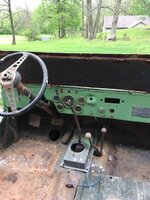
My Dad has a '46 CJ-2A that I kind of have my name on. When I was a kid our Rural Volunteer Fire Department had a WWII Jeep was on loan from the state. It was complete and original, blackout lights shovel and all. I used to get to drive it, ruined me for life. I have always had a little UTV since Broncos, Scouts, FJ-40s, CJ's, Wrangler.Thanks, gents.
Would that all of mankind should suffer such abuse!
I don't know if you shop on eBay, but when I was scrolling through the listings to reacquaint myself with the going rates, I saw plenty of them selling for prices ranging from $3 (no box, no windshield, empty) to $21 (complete, full), which is funny, because if you multiply that by a factor of 1,000, it's kinda sorta the same rationale for pricing the actual size models from Willys and Ford!
It's amazing how many fire companies got them and how many ended up with MVPA guys years later. I know a guy in Eastern Shore Maryland who purchased one from a small town volunteer fire company. It had been painted red and it only sat two. The entire back half of the jeep was a pumper, also painted red. When he removed it in the restoration process, he found a partial toolkit, which I helped him identify as original. When the fire company took possession of it in the 50's, they didn't even bother removing the tools, they just mounted the pumper on the back right over everything that was back there!When I was a kid our Rural Volunteer Fire Department had a WWII Jeep was on loan from the state.
That'll do it!I used to get to drive it, ruined me for life.
Well, you lucky so-and-so! Is it running?My Dad has a '46 CJ-2A that I kind of have my name on.






The man the myth the legendIt's amazing how many fire companies got them and how many ended up with MVPA guys years later. I know a guy in Eastern Shore Maryland who purchased one from a small town volunteer fire company. It had been painted red and it only sat two. The entire back half of the jeep was a pumper, also painted red. When he removed it in the restoration process, he found a partial toolkit, which I helped him identify as original. When the fire company took possession of it in the 50's, they didn't even bother removing the tools, they just mounted the pumper on the back right over everything that was back there!
That'll do it!
Well, you lucky so-and-so! Is it running?
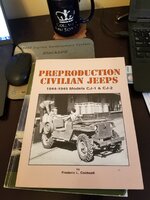
I am friends with Bob Westerman, who runs the CJ-2A website, and especially good friends with his co-hort, Fred Coldwell. If you're interested in the CJ-2A, how it evolved from the MB, get Fred's book, "Preproduction Civilian Jeeps", title page shown below. It's about CJ-1's and very early CJ-2's, pre-A, which are extremely rare. He owns two of them. It's like the Old Testament to the KJB for jeepers. Fred and I co-wrote Chapter 40, Volume 5, in the "Evolution of the Willys-Overland MB Jeep" series.

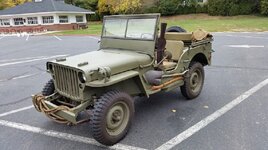
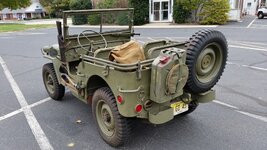
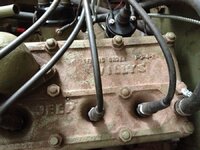
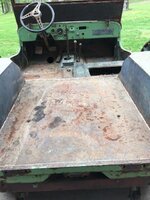
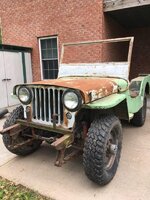
With the caveat that I definitely do not want to turn this thread into an MB "build" thread, that is a fantastic starter jeep. It looks very "straight" as we like to say, and solid. And this...Here it is when we picked it up.
...makes the project more pleasurable than a complete frame-off. But don't forget the braking! Running and driving (and shifting without getting seized up in 2nd gear!) is good, but braking is essential!It runs and drives great.
Well......I'm not sure how "straight" it is. The sides have both been covered by sheet metal that we haven't peeled off yet. Brakes are all new and it stops well. The fact that it was running, driving, braking was why I drove from Alabama to Missouri to buy it. It was a great trip with my son too.With the caveat that I definitely do not want to turn this thread into an MB "build" thread, that is a fantastic starter jeep. It looks very "straight" as we like to say, and solid. And this...
...makes the project more pleasurable than a complete frame-off. But don't forget the braking! Running and driving (and shifting without getting seized up in 2nd gear!) is good, but braking is essential!
In other words, no problem hitting 60MPH!my current jeep is a 73CJ5 with the 304V8