OP
Private Lugnutz
Well-known member
I wasn't suggesting magnification. I'm sure these all work the same. I'm saying it's neat looking because it resembles a spyglass or scope. whereas the Swift & Anderson is square.

Thanks for confirming our educated guesses about Swift & Anderson supplying these to the Army, probably the Corps of Engineers, LS. We're very happy for you and not at all envious.I have one in box with instructions.

Thanks, but I have them. That's where I got the cropped image of the guy using one in my post. Appropriated it from an ePay sale.I can scan them if you don’t have them.
Well, apparently I was doing something wrong before. I swore I could rotate the projection of the level by rotating the brass end, but that obviously doesn't work now that I am trying to do it (corrected above). Mine has no magnification, and does not work well in poor light. Mine is ~7/8" through the body tube.We would love to see the Dietzgen and Frese models when you guys have the opportunity.

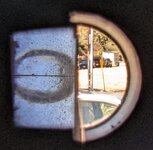
I see it now! Nice design.....and a flat on the ocular...
Yup, as I noted, was a pain in the **** to photograph through the eyepiece. I had a nice tripod standing nearby for my telescope, but chose not to use it due to the effort of removing the scope, and minimal benefit with a round bottom.Hmm. Only one dead level reticle. And another cylindrical one like Outlaw's Frese. One thought on that. These are hand sights. But you can rest the S&A on a stand because it's square.

I think I see a "JAN. 1. 1901." underneath the logo, and that was a Tuesday (patent day). Unfortunately, DATAMP is not helping. They have sixteen (16) patents in their database on that date, but none of them are any kind of wrench. They have ninety-six (96) bicycle or pocket wrenches, but none of them have a Jan. 1, 1901 patent date.

It's not just a learning curve issue. At this point, I wish that's all it was, in which case I would try to learn fast. Unless my curve is so steep it's not even on the curve, I think the issue is worse. I don't think it's designed to search on patent numbers! Because why would it? if you think about it. Who would use a search tool to find a patent you already have the number for!? All the fancy Boolean expressions for finding patents by function or mechanism or materiel or topic etc that an inventor would use it for are not just overkill. They omit patent numbers! The whole premise of the tool is that you don't know the patent number....all the f-ing arbitrary class codes present an unnecessary learning curve for the occasional researcher.

You mean the METHOD OF MAKING A 3D PRINTED DENTAL ALIGNER OR MOUTHGUARD?I tried patent 1902878 and the search results were for something completely unrelated.

Just so you understand the scope of the issue, there's no telling how many of those 22,686 records it returned, 500 per page, were relevant. The search tool will return ALL instances of the number "6002" it finds, whether that refers to the patent number 6,002, issued to Solyman Merrick on Jan 2, 1849 for a screw wrench, or not. If "6002" is any other number or simply PART OF any other number (Zip Code 76002, Serial Number 8946002654, etc), it will list the patent record containing that number. And because it doesn't seem to be finding any pre-1900 patents, probably all of those were irrelevant.On the 6002, I got a drop-down menu at lower left with no less than 22,868 line items to pick through.


 www.eventbrite.com
 www.eventbrite.com
Give that man a CEE-gar!Patent # 1,000,000, whatever that may be.
So that I could metaphorically use it? Not a bad idea!John Browning's Model of 1911?


