Grab yourselves a cup of coffee (or tea) and find a comfortable chair, because this is going to be a long post. My first day here too, so hello everybody.
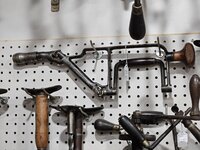
Before the advent of electricity, people used hand power to put holes in things (or steam or water power, but we are not discussing those). For big holes a man (or woman) would use a post/pillar drill, or a T-auger, or as as the holes got smaller, a bench drill, a chest or shoulder drill, a hand crank drill, or a push drill. Braces were also an option, and offered more torque than hand crank drills. By the 1980's, the combination of slip chucks and rechargeable batteries had sounded the death knell for hand powered drills in every household. They still can be found in a very few specialized trades and hobbies. Not razor collecting, unfortunately, which is my main hobby.
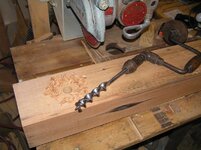
I vividly remember playing with the old brace bit that was stored in the garage, using it to slowly bore holes in scrap pieces of 2x4's. It was not a high quality brace, and the auger bits were dull as could be. Since I was about 10 at the time, I don't recall the brand, but since it lacked a rachet, it was not a "high end" or "professional's" brace. My father, a machinist, had no use for a relic like that, and it was sold in a yard sale a few years later, probably for 25 cents. Good riddance. 30 years later, a high end brace, sharp bits, and bigger muscles... what a difference. I never did forget the fun of playing with that first old bit brace though.
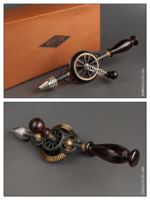
[A modern, very high end, limited edition hand drill. Bridge City Tool Works CT-6 Hand Drill made in 1998. This one was sold on the secondary market for $675. Ironically, the crank handle on these is easily bent, and they have to be retrofitted with a reinforced handle kit. They are also very noisy, but it sure is pretty. Keep reading for better, uglier, and way cheaper options.]
With the growing desire to return to the "artisan" style of doing things, these type of tools are once again rising in popularity. Some more so than others. Since every house and shop in America used to have hand drills and braces, they are still widely common and relatively inexpensive. The trick is finding the ones that were originally very good quality to begin with, and haven't been overly abused.
I recommend buying fewer tools at first, rather than lower quality tools. I guarantee that you’ll have to buy a better replacement down the road. But you can often find the highest quality antique tools for less money than poor quality new tools. There are NO modern "vintage style" hand drills or braces that are the equal of actual vintage ones. You guys already know that, of course. Preaching to the choir, as it were.
This begs the question, "Is there still a place for a manual hand drill in a modern society?" The answer, surprisingly, is "yes." There are a few things that hand drills excel at.
Tight spaces. Perfectly vertical or horizontal holes, and very small holes. Modern electric or battery powered drills simply cannot hold the smallest drill bits, and the ones that can, still have too high an RPM speed for those tiny bits...they also cannot get a very shallow angle in a corner. For a repetitive task, or for driving 3 1/2" construction screws an electric or battery powered drill is of course, far superior. But for drilling tiny holes for the hinge of a small box or a violin or when a precise depth is needed, a hand powered drill is still the better choice, and instrument makers, jewelers, organ makers and cabinet makers would tell you the same.
Note: Piano and organ makers had their own subset of specialized bit braces and if interested you can learn more about them here:
http://mshepherdpiano.com/antique-piano-tools/pianomakers-braces/
It's also one of the few trades that almost exclusively still uses slotted screws.
The Post or Pillar Hand Drill was usually mounted on a wall, beam, (or in the case of the pillar drill), on a workbench or free-standing. The quality of these is all over the place, as is condition and completeness. Holes wind up not quite circular, since the drill oscillates as it penetrates. This is not a quality issue or "it's worn out," it is a design flaw of just about all pre-motorized post and pillar drill designs. If you look into these drills further, be sure to look for one with an automatic feed. Many of those old drills don't have that feature, which leaves the user turning two wheels instead of one. These were really designed for drilling metal, and when using them for wood, the automatic advance often falls behind the drilling depth, so a person will be forced to manually advance the drill anyways. Something to keep in mind. These type of drills really are obsolete, and the only reason to keep one around is in case of a very long term serious power outage. Methinks that would come with it's own set of problems, and the ability to drill holes in thick metal is pretty far down the survival list. Still, there are people who enjoy collecting and restoring them.
A unique variation is the ultra rapid hand drilling machine, which is a cross between a pillar drill and a breast drill. More info here:
https://www.georgesbasement.com/geobasmt/grbraces/Ultra-RapidDrill/TheDrillItself/Ultra-Rapid.htm
Not only are they rare, they are pretty much only found in (what were then) third world countries as they were exported, not used in the U.S. They were obsolete by U.S. standards at the time they were made.
There was a little company called North Brothers, who built their reputation on drills, and they made two of the nicest and most advanced of the pillar/bench drills, the 1003 and the larger two-speed 1005. They were known to be fragile at the top, and the casting is often broken there, so if you shop for one, be aware of this.

More info here: https://www.google.com/amp/s/www.timetestedtools.net/2016/08/30/north-brothers-yankee-no-1003/amp/
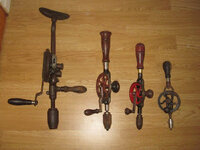
[L to R, an illustrative size difference.
MF No 12 breast drill, No 2 , No 5, and No 1 hand drill. The tiny No 1 drill can accept drill bits as large as 1/16".]
Moving on to the breast (or shoulder, or belly) drills. These are the largest members of the "egg beater" or (for you UK chaps) "egg whisker" drills. These are hefty drills, often weighing 4-5 pounds. They were mostly designed to put holes in metal, or holes in wood. (Pro Tip: a brace with a wide sweep (swing) will provide more leverage than just about any hand crank drill). Most came with a secondary side handle, and many are two-speed drills. You operated them by using your body weight to provide the penetrating power while you cranked the handle.
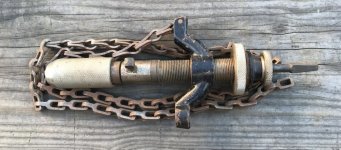
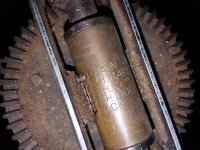
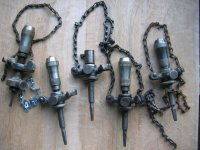
There are also attachments for bit braces called "chain drills" which attach to the brace and wrap around the object being drilled, usually a cast iron pipe. Some are ratchet advance (self feeding), and some are manual advance. They are clumsy and awkward to use, compared to a modern drill press, but they were the ultimate labor savers before electricity. The best of these was the North Bros. No. 1500, which came with a three jaw chuck (for holding round shank bits). The No. 500 is identical, but came with a two jaw chuck (for holding tapered square shank bits). The No. 1500 sold for $3.90 in 1917, or about $80 in 2021 USD. The ad below is probably from 1915 or so.

Note: "Mechanic" was a bit of a 'catch all' term in the early 1900's. Today's equivalent would be a machinist, maintainence worker, engineer, or an actual mechanic. Any person called a "mechanic" was a skilled laborer or craftsman.
Then there's the large hand drills. These are incredibly versatile and can be used as both a hand drill or breast drill. The handle is usually oversized, round, with a mushroom top or flat top, and includes a side handle for stability as well. Some examples include the Goodall Pratt 259, the North Bros. 1545, 545 and the Miller Falls 198 (1913-1922), No 1980 (1914-1944), and No 1981 (1914-1917).
Please be aware that the large drills listed above are all two-speed, ratcheting drills. There are similar models, either without the two-speed, ratchet, or both. Miller Falls 98, 980, and 981 are two-speed, non-ratcheting. The Goodell Pratt 5 1/2B is a two-speed drill, also non-ratcheting. These could be used like a breast drill, but were more often used while the user's forehead or chin rested on top of the handle, one hand gripped the side handle, and the other turned the crank.
The smaller drills usually don't have side handles, and none have multiple speeds that I'm aware of (except for the North Brothers 1435). The North Bros. 1530 and 1530A and the Miller's Falls #2, Record 123 and the Stanley 803 are all examples of this size drill. Smaller hand drills were made, but these were and are considered hobby tools or jeweler's tools, and are more the domain of the model boat and airplane builder than a serious wood workshop tool.
To me, the 'ne plus ultra' of the eggbeater style drill has got to be the North Bros "Yankee" ratchet drills with the five position function selector – such as the well known No. 1530, 1545 & 1555. The 1545 & 1555 have a speed selector switch in addition to the 5 function selector. Most people who like these kinds of drills have at least heard of those three models.
However, there are more members of the Yankee drill family.
The No. 1555 is a two-speed breast drill, with a three-jaw chuck. It’s cousin, the 555, is identical - but for a two-jaw chuck for auger bits, etc.
There are single speed versions of both those drills as well, the 1550 and the 550.
(A note about the different chucks: the three jaw chuck is a "universal" type chuck and will work with most round or modern octagonal bits. The two jaw chuck is designed to work best with square vintage auger type bits. While it's easy to say one drill is for metal and the other is for wood, that isn't the case. One drill is for metal and wood, and the other is really only for wood, unless you can find square taper shank twist bits. Those bits used to be common, but people often cut the square tapers off to use in modern drills. If you plan to drill metal with any of these, you really want a two-speed version).
Likewise the No.1545, a two-speed large-ish eggbeater drill with a three-jaw chuck, has a cousin, the No.545 with a two-jaw chuck; and you also have the No. 1540 and 540, single speed versions of the 1545 and 545 eggbeater drills.
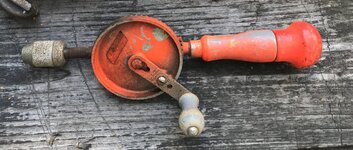
The last member of this group of the family is the diminutive No. 1530, a small single speed eggbeater drill with a three-jaw chuck, it later became the No. 1530A some time during the decade before North Bros were bought out by Stanley (in 1946). The 1530A drills are sometimes marked with a Bell Systems logo, and were a mandatory part of any linesman's toolkit for over 40 years. As such, they tend to be fairly common and relatively inexpensive. I paid $9 plus shipping for my 1530A, which is about $20-30 less than they usually go for online. Pristine examples are very rare, though restored and refurbished drills are fairly common, and command a sizable premium, often adding $100+ to the base value. I paid $42 + shipping for the 1545 drill, which isn't bad either, since it is a far less common drill, and it came with the original side handle. About 2/3 of these drills are missing that handle.
The differences between the 1530 and 1530A are signifigant. High stress points that used steel were switched to more forgiving brass, and the frame was redesigned to strengthen the frame and handle attachment point. Many 1530's have broken frames where the frame and handle meet, so it can be a bit risky to buy one without physically handling the drill. I've yet to see a 1530A drill broken at that point, or just broken, period. With one exception... the gear castings on these drills tends to be on the brittle side, so there are cases where a drill will have chipped or broken teeth, usually caused by abusing the drill beyond its capabilities.
Speaking of capabilities...
All these Yankees are equipped with a five position selector which allows:
Plain – normal function (like your common Stanley No.503)
Left Hand Ratchet;
Right Hand Ratchet;
Right Hand Double Ratchet;
Lock - gears locked.
I've looked at the patent drawings for the function selector. I'm convinced that the North Bros. shop was in league with the devil. It's the only explanation that makes sense. Chris Schwarz calls it "magic," and who am I to disagree? All I know is it goes right over my head, and I'm a certified blueprint reader. Took the college course and everything. Let's talk about the 4th position. Right hand double rachet. What that means, in plain English, is that no matter which direction you crank the handle, the chuck spins clockwise. If I remember right, the patent also included a left hand (reverse) double rachet. Aside from any prototypes which may have been made, that particular selector was never put into production. Probably a wise choice, since most people never moved the selector out of position 1, and used it for drilling holes in baseboards for telephone wires.
"I am aware of 4 variations on the 1530. The first two are both labeled 1530, and manufactured by the North Bros. The difference between the two is the thickness of the barrel gears. I strongly suspect the thick geared version came first. These tools have a tendency to be broken under the handle. Unscrew the handle and see how the tube is cut away to provide seating for the handle. [Ryan: The 1545 shares this same weakness, but is less likely to be broken since it is bigger and more robust than the 1530].
The 3rd variation is the 1530A, also manufactured by the North Bros. This version has the thinner barrel gears from the 1530, but the machining method for the handle seating is improved - so they aren't usually broken. Several examples of the 1530A I've seen have longer chucks than the 1530, but not all. Oh yeah, I think they switched from brownish-red stain to brownish-red paint in this time period for the handle and crank knob.
The last variation is the 1530AX, manufactured by Stanley after the acquisition. I don't see these too often. The paint is even brighter colored, and the chuck is grooved vertically on the outside - making it more painful on the fingers IMHO.
You can disassemble most of the drill, but IME trying to disassemble the ratchet barrel is a waste of time - there're no moving parts in there that you can repair, you'll never get it back together [Ryan: only one or two people have done so, taking many hours to do so, and regretting their life decisions the whole time], and a patent search on the numbers on the barrel of a 1530 will tell you everything you want to know about what's inside."
- Bretton Wade (aka Noz Moe King) in Bellevue, WA
Here's many of those patents:
https://www.georgesbasement.com/yankeedr/patents/patentlist.htm
And here's a 1931 "Yankee" catalog:
https://archive.org/details/YankeeTools1931
Reviewing manually operated hand drills through many different forums and blogs, it became clear to me that there were only 4 drills that were relatively easy to find, relatively inexpensive, and were considered to be the best of that type of tool.
North Bros. "Yankee" No. 1530A and No. 1545 and Miller's Falls No. 5 and No. 2.
After talking up the Yankee drills, you might find the inclusion of such basic drills as the No. 5 and No. 2 to be on the extreme other end of the spectrum. Neither are ratcheting, have multiple speeds or multiple functions. This actually gives them some advantages over the Yankee drills. For the craftsman that doesn't need all the extra functionality, the No. 5 and No. 2 are extremely smooth running, due to hidden ball bearings, and are very light weight, an important consideration when you carry your tools from job to job, or use your tool all day.
For an in-depth look at the No. 2
https://www.georgesbasement.com/mfno2typestudy/mfno2types.html
For an in-depth look at the No. 5
https://www.georgesbasement.com/mfno135typestudy/index.htm
Because of their functions, the 1530A and 1545 can replace larger drills, but weight and smoothness have a quality all their own.
"In February 1956, Joe Guilbault, a veteran of fifty years in the Millers Falls hand drill department, was interviewed for the firm's employee magazine, Dyno-mite. During his long tenure, Guilbault worked on sixty-one different hand drill models, fitting the gears on more drills than perhaps anyone in the history of the company. Asked if he has a favorite among all the models, Guilbault replied, 'The number two, that is it. The best hand drill in all the world. The number five, too. I like two and five best.'"
Source:
https://www.google.com/url?sa=t&sou...Vaw1ZIiz_rBvXKVHEDxlytZ5Y&cshid=1614142146287
Because they were considered great drills, even back when they were new, they were popular. Lucky for collectors, they tend to be inexpensive and readily found locally in antique stores. They are more expensive but just as easily found on American auction sites.
Millers Falls also made very good ratcheting two-speed hand drills, and it's a shame that they get over shadowed by the North Bros. drills. Adding a 1 in front of the models numbers turned them into the ratcheting models No. 198 (1913-1922), No 1980 (1914-1944), No 1981 (1914-1917) the only difference between the various models is the shape of the top handle. The 1981 has a small breast plate attachment.
A post similar to mine, though less specialized and much broader can be found here:
https://woodandshop.com/woodworking-hand-tool-buying-guide-hand-drills-braces-bits/
He prefers the Goodell-Pratt 5 1/2, because of the large gearing wheel and the two speed option. He would probably also really like the smaller North Bros. No. 1435 for the same reasons.
As for chest drills, the North Bros. No. 1555 is the clear winner across the board. Though a person with a 1545 might never need the bigger drill. At that size, a brace or T-auger is more useful in wood, and an electric drill will work better for steel. This is mostly for the die-hard "neander" (hand powered tool enthusiast).
Before the advent of electricity, people used hand power to put holes in things (or steam or water power, but we are not discussing those). For big holes a man (or woman) would use a post/pillar drill, or a T-auger, or as as the holes got smaller, a bench drill, a chest or shoulder drill, a hand crank drill, or a push drill. Braces were also an option, and offered more torque than hand crank drills. By the 1980's, the combination of slip chucks and rechargeable batteries had sounded the death knell for hand powered drills in every household. They still can be found in a very few specialized trades and hobbies. Not razor collecting, unfortunately, which is my main hobby.
I vividly remember playing with the old brace bit that was stored in the garage, using it to slowly bore holes in scrap pieces of 2x4's. It was not a high quality brace, and the auger bits were dull as could be. Since I was about 10 at the time, I don't recall the brand, but since it lacked a rachet, it was not a "high end" or "professional's" brace. My father, a machinist, had no use for a relic like that, and it was sold in a yard sale a few years later, probably for 25 cents. Good riddance. 30 years later, a high end brace, sharp bits, and bigger muscles... what a difference. I never did forget the fun of playing with that first old bit brace though.
[A modern, very high end, limited edition hand drill. Bridge City Tool Works CT-6 Hand Drill made in 1998. This one was sold on the secondary market for $675. Ironically, the crank handle on these is easily bent, and they have to be retrofitted with a reinforced handle kit. They are also very noisy, but it sure is pretty. Keep reading for better, uglier, and way cheaper options.]
With the growing desire to return to the "artisan" style of doing things, these type of tools are once again rising in popularity. Some more so than others. Since every house and shop in America used to have hand drills and braces, they are still widely common and relatively inexpensive. The trick is finding the ones that were originally very good quality to begin with, and haven't been overly abused.
I recommend buying fewer tools at first, rather than lower quality tools. I guarantee that you’ll have to buy a better replacement down the road. But you can often find the highest quality antique tools for less money than poor quality new tools. There are NO modern "vintage style" hand drills or braces that are the equal of actual vintage ones. You guys already know that, of course. Preaching to the choir, as it were.
This begs the question, "Is there still a place for a manual hand drill in a modern society?" The answer, surprisingly, is "yes." There are a few things that hand drills excel at.
Tight spaces. Perfectly vertical or horizontal holes, and very small holes. Modern electric or battery powered drills simply cannot hold the smallest drill bits, and the ones that can, still have too high an RPM speed for those tiny bits...they also cannot get a very shallow angle in a corner. For a repetitive task, or for driving 3 1/2" construction screws an electric or battery powered drill is of course, far superior. But for drilling tiny holes for the hinge of a small box or a violin or when a precise depth is needed, a hand powered drill is still the better choice, and instrument makers, jewelers, organ makers and cabinet makers would tell you the same.
Note: Piano and organ makers had their own subset of specialized bit braces and if interested you can learn more about them here:
http://mshepherdpiano.com/antique-piano-tools/pianomakers-braces/
It's also one of the few trades that almost exclusively still uses slotted screws.
The Post or Pillar Hand Drill was usually mounted on a wall, beam, (or in the case of the pillar drill), on a workbench or free-standing. The quality of these is all over the place, as is condition and completeness. Holes wind up not quite circular, since the drill oscillates as it penetrates. This is not a quality issue or "it's worn out," it is a design flaw of just about all pre-motorized post and pillar drill designs. If you look into these drills further, be sure to look for one with an automatic feed. Many of those old drills don't have that feature, which leaves the user turning two wheels instead of one. These were really designed for drilling metal, and when using them for wood, the automatic advance often falls behind the drilling depth, so a person will be forced to manually advance the drill anyways. Something to keep in mind. These type of drills really are obsolete, and the only reason to keep one around is in case of a very long term serious power outage. Methinks that would come with it's own set of problems, and the ability to drill holes in thick metal is pretty far down the survival list. Still, there are people who enjoy collecting and restoring them.
A unique variation is the ultra rapid hand drilling machine, which is a cross between a pillar drill and a breast drill. More info here:
https://www.georgesbasement.com/geobasmt/grbraces/Ultra-RapidDrill/TheDrillItself/Ultra-Rapid.htm
Not only are they rare, they are pretty much only found in (what were then) third world countries as they were exported, not used in the U.S. They were obsolete by U.S. standards at the time they were made.
There was a little company called North Brothers, who built their reputation on drills, and they made two of the nicest and most advanced of the pillar/bench drills, the 1003 and the larger two-speed 1005. They were known to be fragile at the top, and the casting is often broken there, so if you shop for one, be aware of this.
More info here: https://www.google.com/amp/s/www.timetestedtools.net/2016/08/30/north-brothers-yankee-no-1003/amp/
[L to R, an illustrative size difference.
MF No 12 breast drill, No 2 , No 5, and No 1 hand drill. The tiny No 1 drill can accept drill bits as large as 1/16".]
Moving on to the breast (or shoulder, or belly) drills. These are the largest members of the "egg beater" or (for you UK chaps) "egg whisker" drills. These are hefty drills, often weighing 4-5 pounds. They were mostly designed to put holes in metal, or holes in wood. (Pro Tip: a brace with a wide sweep (swing) will provide more leverage than just about any hand crank drill). Most came with a secondary side handle, and many are two-speed drills. You operated them by using your body weight to provide the penetrating power while you cranked the handle.
There are also attachments for bit braces called "chain drills" which attach to the brace and wrap around the object being drilled, usually a cast iron pipe. Some are ratchet advance (self feeding), and some are manual advance. They are clumsy and awkward to use, compared to a modern drill press, but they were the ultimate labor savers before electricity. The best of these was the North Bros. No. 1500, which came with a three jaw chuck (for holding round shank bits). The No. 500 is identical, but came with a two jaw chuck (for holding tapered square shank bits). The No. 1500 sold for $3.90 in 1917, or about $80 in 2021 USD. The ad below is probably from 1915 or so.
Note: "Mechanic" was a bit of a 'catch all' term in the early 1900's. Today's equivalent would be a machinist, maintainence worker, engineer, or an actual mechanic. Any person called a "mechanic" was a skilled laborer or craftsman.
Then there's the large hand drills. These are incredibly versatile and can be used as both a hand drill or breast drill. The handle is usually oversized, round, with a mushroom top or flat top, and includes a side handle for stability as well. Some examples include the Goodall Pratt 259, the North Bros. 1545, 545 and the Miller Falls 198 (1913-1922), No 1980 (1914-1944), and No 1981 (1914-1917).
Please be aware that the large drills listed above are all two-speed, ratcheting drills. There are similar models, either without the two-speed, ratchet, or both. Miller Falls 98, 980, and 981 are two-speed, non-ratcheting. The Goodell Pratt 5 1/2B is a two-speed drill, also non-ratcheting. These could be used like a breast drill, but were more often used while the user's forehead or chin rested on top of the handle, one hand gripped the side handle, and the other turned the crank.
The smaller drills usually don't have side handles, and none have multiple speeds that I'm aware of (except for the North Brothers 1435). The North Bros. 1530 and 1530A and the Miller's Falls #2, Record 123 and the Stanley 803 are all examples of this size drill. Smaller hand drills were made, but these were and are considered hobby tools or jeweler's tools, and are more the domain of the model boat and airplane builder than a serious wood workshop tool.
To me, the 'ne plus ultra' of the eggbeater style drill has got to be the North Bros "Yankee" ratchet drills with the five position function selector – such as the well known No. 1530, 1545 & 1555. The 1545 & 1555 have a speed selector switch in addition to the 5 function selector. Most people who like these kinds of drills have at least heard of those three models.
However, there are more members of the Yankee drill family.
The No. 1555 is a two-speed breast drill, with a three-jaw chuck. It’s cousin, the 555, is identical - but for a two-jaw chuck for auger bits, etc.
There are single speed versions of both those drills as well, the 1550 and the 550.
(A note about the different chucks: the three jaw chuck is a "universal" type chuck and will work with most round or modern octagonal bits. The two jaw chuck is designed to work best with square vintage auger type bits. While it's easy to say one drill is for metal and the other is for wood, that isn't the case. One drill is for metal and wood, and the other is really only for wood, unless you can find square taper shank twist bits. Those bits used to be common, but people often cut the square tapers off to use in modern drills. If you plan to drill metal with any of these, you really want a two-speed version).
Likewise the No.1545, a two-speed large-ish eggbeater drill with a three-jaw chuck, has a cousin, the No.545 with a two-jaw chuck; and you also have the No. 1540 and 540, single speed versions of the 1545 and 545 eggbeater drills.
The last member of this group of the family is the diminutive No. 1530, a small single speed eggbeater drill with a three-jaw chuck, it later became the No. 1530A some time during the decade before North Bros were bought out by Stanley (in 1946). The 1530A drills are sometimes marked with a Bell Systems logo, and were a mandatory part of any linesman's toolkit for over 40 years. As such, they tend to be fairly common and relatively inexpensive. I paid $9 plus shipping for my 1530A, which is about $20-30 less than they usually go for online. Pristine examples are very rare, though restored and refurbished drills are fairly common, and command a sizable premium, often adding $100+ to the base value. I paid $42 + shipping for the 1545 drill, which isn't bad either, since it is a far less common drill, and it came with the original side handle. About 2/3 of these drills are missing that handle.
The differences between the 1530 and 1530A are signifigant. High stress points that used steel were switched to more forgiving brass, and the frame was redesigned to strengthen the frame and handle attachment point. Many 1530's have broken frames where the frame and handle meet, so it can be a bit risky to buy one without physically handling the drill. I've yet to see a 1530A drill broken at that point, or just broken, period. With one exception... the gear castings on these drills tends to be on the brittle side, so there are cases where a drill will have chipped or broken teeth, usually caused by abusing the drill beyond its capabilities.
Speaking of capabilities...
All these Yankees are equipped with a five position selector which allows:
Plain – normal function (like your common Stanley No.503)
Left Hand Ratchet;
Right Hand Ratchet;
Right Hand Double Ratchet;
Lock - gears locked.
I've looked at the patent drawings for the function selector. I'm convinced that the North Bros. shop was in league with the devil. It's the only explanation that makes sense. Chris Schwarz calls it "magic," and who am I to disagree? All I know is it goes right over my head, and I'm a certified blueprint reader. Took the college course and everything. Let's talk about the 4th position. Right hand double rachet. What that means, in plain English, is that no matter which direction you crank the handle, the chuck spins clockwise. If I remember right, the patent also included a left hand (reverse) double rachet. Aside from any prototypes which may have been made, that particular selector was never put into production. Probably a wise choice, since most people never moved the selector out of position 1, and used it for drilling holes in baseboards for telephone wires.
"I am aware of 4 variations on the 1530. The first two are both labeled 1530, and manufactured by the North Bros. The difference between the two is the thickness of the barrel gears. I strongly suspect the thick geared version came first. These tools have a tendency to be broken under the handle. Unscrew the handle and see how the tube is cut away to provide seating for the handle. [Ryan: The 1545 shares this same weakness, but is less likely to be broken since it is bigger and more robust than the 1530].
The 3rd variation is the 1530A, also manufactured by the North Bros. This version has the thinner barrel gears from the 1530, but the machining method for the handle seating is improved - so they aren't usually broken. Several examples of the 1530A I've seen have longer chucks than the 1530, but not all. Oh yeah, I think they switched from brownish-red stain to brownish-red paint in this time period for the handle and crank knob.
The last variation is the 1530AX, manufactured by Stanley after the acquisition. I don't see these too often. The paint is even brighter colored, and the chuck is grooved vertically on the outside - making it more painful on the fingers IMHO.
You can disassemble most of the drill, but IME trying to disassemble the ratchet barrel is a waste of time - there're no moving parts in there that you can repair, you'll never get it back together [Ryan: only one or two people have done so, taking many hours to do so, and regretting their life decisions the whole time], and a patent search on the numbers on the barrel of a 1530 will tell you everything you want to know about what's inside."
- Bretton Wade (aka Noz Moe King) in Bellevue, WA
Here's many of those patents:
https://www.georgesbasement.com/yankeedr/patents/patentlist.htm
And here's a 1931 "Yankee" catalog:
https://archive.org/details/YankeeTools1931
Reviewing manually operated hand drills through many different forums and blogs, it became clear to me that there were only 4 drills that were relatively easy to find, relatively inexpensive, and were considered to be the best of that type of tool.
North Bros. "Yankee" No. 1530A and No. 1545 and Miller's Falls No. 5 and No. 2.
After talking up the Yankee drills, you might find the inclusion of such basic drills as the No. 5 and No. 2 to be on the extreme other end of the spectrum. Neither are ratcheting, have multiple speeds or multiple functions. This actually gives them some advantages over the Yankee drills. For the craftsman that doesn't need all the extra functionality, the No. 5 and No. 2 are extremely smooth running, due to hidden ball bearings, and are very light weight, an important consideration when you carry your tools from job to job, or use your tool all day.
For an in-depth look at the No. 2
https://www.georgesbasement.com/mfno2typestudy/mfno2types.html
For an in-depth look at the No. 5
https://www.georgesbasement.com/mfno135typestudy/index.htm
Because of their functions, the 1530A and 1545 can replace larger drills, but weight and smoothness have a quality all their own.
"In February 1956, Joe Guilbault, a veteran of fifty years in the Millers Falls hand drill department, was interviewed for the firm's employee magazine, Dyno-mite. During his long tenure, Guilbault worked on sixty-one different hand drill models, fitting the gears on more drills than perhaps anyone in the history of the company. Asked if he has a favorite among all the models, Guilbault replied, 'The number two, that is it. The best hand drill in all the world. The number five, too. I like two and five best.'"
Source:
https://www.google.com/url?sa=t&sou...Vaw1ZIiz_rBvXKVHEDxlytZ5Y&cshid=1614142146287
Because they were considered great drills, even back when they were new, they were popular. Lucky for collectors, they tend to be inexpensive and readily found locally in antique stores. They are more expensive but just as easily found on American auction sites.
Millers Falls also made very good ratcheting two-speed hand drills, and it's a shame that they get over shadowed by the North Bros. drills. Adding a 1 in front of the models numbers turned them into the ratcheting models No. 198 (1913-1922), No 1980 (1914-1944), No 1981 (1914-1917) the only difference between the various models is the shape of the top handle. The 1981 has a small breast plate attachment.
A post similar to mine, though less specialized and much broader can be found here:
https://woodandshop.com/woodworking-hand-tool-buying-guide-hand-drills-braces-bits/
He prefers the Goodell-Pratt 5 1/2, because of the large gearing wheel and the two speed option. He would probably also really like the smaller North Bros. No. 1435 for the same reasons.
As for chest drills, the North Bros. No. 1555 is the clear winner across the board. Though a person with a 1545 might never need the bigger drill. At that size, a brace or T-auger is more useful in wood, and an electric drill will work better for steel. This is mostly for the die-hard "neander" (hand powered tool enthusiast).
Last edited:

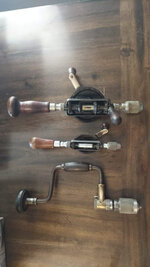












 couple, but this is my go to.