To avoid these ads, REGISTER NOW!

The Original "Cordless" Drills

To avoid these ads, REGISTER NOW!

d42jeep

Well-known member
Joined
Oct 22, 2014
Messages
16,531
Location
Northern California
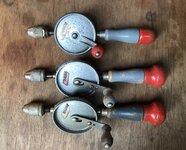
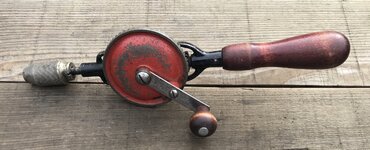
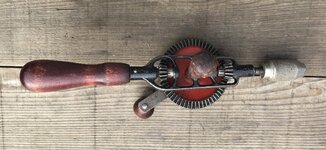
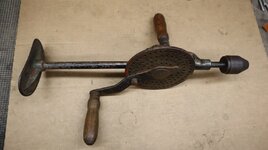
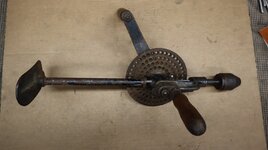
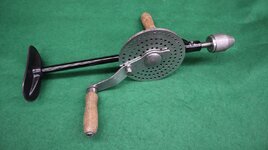
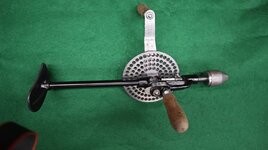
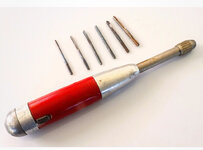
I would have left this spray bombed eggbeater behind yesterday but when I shook it there was a rattle from the bit storage area. I found quite a few bits so I picked it up. Here it is after some cleanup today.
-DonIMG_0105.jpegIMG_0106.jpegIMG_0125.jpeg
I ended up adding the new eggbeater to my S-K carpenter’s box. It replaced the upper one in the following two pictures. IMG_0183.jpegIMG_0182.jpeg
Here are the tools in the S-K box. They are mostly all Stanley, excluding the auger bits.
-DonIMG_0184.jpeg
 

Old tool guy

Well-known member
Joined
Apr 13, 2023
Messages
3,248
Ok, so i have this goodell-pratt 0316 chain drill, it’s in very good condition except for a little tarnishing. I took it apart to clean, and i found a minor problem. The three rings just above the chuck are a crude, maybe basic is better, ball bearing system. The 1st & 3rd rings are just flat washers, the middle one has an extra large center hole to contain the balls. Unlike the chucks on hand braces, there are no grooves.

As you can see, the balls are in really bad condition, several are just hemispheres and all are worn down. I was able to measure a couple and they are 0.12+” … approaching 1/8”. I measured the thickness of the washer, it is a little less than 0.12 which makes sense … that leaves just a hair for the balls to make contact. So i ordered an assortment of ball bearings from amazon, something like 600 for $9. Probably not highest quality, but certainly good enough for rebuilding this.

IMG_2127.jpeg
.
IMG_2117.jpeg
 

RTM

Well-known member
Joined
May 13, 2019
Messages
13,139
Location
SF Bay Area
As you can see, the balls are in really bad condition, several are just hemispheres and all are worn down. I was able to measure a couple and they are 0.12+” … approaching 1/8”. I measured the thickness of the washer, it is a little less than 0.12 which makes sense … that leaves just a hair for the balls to make contact. So i ordered an assortment of ball bearings from amazon, something like 600 for $9. Probably not highest quality, but certainly good enough for rebuilding this.
Someone really got a lot of miles out of that tool. Well done bringing it back.
 

Old tool guy

Well-known member
Joined
Apr 13, 2023
Messages
3,248
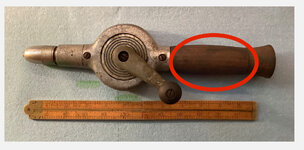
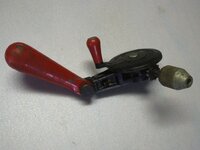
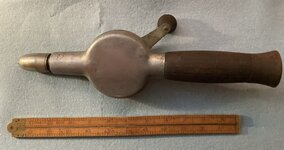
Need a little help please. Just got this egg beater drill, trying to identify it. It’s in very good condition, a minor split in the end cap, gunked up, but operates smoothly. I have gone over it very carefully but cannot find any kind of makers mark, no patent date … nada. I have not started cleaning yet, I did open the gearbox, the grease is a little stiff but otherwise no issues. Chuck operates smoothly. No marks inside the case either.
 

Attachments

  • IMG_4631.jpeg
    IMG_4631.jpeg
    799.9 KB · Views: 17
  • IMG_4632.jpeg
    IMG_4632.jpeg
    1.2 MB · Views: 18

Old tool guy

Well-known member
Joined
Apr 13, 2023
Messages
3,248
Ok, looks very similar to the Craftsman from the 1948 catalog. Not the same, but close. The craftsman crank handle attaches to the edge of the gear cover, mine attaches to the center. Craftsman advertises blue plastic end cap, mine is wood.

1699399216509.jpeg
 

Attachments

  • IMG_4633.jpeg
    IMG_4633.jpeg
    580.6 KB · Views: 17

Old tool guy

Well-known member
Joined
Apr 13, 2023
Messages
3,248
I have one of those. Or two … or more. There is a similarity, but one of the basis for the 104 and 308 drills was the inclusion of the plastic handle, as a modern design material. And there aren’t enough close details to call them cousins. I’m guessing it was a private label brand for Ace Hardware or similar, maybe with a decal that wore off.
 

RTM

Well-known member
Joined
May 13, 2019
Messages
13,139
Location
SF Bay Area
Hmm, I don’t see anything like that in older Stanley catalogs. I found some Leytool drills with concentric circles, but not enough. Still digging.
 

TheRealZeus

Well-known member
Joined
Oct 4, 2021
Messages
5,012
Location
CONTINENTAL USA
Hypothetically; is it possible someone remade this handle? I have seen very similar as well, but not he circled portion is metal.IMG_2189.jpeg
 

Old tool guy

Well-known member
Joined
Apr 13, 2023
Messages
3,248
Hypothetically … if it was a replace,ent handle, it was done by a GJ member cuz the work is flawless. There is a screw deep in the handle that secures it to the drill body, and why would someone go the the trouble of using a metal insert for the threads?
 

TheRealZeus

Well-known member
Joined
Oct 4, 2021
Messages
5,012
Location
CONTINENTAL USA
Hypothetically … if it was a replace,ent handle, it was done by a GJ member cuz the work is flawless. There is a screw deep in the handle that secures it to the drill body, and why would someone go the the trouble of using a metal insert for the threads?
Totally 💯 it looks fantastic.

Plausible answer; Because they are that good. 👍
 

RTM

Well-known member
Joined
May 13, 2019
Messages
13,139
Location
SF Bay Area
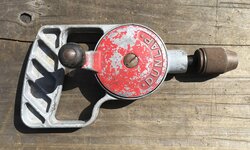
Saw this on ebay. Looked in the on-line list of MF drills, did not see a model 2-AG. There is a 2-A. And the letters turned sideways looks odd too.


Seems to be a bunch of them out there On the web, so I doubt someone tried to mark "his". No time to look them up in catalogs, but unless someone unearthed some new info, I doubt Randy at oldtoolheaven would have missed it.

I personally think it’s odd that the 2A was the newest of the 2 series, only 1957 to 68.

Maybe the G was to symbolize a government contract? Purely a guess on my part.
 
To avoid these ads, REGISTER NOW!

Old tool guy

Well-known member
Joined
Apr 13, 2023
Messages
3,248
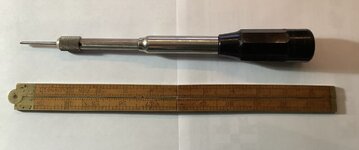
Got a question about a push drill. Just picked up this Goodell Pratt 188 drill, it’s in very good condition. No bits came with it, but that’s ok I have a couple. Seems to be a little stiff.

Here’s the question. When I try to use it, push down firmly on the handle, the bit only rotates about 90*. That seems like too little, I would have expected 180* at least. The exposed length of the small shaft is 2-1/4”, the upper shaft only goes 5/8” stop to stop. Thoughts?
.
1707863041993.jpeg
 

Old tool guy

Well-known member
Joined
Apr 13, 2023
Messages
3,248
Ok, I found this post from 2011, the author shows how to break it down. He makes the comment that 1-1/2” of push travel gives 1 rev of the bit, so mine clearly has a blockage somewhere.


Old tool guy

Well-known member
Joined
Apr 13, 2023
Messages
3,248
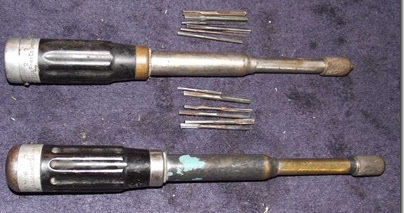
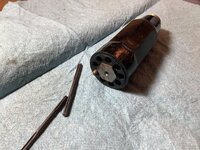
Field stripped it. Found 2 bits up in the handle where they didn’t belong. Doesn’t make sense, the 8 holes for the bits have solid bottoms, no way for them to fall through.
 

Attachments

  • IMG_4931.jpeg
    IMG_4931.jpeg
    1.2 MB · Views: 11
  • IMG_4930.jpeg
    IMG_4930.jpeg
    1.4 MB · Views: 14

RTM

Well-known member
Joined
May 13, 2019
Messages
13,139
Location
SF Bay Area
Don't know my GP push drills that well, but do know they need a specific bit with a cross on the **** end, so you did well to find more.
 

Eric Brown

ALLIANCE MEMBER
Joined
Jun 14, 2024
Messages
672
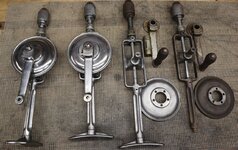
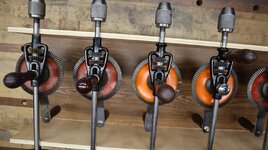
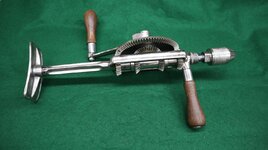
Started working on a group of four Yankee 1555 breast drills. All were bought with broken parts. Looks like I will end up with one good one. One with a couple teeth missing on gears, and two that will be parted out. Will probably nickel plate the frames and big gears on the parted-out ones. (In case someone wants to "upgrade") The other two, to the left in the pictures, will get fully nickel plated. You can see some of the details I'm working on. Like smoothing and polishing the idler gears between the two sets of gear teeth. I'll post pictures after plating. All wood handles will be replaced with walnut.

Yankee Group 1.jpg

Yankee Group 2.jpg
 

Eric Brown

ALLIANCE MEMBER
Joined
Jun 14, 2024
Messages
672
Just got a very interesting four speed with ratchet French breast drill by La Contal. He had patents in France, Germany, and the USA. The USA patent is #1495885 (May 27, 1924). This patent is not on the DATAMP.org site. There is an excellent write-up by Sean McConnell:

https://nzvtcc.org.nz/author/sean/ Click on "Read More" for a PDF

Here are before and after pictures. I will be nickel plating the exposed metal next week.

Contal received 1.jpg

Contal received 2.jpg

Contal received 3.jpg

Contal cleaned 1.jpg

Contal cleaned 2.jpg


Contal cleaned 3.jpg
 

Old tool guy

Well-known member
Joined
Apr 13, 2023
Messages
3,248
Nice. Interesting variable speed design. How did you finish the black parts? Did you consider japanning them?
 

Eric Brown

ALLIANCE MEMBER
Joined
Jun 14, 2024
Messages
672
Nice. Interesting variable speed design. How did you finish the black parts? Did you consider japanning them?
Japanning is outside my wheelhouse. You need an oven and the boss complains enough about smells as it is. Scaling back so not going to buy an oven for the garage. Just used black lacquer. Just trying to preserve for the future. Lacquer is better than rust.
 

Eric Brown

ALLIANCE MEMBER
Joined
Jun 14, 2024
Messages
672
Started working on a group of four Yankee 1555 breast drills. All were bought with broken parts. Looks like I will end up with one good one. One with a couple teeth missing on gears, and two that will be parted out. Will probably nickel plate the frames and big gears on the parted-out ones. (In case someone wants to "upgrade") The other two, to the left in the pictures, will get fully nickel plated. You can see some of the details I'm working on. Like smoothing and polishing the idler gears between the two sets of gear teeth. I'll post pictures after plating. All wood handles will be replaced with walnut.

Yankee Group 1.jpg

Yankee Group 2.jpg
Update. The nickel plated one is mostly done. Still have a handle bolt to take care of.

Yankee 8-8-24 1.jpg

Yankee 8-8-24 2.jpg
 

Eric Brown

ALLIANCE MEMBER
Joined
Jun 14, 2024
Messages
672
A group of mostly Fulton breast drills. A little history. Goodell-Pratt had several patents used on these drills. First was one for a three-jaw chuck. Patent #544411 by Lanfair Aug 13, 1895. This design uses three compression springs between the three jaws. When the chuck is fully opened the springs are exposed and many times are damaged. Assigned to the Goodell Brothers. The next patent was by H. Goodell and used two pinion gears with a common pin securing them to the shaft. Patent #862069, July 30, 1907. Then the F.E. Farley patent #1770884, March 20, 1930. This was for an inexpensive construction that used a rod between the main frame and breast plate that has two positions for the gears. Note: The great depression had just occurred and demand for expensive/high quality tools dropped. It was at this time Millers-Falls forced a merger with Goodell-Pratt in 1931. This merger gave Millers-Falls access to multiple factories that Goodell-Pratt had. One of these was Shelbourne, renamed Mohawk-Shelbourne. Sears was looking for cheaper tools to give customers choices from the top-of-the-line Craftsman's. Sears sold these breast drills under the Fulton brand name. So, quality wise, the Millers-Falls were at the top, then the Goodell-Pratt, and finally the Mohawk-Shelbourne.

In the pictures below, from left to right, are a Shelbourne, marked patent applied for, a Goodell-Pratt company. Next is an identical Fulton one also patent applied for. These would both have been made by Shelbourne before the Millers-Falls merger. The next two are also Fulton's and are marked with the patent number on the crank arms. Last is another Fulton, described later. These were probably all made by Mohawk-Shelbourne.

Fulton Group 1.jpg

Fulton Group 2.jpg

Fulton Group 3.jpg

The design of the drills shown show changes over the years. Note on the first two the auxiliary handle is loosened to change from one speed to the other. Where the spindle exits the frame is basically a straight sleeve. The bolt holding the breastplate on is a small square and the breastplates have rounded ends. The third drill shows the exit of the spindle going through an enlarged end, the bolt holding the breastplate on is a larger square, the breastplate is more oval. The fourth drill moves the auxiliary handle to the spindle end of the frame and is replaced with a knurled knob. The fifth drill uses a steel frame instead of a casting. It uses a different main gear with a knurled screw that screws into the frame. A third hole is for the auxiliary handle. The chuck has a different outer shape, but the internals are the same. The breastplate is similar to the earlier models with rounded ends and uses a slotted set screw instead of the square headed bolt.

A nice feature of these drills is that removing the main gear and removing the rod to the breastplate, it can be stored in a smaller area. Most these drills weigh between four and five pounds. None of them have a spindle bearing as found on the Goodell-Pratt and Millers Falls offerings.
 

Eric Brown

ALLIANCE MEMBER
Joined
Jun 14, 2024
Messages
672
Update. The nickel plated one is mostly done. Still have a handle bolt to take care of.
Yankee 8-8-24 1.jpg

Yankee 8-8-24 2.jpg
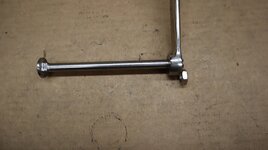
Finally got the handle taken care of. Used a 3/8" stainless carriage bolt. I needed about 5 1/2" of unthreaded under the square. Ordered some from McMaster, but the only thread length they list is minimum threaded. Ordered some long ones and they were all threaded down to about 3" from the square. No good. Finally found some on E-Bay that were 7 1/2" long. Asked, and they verified there was 5 1/2" unthreaded. Got them and here is the process I used. First cut the threaded portion off and chamfered the end.

Bolt 1.jpg


Next was threading. I set the vice up level (it rotates) and then used a square on the bolt. That would make it perpendicular.

Bolt 2.jpg

Bolt 3.jpg

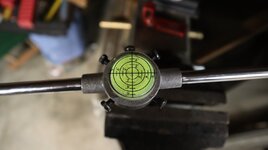
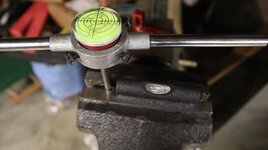
Next was threading. I use a round bubble level with a magnet on the back. Stuck that to the die and held it level while threading for about the first 1/2"

Bolt 4.jpg

After threading I check the length with the jam nut. I needed two extra turns (1/8" with a 3/8-16 die).

Bolt 5.jpg

Then I removed the square using a file and 1" belt sander. Thats for the crank handle side. The auxiliary handle on the left of this drill uses a 3/8"-16 right hand thread and the square is left on. It goes into a square mortice hole. No screwdriver slot needed.

Bolt 6.jpg

Next, I cut a screwdriver slot in the head using a Starrett screw slotting blade in my hacksaw (#249A-2, discontinued). Polished the whole bolt. This blade cuts about a 0.050" wide slot.

Comparing the Starrett screw slot blade (top) to a normal blade (bottom)

Bolt 8.jpg

Then I made a walnut handle with a stainless ferrule. Jam nut holds it all tight. Note: Left-handed bolt and jam nut were used to prevent loosening. A right-handed bolt would want to unscrew on the crank side.

Bolt 7.jpg
 

Eric Brown

ALLIANCE MEMBER
Joined
Jun 14, 2024
Messages
672
Incredible craftsmanship, Man! 👌 💯
Thank you. You could do it too if you have the right tools and patience. Maybe a little guidance. I realize that my labor is free and will never get compensated for it. Most people wanting these tools want to pay garage sale prices. I'll be lucky to break even after I total up all the supplies I used. So why do I do it? Satisfaction. I enjoy it. Like fishing. What's the point if you throw it back in? It's fun and satisfying.
I like to think that maybe, just maybe, the tool will last longer because it looks good and works well.
 
To avoid these ads, REGISTER NOW!
Top Bottom