

You are using an out of date browser. It may not display this or other websites correctly.
You should upgrade or use an alternative browser.
You should upgrade or use an alternative browser.
The Tiny Tools Thread
- Thread starter Outlawmws
- Start date
mdbeck1
Well-known member
....
Bench grinder gets more use than I thought it would

Where'd you get the mini grinder from? Got a feeling I could find plenty of uses for it!
I'm not softailgarage but I've got a small grinder that looks a lot like that one. I got mine at Harbor Freight.
Jarhead0408
Well-known member
mdbeck1, Thanks for the info man!


softailgarage
Well-known member
I'm not softailgarage but I've got a small grinder that looks a lot like that one. I got mine at Harbor Freight.
Correct, as much as I hate to admit it, HF.
mdbeck1
Well-known member
Correct, as much as I hate to admit it, HF.
No shame there. I've used mine a little bit and it's okay. The flexible tool holder is nice so I don't have to break out the dremel.
I bought thses two small tools with a bunch of stuff a few weeks ago. The pipe wrench is make in Germany. It is 6" and the adjustable is made here. It is a "Sterling" No. 1, made by the Frank Mossberg Co. of Attleboro, Mass. It is 5"
Neat little tools that I will never use, but hey they are tools!
John
Neat little tools that I will never use, but hey they are tools!
John
Attachments

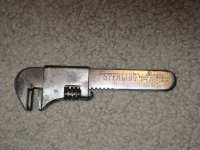
A couple of additions:
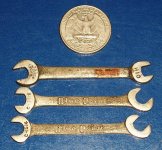
These are now my smallest Ignition wrenches, one Bonny (stamped and it had the old Bonny sticker... I barely notice that was what the sticker said, I nearly wire wheeled it off!). The cool ones are the matching (sizes reversed) pair of Blue Point.

And a Little Oil can; I don't think its the smallest in the thread though, and a 4 oz Tinners hammer head.

These are now my smallest Ignition wrenches, one Bonny (stamped and it had the old Bonny sticker... I barely notice that was what the sticker said, I nearly wire wheeled it off!). The cool ones are the matching (sizes reversed) pair of Blue Point.
And a Little Oil can; I don't think its the smallest in the thread though, and a 4 oz Tinners hammer head.
Attachments

Last edited:
 J/k good stuff Outlaw!!!
3baygarage
Well-known member
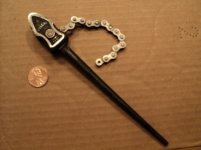
Outlaw, some tiny tools for your thread! Did some digging through tools in my garage today and came up with some great tiny stuff to share.
Williams Special 3/32" offset wrench
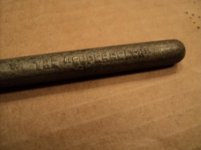
Vulcan miniature salesman sample working chain wrench(JH Williams Co.)
Williams Special 3/32" offset wrench
Vulcan miniature salesman sample working chain wrench(JH Williams Co.)
Attachments




3baygarage
Well-known member



3baygarage
Well-known member
Thanks, I have another but can't locate it at the moment. Time for me to get my New Year's Eve ball drop on! Almost toast time here.Nice! I like the tiny chain wrench!
Have a Happy New Year!
Well ****. You beat me to it.Have a Happy New Year!
 Hope all of you have a safe and Happy New Year.
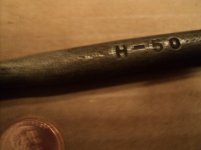
Picked this little guy up yesterday at a flea market.


Hard to see, but "2nd" is stamped over some existing cast lettering.


And the manufacture is ground out


Also has "Guaranteed" cast in the back of the the jaw adjustment on one side


Hard to see, but "2nd" is stamped over some existing cast lettering.


And the manufacture is ground out


Also has "Guaranteed" cast in the back of the the jaw adjustment on one side
jakemac
Well-known member
While packing my truck to go mow a lawn tomorrow (5hrs each way, one day trip), I was dumping a bucket from the back of my truck to sort out some tangled ratchet straps. Out of the pile drops an odd bit of metal. It was a small vise with 1" jaws !
There are no marks on it, so I don't know who made it, and I don't remember when I picked it up. It could have been in the bottom of the bucket for at least 6 years !
There are no marks on it, so I don't know who made it, and I don't remember when I picked it up. It could have been in the bottom of the bucket for at least 6 years !
Attachments


wildbill23c
Well-known member
Surprised nobody has posted the Dremel 580 4" Table Saw

Or the 2" Mini Cut-Off Saw

I try and look around several places when I have the time and money, for miniature tools. Haven't had much luck though here locally. I wish I had engineering and metal-work knowledge to build some miniature farm equipment like a small swather, baler, hay stacker, etc.

Or the 2" Mini Cut-Off Saw

I try and look around several places when I have the time and money, for miniature tools. Haven't had much luck though here locally. I wish I had engineering and metal-work knowledge to build some miniature farm equipment like a small swather, baler, hay stacker, etc.
davethorik
Well-known member
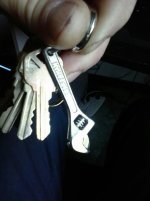
Here is a 4" Craftsman adjustable wrench I picked up yesterday.
John
i love the cute little 4" adjustables. they seem to be uncommon...either nobody bought 'em or everyone broke theirs. not sure if I have ever seen a C-man.
Here is the one I found, Snappy (actually made by Diamond Tool & Horseshoe) at a yard sale, it is my first one. I love it, and actually use it a decent amount.
edit; this little guy is actually 4.5" oal, how long is your oal?
Attachments

i love the cute little 4" adjustables. they seem to be uncommon...either nobody bought 'em or everyone broke theirs. not sure if I have ever seen a C-man.
Here is the one I found, Snappy (actually made by Diamond Tool & Horseshoe) at a yard sale, it is my first one. I love it, and actually use it a decent amount.
edit; this little guy is actually 4.5" oal, how long is your oal?
Mine is 4.25 oal.
John
jsaw
Well-known member

Alan Douglas
Well-known member

jakemac
Well-known member
While packing my truck to go mow a lawn tomorrow (5hrs each way, one day trip), I was dumping a bucket from the back of my truck to sort out some tangled ratchet straps. Out of the pile drops an odd bit of metal. It was a small vise with 1" jaws !
There are no marks on it, so I don't know who made it, and I don't remember when I picked it up. It could have been in the bottom of the bucket for at least 6 years !
Cleaned, polished, and painted
Attachments

WallynSC
Well-known member
Very nice!
Bighead38
Well-known member
I love mini tools. I'll have to post up some of mine one of these days.
3baygarage
Well-known member
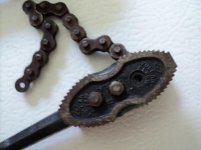
I'm so happy!  Found my other miniature chain wrench, the one on the right. It was hidden in a Williams socket box
  but I'll be sure to keep them together now!
It's a J.H. Williams Vulcan BI JAW.
Found my other miniature chain wrench, the one on the right. It was hidden in a Williams socket box but I'll be sure to keep them together now!It's a J.H. Williams Vulcan BI JAW.
Attachments



timdp
Well-known member
That is a jeweler's saw. For anyone planning on using one without breaking lots of blades, the blades need to be pre-tensioned. Clamp blade in one end, put the handle in your belly and the other end of the saw against the bench (blade up). Push against the bench with your body and tighten the other blade clamp so the blade is tensioned.
The other tip is to ALWAYS hold the blade vertical. Generally a V block is used to support the piece being cut. Saw in use with V block: http://www.micromark.com/jewelers-saw,6747.html
Tim
The other tip is to ALWAYS hold the blade vertical. Generally a V block is used to support the piece being cut. Saw in use with V block: http://www.micromark.com/jewelers-saw,6747.html
Tim
Here is a "Hack Saw" the blades have to be clamped, as they are too small to have pins or be pinned...

rlitman
Well-known member
That is a jeweler's saw. For anyone planning on using one without breaking lots of blades, the blades need to be pre-tensioned. Clamp blade in one end, put the handle in your belly and the other end of the saw against the bench (blade up). Push against the bench with your body and tighten the other blade clamp so the blade is tensioned.
What an insanely weird method.
Here's the right way:
Loosen the three thumbscrews (the bow length adjustment screw needs to be FULLY loosened so that the bow is able to move around in both length and be free to pivot a few degrees).
Clamp the blade sticking straight from the bow end.
Adjust the bow length until the blade sits in the right position in the handle clamp, and clamp it sticking straight out (there must be a little curve to the blade at this point because the two clamps are not pointed in the same direction!).
Grasp the handle end of the frame under the fingers of one hand, and push the rounded button on the end of the bow firmly with the thumb to apply initial tension.
Tighten the final thumbscrew. This is where the magic happens!
If you clamped both ends right, the blade should now exit the clamps without bending (if it's kinked, you should start over and get everything straight, or expect to break blades quickly).
The magic? The bow not only slides in and out, but also pivots a little. When you tighten the thumbscrew it pivots the bow into the final correct position (where the clamps now line up), and sets the final tension.
Oh, and that wingnut at the far end of your blade: completely unnecessary.
As for working vertically, that's not necessary if you have the right hand control. I like to work with my work clamped in a panavise, and adjust the angle to suit what I'm cutting.

Junk Man, that's an ignition for VERY old cars. Usually there will be two blades; one for the plug and one for the points.
There are two blades on mine.