LeonardY
Well-known member
And I still read the whole thing.3D Printer Content Warning!

Great job. I admire your ability to modify and make things work for you.

And I still read the whole thing.3D Printer Content Warning!
Very familiar with Klipper and will use it eventually when I build a new printer. Right now it doesn't really offer me much, I'm not a speed demon, and the promise of a simpler config is going to be offset by having to relearn everything and deal with any new platform specific issues. My communication chain to this printer is already long enough, I run Octoprint remotely on a little fanless PC and don't want to complicate that with Klipper processing and a Raspberry Pi. But the Resonance Compensation (Input Shaping) Klipper offers seems like a killer feature and I look forward to messing with it down the road.I just recently upgraded from a toy printer to a real tool. I am finding Klipper and MainSail to be vastly superior and easier to configure then Marlin. The SKR Mini support it. I am going to go that way when I upgrade my old printer. The only downside I have found is it really needs a dedicated raspberry pi to fully like up to its potential. That and the 400x400 heated bed were actually the long lead time parts on my build.
I also highly recommend the BTT octopus V1.1. It is over kill in so many ways with 8 driver, four heaters, and 20 something IO. However if you think you might upgrade again in the future it is worth it.


Yeah, been there. Done that. I just printed successfully in ABS. I cranked the temperature up a little higher 235C at the nozzle and 110C for the bed. I let the nozzle ooze until it stopped. The part was small and the print was only 13 minutes so I didn't worry about the a brim.Changing too many variables at one time is asking for trouble

One of the things that caught me out was I was initially printing too hot. Before swapping the hot-ends I did a baseline check with the original and pushed it to 240℃, which was as high as I felt safe with a Capricorn PTFE liner. It came out reasonably well, so when I tried with the new all metal one, I bumped it up to 250℃ but it was a total blobfest. The new heater, despite looking quite similar in construction, seems to be a lot more effective than the old one, and having the extra horsepower I made the mistake of twisting the throttle needlessly.I just printed successfully in ABS. I cranked the temperature up a little higher 235C at the nozzle and 110C for the bed. I let the nozzle ooze until it stopped.

Me too. I seem to be constantly cleaning.I hate to admit this is one of the more orderly corners of my office, I need to clean badly.

My Festool rail arrived (from Germany) and the first thing that jumps out at me is that the holes are actually slightly slotted. It makes sense since the registration along the length of the rail is the critical constraint, allowing slop across the width direction will improve the ease of the pin entry and make the sled alignment less critical. The slot form isn't obvious in the pictures I've seen, it's pretty subtle, so it was a bit of a surprise and I'll need to rethink how I'd make my own.
) is a small pub run by a young local couple, where the food and draft beer are excellent. The owner is a great cook, Japanese have a tendency to become fanatical with their hobbies and professions, and he's fully into making excellent food despite the humble stage. A few years ago we were talking about steaks and I told him I did Sous Vide, and he was shocked I had one at home. At the time the new generation of consumer focused units hadn't made it to Japan and like everything professional over here the cost of a system was astronomical. He was dubious that a few hundred bucks could get a working system, so I lent him mine for a few weeks and he was sold. 

 V-Blocks and clamping straps were an option, but setting it up, it looked precarious and relied too much on the parts integrity since I was making a big hole on the opposite side of where it was being gripped. As I have an ever growing collection to dip into I decided the best solution was MOAR VISES! Mounting my first vise conventionally but offset to maximise the Y travel (as otherwise it will collide with the Column) I clamped another precision vise in its jaws. This also provided me an opportunity to use one of my Nishimura Jig spring jacks to support the other end. These clever little guys have magnets in the bottom and a spring loaded plunger that allows you to lock it from the front, so it can get into tight spaces like I had here. Even with this leaning tower of visa, (got to get my dad jokes in) I still had enough Z height to just clear the part, but found that I needed to add some top straps to keep it from moving anyway.


I can only hope it holds up. The ABS part seems robust, but nothing gives confidence like metal.Wow, 3D printing, lathe work, milling, and anodizing used all in one tiny part! I hope your friend the chef realizes how good the quality is once the new part doesn't fail like the OEM replacements.

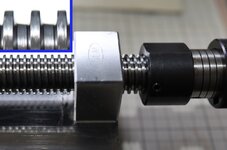

.
Hope this was worth the read!


 ) threads, which I suspect reaches back to the dual occupation of American and British forces after WWII, and astonishingly resulted in the currently bifurcated standards of 60hz electricity in Western Japan and 50hz here in the East. I suspect this tool is from the 1950's. After cleaning it up, I took a reading off of a new M10 bolt I had on my desk and it gave a very believable measurement, I expect the device is still quite usable.
Yeah, it was one of those times where I hit the buy button before I even looked at all the pictures. I honestly expected them to tell me they were off by a decimal place and cancel the sale, but it showed up the next day in even better shape than it looked in their photos. As good as my finds are, there are still serious concessions I have to make compared to being in the states, so I suspect it all evens out in the end.I'd never looked at precision vises until recently, and I've never even heard of hydraulics within a screw mechanism. Very nice design! I'll bet you were able to pick that one up at a truly "you ****" price - - nice job scanning the online listings!
Nice score on the thread micrometer! I've also gone down the threading rabbit hole periodically while working on my tractor. It's from China, and they also have a weird combination of British Whitworth and Japanese threads that occasionally pop up amongst the mostly metric stuff. Since the "industrial revolution" happened so much later in the Far East, I'm not surprised they copied existing standards from other countries -- I just wish they'd picked one country and stuck with it!I'm sure it doesn't seem like it, but I've barely scratched the surface about threads. I still feel bad that I chose not to go into any depth about thread pitches or some of the other fundamental aspects and interesting thread forms. I'm by no means authoritative on the subject, I often find myself vexed by them, especially over here where the Japanese have their own nomenclature for existing threads and far more of the british style just to complicate things further. Pipe threads are some of the worst... but that's all I will subject you to for now.
I don't research nearly well enough to pontificate the way I do, but I think the complexity of some of the most superficially trivial things helps me appreciate the world a little better, and I try to share what I think I know. I'm sure I'm missing other ways to do it (obviously ring gauges), and internal threads must be a nightmare to check, other than plug gauges I've got no idea how it's done.As I often read your thread and am amazed at the depth of your research. But reading that thread wires was the only way to measure threads, I was ready to call bull....until I scrolled down lower. I am a Journeyman tool & die maker schooled in the old way (ages me don't it), who now is a CNC programmer, I am very familiar with thread micrometers and they are definitely the way to measure threads.
Thank you for all the information you present to all.


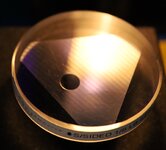
Yes, this was a used unit, so the previous owner wasn't as careful as you should be, but it really doesn't affect the function.Is the face of the glass vulnerable to scratching?
Alcohol is specified by LapMasters for cleaning the lens.How do you clean both surfaces before setting the glass down?
The actual distance between the lines isn't that important other than the farther apart they are, the closer the two surfaces are to each other. There is always a kind of air gap, and careful positioning can allow you to position the flat in such a way that you could calculate the deviation from flatness, but most of the useful information is revealed in the curvature and behavior of the lines when pressure is applied which gives a map of the surface topology.The stripes in the picture … do you measure the distance between them to determine flatness?
Now that, I fully understand.It's also just kind of neat.
Fascinating! You never know what you'll learn when visiting the Tiny Tokyo Shop.Today I present to you, the fascinating Optical Flat.


That Canon stitching utility is amazing -- it looks like one photo!
There's a very good microwave engineer on YouTube, TheSignalPath who I'm pretty sure could reverse engineer it if I sent it to him (and it was worth his time to bother.) But it is some sort of amplifier or signal splitter and I doubt it is as interesting as it looks, and part of me is happier not knowing.Cool story -- I wonder how many hours that HP employee put into that device.
Ever thought about using it for anything?
I used to frequent all of those shops in the late 70's and early 80's. Who knows we could have already met. I would buy bits and bobbles that just looked neat. I would make models from the parts. There was one place that I would go to all the time. I think it was called San Carlos Surplus. I would come to the counter with a bunch of stuff and the sales guy would take pity on me. He would say "That looks like 2 dollars worth of stuff." He would also spend the time and tell what something was from or used for.When I was quite young I dropped out of school to work selling electronics in a small shop in the northern bay area of California.
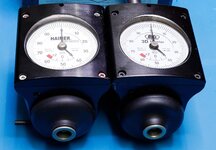
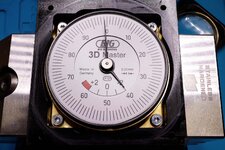
That's great. Glad you got one and were able to make it functional.A while back I went on a long discourse about multi-axis indicator probes and hight setters. I've collected a number of different Big Daishawa devices, and one of my good compatriots here @LeonardY brought up the Haimer style of probe, which is a premium device that offers several advantages over a simple contact probe when used manually. The key advantage of the Haimer design is that it compensates for the probe tip and length so it shows when the spindle is exactly on center. With the electric probes I discussed before, you need to remember to subtract half of the probe tip diameter, not a big deal if it is automated by a CNC since it will automatically compensate, but when used manually is fertile ground for bozo crashes. The electric probes also do not tell you if you have overshot, because they are basically binary devices, they will show when the probe is moved from the rest position, but not by how much. A CNC will typically make several approaches at different speeds to zero in on that contact, but doing so manually on a machine that may have some backlash or imprecise manual controls can become tedious. So a Haimer is something that I've wanted to pick up, assuming the price was reasonable.
A few days ago a seller listed this pair of indicators, the Haimer was listed as "Junk" and the OEM "Big Daishawa" version was working, but out of calibration. They were cheap enough to take a chance, my theory being worst case I could hopefully make a working unit out of the two. When they arrived I did a quick exam of the units. The Junk part had play between when the probe (not pictured here, the probes are fragile ceramic and sacrificial to protect the device so I keep them detached and separately boxed) so when you pressed the probe there was several millimeters of slop before the dial engaged. The other unit worked properly, but was not at the -2mm (zero position) when at rest so it would need some recalibration.
Opening up the face of the unit (the 4 screws on the front) revealed that the dail section was a single subcomponent, and removing it revealed that it was actuated by a single pin that engaged with a small block which moved up and down and was linked to the probe deflection. The slop that the device was experiencing was due to the clockwork module slipping out of position causing a gap between the pin and the block when the unit was at rest. The clockwork has its own spring and this needs to be preloaded against the block until it reads -2mm (half the diameter of the 4mm ball of the probe.) There were a pair of opposing set screws located on the left upper and lower corners that control the vertical position of that dail unit, and this is how the pre-load and rest position is calibrated, the photo above is the working unit showing the ~0.02mm of miscalibration before I dialed it in to exactly zero.
Another issue with the 'junk' Haimer was that the plastic dail lens was quite scratched up, a few minutes with a plastic polishing kit cleared that up quite nicely and the centering screws were worn and one had a stripped hex head. At the top of the unit there are 4 set screws that are essentially captured and accessed by 4 small holes. They allow you to adjust the eccentricity of the probe tip to perfectly center it to the spindle axis, I need to set up one of my more precise spindles to align these two units, and I will also confirm that they are properly indicating at that time. Replacing those set screws requires the removal of the top shank unit since the access holes are only big enough for the allen wrench to adjust them. The top is held to the unit with 8 screws and is tightly fit into the body with an O ring seal and also provides an internal seat for the probe's preload spring. Be prepared for that to fly out when you open it!
Two of the grub screws came out without any trouble, but one of the remaining ones was overtightened and quite stuck, and the other had the stripped out head. I've found that the best way to deal with damaged hex heads is to use a Torx bit, I think it has a bit of taper that helps engage a wallowed out socket. Using a T8 Torx bit I was able to remove the remaining screws, and replaced all 4 with fresh flat point M4x8mm units. The rubber dust boots were removed and cleaned, and some Mitutoyo Metrol micrometer oil was put on the probe ball socket located under the boots in order to ensure low stiction.
So assuming these will dial in and operate as consistently as they appear, I think another successful gamble. I found a couple new Haimer replacement probes at auction for $30 each, the junk unit didn't come with one, and I'm hoping I don't crash my way into poverty once I start using these.
What I found was they would back out.
Longer screws might help. I would be afraid to put loctite. There is a definitely a limit to how far you can crank on the screws to adjust it. Wonder if that's how the one grub screw was stripped on yours.I noticed that the 8mm screws left a lot of the threaded hole empty, that a longer screw (12-16mm) with more engagement was certainly possible. Not sure if a longer screw would help, maybe a bit of low strength loctite will be in order. I'm going to try and document the truing, not that it should be particularly complex or interesting, but it gives me an excuse to pull out some of my other toys.
There are loctite formulations that are really taylored for this application, and are quite reversible (I use 222) and I think worry free. I did consider that they may have limited the amount of thread engagement (screw length) as a mechanical fuse to limit the force the set screw could apply, but as I'm not a gorilla I would be careful how much I was cranking this anyway. The part that stripped out on the screws was actually the hex socket, which I think must be the weakest link, which is why I was second guessing the length as the protective measure. One of those cases where I'd love to talk to the engineer behind it, but afraid the answer would be, "8mm was cheaper, it works, what is the problem with it?"Longer screws might help. I would be afraid to put loctite. There is a definitely a limit to how far you can crank on the screws to adjust it. Wonder if that's how the one grub screw was stripped on yours.
 and I recovered a few fragments from the box.