To avoid these ads, REGISTER NOW!

Tools/machines that have become obsolete?

BarrelRoll

Well-known member
Joined
Jan 10, 2006
Messages
415
Location
Alaska
Automotive engine rebuilding tools. Now days in a shop it's almost always slap a reman in instead of rebuilding.

Speed handles for sockets

Air ratchets

Pass through sockets, ratcheting wrenches have replaced them in 95% of applications.

I work at a gold mine doing repairs on anything without tracks or wheels, in the field we mainly stick weld. In the shop I use the MIG if I can reach it. Working in the rain and snow it's much easier to drag leads off the back of the truck than deal with a wire feeder. I do agree the usefullness of a stick welder is becoming a lot less common. MIG welders have come down in price as well.
 
To avoid these ads, REGISTER NOW!

Firebrick43

Well-known member
Joined
May 12, 2015
Messages
14,068
Location
West central Indiana
Automotive engine rebuilding tools. Now days in a shop it's almost always slap a reman in instead of rebuilding.

Speed handles for sockets

Air ratchets

Pass through sockets, ratcheting wrenches have replaced them in 95% of applications.

I work at a gold mine doing repairs on anything without tracks or wheels, in the field we mainly stick weld. In the shop I use the MIG if I can reach it. Working in the rain and snow it's much easier to drag leads off the back of the truck than deal with a wire feeder. I do agree the usefullness of a stick welder is becoming a lot less common. MIG welders have come down in price as well.
Umm, a reman is a rebuild?
 

Old Man Roger

Well-known member
Joined
Apr 6, 2017
Messages
17,634
Location
Palm Coast Florida
I don't disagree with the above generally, but sometimes the exception proves the rule.

Today, my buddy who's shop I work out of sometimes, is welding on a bridge today with his shop-truck engine driven Miller welder. He will be dangling his long leads over the railing and welding reinforcing gussets on the beams. We cut the 1/4" (maybe 5/16") 6"x6" L-angle, 6 @ 26" and 12 @ 14". That is a lot of weld on a structure that doesn't lend itself to a tent to exclude a breeze.

Engine driven stick still has a place, but that place keeps getting smaller!
This reminds of the draw bridge in Palm beach. The whole thing standing up straight was draped in cloth for a few months while they welded.

453E495B-404E-4C76-8557-B0BC2194F41B.jpeg
 

lynnbilodeau

Well-known member
Joined
Jun 4, 2013
Messages
813
Location
Oklahoma
That's surprising news. Distributor testers used to go for thousands of dollars in working condition. Is that no longer true? Are the old farts dying off?
Absolutely not the case for a fully working Sun distributor tester. Even the simulators bring good money.
See post #56 above.
Also, check out this page: http://paramountd.com/sale.html

Even a non working unit will bring decent money, as they can be updated and both.web.jpgrefurbished. I got this one cheap, and converted it to all transistors. It works perfectly, and I use it regularly. I also got an adapter so I can test MSD distributors and GM HEI distributors. The analyzer is really outdated, and not good for much, but it came with the deal, and makes for some cool garage art.
 

dscheidt

Well-known member
Joined
Apr 26, 2017
Messages
2,894
I would also point out that just because something is obsolete doesn’t mean it isn’t still useful. I know my 1991 CNC Hurco is obsolete. It still gets used every day and still makes money. A new mill would be better in every measurable way but I’m looking at 150k+ for a machine that the ROI isn’t there on yet. I’ll keep using my obsolete mill until I can justify upgrading.

a fully depreciated piece of equipment that gives a shop a capability it wouldn't otherwise have can be pretty valuable, especially if the space it takes up isn't otherwise needed. I know a shop that was using a planer (the only one I've ever seen working) to get five mounting pads coplaner and perpendicular to the some other feature. They were making a welded mounting stand for some sort of machine, the part was about 6'X 5', too big for anything else they had. The planer stayed set up, and they put hte bases on it the three or four times a year they were making that part. They'd bought the planer specifically (cheap, I'm sure) to do that job, previously they had to send it out.
 

F-22

Well-known member
Joined
Jan 23, 2022
Messages
1,830
The old saying about metal shapers being "able to make anything but a profit" is applicable here. For the hobbyists with space, they can be a great machine as they're cheap and capable, but take up significant floorspace for anything of size and are deceptively heavy making moving a challenge. The vast majority of home shop users will be better served with a knee mill over a shaper, and in production shops where floorspace matters, more versatile cnc mills have taken their spot for most things
There are certain niche cases where a shaper is hard to replace. I think most notably internal keyways? There are milling heads for milling inside a hole, but not for smaller diameters. In that case, you'd probably use wire EDM or die-sink EDM. In this case a shaper is considerably faster and cheaper to run.
I know this is very niche, but if you know and have a shaper it can be very worth it. I had the luck to get a job where we had to make a 500mm long keyway in some sort of an axle that was 1500mm long and with an internal hole of I think 150mm. 10 pieces. Luckily we had a large shaper that can work up to 620mm. The "end" of the keyway was made by drilling through the axle from the side, then plugging the hole from the outside. We got the shaper for 1000€ and on the single job got back the investment a few times.

What surprises me is that cam operated lathes, such as Brown & Sharpe screw machines seem to have largely disappeared. These machines can make complex turned parts in seconds, much faster than CNC lathes. I assume all of the high volume stuff is made overseas now? I used to run an eight spindle machine that made brass parts that were turned, knurled, drilled, then picked up and machined on the back side, including tapping. Cycle time was 1-1/4 seconds for a finished part.
Some the new Swiss type CNC machines are almost as quick as the cam machines. However the set up time on a Swiss machine takes hours vs minutes on the CNC. And a lot longer of you have to make the cams for a new part.
The big name here in Europe was Index Traub. Many still run. They are very fast when set up right, and work fine. For a large series, it's hard to be faster. But Index now makes CNC controlled ones. There is simply a limit to what is possible without computer control. The stuff a modern mass production milling and machining centre from Index can make today, would make a purely mechanical machine ridiculously speciallized and expensive without being faster. Computer control allows so much more flexibility that would otherwise simply be impossible.

I'm not convinced that CNC is "worth it" for 99% of my home shop tasks.

Yesterday, as just one of many examples, I needed to turn a section of 1" steel shaft down to an interference fit for installation in a bore.

My 1953 South Bend Heavy 10 didn't need CNC or even a digital readout to make short work of that. I doubt anyone could have programmed the CNC machine to cut it by the time I was back in the house watching the Colts game.

CNC comes into it's own where you are making multiple copies of the same part. I almost never do that. Same thing with milling. I did put a DRO on my Mill which is nice....but in the decade or so I've owned it, I've only thought "CNC would be really nice for this job I'm doing today" once or twice.
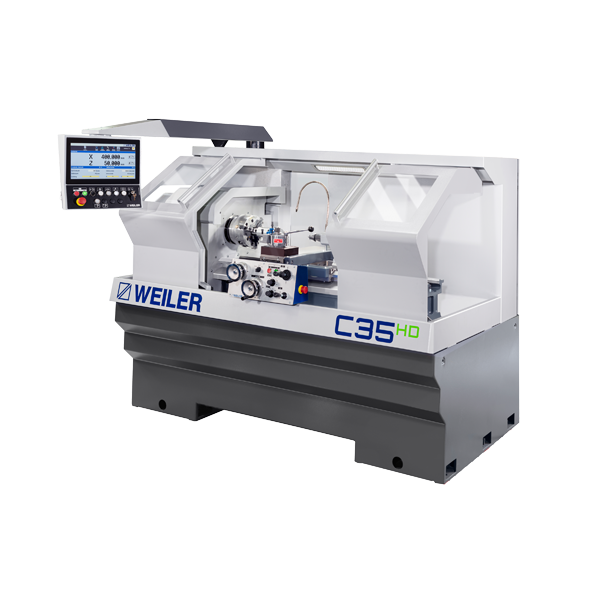
For stuff like that, I'd say that manual lathes are completely obsolete when compared to modern "servo lathes". Those combine manual operation with computer control and servo drives. Eliminates a bunch of gearboxes, can make literally any possible feed or speed just by winding a knob or entering the thread feed into the display (no gearbox - no steps). Can instantly make chamfers under desired degrees by entering it in the display. Can instantly make radius features on its own in the same way. Eliminates a bunch of axles and drives of a manual lathe cause the servo motor can do whatever you think of. Can keep a constant cutting speed as you go in the material (deeper you go, the faster it spins up, HUGE advantage for parting). Combines multifix holders with CNC memory of tools - can make manual otol changes while using it as a CNC.


Is there anything a manual mill can be better at?
 

brianh

Well-known member
Joined
Apr 6, 2010
Messages
1,299
Location
grahamsville NY
After getting a CNC router 20 years ago a whole bunch of tools became obsolete. It is my tenon machine, mortise machine, dovetailer, wide format planer, the best return on money spent on a tool ever.
 

Firebrick43

Well-known member
Joined
May 12, 2015
Messages
14,068
Location
West central Indiana
Stick welding is still used in a lot of industries. Mig simply doesn't penetrate sufficiently for heavy wall without a lot of add on technology. It is also common in smaller shops working with heavy wall. Including small production shops.
Add on technology?

It’s as simple as using the right wire/wire size, CO2, and a machine with enough amps.

Dual shield wire will penetrate just as well as smaw
 

Sweetcorn

Well-known member
Joined
Feb 14, 2018
Messages
676
Location
North Central Ohio
I live in (and spend waaay too many hours a day at it) the world where decisions about manual vs CNC operations are made day in and day out. I really spend too much of my day guiding others to make wise choices.

The simple fact of the matter is if you want to be the most efficient operating shop you can be, you have to have both capabilities.

The most important thing of all is knowing when the right time is to use one option or the other, because they both unequivocally have their place in the world. Bad decisions on that can make or break a job.

I can say the same about mig v stick.

Edited to add: In my opinion, the best thing you can have in the shop is an employee who can make the right decisions outlined above.
 
Last edited:

Packard V8

Well-known member
Joined
Mar 16, 2009
Messages
7,380
Location
Spokane, WA
Edited to add: In my opinion, the best thing you can have in the shop is an employee who can make the right decisions outlined above.
And employees who are not only willing but want to get all the training they can to keep up with new technology as it comes along. Those who find problems rather than solutions to new equipment should be encouraged to find other places of employment.

jack vines
 
OP
M

MushCreek

Well-known member
Joined
Jan 14, 2015
Messages
9,780
Location
Upstate South Carolina
One problem with CNC is when you tie up a $200K machine doing a job that could be done nearly as quickly on a $10K machine. When I ran parts with my cam operated Swiss machine, not only was it fast, but I bought the thing for $2500, plus a few hundred bucks for a set of cams. The machine was built in 1953, and spit out perfect parts all day long. Those CNC Swiss with a zillion axes are great, but they ain't cheap.
 

californiamilleghia

Well-known member
Joined
Apr 11, 2020
Messages
537
Location
SoCal
even older 3d printers and cnc routers are becoming obsolete , as they are so slow , and at a shop "Time is money"

I have an older Techno CNC router that used its own black and white computer and cost new over $25k , got it for $75 but need to change it over to Arduino !
 

DocsMachine

Well-known member
Joined
Sep 16, 2006
Messages
1,864
I'm surprised no one's mentioned Turret Lathes. :D

They were once utterly ubiquitous- any manufacturer would have anything from a few dozen to literally hundreds of them. When mine was made in 1939, it had a serial number in the 1.5 million range. And W&S numbered them sequentially.

But today, even the "home shop" size machines are barely worth beer money, and any of the larger ones are only worth scrap. When I rebuilt mine- I actually have a use for it- I had guys online giving me tooling. They had no use for it, nobody wanted to buy it, they didn't want to throw it out...

As for the manual vs. CNC thing, yes, as far as production goes, manual is long obsolete. No question there. BUT... every production shop I know of has at least one manual mill and manual lathe, typically kept for repairs or minor fixture parts, etc. (Or, if they're a job shop, that quick walk-in job that's not worth waiting for time in one of the CNCs.)

Doc.
 

dr_clyde

Well-known member
Joined
Jan 7, 2009
Messages
6,446
Location
Holland, MI
I'm surprised no one's mentioned Turret Lathes. :D

They were once utterly ubiquitous- any manufacturer would have anything from a few dozen to literally hundreds of them. When mine was made in 1939, it had a serial number in the 1.5 million range. And W&S numbered them sequentially.

But today, even the "home shop" size machines are barely worth beer money, and any of the larger ones are only worth scrap. When I rebuilt mine- I actually have a use for it- I had guys online giving me tooling. They had no use for it, nobody wanted to buy it, they didn't want to throw it out...

As for the manual vs. CNC thing, yes, as far as production goes, manual is long obsolete. No question there. BUT... every production shop I know of has at least one manual mill and manual lathe, typically kept for repairs or minor fixture parts, etc. (Or, if they're a job shop, that quick walk-in job that's not worth waiting for time in one of the CNCs.)

Doc.
Turret lathes still see a small amount of use in niche areas. I wouldn't mind a small one, they're fast as hell for multi step ops on really small parts. My CNC has a 12" hydraulic chuck and is a pain to chuck on small parts. We occasionally need to drill, chamfer, tap and countersink little pins or rods, a turret lathe is just the ticket for jobs like that.

A friend of mine has a few turret lathes in his shop, and he has a dozen top of the line Mazak CNCs on his floor. He's got a Gisholt and a large Warner and Swasey, the W&S has like a 7 or 8" spindle bore and it gets used daily for boring large tubes, the Gisholt gets set up for production threading on brass castings using a geometric die head. Faster and more efficient than using a CNC.

By and large, they're obsolete, but they have certain shops where they still see some use.
 

CarBikeGuy70

Well-known member
Joined
Mar 12, 2015
Messages
170
Location
Western CT
Some the new Swiss type CNC machines are almost as quick as the cam machines. However the set up time on a Swiss machine takes hours vs minutes on the CNC. And a lot longer of you have to make the cams for a new part.
Newer CNC swiss machines are amazing. I am not in the industry but my father was in the screw machine biz for most of his adult life. He worked with B&S, Davenport, Swiss for the most part. I had the opportunity to tour his old shop and the newer machines are just amazing. of course the numbers are as well. I don't see how smaller production runs would be profitable with out the CNC component of machine control. In my Fathers' day they had production runs of several hundred thousand pieces over a period of time. Tooling and set up will kill jobs with small piece numbers. Just in time manufacturing changed everything- as well as off shore production.
 

CarBikeGuy70

Well-known member
Joined
Mar 12, 2015
Messages
170
Location
Western CT
One problem with CNC is when you tie up a $200K machine doing a job that could be done nearly as quickly on a $10K machine. When I ran parts with my cam operated Swiss machine, not only was it fast, but I bought the thing for $2500, plus a few hundred bucks for a set of cams. The machine was built in 1953, and spit out perfect parts all day long. Those CNC Swiss with a zillion axes are great, but they ain't cheap.
Oh so very true. A good layout and tooling can make a Swiss cam controlled machine spit out parts the are a work of art and very precise. Just something about a screw machine eating up bar stock that has stuck in my mind from the first time I saw one running in my early years.
 
To avoid these ads, REGISTER NOW!

liliysdad

Well-known member
Joined
Jul 18, 2008
Messages
5,404
Stick welding is far from obsolete in the oil patch. Pipeliners still run stick almost exclusively, and a lot of production shops are still very stick dependent.

One of the largest oilfield service companies on the planet welds the vast majority of their pumps and pressure vessels using stick welders.
 
Last edited:

Packard V8

Well-known member
Joined
Mar 16, 2009
Messages
7,380
Location
Spokane, WA
A friend of mine just got a steal deal on sets of metric and inch Snap-on combination wrenches made obsolete by Gearwrench ratcheting combos. Yeah, right.

jack vines
 

F-22

Well-known member
Joined
Jan 23, 2022
Messages
1,830
Stick welding is still used in a lot of industries. Mig simply doesn't penetrate sufficiently for heavy wall without a lot of add on technology. It is also common in smaller shops working with heavy wall. Including small production shops.
Add on technology?

It’s as simple as using the right wire/wire size, CO2, and a machine with enough amps.

Dual shield wire will penetrate just as well as smaw
Stick welding is not obsolete due to cost. Yes you *can* find a Mig welder for practically anything too. But it will be waaay more expensive and complex (watercooled nozzles once you get into bigger machines...). It is not practical. Modern stick welders are cheap and small and a trained welder will make a sufficiently strong weld with it. For large scale metal constructions welded on the spot, or mostly anything extra thick, a stick welder is very far from ever being obsolete.
 

Tennessee Cattleman

Well-known member
Joined
Aug 18, 2012
Messages
408
Location
East Tennessee
Stick welding is not obsolete due to cost. Yes you *can* find a Mig welder for practically anything too. But it will be waaay more expensive and complex (watercooled nozzles once you get into bigger machines...). It is not practical. Modern stick welders are cheap and small and a trained welder will make a sufficiently strong weld with it. For large scale metal constructions welded on the spot, or mostly anything extra thick, a stick welder is very far from ever being obsolete.
The stick welder is my go to machine for welding, simple to use and it works.
 

seber

Well-known member
Joined
May 31, 2016
Messages
4,196
Location
Deep East Tx.
Hand saws. I still use them more than any of the dozen or so other choices I have, but I know I am an oddball.
 

jives

Well-known member
Joined
Jan 4, 2013
Messages
2,807
Location
Central NY
Hand saws. I still use them more than any of the dozen or so other choices I have, but I know I am an oddball.
A quick scan of free on CL, FBM, and what is at the local ReUse store shows that hand saws are out. At our local ReUse there must be close to 30 saws.

Also commonly free are pianos. A tool for musicians.
 

Captain Spaulding

Well-known member
Joined
Feb 13, 2017
Messages
753
Location
Southern Indiana
What surprises me is that cam operated lathes, such as Brown & Sharpe screw machines seem to have largely disappeared. These machines can make complex turned parts in seconds, much faster than CNC lathes. I assume all of the high volume stuff is made overseas now? I used to run an eight spindle machine that made brass parts that were turned, knurled, drilled, then picked up and machined on the back side, including tapping. Cycle time was 1-1/4 seconds for a finished part.
Many times, the problem is that a quality machine that requires a knowledgeable and experience user is replaced by something a trained monkey could operate that can do a lot of the work the “better” machine can do. Most of the money is made on the trained monkey work.
 

Ducky

Well-known member
Joined
Mar 17, 2009
Messages
99
Location
Southeast, Alaska
In the mining industry too stick welders are essential. I worked at one of the local hard rock mines for years. If one was fabricating in the shop then it would be with the wire feed. All new steel, clean and fast. But for mobile repair, it was exclusively stick. We had a truck mounted welder with air and gas set up for cutting. In the shop at the bay doors, we had a stick set up for repair work that could reach outside to do the easier repairs without having to bring the equipment inside. In the mill, they have stick welders set up through out the different levels. This was because of access. You have to be able to reach anywhere at anytime. It is a 24 hour operation.
 
OP
M

MushCreek

Well-known member
Joined
Jan 14, 2015
Messages
9,780
Location
Upstate South Carolina
Many years ago I heard that one of the reasons they stopped making screw machines were due to safety and liability concerns. I suppose they could make all sorts of interlocks, like they have on CNC equipment, but then they'd be a PITA to set up. We got in three new CNC's that you could not move the table unless all of the doors were closed. Kinda makes set-up tricky, doesn't it? Of course, we figured out how to override the controls pretty quickly.
 

dchawk81

Well-known member
Joined
Jul 31, 2014
Messages
14,377
Many times, the problem is that a quality machine that requires a knowledgeable and experience user is replaced by something a trained monkey could operate that can do a lot of the work the “better” machine can do. Most of the money is made on the trained monkey work.
As a trained monkey, I find this superior.
 

dr_clyde

Well-known member
Joined
Jan 7, 2009
Messages
6,446
Location
Holland, MI
After reading this thread, it appears obsolescence is a wildly variable, subjective term.

That's fair, but a lot of guys use the word obsolete interchangeably in place of terms like "old", "useless" or "inefficient".

ob·so·lete

/ˌäbsəˈlēt/

adjective

1. no longer produced or used; out of date.

A bridgeport mill is not obsolete. They are still made new and purchased new, and used in many, many industries and shops. They have a well deserved place in the shop and are very useful tools. The process of making patterns on a bridgeport mill (what they were origianlly intended to do) IS obsolete.

A 1950 pickup truck can still go down the road and function as a pickup truck but it is obsolete compared to a current model year. Doesn't mean you can't use it anymore, it just means we've got better trucks.
 

speed bump

Well-known member
Joined
May 28, 2008
Messages
6,317
Location
Butte Montana
Stick welding is not obsolete due to cost. Yes you *can* find a Mig welder for practically anything too. But it will be waaay more expensive and complex (watercooled nozzles once you get into bigger machines...). It is not practical. Modern stick welders are cheap and small and a trained welder will make a sufficiently strong weld with it. For large scale metal constructions welded on the spot, or mostly anything extra thick, a stick welder is very far from ever being obsolete.

Big and heavy weldments are pretty much the domain of fcaw and dual shield. If you are welding 1"+ with stick for anything more than field fixes or a small joints then most welders are wasting a lot of time as compared to wire. We lined a mill trunnion recently, did half stick and half FCAW (about 20 lbs of electrode total) and the wire feed was almost 3 hours faster as compared to stick welding.
 

Crazyjake8493

Well-known member
Joined
Sep 26, 2014
Messages
3,966
Location
Upstate NY
I can't say it's fully obsolete, but neither my biscuit joiner nor the one at work have been touched since we started using Kreg jigs and pocket hole screws.
 
To avoid these ads, REGISTER NOW!
Top Bottom