To avoid these ads, REGISTER NOW!

Truss Design

bczygan

Well-known member
Joined
Nov 4, 2009
Messages
22,002
Location
DETROIT! Arsenal of Scrappers
It's funny. A long time ago, in my work in an Architectural office, I did the same thing. Wondered if there was a program I could use to design trusses. Designing by hand was too time consuming. And modern high end houses have too many different conditions, so you are designing dozens of different ones for each house. So, while dissatisfied at the status-quo, I realized things were the way they were, for a reason. Actually, for a lot of reasons. When you get the program finished, I will play with it just for fun. It will be free on the net, right?
The one truss design I would like to see you address is the gambrel. It gives such volume, which for our shops and garages, with lifts, and the height restrictions on residential zoning, would be ideal. Also, if you can address rebuilding trusses in existing buildings, to provide additional height, that would be of value for the same reason.

I'd like to see a truss design calculator where the ceiling joists were raised and calculations done to reinforce the top chord between the raised joist and top plate.

Lots of conditions you could address that would be useful for us here.
 
To avoid these ads, REGISTER NOW!
OP
M

Medeek

Well-known member
Joined
Jan 13, 2013
Messages
550
Location
Copalis Beach, WA
It's funny. A long time ago, in my work in an Architectural office, I did the same thing. Wondered if there was a program I could use to design trusses. Designing by hand was too time consuming. And modern high end houses have too many different conditions, so you are designing dozens of different ones for each house. So, while dissatisfied at the status-quo, I realized things were the way they were, for a reason. Actually, for a lot of reasons. When you get the program finished, I will play with it just for fun. It will be free on the net, right?
The one truss design I would like to see you address is the gambrel. It gives such volume, which for our shops and garages, with lifts, and the height restrictions on residential zoning, would be ideal. Also, if you can address rebuilding trusses in existing buildings, to provide additional height, that would be of value for the same reason.

I'd like to see a truss design calculator where the ceiling joists were raised and calculations done to reinforce the top chord between the raised joist and top plate.

Lots of conditions you could address that would be useful for us here.
I'm not particularily familiar with the gambrel truss, most gambrel roofs I've seen are framed up the traditional rafter (stick built on site). However, if you can send me a couple good pictures of a standard gambrel style truss I can enter it into the code and you will be able to play with its geometry.

My other truss I really want to enter is the attic truss. I've used this one quite a lot. Unlike your other common trusses though there are more variables that are interrelated here. The attic width is a function of the span and the pitch, so I need to determine a realistic algorithm for calculating this width. This one will prove to be challenging but who doesn't like a challenge. The attic min.-max. span will probably be 24' to 30', beyond that the lower chord probably cannot be a 2x12 and would to be an engineered floor truss, so you end up with two trusses in one. Smaller than 24' and the attic space becomes to narrow and in my opinion is hardly worth all the trouble.

I've been reading the TPI 1-2007 and the equations and checks for member sizing, deflections etc... is rather extensive so it may be a while before I can generate the algorithms that address the true engineering aspects of a truss design, however even so the app as it currently stands now is already quite interesting showing the axial internal forces of the members.
 
OP
M

Medeek

Well-known member
Joined
Jan 13, 2013
Messages
550
Location
Copalis Beach, WA
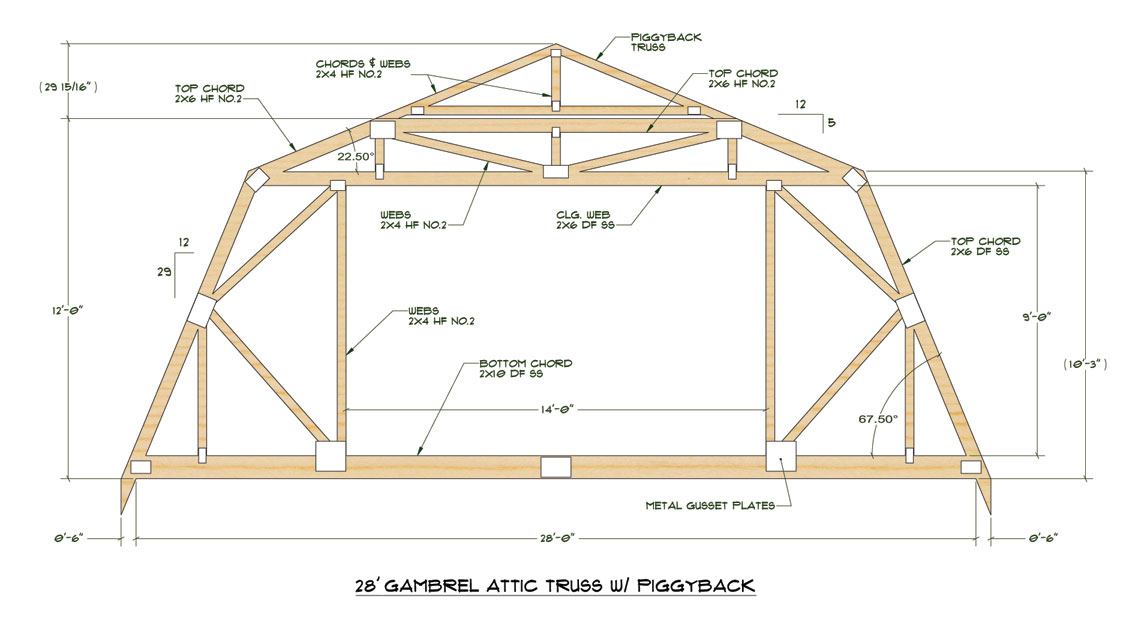
This is exactly why I need access to a good truss design software, I have no idea what I can do with an attic style gambrel truss. Last night I attempted a design for such a truss, my results are basically garbage. Too much lost space with the webbing, better to use a floor truss and maybe stick frame the gambrel on top. There are a lot of way to approach this the question is which is the best. It would be really nice to have a piece of software where one could play with different version and ideas until the perfect combination popped out. Now I'm waiting to hear back from a truss plant who is probably ignoring me since my request is non-standard and who knows what I'll get back.

28-GAMBRELTRUSS.jpg
 

readhead

Well-known member
Joined
Dec 8, 2012
Messages
6,175
Location
Durango, Co.
I think that would be easy with HSS and screw or shoot plates onto the top cords. Depending on cost and the customer it could be a viable option.
With part of it exposed it could be a design feature.
 
OP
M

Medeek

Well-known member
Joined
Jan 13, 2013
Messages
550
Location
Copalis Beach, WA
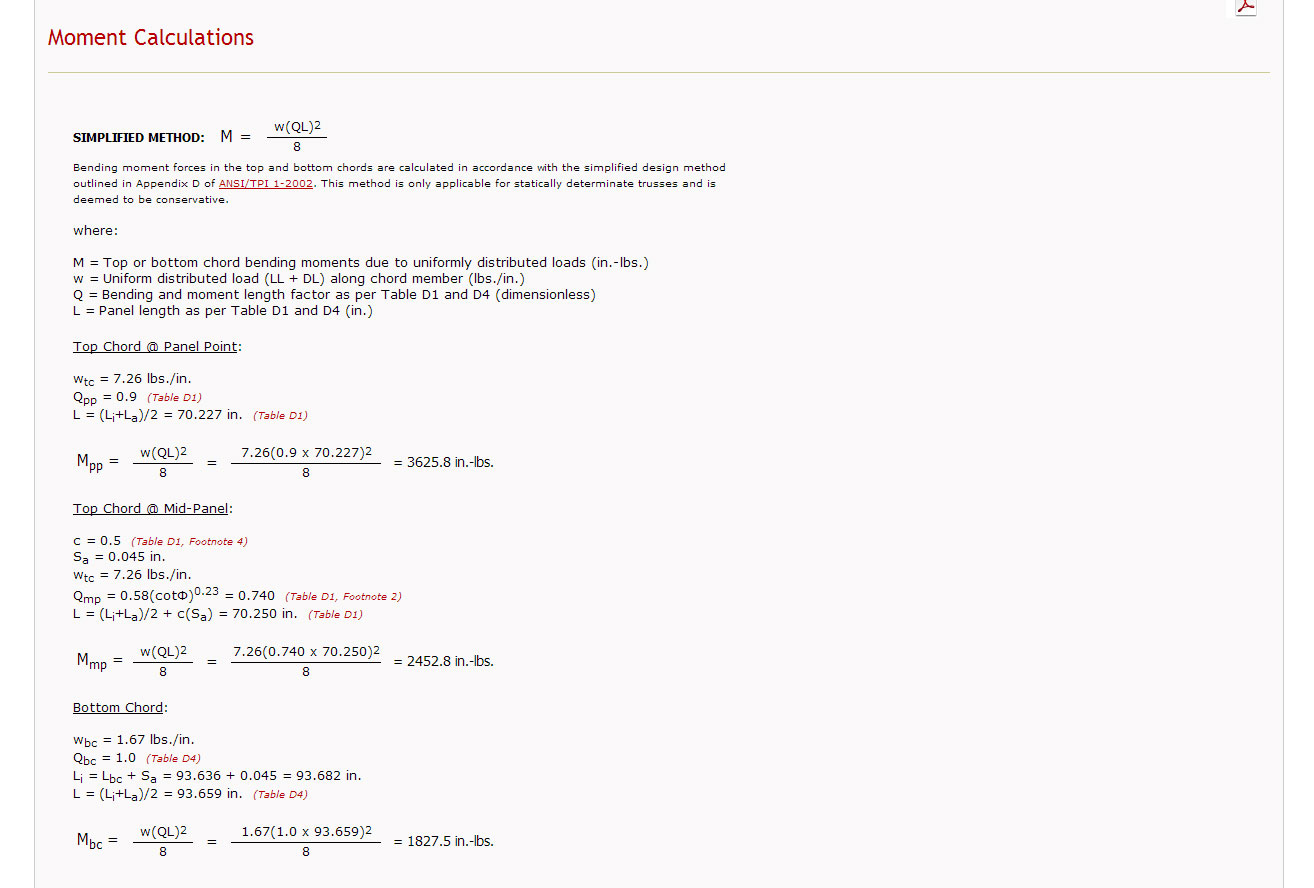
I've kind of hit a road block on the moment calculations for my truss designer project. The current spec TPI 1-2007 calls for using the matrix method in determining the moments. However, I need to be able to run this app without doing a full blown analysis using RISA or some other FEA type product. For now I've gone with the simplified method which is the method used in the TPI 1-1995 standard, at least I can produce a solution and it is considered more conservative than the current matrix method.

If anyone has any ideas on how to do a simple matrix method analysis of a common fink truss please send me in the right direction. My biggest unknown with this would be how to deal with the fixity of joints at panel points and heels. I've just ordered a copy of Hibbeler's Structural Analysis to further research how best to deal with frames, trusses etc...

One thing I found really helpful was the samples provided in the previous editions of the TPI 1, its really quite disappointing to see no such example calculations in the current standard (2007).

Here is a typical output for a fink truss showing moment calculations:

fink_moments.jpg


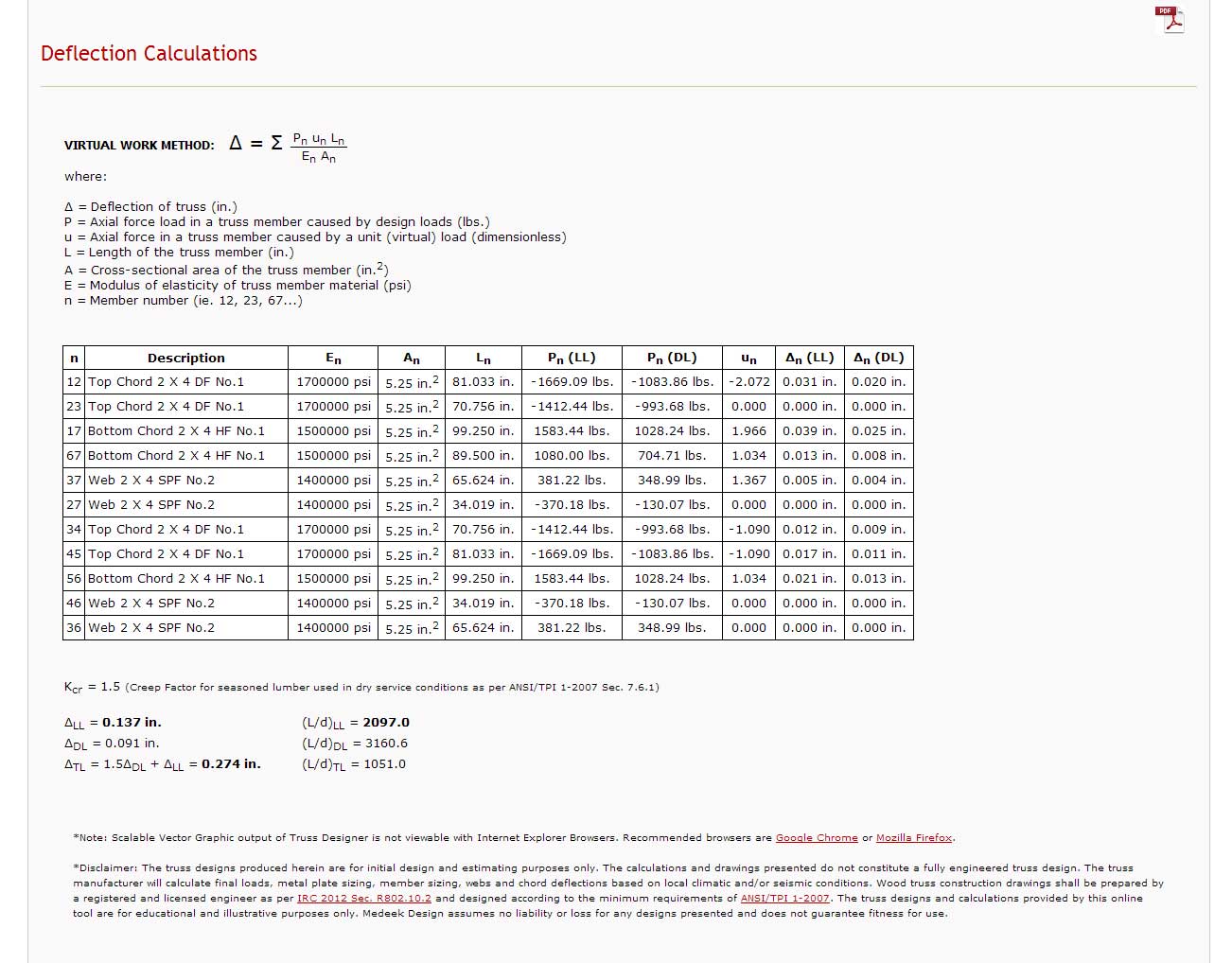
I also added deflections calculations using the virtual work method, curious to see how this stacks up against an identical truss with same loads and lumber analyzed with Mitek or Alpine:

fink_deflections.jpg


The fink truss is what I am concentrating at the moment, once I have a full analysis for it then I will begin to update the other various truss types and bring them up to speed will full calcs.

I've also added an on-demand AutoCAD generator which outputs the truss geometry into a .DWG file for other designers to download for their convenience. Note that this is not something Mitek or Alpine provides so I'm pretty pleased with this new feature. Typical CAD output below:

fink_autocad2.jpg
 
OP
M

Medeek

Well-known member
Joined
Jan 13, 2013
Messages
550
Location
Copalis Beach, WA
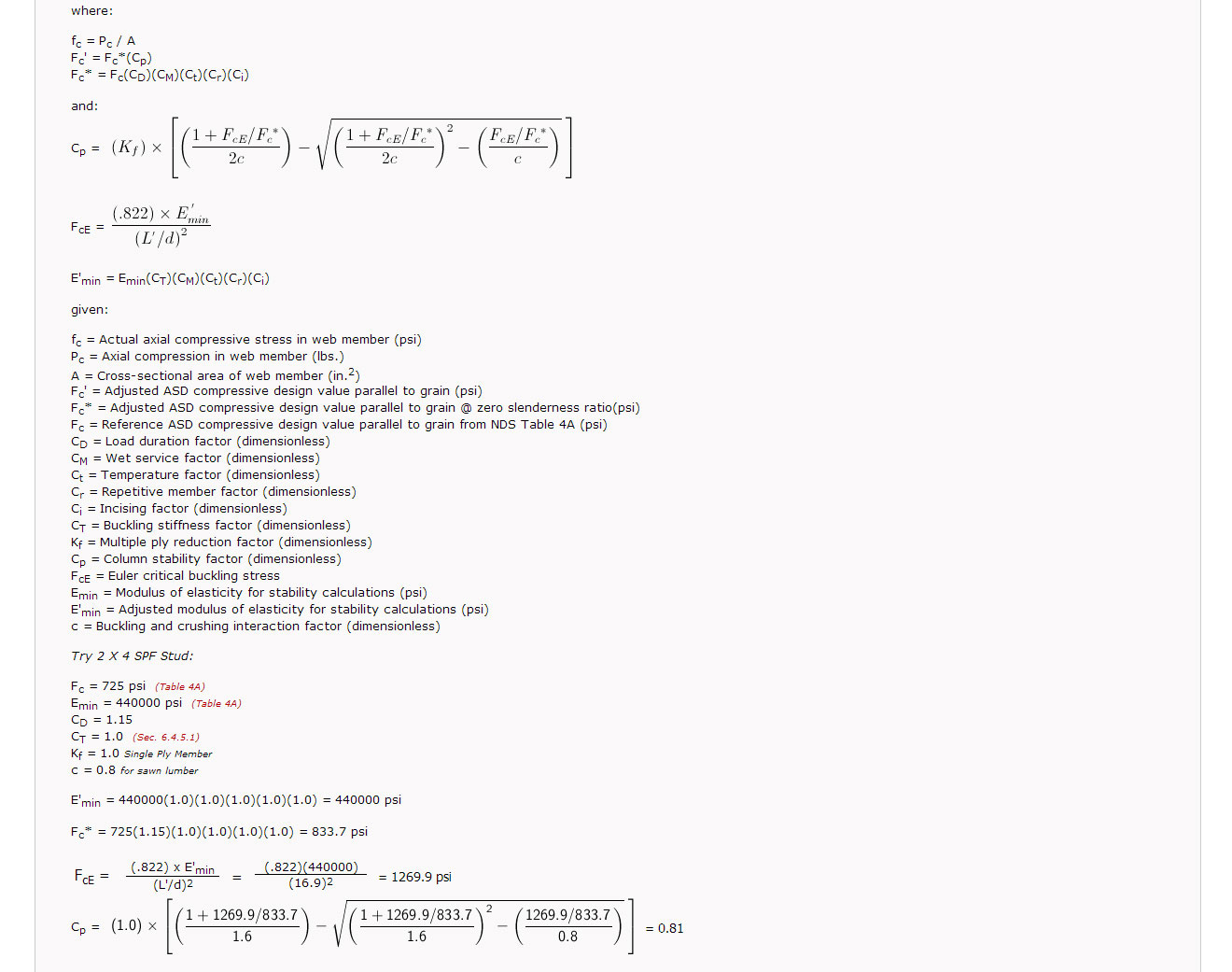
I've just completed the tension and compression analysis for the web members for the fink truss. It took a little longer than expected but most of that was comparing notes between the TPI, NDS and "Design of Wood Structures" text. The rest was trying to format the equations correctly with html and finally resorting to LATEX and a third party program. Below is part of the calculations for a 4/12 fink truss:

fink_compression.jpg


My next hurdle is to try and program the top and bottom chord analysis however I am having a bit of trouble making sense out of the TPI 1-2007 when it comes to calculating the effective lengths for the chords, the previous method used in TPI 1-2002 seems a whole lot simpler than the current standard, it will probably take me a few days to mull it over. Once that is done a heel analysis and then all of the metal plates analysis and then its done. However, so far I have not introduced any short term loading due to wind or seismic so in the future I may attempt that as well.
 
OP
M

Medeek

Well-known member
Joined
Jan 13, 2013
Messages
550
Location
Copalis Beach, WA
With a little help from a text called "Design of Wood Structures" by Donald E. Breyer and a recently purchased copy of the NDS 2012, the equations in TPI 1 finally made a lot more sense. I will say this has been quite an education with regards to structural design of wood structures. Last night I finally completed the full lumber analysis for the fink truss. Top and Bottom chords as well as all the webs. Now its time to start working on the heel joint check and all of the connector plates. Wind loads might be next but I need to research this quite a bit more.

After doing some reading on trusses it seems that the simplified method of calculating moments should be fine for statically determinate common trusses such as a fink, howe, king or double fink truss. Its when you start trying to analyze the statically indeterminate variety (ie. attic trusses) then the simplified method really comes up short. For that I will need RISA integration with the app.
 
OP
M

Medeek

Well-known member
Joined
Jan 13, 2013
Messages
550
Location
Copalis Beach, WA
Three types of scissor trusses I'm looking at adding are: Howe Scissor (4/4), Mod Queen Scissor (6/4), Double Howe Scissor (6/6)
 

tbrenan

Member
Joined
Oct 23, 2012
Messages
11
Location
British Columbia Canada
Things in the USA are a lot different than here in Canada, at least is my experience, trusses are readily available for all sizes of buildings-garages, in my limited experience -3 garages-one very large 4 car and storage the "package" came with all the required materials--never saw anything realted to an engineers stamp.
 

ndoran

Well-known member
Joined
Jun 23, 2011
Messages
496
Things in the USA are a lot different than here in Canada, at least is my experience, trusses are readily available for all sizes of buildings-garages, in my limited experience -3 garages-one very large 4 car and storage the "package" came with all the required materials--never saw anything realted to an engineers stamp.

Here in Canada the practice of engineering is more controlled than in the U.S. plus the Canadian laws are more onerous. To illustrate:

1) when I use a commercial software package I have to satisfy myself of the accuracy of the results from software package because I take liability for the results when I use them and I place my seal on the drawings.

2) Liability for faulty advice does not require a contract if I even suggest engineering advice to someone and they follow the advice and they suffer a loss I am liable for the loss and so is my employer even if this happens in my own time. This is why engineers do not offer advice except to their clients when they have E&O insurance and the appropriate provincial engineering licencing body authorisation to practice as a consulting engineer.

3) many engineers work for companies that design and manufacture a product, it is common for these companies not to be registered as consulting engineers. This means that the engineers are limited in the advice they can offer to someone who wants to buy a product for a given application. The engineers will design the product for their employer to manufacture but they cannot provide generic advice.
 

Lightfoot

Well-known member
Joined
Dec 6, 2010
Messages
430
If you plan on building a garage with a truss roof, you will still need to have an engineers stamp if you want to get a building permit.

I guess that depends on where you are located. Here, they just ask what size it is, how much it's going to cost (so they can add that amount to your property value for taxing purposes), and if you are going to have electric (will need electrical inspector when complete). Sign a check and you walk out with your building permit in hand.
 

DekeT

Well-known member
Joined
Aug 12, 2011
Messages
2,234
Location
USA
I am a Registered Professional Engineer in Washington State, and also an attorney.

The OP is embarking on a perilous course, in my estimation, even if the software is used for his own purposes. He should not be substituting his own professional judgment for that of the truss designer/manufacturer, who has already properly sealed the truss design.

Well he did say he is using static solutions for designing his indeterminate structure.
 
OP
M

Medeek

Well-known member
Joined
Jan 13, 2013
Messages
550
Location
Copalis Beach, WA
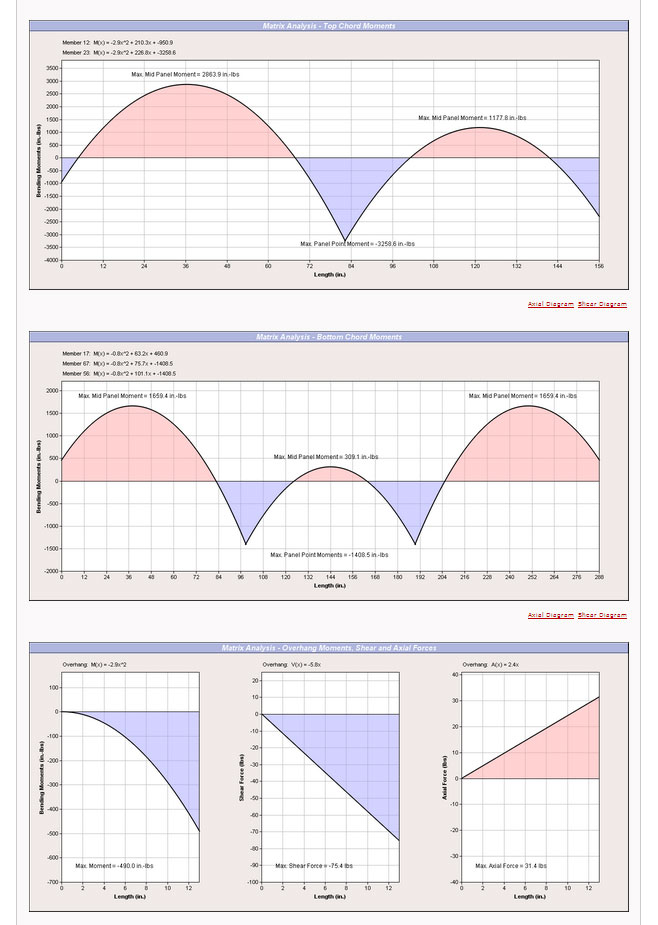
After about a good week of solid programming and scratching my head I've finally managed to add the requisite Matrix Analysis to my Truss Calculator. Thank-you R.C. Hibbeler for your Structural Analysis text on the subject (ch. 14 - 16), if the subject had not clearly laid out in front of me I would never have figured out the numerous steps to arrive at the solutions.

Here is an example of the output of my matrix analyzer for the Fink truss:

fink_matrix.jpg


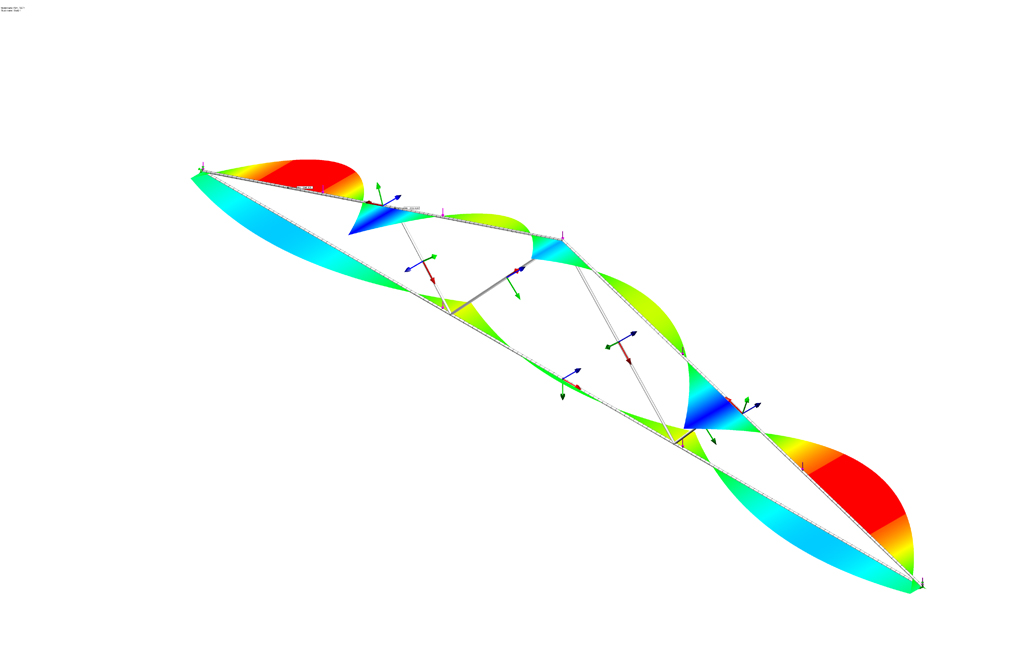
I've even inserted the correct code to account for the additional loading/moments if there are overhangs. I double checked my work by modeling up identical trusses (beams and trusses members) in both Strand7 and Solidworks (COSMOS/Simulator). My result were within 1.5% or better, so I'm really happy about that.

fink_fea_solidworks.jpg


My only concern with my analysis is how correct my analog for the truss really is. What I mean is that the bending moments are heavily influenced by the amount of rigidity of the joints. Fixing the joints (where chords meet) or pinning them dramatically affects the bending moments and even the axial and shear loads to some extent. My analog model is basically rigid at the heel and peak joints and pinned at all other web-to-chord or web-to-web joints. This seems to approximate most closely the moments calculated using the simplified method (pre TPI-2002).

What I also found quite interesting (and expected) is if you use a stronger type of lumber on the top chord as compared to the bottom chord. The top chord loads increase and the bottom chord loads decrease. The matrix analysis is almost as good as FEA. It's really quite cool to be able to calculate something like this just using a bunch of matrices.
 
Last edited:
OP
M

Medeek

Well-known member
Joined
Jan 13, 2013
Messages
550
Location
Copalis Beach, WA
Leaving the peak joint as a rigid connection without exploring the implications of a pinned or semi-rigid joint seem like a cop-out to me so I spent most of the day attempting to release the peak joint so that it could act as a pinned (zero moment transfer) joint. For the web members I accomplished a similar task by altering the 6x6 stiffness (k') matrix so that it only included the axial terms, thereby eliminating any shear or moment forces, making these members axial only or simple pinned truss members. However, for the top chord members it was not such an easy task. I initially tried eliminating the row of the matrix that was responsible for the far end moments (pinned end), but it some became apparent that the interplay between moments and shear forces was more than I had originally thought. I was about to accept defeat but then after spending a couple more hours digging about online I came upon a gem of a paper published in 2010 in the Electronic Journal of Structural Engineering by M. E. Kartal. This paper outlined a couple of methods for obtaining the correct stiffness matrix for semi-rigid connections. With this information I was then able to add in feature so that one can select whether the peak joint is rigid, semi-rigid or pinned.

I then tested it for accuracy against an identical model in Solidworks Simulator for both the pinned and rigid connection at the peak joint with near perfect results. Unfortunately, Solidworks does not allow for adjusting the rigidity of connections between beams in its interface so I currently do not have the tools to test the accuracy of the semi-rigid model. However it appears to present the correct trends when compared against the other two options. If someone has a copy of ANSYS or some other reasonably high end FEA software I would be interested to see how well it will compare with third party verification.
 
OP
M

Medeek

Well-known member
Joined
Jan 13, 2013
Messages
550
Location
Copalis Beach, WA
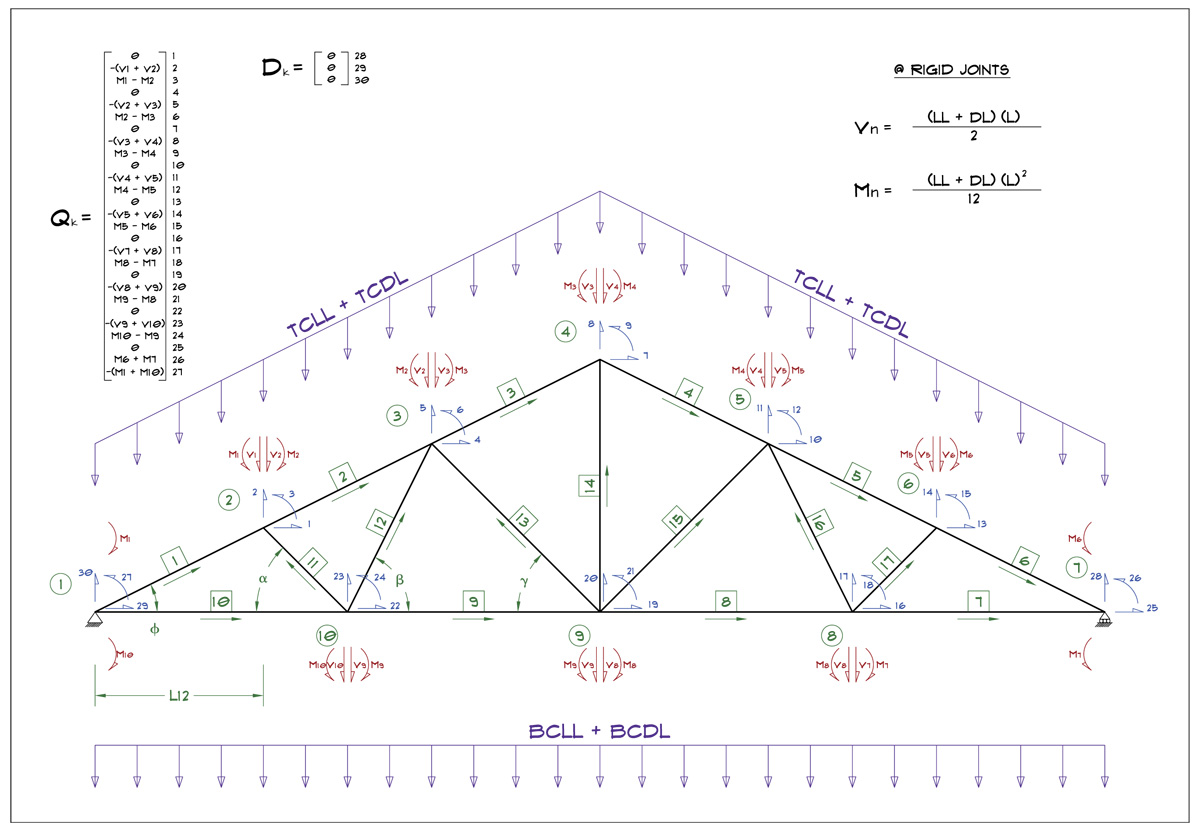
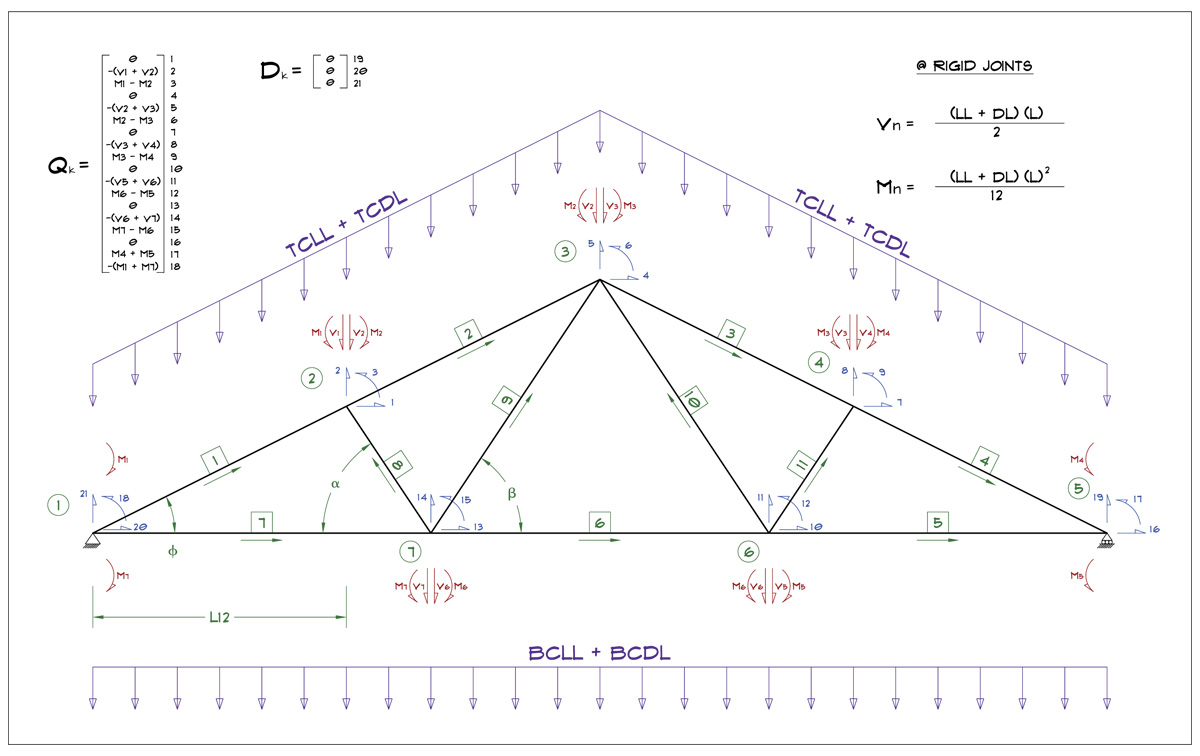
Starting to work on the modified queen truss, here is the schematic for the matrix analysis of it. The structure stiffness matrix will be a 30 x 30 matrix (900 values), its no wonder they didn't do this sort of thing prior to our modern computers, imagine trying to calculate this by hand. :)

MODQUEEN_MATRIX.jpg


Compare this to the fink truss, which has a few less webs and hence the computations are less 21 x 21 matrix (441 values)

FINK_MATRIX.jpg
 
Last edited:

Steinmetz

Well-known member
Joined
Oct 11, 2012
Messages
2,274
Location
Washington State
It's a shame that assault and battery against litigious idiots with zero respect for personal responsibility is itself illegal.

It's getting to the point that I'm surprised that it's even legal to teach arithmetic in public schools these days, for fear that someone might use the maths themselves and sue the textbook publisher when they screw something up.

Tell me what degree of "personal responsibility" is not exercised by the innocent victims of a structural collapse. It happens.
 

thoraudio

Well-known member
Joined
Aug 9, 2013
Messages
330
Location
Alabama
Here in Canada the practice of engineering is more controlled than in the U.S. plus the Canadian laws are more onerous. To illustrate:

1) when I use a commercial software package I have to satisfy myself of the accuracy of the results from software package because I take liability for the results when I use them and I place my seal on the drawings.

2) Liability for faulty advice does not require a contract if I even suggest engineering advice to someone and they follow the advice and they suffer a loss I am liable for the loss and so is my employer even if this happens in my own time. This is why engineers do not offer advice except to their clients when they have E&O insurance and the appropriate provincial engineering licencing body authorisation to practice as a consulting engineer.

3) many engineers work for companies that design and manufacture a product, it is common for these companies not to be registered as consulting engineers. This means that the engineers are limited in the advice they can offer to someone who wants to buy a product for a given application. The engineers will design the product for their employer to manufacture but they cannot provide generic advice.

That's not much different than it is down here.

Thoraudio PE
 

kythri

Well-known member
Joined
Jan 3, 2007
Messages
6,330
Location
Lebanon, OR
Tell me what degree of "personal responsibility" is not exercised by the innocent victims of a structural collapse. It happens.

And that has exactly what to do with medeek and his academic exercise here, especially when it's got a disclaimer that it's for educational purposes only, and should not be used to replace proper consultation?
 
To avoid these ads, REGISTER NOW!
OP
M

Medeek

Well-known member
Joined
Jan 13, 2013
Messages
550
Location
Copalis Beach, WA
The information presented on my website carries no force unless it is sealed by myself or another professional engineer. You can print out the entire 9+ pages of calculations and take them to any building dept. and unless it has that engineer's stamp on it somewhere then it will be rejected. I'm not saying that my calculations are incorrect but it is the way the system works.
 

bczygan

Well-known member
Joined
Nov 4, 2009
Messages
22,002
Location
DETROIT! Arsenal of Scrappers
There are many places where you can design and build your own trusses, or where a seal isn't required. That gap slowly closes.
Anything can be litigated. Nothing makes you safe except dying, and sometimes not even that will protect you.
I hail this exercise. Did enough of this to understand it when I was designing and enough to realize engineers do this and Architectural Designers do not.

The two main programs out there do more than just engineer trusses. They value engineer them for cost savings so they can be competitive.. This is based on everything from intended use to local codes to cost and availability of local lumber materials.

I am sure the group of engineers overseeing them are constantly at work adjusting for code changes and changes in the marketplace.

It HAS made trusses a commodity.

But that is no reason to NOT understand how they are designed and constructed.

The engineer/lawyer is right. We are litigious. And expressing any knowledge is sticking your neck out a little.

But of far greater value in my book, is getting people interested in the subject and educating them about it.

The difficulty, is in convincing them that the level of knowledge they possess isn't sufficient to do the design work completely themselves.

Not that you can't. Designing a simple truss is something any halfway intelligent person should be able to do. It's the special conditions that trip you up. That's what engineers are for. They have a depth of knowledge, and are able to spot those special conditions. They are bound to look at every aspect of a design and pronounce it good. They stake their professional privilege, finances, and even their personal freedom in the balance.

I wonder if most people realize on a day to day basis, that they work, play and sleep under tons of material, that if not properly designed, would fall and crush them to death?
 

WNYflyer

Well-known member
Joined
Sep 13, 2009
Messages
2,115
Location
Lockport, NY
Starting to work on the modified queen truss, here is the schematic for the matrix analysis of it. The structure stiffness matrix will be a 30 x 30 matrix (900 values), its no wonder they didn't do this sort of thing prior to our modern computers, imagine trying to calculate this by hand. :)

MODQUEEN_MATRIX.jpg


Compare this to the fink truss, which has a few less webs and hence the computations are less 21 x 21 matrix (441 values)

FINK_MATRIX.jpg

As it pertains to the first truss and the second truss would be similar,

Generally accepted practice is to have no rigid connection of member 1 to 10 and member 6 to 7. Those end connections should be modeled as pins while it currently looks like you have rigid connections thus moment transfer from one member to the other.

The diagonals should be axial only members thus modeled as pin connections at each end. The top chord to top chord (i.e 1 to 2) and bottom chord to bottom chord connections (i.e. 9 to 10) at each joint away from the support connections could go either way, pinned or fixed. Whether fixed or pinned in these areas is really dependent on the material being used, the length of material available, the actual continuity of the member/material through the joint, can reasonable connection plate and fasteners details be developed for a rigid joint, do those conections fit?. If you want to model rigid joints at the nodes then educated decisions must be made before hand on how the truss is actually going to be detailed and constructed so that the model truely represents the finished fabricated truss.

Of course you could always get rid of the rigid joints and model all the joints as pins (except roller support) like in the old days before computers and have a somewhat conservative design.
 
OP
M

Medeek

Well-known member
Joined
Jan 13, 2013
Messages
550
Location
Copalis Beach, WA
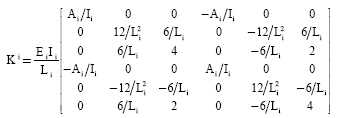
These schematics really say nothing about which members are pinned, semi-rigid or rigidly connected. The stiffness matrix (k) for each member is what determines that.

eq7-2k9-3906-3911.gif


In my analysis I am treating all of the webs as pinned jointed on both ends and only capable of transferring axial loads (classical truss members). The top and bottom chords at panel points are treated as rigid connections. The peak joint is treated either as rigid, pinnned or semi-rigid, this is user configurable. The heel joint is treated as rigid or semi-rigid. My reasoning and justification for these model settings is based on a number of papers I have compiled on the rigidity of joints of MPC wood trusses. I have saved each one and will compile a reference list at some point to accompany the truss designer documentation.

These two papers especially the bottom one were quite helpful:

http://design.medeek.com/resources/truss/DOCUMENTS/Paper_124.pdf

http://design.medeek.com/resources/truss/DOCUMENTS/20103.pdf
 
Last edited:
OP
M

Medeek

Well-known member
Joined
Jan 13, 2013
Messages
550
Location
Copalis Beach, WA
Currently working on the plate calculations. Those will be rather lengthy but the upside is the summary is what most people will want or need, however I will show each lateral resistance, tension, shear, net section and moment check for each plated area of each joint. I'm doing one by hand first before I code it and I've already used 10 pages for the calculations and I still have to add the heel joint. I hope if nothing else people can use this app to at least better appreciate all of the checks that go into a simple truss.
 
OP
M

Medeek

Well-known member
Joined
Jan 13, 2013
Messages
550
Location
Copalis Beach, WA
26 pages of truss plate calculations for one simple fink truss.

truss_plate_calcs.jpg


It's no wonder we use computers for this sort of thing.

Now I just need to take it from this pseudo-code into Perl code with a bit of fancy logic and we've got her licked. :)
 
OP
M

Medeek

Well-known member
Joined
Jan 13, 2013
Messages
550
Location
Copalis Beach, WA
Latest Updates Oct. 2015

I haven't posted about the truss designer for a while, apologies for that.

Still trying to improve it as time allows. The list of upgrades and improvements was getting rather lengthy so I've created a changelog page here:

http://design.medeek.com/calculator/changelog.html

Unfortunately, I had to put a daily limit on its usage because the server was getting hammered but it is still free to use.

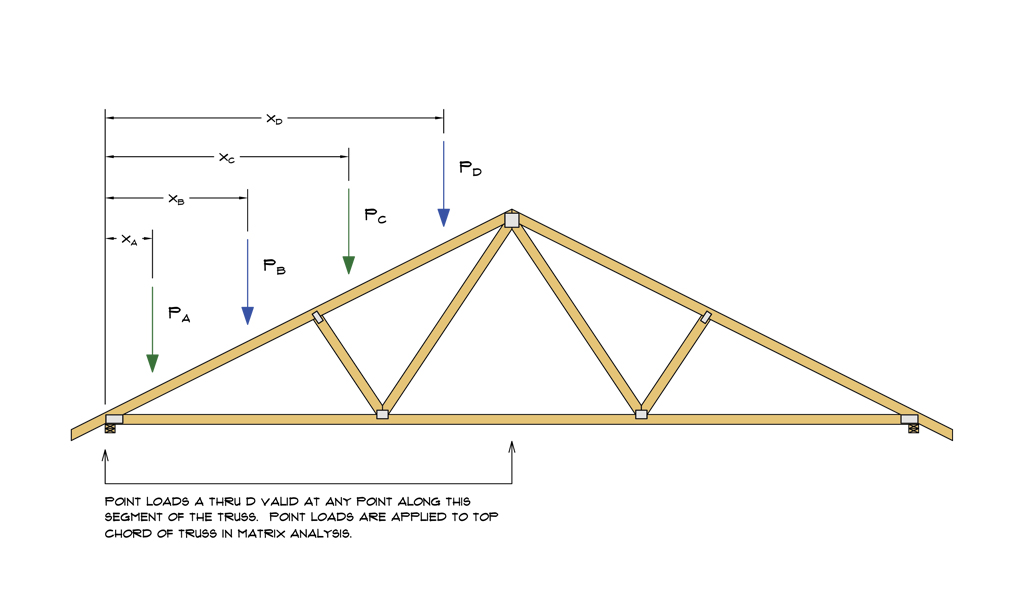
The biggest improvement is the ability to specify the lumber grade, size and species as well as utilize point loads. This should make this tool far more useful for those wanting to check their roof for solar panel installations etc...

I'm still thinking about generating a REVIT model for those wanting to import the truss directly into that software or even into Sketchup. I don't know how much demand there is for that sort of thing but it would be fun to program.

I appreciate all of the support I've received over the last couple of years on this project. Suggestions/feedback is always awesome.
 
OP
M

Medeek

Well-known member
Joined
Jan 13, 2013
Messages
550
Location
Copalis Beach, WA
Added SketchUp 3D (.rb) file output for the truss geometry. This file, when copied into the SketchUp plugins folder, will create a menu item within SketchUp allowing for unlimited creation of the given truss geometry within SketchUp. I think this feature will be particularly interesting to those DIYers who wants to draw up their own model and plans using SketchUp.
 
OP
M

Medeek

Well-known member
Joined
Jan 13, 2013
Messages
550
Location
Copalis Beach, WA
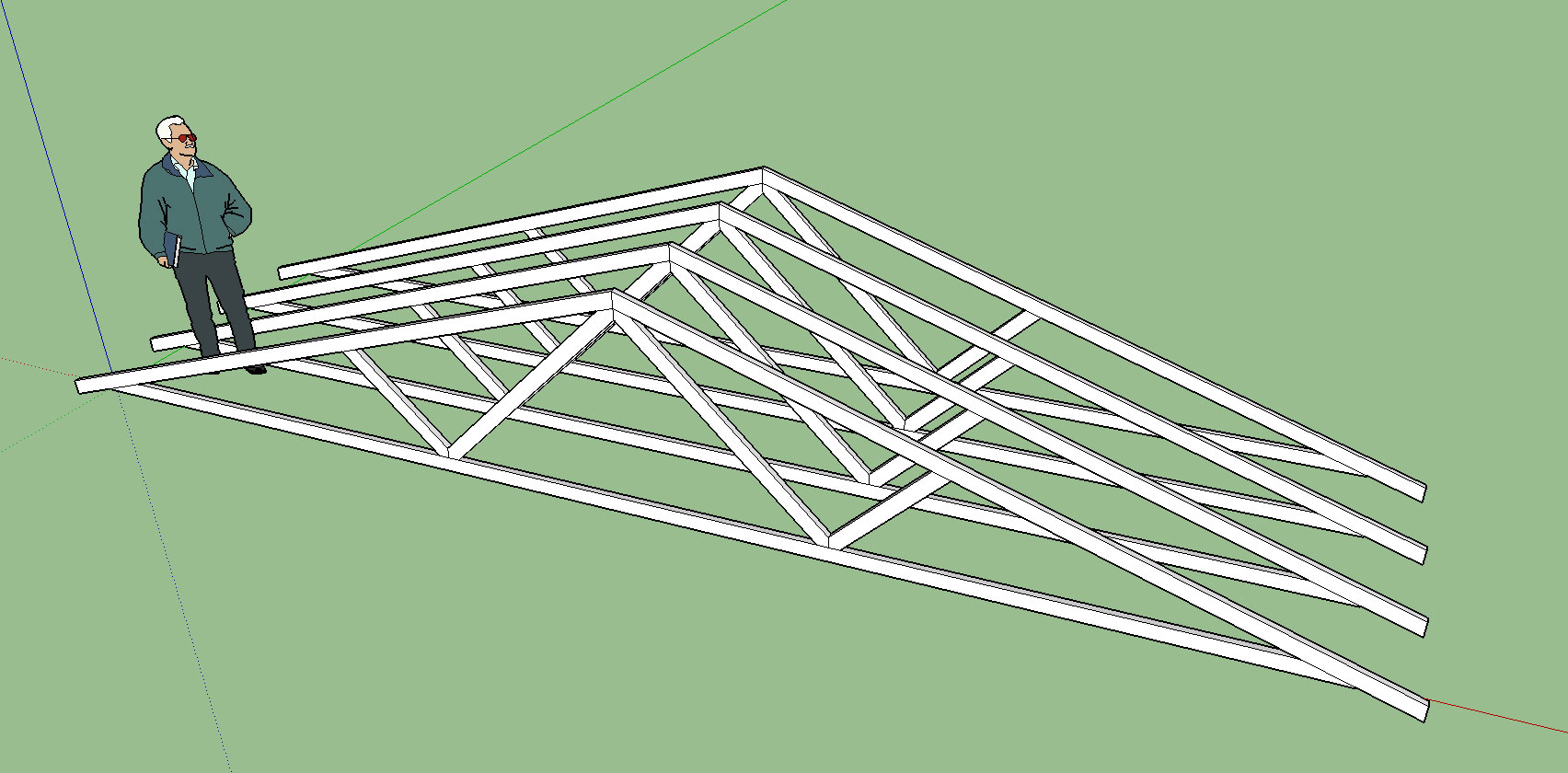
I've updated the code so that the plugin now allows for user input in order to specify number of trusses and spacing of the trusses. For example 4 trusses @ 24" o/c would give you:

TRUSS_SKETCHUP2.jpg


The actual truss geometry cannot be altered within SketchUp it is hard coded into the plugin when it is created by the calculator. For different truss sizes and shapes it is simply a matter of creating and storing separate .rb files for them. Dropping these files into the SketchUp folder sets up the menu item. This method seems to be the easiest for interacting with the SketchUp API.
Modify message
 
OP
M

Medeek

Well-known member
Joined
Jan 13, 2013
Messages
550
Location
Copalis Beach, WA
I have now created a separate plugin that is independent from the website and the Truss Designer. This plugin will allow for truss geometry creation within SketchUp.

For the fink truss all raised heel types are now active:

http://design.medeek.com/resources/medeektrussplugin.html

The algorithm is now smart enough to determine when to use a wedge, slider or vertical member with strut. Depending on the heel height, and the pitch a wedge is either a 3.5" or 5.5" deep. Likewise the slider is also auto selected to be either a 3.5" or 5.5" member.

I've also setup the plugin so it is now an .rbz file and can be installed from within SketchUp (preferences).

Another important change is the wrapping of the geometry creation portion of the script so that any changes to a model can be easily reversed with "undo"
 
Last edited:
OP
M

Medeek

Well-known member
Joined
Jan 13, 2013
Messages
550
Location
Copalis Beach, WA
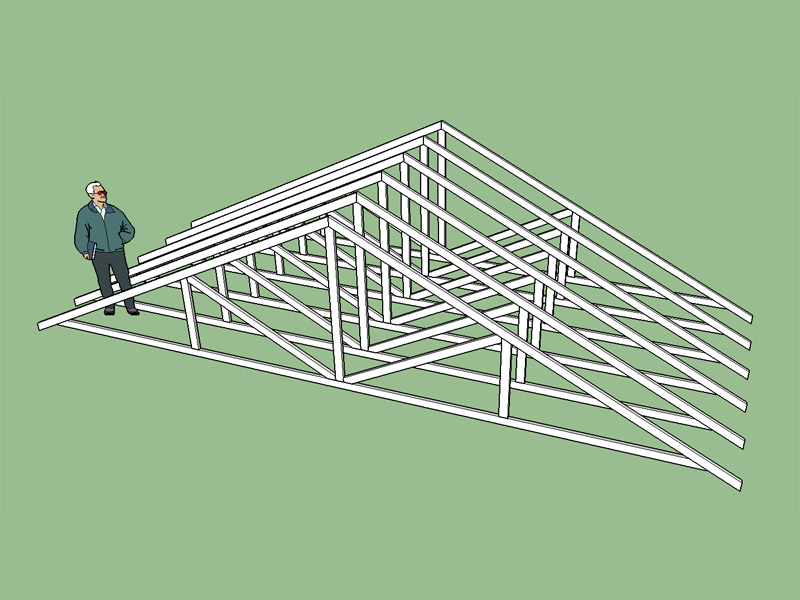
The left and right overhangs can now be set independently, however the right overhang defaults to match the left overhang to help speed user input:

TRUSS_SKETCHUP8.jpg


I've also created a new page for the plugin with some basic documentation:

http://design.medeek.com/resources/medeektrussplugin.html

Just an FYI, the energy heels are enabled fully for the fink truss but not for any other truss type and the TRIAL version is actually not limited in any way. I will probably keep it that way until the plugin is significant enough to actually warrant charging for it.
 
OP
M

Medeek

Well-known member
Joined
Jan 13, 2013
Messages
550
Location
Copalis Beach, WA
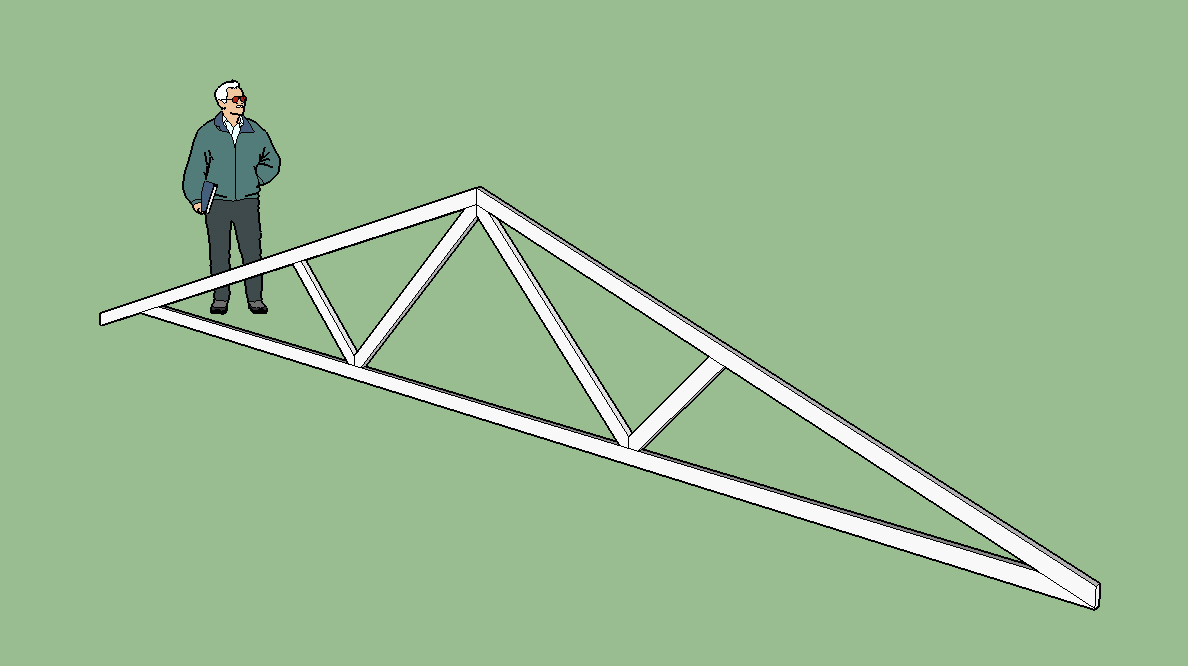
This is the same truss I used in my 28'x48' garage:

TRUSS_SKETCHUP10.jpg


Now I need to work on the energy heel option for this truss as well as some additional logic for attic trusses in the following span ranges 16-24 feet and 30-36 feet.
 

atthebeach

Well-known member
Joined
Mar 18, 2014
Messages
311
Location
At The Beach
>Medeek: This is one of the most interesting threads on GJ, imho. We were all using slide rules back when I went through Engineering school.

I am intrigued by your avatar. What am I looking at - an aerial view of your house, a totem pole face, or just a cool looking design?
 
OP
M

Medeek

Well-known member
Joined
Jan 13, 2013
Messages
550
Location
Copalis Beach, WA
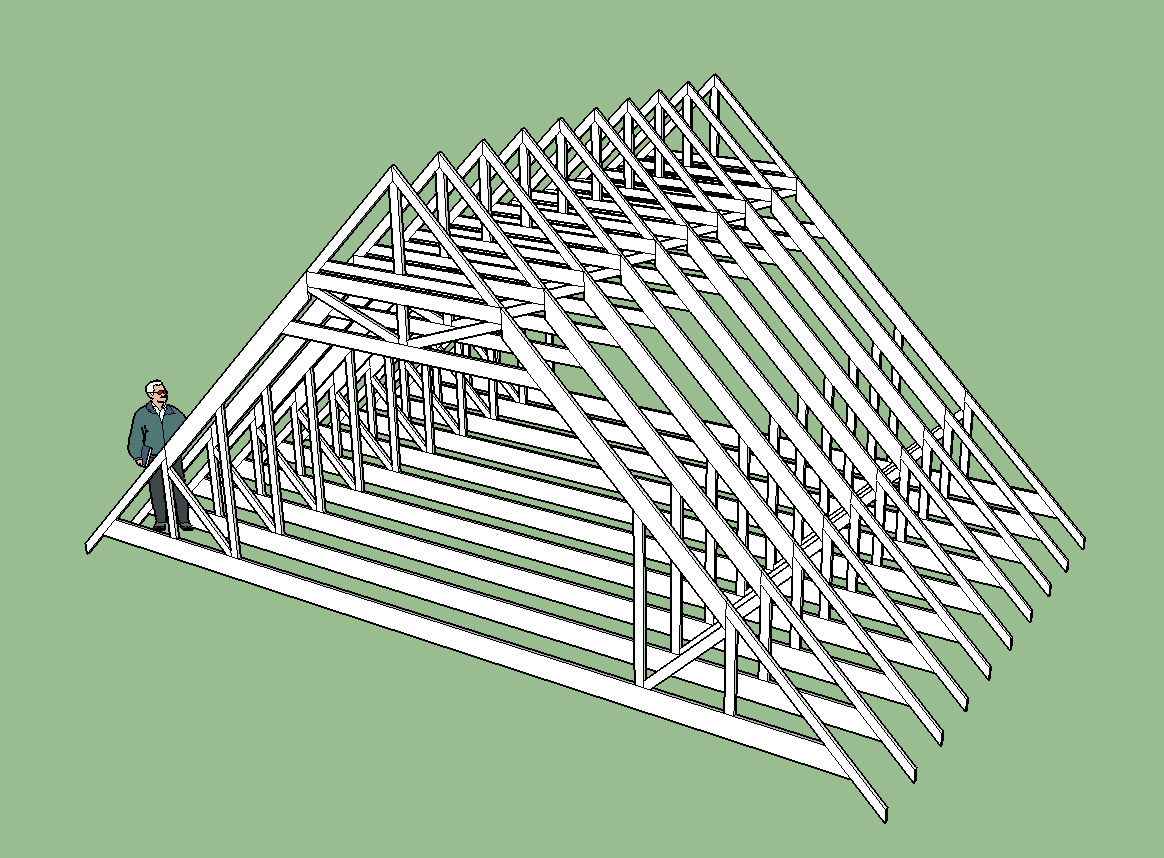
Howe truss type is now active.

The latest plugin version is 1.0.4. I would highly recommend downloading the latest version since I have also spent some time this morning cleaning up my code and removing global methods and variables so that I don't clash with other extensions or modules.

truss_su7_800.jpg
 
OP
M

Medeek

Well-known member
Joined
Jan 13, 2013
Messages
550
Location
Copalis Beach, WA
>Medeek: This is one of the most interesting threads on GJ, imho. We were all using slide rules back when I went through Engineering school.

I am intrigued by your avatar. What am I looking at - an aerial view of your house, a totem pole face, or just a cool looking design?

In my other life I am also an artist:

http://www.wilkersonart.com

This is a bear head (Medeek - Grizzly Bear) that I drew a few years back.

http://wilkersonart.com/beargallery.html

Since it is a relatively simple design I have utilized it for my logo.
 

JettaGetUpandGo

Well-known member
Joined
Jun 3, 2015
Messages
685
Location
Pewaukee, WI
I work as a designer for a residential builder of homes ranging from 1,800 sq. ft. to 5,000+ sq. ft. Some of the roofs on the larger homes get quite complicated, but we figure them out before we send our plans out to the truss designers.

We specify pitch, overhang, and heel height. The drawings show whether or not a roof line is clipped back, at a different plate height, different truss heel, stepped up in the middle due to a ceiling treatment, etc. If attic trusses are used we specify the size of the bottom chord to handle the weight we anticipate the floor system/ bottom chord will need to support.

As long as the trusses are designed around these criteria we really don't care how they they are built, where they put the girder for the jacks on a hipped roof, etc. Once the trusses are designed we receive an overall layout and a drawing of each individual truss with all of its calculations to approve before they are built. We verify the pitch/overhang/heel/ceiling types and the span distance then trust that the calculations and webbing are correct. The liability for that part is on them.

Personally, I don't see how a tool like this is valuable to a designer like me. The truss design and structural load calculations within the truss are things that we ever need to worry about. We design for 45 lb. per linear foot of truss when calculating headers and structural beams. This is more than enough to cover our bases.
 
To avoid these ads, REGISTER NOW!
Top Bottom