mike93lx
ALLIANCE MEMBER
So a metallic parallel pathway....Oh right - that's 2 runs of unshielded Cat6a for any future networking needs.
...forgot about that.
Replace the feeders

So a metallic parallel pathway....Oh right - that's 2 runs of unshielded Cat6a for any future networking needs.
...forgot about that.
I mean kinda - cat6 can only carry like 2 amps max. That has to matter.So a metallic parallel pathway....
Replace the feeders
It's all been discussed with the need for a 4 wire feeder.I mean kinda - cat6 can only carry like 2 amps max. That has to matter.
Can you elaborate on why it's dangerous? I truely don't know. This wire for example, is also buried, although at the top of the trench, and would only be connected to network switches at either end.
Maybe by comms protocol limited to 2A, but the conductor/jacket will try to carry whatever current is imposed upon it. If the current is too much, then the path(s) could burn clear due to the excessive current. Like a toaster element.I mean kinda - cat6 can only carry like 2 amps max. That has to matter.
Can you elaborate on why it's dangerous? I truely don't know. This wire for example, is also buried, although at the top of the trench, and would only be connected to network switches at either end.
Ahh - the house panel has been as-is for the last 10 years when we built the house.Maybe by comms protocol limited to 2A, but the conductor/jacket will try to carry whatever current is imposed upon it. If the current is too much, then the path(s) could burn clear due to the excessive current. Like a toaster element.
The real issue is you possibly getting zapped as you grab pieces of those unintended paths especially when opening those circuit paths and you being grounded. GFCI's are made to trip at 4-6mA for a reason.
So here's another question.............did Sparky wire the house feeder into the house sub-panel with USE-2 also? Any pics of that insulation?
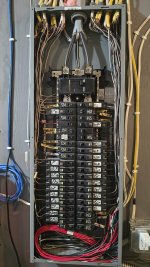
Ok, that may be, but it didn't mean the feeder didn't have to get replaced with the meter pan upgrade. Anyway, it's SER 4-wire, so it's ok. (Had to ask.....b/c ya never knooooooooowwwwww.)Ahh - the house panel has been as-is for the last 10 years when we built the house.
It's got a gray sheathed 4-wire feeder, looks quite different to the URD I used. Ignore the red wires in the bottom of the panel. I have a transfer switch for my generator I need to wire up still.
You never know, understatement of this entire thread, haha.Ok, that may be, but it didn't mean the feeder didn't have to get replaced with the meter pan upgrade. Anyway, it's SER 4-wire, so it's ok. (Had to ask.....b/c ya never knooooooooowwwwww.)

Poly vapor barrier under planking?You never know, understatement of this entire thread, haha.
Also - in a now unrelated topic, my building inspector signed off on my framing inspection today, along with my foam flange solution around my electrical boxes.
That should not be indoors.
Keep reading....it's explained.Curious, why not?
Yep, i'll have to have that inbetween the insulation and planks regardless, then ill just use some left over window flashing tape around the boxes to the poly.Poly vapor barrier under planking?
Keep reading....it's explained.
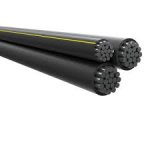
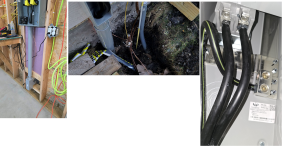
That would be sufficient to deal with the insulation issue.What if the exterior LB were changed to a larger junction box, and the section of wire from that point to the panel were removed and replaced with either SER or XHHW with 4-wire?
That is another breed entirely. They know ALL the tradesA friend asked me to tag along with their home inspector last Friday. This was a pre-purchase inspection. He showed me the "missing" Penetrox. I explained todays alloys. He never heard of that. I see it is still used quite often, I assume just to avoid getting questioned.

In addition to your valid concern, there is the labor to put that ground wire in a trench. The original trench is layered with power, gas, internet etc. Tough to add another conductor down deep. Digging another trench may not be an attractive option either.That would be sufficient to deal with the insulation issue.
The ground needs to be with the rest of the wires, AFAIK...i believe the NEC says "in the same Raceway", but I don't know how that exactly works with direct burial. Touching?
If this whole run is in conduit (I can't remember) , this is a pretty easy fix.
Mike I interpret the OP's installation is simply direct burial without conduit but it should be clarified.That would be sufficient to deal with the insulation issue.
The ground needs to be with the rest of the wires, AFAIK...i believe the NEC says "in the same Raceway", but I don't know how that exactly works with direct burial. Touching?
If this whole run is in conduit (I can't remember) , this is a pretty easy fix.
Maybe philosophical, but what is "the ditch" ? I think there's a bit of a difference between wires being separated a little in laying and backfill and the wires not being together at all.Regarding keeping the conductors all in the same "raceway", the ditch is the raceway. The 3 conductors are simply spiral wrapped (no sheathing) at the bottom of the ditch and these often separate when dumped in the ditch as I have seen when new services are run. Why would it matter if an added direct burial ground were placed not directly with this group at the 4' depth?
Agreed, but It's going to be damn near impossible to get that done when the inspector is this wrong.if a contractor did this he should fix it on his dime
The worst part is that proper cable selection was only a part # difference. Labor virtually the same, incremental cost trivial.It's direct burial, confirmed by OP to me earlier in thread or possibly in a PM.
This whole this is a mess, and I've stated my position. It ***** with the sunk costs, if a contractor did this he should fix it on his dime. If the OP did it it should still get fixed but I can understand the $$$ issue

This is where having a sketch/drawing that includes sufficient detail submitted with the permit application gives EVERYONE a chance to review details and forget the memory game or assumption game.
As an example.....of existing hardware and new hardware to be installed.
Unbounded statements are trouble. But they could be argued both ways. People learn (usually the hard way).As simple as this sounds, it's Amazing to me how often it's overlooked.
I'm in the middle of a 6-figure issue right now where someone ordered off a quote that essentially said "to supply all parts". All parts for what? Zero scope for the project...
Our specialty!!So just to throw in somewhat of a conclusion here -
I've been chatting with @mm08822 about the same thing @larry4406 suggested - next spring before I fix my trench mess I want to buy a EGC and bury it in the trench at a somewhat shallow depth.
In my mind, having that wire exist, however at an incorrect depth, should be better than it not existing. And if it was hit by digging, it should be a pretty tame situation.
That should also be something i'm 100% capable of doing myself - I know where it goes in the meter main panel, I can get it into the shop on my own, then I can just make the changes in the shop panel and I should be good to go. Or, better to go. Just out a few more hundred dollars and a week of stress from this forum lol.
Thanks again everyone for the insight, although living in ignorance of 3 vs 4 wire feeder and the definition of a subpanel had its perks haha.

I don't think that's a bad practice, but how often does a main become a sub?Here is a thought for the future. I always separate the neutrals and grounds in a new panel. I buy a couple of ground busses at the start and never look back.
If that panel ever needs to become a sub in the future, remove the bonding screw and call it done.
I think this is a reasonable outcome given where things currently stand.So just to throw in somewhat of a conclusion here -
I've been chatting with @mm08822 about the same thing @larry4406 suggested - next spring before I fix my trench mess I want to buy a EGC and bury it in the trench at a somewhat shallow depth.
In my mind, having that wire exist, however at an incorrect depth, should be better than it not existing. And if it was hit by digging, it should be a pretty tame situation.
That should also be something i'm 100% capable of doing myself - I know where it goes in the meter main panel, I can get it into the shop on my own, then I can just make the changes in the shop panel and I should be good to go. Or, better to go. Just out a few more hundred dollars and a week of stress from this forum lol.
Thanks again everyone for the insight, although living in ignorance of 3 vs 4 wire feeder and the definition of a subpanel had its perks haha.
Put a transfer switch ahead of main panel.I don't think that's a bad practice, but how often does a main become a sub?
24" is the minimum depth. I would expect damage to anything else in the trench trying to group everything as expected. 12" is plenty for a ground wire, IMO. Put some caution tape in the trench as a feel good thing to do. Way better to eliminate the safety issue than walk away from it.I think this is a reasonable outcome given where things currently stand.
Fix it prior to the yard repair in the spring.
Glad I could contribute something. I really felt bad for you given how you reached out for info and the power company, your electrician, and the AHJ all failed you. Quite sad. I would have been beside myself looking for a way out (thus why I posted what I think I would have done in your shoes!).
I know I have looked into 24" wide trenches by the power company and have seen their tri-plex cable strands separate leaving one along one side of the trench, another in the middle, and another on the far side. And this was not just local, but for quite a bit of run like 10-20'! Thus the strands were not colocated anymore and were near 2' apart. Seeing this, what is the harm that one is higher as long as the minimum burial depth is met?
If the strands of the tri-plex were mandatory they be held tight together, instead of the spiral wrap, I would then think the manufacturers would use a more positive method of retention.
Sure, I know what could cause it.Put a transfer switch ahead of main panel.
That’s exactly what I had in mind. Just went through that with a house and fortunately the panel had grounds and neutrals separated. Transfer switch was an easy install.Put a transfer switch ahead of main panel.
Funny you say that, i bought a ground bar when I bought the panel, because that just seemed to make sense. Then they told me I didn't need it lol.Here is a thought for the future. I always separate the neutrals and grounds in a new panel. I buy a couple of ground busses at the start and never look back.
If that panel ever needs to become a sub in the future, remove the bonding screw and call it done.