Oldtuleguy
Well-known member
- Joined
- Nov 4, 2017
- Messages
- 10,459
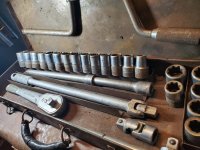
I have seen a few cad examples so it seems likely they were made into wartime.
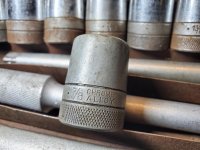
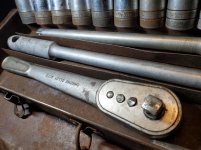
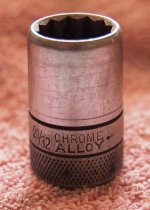
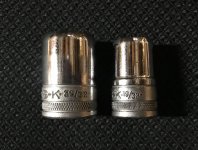
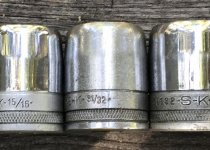
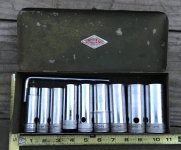
Nice find. My 4way is a S-K Wayne but I would have preferred S-K Tools. What size is the Chrome Alloy socket?
-Don
I'm sure Lugz will be by to remind us, but Cad plating was used long before the war as a value / economy line plating option and does not necessarily mean wartime production.
Thanks Don. The Socket is 13/16". Do you need it?
![]()
Was this a polite way of saying I am a predictable broken record on that subject?I'm sure Lugz will be by to remind us, but Cad plating was used long before the war as a value / economy line plating option and does not necessarily mean wartime production.![]()
I haven’t yet run across any Black Oxide finish Chrome Alloy sockets.
"Black Oxide finish Chrome-Alloy" is an oxymoron. As is Black Oxide finish Chrome-Vanadium, Black Oxide finish Chrome-Molybdenum, etc. Black oxide was invented in 1942 in response to chrome-plating restrictions at a time when chromium was also being restricted in the high-chrome steel compositions that dominated the late 1930's into 1941, including Chrome-Alloy. The earliest you will ever see a black oxide finish is on wartime tools made of "New Emergency" triple alloy steel and those won't have high-chrome composition markings.I have about 60ish pieces and no black oxide.
(Just bustin' yer chops...)I am trying to learn whether or not a 21/32nds socket would have been included in my black oxide SK socket set from WWII...[ ]...Is it made in 1/2" drive in the 1943 SK catalog?
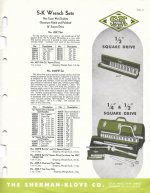
...the 1943 SK catalog did include a set that included a 21/32" socket (40121). I see other sets that did not include it, though, so the proof is probably in the empirical pudding (collected examples).
Not a brand, per se, but it was very typical of OEM's to use steel composition and steel composition markings like a brand in the 1930's, yes. Sometimes, especially for tools they sold to others to re-badge (on a box) these markings are a way to help confirm the identification of the OEM made through physical characteristics.David Jackson said:One other question I have is about Chrome Alloy - is it a brand? I take your point about using those words (Chrome Alloy) to search.

Was this a polite way of saying I am a predictable broken record on that subject?![]()


Ahhh. That sent me back to the source. For some reason I never think about the 21/23" as a size that was restricted, only the 31/32". But indeed it was eliminated by WPB L-216. Maybe because I've been spending too much time in Plomb catalogs. They removed it from the Price List in '43, but it's not struck in the catalog. Haha. S-K and also Williams catalogs much better (easier) references for seeing L-216 in action. Both sockets were removed from the WPB restricted list by L-216 amendments, with many other tools, by '45. I'll see if I can find that date.It’s marked suspended...
Nice! That 31/32" is very hard to come by. I have only ever seen 2.I do have all of the oddball sizes in postwar sockets.
-Don

Two were specified: B40826 (13/16") and B40828 (7/8"). Thanks to you and Roy, it is indeed complete. Sorry for the wait!Lugz has some in his recently found set which I’m waiting to see a picture of now that it should be complete.
Ahhh. That sent me back to the source. For some reason I never think about the 21/23" as a size that was restricted, only the 31/32". But indeed it was eliminated by WPB L-216. Maybe because I've been spending too much time in Plomb catalogs. They removed it from the Price List in '43, but it's not struck in the catalog. Haha. S-K and also Williams catalogs much better (easier) references for seeing L-216 in action. Both sockets were removed from the WPB restricted list by L-216 amendments, with many other tools, by '45. I'll see if I can find that date.
EDIT:
In summary, you have two small wartime windows, DJ. Late 41 to March 1943 when it was still being made. And then 1945-ish when it was allowed to be made again.
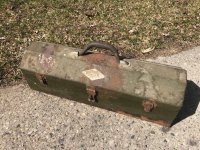
I’ve picked up a few of those, including a wartime one with the decal rather than the riveted plate. They are a handy size and not too heavy to move around.
-Don
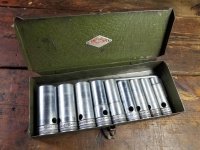
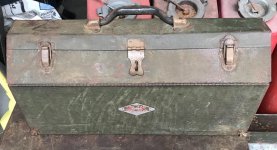
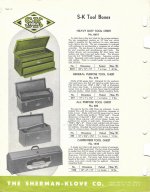
This box I posted is 2" narrower, and actually 2" longer than the boxes you show, d42jeep. Note the fact it has a full hip lid, and the clasps and hasp are mounted frontside.
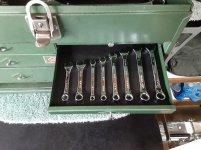
When I saw it online, I actually envisioned the lift out tray fitting my 40s 3-drawer chest, but alas, it's too long for that.
I had a narrow miss on a mint machinist chest yesterday for the same $10. I'll keep swinging til I find one of those, and a nice carpenter's box.
Working full time, and being first on the site for prime opportunities is proving difficult, as I alluded to in an Xcelite post earlier today.
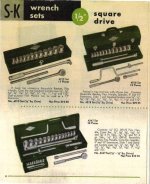
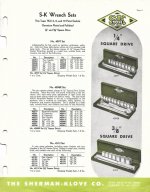
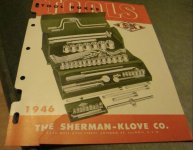
Probably not. Your catalog still has the wartime logos and the water transfer paper decals on the lids, so it was published before they switched to the metal riveted badge. As far as I know, I don't think we have a documented specific cutover, only that it's 1947 or later. I am assuming Don is guessing 1949 based on the catalog number, which may have the year embedded. I don't pay too much attention to postwar SK other than knowing the metal badges are postwar. If someone has other SK catalogs from that era, say 1950, 1951, etc, and they use that same catalog numbering system, it would back up Don's theory.It came with this service guide, which is dated 1954, could that also be the date of the catalog too?