
You are using an out of date browser. It may not display this or other websites correctly.
You should upgrade or use an alternative browser.
You should upgrade or use an alternative browser.
vintage saw restoration
- Thread starter LesserSon
- Start date

IDK in your area. My first thought was powder post beetle larvae.Sure... I'll just hang it from a hook out in the garage. Not a problem.
What did that? Little weevils? Teeny-tiny little holes all over the thing. I had assumed they were long gone.
powder post beetle larvae
More generally wood boring beetles
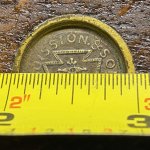
Exactly the same size, weird, I thought British warranted superior saws would have an English theme and not an eagle being the USA themeYeah, as I was posting, I thought of that…
both look to be 31/32”

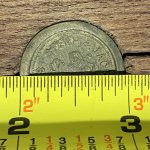
So… I’ve been assuming you can see a S&J etch on your saw that I can’t see in the photo. So the blade is from England. As RTM was suggesting, maybe that’s the only part that’s from England. I’m accepting the handle as original, but there is no way the medallion is from England. It’s American, possibly/probably made by Disston.
They were sold to other American saw makers, placed on retail contract saws and sub-brand saws, and sold as replacements to consumers. Particularly in that era, saw nuts broke because they were cast. But even later, it was not hard to lose them when resharpening or even on a job site.
Though visible, the diameter difference on the ones I measured is slight; I imagine a replacement medallion might be a pretty good fit in either direction, depending on how humidity was affecting the wood dimensions at the time of replacement.
They were sold to other American saw makers, placed on retail contract saws and sub-brand saws, and sold as replacements to consumers. Particularly in that era, saw nuts broke because they were cast. But even later, it was not hard to lose them when resharpening or even on a job site.
Though visible, the diameter difference on the ones I measured is slight; I imagine a replacement medallion might be a pretty good fit in either direction, depending on how humidity was affecting the wood dimensions at the time of replacement.
yes the etch is there and is SJ, you might be right, maybe SJ britain only exported the blades and some company in USA or where ever it was exported to made the handles, therefor they couldn't use an SJ or their own medallion so just used the generic and ubiquitous "warranted" medallionSo… I’ve been assuming you can see a S&J etch on your saw that I can’t see in the photo. So the blade is from England. As RTM was suggesting, maybe that’s the only part that’s from England. I’m accepting the handle as original, but there is no way the medallion is from England. It’s American, possibly/probably made by Disston.
They were sold to other American saw makers, placed on retail contract saws and sub-brand saws, and sold as replacements to consumers. Particularly in that era, saw nuts broke because they were cast. But even later, it was not hard to lose them when resharpening or even on a job site.
Though visible, the diameter difference on the ones I measured is slight; I imagine a replacement medallion might be a pretty good fit in either direction, depending on how humidity was affecting the wood dimensions at the time of replacement.
RTM
Well-known member
Wow, seeing your two S&J saws against the #7 shows a big small difference. The second nut from the top is in a slightly different location than the #7, but matches the OP.Every part of your saw - except the medallion - looks S&J enough to me. I’m not sure whether the lambs tongue that shows on my two varied, died out in S&J designs, or is just not as pronounced on yours.
So I was wrong about the handle replacement possibility. And no clues about the medallion.
I know Lumberjocks has a medallion thread, US and international makers included. See if I can find the link.
RTM
Well-known member
The link to that is acting up. But coincidentally, a saw with medallions on the reverse side showed up, figured I'd toss it here for reference. It links out to a Phenix line of saws
.
.
I don’t think that’s an impossible sequence of events, but what I’m suggesting is that the medallion is a later replacement, not that the handle was made elsewhere than England. I think the medallion alone being not original to the saw is the simplest and most probable explanation. (Applying Occam’s razor.)yes the etch is there and is SJ, you might be right, maybe SJ britain only exported the blades and some company in USA or where ever it was exported to made the handles, therefor they couldn't use an SJ or their own medallion so just used the generic and ubiquitous "warranted" medallion
In addition to the possibility of it being replaced during the years the saw was in active service, there are collectors of saw medallions. Plausibly, somebody purposely removed the S&J medallion for a collection, and replaced it with a more common (in USA) WS medallion to keep the saw functional.
Last edited:
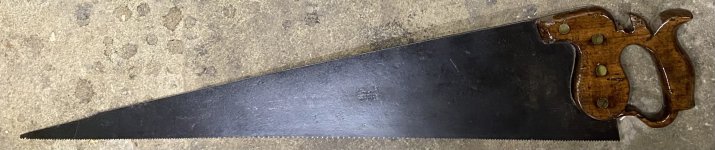
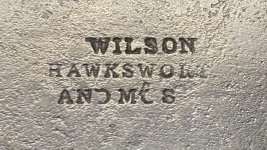
Information from this source suggests the Wilson, Hawksworth & Moss saw would have been made in Sheffield England and dates from 1832-1853, based on Moss’s years of partnership. (EDIT - post 40 documents the as-found condition, and a similar but narrower estimate of 1833-1849.)
Last edited:
Conrad & Roberts was a mid-19th century hardware retailer at 123 N Third St Philadelphia. (Looks like the building is still there in Street View.) There is a good refinishing tale of a similar saw on the lumberjocks website. Someday, maybe, I’’ll come across a C&R medallion in an otherwise unsalvageable saw and perform a transplant, because if memory serves, it was missing or replaced with a much later spun-brass medallion. Something interesting - there is a name stamped on this handle - like the one on lumberjocks - so maybe that was a gimmick at C&R: stamping the purchaser’s name at point of sale.
(EDIT - Actually, that’s the contemporaneous Disston No8 they’re citing for comparison, with the stamped customer name, so IDK what significance it has.)
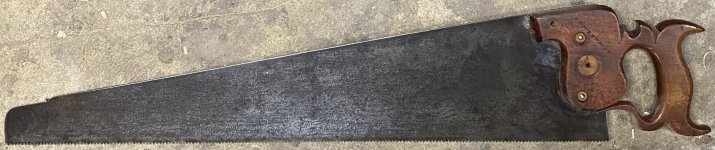

(EDIT - Actually, that’s the contemporaneous Disston No8 they’re citing for comparison, with the stamped customer name, so IDK what significance it has.)
Last edited:
Yes sometimes the more simple answer is the more likelyI don’t think that’s an impossible sequence of events, but what I’m suggesting is that the medallion is a later replacement, not that the handle was made elsewhere than England. I think the medallion alone being not original to the saw is the simplest and most probable explanation. (Applying Occam’s razor.)
In addition to the possibility of it being replaced during the years the saw was in active service, there are collectors of saw medallions. Plausibly, somebody purposely removed the S&J medallion for a collection, and replaced it with a more common (in USA) WS medallion to keep the saw functional.
I gave the handle a quick scrape and oil revealing a gorgeous wood pattern which is a close match to another Sheffield Robert sorby saw I have from 1850 to 1870

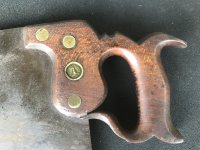
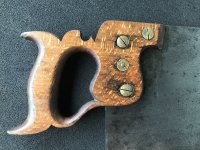
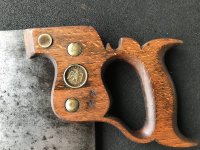


RTM
Well-known member
I use a 1/3 by weight each of BLO, beeswax, & turpentine, melted together (outside on a double boiler), then applied with a grey or maroon Scotchbrite, then buffed off. I personally find shellac and poly give a very plasticky feel in use. The mix lives in a short squat Mason jar.Interested to know how people are finishing their handels
I will try that on my next saw I’m doing, thanks for that.I use a 1/3 by weight each of BLO, beeswax, & turpentine, melted together (outside on a double boiler), then applied with a grey or maroon Scotchbrite, then buffed off. I personally find shellac and poly give a very plasticky feel in use. The mix lives in a short squat Mason jar.
With shellac I smooth with 0000 steel wool between 3 coats and then finishing to dull the finished shine, smooth nice finish and can then use paste wax
All of what follows is reconstructed by reasoning, as I have not found a detailed first-hand description of the process:
I determined that Disston used shellac, by dissolving remaining finish off handles with alcohol. Lacquer would just cloud.
In production, I think shellac chips must have been liquified by heat rather than by solvent - it would be dry as soon as it cooled and be ready for the next step in minutes, instead of days.
Shellac was applied to handle edges after they were carved. After flat sanding the sides and any decorative carving, the whole handle must have been fully dipped once before slitting and boring the screw holes. The finish is always thicker on the edges, very thin (one coat) on the flats, and completely absent in the slot and holes.
Disston’s “weatherproof” handles were finished with polyurethane.
I determined that Disston used shellac, by dissolving remaining finish off handles with alcohol. Lacquer would just cloud.
In production, I think shellac chips must have been liquified by heat rather than by solvent - it would be dry as soon as it cooled and be ready for the next step in minutes, instead of days.
Shellac was applied to handle edges after they were carved. After flat sanding the sides and any decorative carving, the whole handle must have been fully dipped once before slitting and boring the screw holes. The finish is always thicker on the edges, very thin (one coat) on the flats, and completely absent in the slot and holes.
Disston’s “weatherproof” handles were finished with polyurethane.
four.cycle
Well-known member
^ The old Craftsman hand saw that I reworked a year ago got multiple coats of a "Minwax" stain/polyurethane mix. Looks good. Feels weird. I don't use hand saws that much that it will bother me, but I would not use poly again on a saw tote - I'll just use BLO on the next one. 
four.cycle
Well-known member
MrsLS had packed up a few cubic feet of basement clutter, so at 04:30 we took it to Jake’s Flea Mkt to sell. After we set up, I did a recon of the field and picked up a few things to refill the void.
My first purchase was some SS flatware reminiscent of my grandmother’s Impassa Japan atomic starburst set (which I have… somewhere), partially addressing one of two problems. ALL the knives (even ones I’ve seen on eBay) have a crack in the blade between the logo stamp and the handle, which I take to be a manufacturing issue. These knives don’t share that flaw. (The unaddressed problem is that the ice tea spoons, of which she was inordinately proud, and her three sisters inordinately jealous, were missing from her home when we emptied it.)
I could make out “cast steel” on the hack saw frame, so I knew it was old. As I hoped, turned out to be Henry Disston & Sons Philada USA.
Champion quilt frame clamp. Craftsman 1/4dr deep. Unmarked brick pointer. Challenger 1/4dr spinner. Wm Hjorth Jamestown NY “AUTO” bent nose pliers, Easco stubby Phillips. Vacuum-Grip Newport battery pliers, Snap-on tiny dikes, Utica slipjoints, France duckbill box joint pliers (with more mfr stamps I haven’t deciphered). Unbranded No1 concrete seamer. Bonney 6” Stillson and 31/32” 6pt socket. $12 for everything, plus we netted ten times that on stuff we sold.


While derusting my Henry Disston & Sons No1 hacksaw frame, I noticed the steel pin holding the handle assembly together (resembling a finish nail) was mangled near failing and the hole through the wood had become a slot, so I drilled the head off and pulled.
The tapered square steel rod that grips the saw blade is captured by the turnip-shaped hole it passes through, so there’s no further disassembly, which was my goal for getting the rust out of the turnip hole. And the heavy brass ferrule was a bit out of round, so I managed to put a few more scratches into it fixing that. Oh well.
What is most interesting to me is the inner wood peg, which has a tapered square hollow to receive the steel. That hollow could have been made directly in the outer wood handle, resulting in a simpler assembly and less total work. But it probably reduces wasted work when there’s an error in making the hollow, from discarding only that little peg, instead of a whole turned handle. It may also help snug into the brass ferrule by slightly wedging the outer handle.
Well, now I can repair and treat the wood parts separately from the steel, which generally yields better finished results.
Last edited:
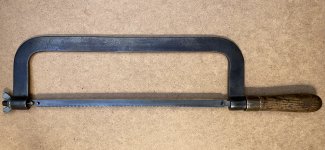

I gave all the parts of the No1 12” hacksaw a coat of BLO, waited a couple weeks, and reassembled. I superglued a couple tiny wedges of hardwood where the grain had tearout from the nail, and redrilled a slightly larger throughhole (1/8”) for a larger finish nail, which fills the brass ferrule a little better. I’m not sure what happened to the blade that was on it; this one was handy.
The No1 is shown (illustrated with a fancier handle) in the 1904, 1918, 1920 & 1923 catalogs, $11/doz.
Last edited: