TheRealZeus
Well-known member
Obviously 1864 is older, so your on the right track. I really thought there would be an individual patent for the latch mechanism alone, sited along with the pipe vice’s patent.











Varco
 www.garagejournal.com




Geez, did the ferry have to make a special trip for just you and your vises.Brought them to my bridge-less island

Kevin, those are a couple of beauties. 109's I have seen on GJ or elsewhere, but never the 209. If I recall correctly, all the big vises Demoman had and showed, he never had a 209.FMC
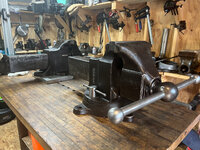
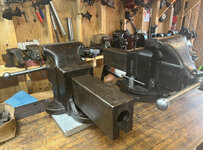
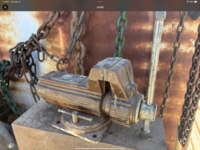
I have worked on both models. Both are heavy. Did major repair work on them both. Normally I don’t work on vises I don’t own but these had to be brought back to life. Brought them to my bridge-less island and then shipped them to Albuquerque. Enjoy the pics.


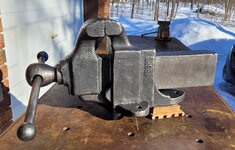

I wonder if this might have a model number 71 instead Of 105. I‘d be happy to add another 105 listing or a number 71. What do you think twagler. KevinHere's a Rae 105 that I just finished putting back together. There is already one shown in the master spreadsheet, but I noticed that the data for mine is quite a bit different, so thought I would post my values as well.
Rae 105
- Jaw Width 5"
- Opens up to 7-1/2" (versus 6" in the spreadsheet)
- Weighs 70.1 lbs (versus 40 lbs in the spreadsheet)
- Country of Origin = Canada
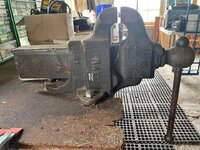
Here is the vise in its as-found condition from FB Marketplace listing photo:
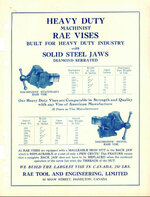
Absolutely beautiful vise, twagler!Here's a Rae 105 that I just finished putting back together. There is already one shown in the master spreadsheet, but I noticed that the data for mine is quite a bit different, so thought I would post my values as well.
Rae 105
- Jaw Width 5"
- Opens up to 7-1/2" (versus 6" in the spreadsheet)
- Weighs 70.1 lbs (versus 40 lbs in the spreadsheet)
- Country of Origin = Canada
Here is the vise in its as-found condition from FB Marketplace listing photo:
It was mounted on a workbench in a log cabin type outbuilding located on a homestead farm just south of Ottawa, Canada. The owner didn't know the history, other than it was there when he purchased the property, and that the original farmhouse dated back to the 1860s.
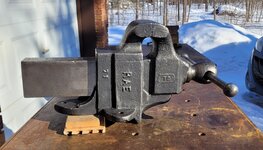
Here are some pictures after a bath in the electrolysis tank. It wasn't actually too rusty, but I find that electrolysis is a good way to remove paint as well as accumulated grease & grime.
I believe that this particular Rae vise dates back to almost the beginning of the company's history in the early 1900s. I found the number "16" stamped (upside down) into the back of the slide, which I believe is likely a date stamp designating that is was manufactured in 1916. The casting is also a bit crude/rough and the model # stamp 105 appears have been a nameplate that was screwed in place on the casting mould rather than being a permanent part of the mould.
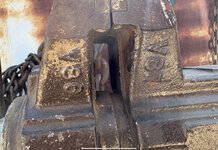
It looks like you guys have figured it out without me that 105 is indeed the model number and that the digits (70 & 71) cast into the other side of the vise are casting mould ID marks. I have a few other old Rae vises with similar markings; a Model 104-1/2 that is marked with 64 and 65 on the dynamic and stationary respectively, this Model 105 which is marked 70/71, and a Model 203 marked 40/45. Interestingly I also have another vise that is almost a twin to this Rae Model 105. It is a "National" Model 205 made by the National Tool & Machinery Co. in Hamilton, Canada that is marked 70/76 (shown above at this posting. There is some speculation that either Rae made rebranded vises for National or vise versa, and that is supported by the fact that they use similar cast mould ID numbers. These vises also look suspiciously like Reed vises from that era, so it sure seems like there was a lot of re-branding or stealing of casting moulds going on back-in-the-day.I wonder if this might have a model number 71 instead Of 105. I‘d be happy to add another 105 listing or a number 71. What do you think twagler. Kevin
Thanks! I really like these American-styled bench vises made by Rae, compared to their other more commonly seen line which is more in the low-profile squat English style made by Record, Paramo, etc. I also tried something new for this Rae 105 for finishing the bare metal. Usually I go for the BLO (Boiled Linseed Oil) finish darkened with some graphite powder, but this time I first sprayed/wiped some Fluid Film Black to fill the pores and provide rust protection, followed by wiping on some wax-based black stove polish for a darker colour and to seal in the non-drying lanolin-based Fluid Film with a top coat finish becomes more of a dry finish. I'm not 100% happy with the way it turned out - it's a bit flat and dull looking to my eye. But is sure is quick and easy! I'd like to try the Sculpt Nouveau patina metal finish that others here use, but there are no Canadian distributers so it's difficult/expensive to get here.Absolutely beautiful vise, twagler!
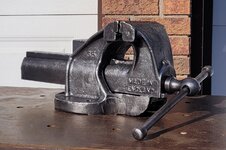


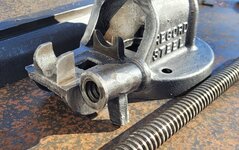
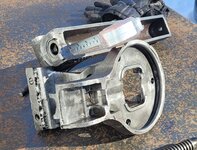
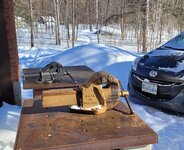
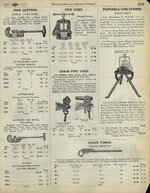
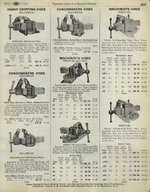
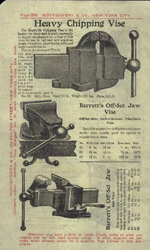
Thanks for sharing the pics here, Kevin! It amazes me how identical not only identical the Prentiss/Barrett 8.5"s are, but even the advertisements between the two separate catalogs are virtually identical. I'd love to see verified proof of whether Prentiss actually made these vises for Barrett or whether Barrett simply copied Prentiss' design (which, it seems, they wouldn't have had any legal barriers from doing)Barrett Machine Tool Co 308-1/2
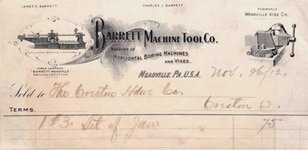
That’s a beautiful letterhead, @CRSINMICH! Thanks for sharing. 1912 was just shortly after Prentiss started using replaceable jaws on its vises tooKMS: This receipt from 1912 shows Barrett selling #3 replacement jaws to a hardware company so at least some of Barrett's vises had them. They cost a pretty penny though, well, 75 of them actually.
That 5 1/2" Record is a beaut. I'm in love!Record Model 35P
- Jaw Width 5-1/4
- Opens up to 6-3/4"
- Weighs 43.2 lbs
- Country of Origin = England
We're still in the depths of winter here, so I've been spending time working indoors putting together some vises again. Here's the latest one, a made-in-England Record 35P. The "P" stands for Plain thread, versus the Model 35 which is the quick-release version.
This model is made of cast steel instead of cast iron, which is the reason it is so light-weight (only 43 lbs) compared the cast iron vises in this same size range. Apparently manufacturing with cast steel is quite difficult compared to cast iron and is more expensive, so you don't see too many of this model. I'm not sure of the age of this particular vise. I purchased it at auction from a local Chrysler-Dodge-Jeep dealership located in Ottawa which was established in early 1960's and closed down last year (real estate in its central city location was too valuable to keep a sprawling car lot open there). I'm guessing that it is probable from the 60's although I think this model first shows up in a 1935 Record catalog.
Since this vise is based on a quick-release version, it uses some of the same odd construction features . The main nut floats between two supports and is located very far-forward compared to standard vises. This is actually a really good design feature which avoids the uneven twisting force of the thread passing through the nut which is imposed in a standard vise with dovetail-mounted nut.
Here's a close-up of the nut and supports. The downward extension on the nut prevents it from spinning (on the quick-release version, it would be a half-nut instead, with a mechanism to either hold it tight to the thread, or to allow it to drop from engaging such that dynamic can be rapidly moved in or out).
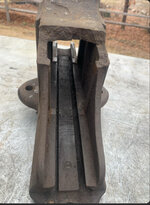
The picture above shows how hollowed out these cast steel vises are. All thicknesses everywhere in the body are no more than about 1/4", incuding the base being just a shell versus a standard vise, and even the jaws are just a shell structure all the way up inside. Apparently that is a requirement of cast steel, I think due to shrinkage/cracking after pouring in the mould if it is too thick anywhere.
Here's a picture showing winter is refusing to give up here. Snow is still about 18" deep throughout the woods. Low last night was -21 degC (-6F) and high today is only -15 degC (+5F). Also just showing off my other Record vise in the foreground. It's a Model No. 6 (with 6" wide jaws. It's my outdoor vise, living clamped to that bench year-round. It's a good vise, but I have to admit to preferring the look of the Model 35 better.
Thanks for looking, Tom

Just to close off this discussion about the similarity between vises made by the National Machinery & Supply Co. and the Rae Machine & Tool Works, both of Hamilton, Ontario, Canada, I finally got around to cleaning off and reassembling the Rae 104-1/2 which was pictured above in this post from two years ago. In addition to the casting marks being the same, I think I have spotted some "ghost letters" just below the RAE cast-in letters, which unless my eyes are deceiving me, are an N and an A (first two letters of NATIONAL). So, I think definitely made by the same company, just switching around nameplates, which I think has been pretty common practice over the years for many vise manufacturers.I have a sneaking suspicion that the National 104-1/2 vise pictured above was made by Rae. Here's a side-by-side comparison with a Rae 104-1/2 vise that I purchased a while back ( Post #87,154). The tell-tales include: (a) identical shape/size/styling, (b) both have the same "cast-in" jaw plates, rather than replaceable jaw plates, and (c) both have the same casting pattern ID number, 65, imprinted on the side of the stationary in exactly the same location.
And yes, they both look exactly like a Reed 104-1/2 which also had the "cast-in" jaw plates, rather than replaceable jaw plates held in with screws.
-Tom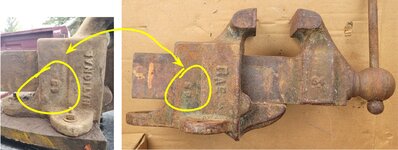


 it is good to mentally check out a bit, when you have a lot of history on one specific topic, before pursuing knowledge on another.