Hurry, hurry, someone please call Caterpillar and tell them to send people out to scratch the surface of those beautiful smooth hard chrome rams! What a bunch of morons, why would they want such highly polished surfaces? An industry wide recall is probably in order.
Anyway, the cross hatch pattern angle is of little consequence, whether is 45 or 15 degrees, is the depth of the valleys and height of the peaks that is important. Had you read your links, you would know this. But you did not. At any angle, the depth would be about the same for any particular cross hatch pattern, so no improvement on the quality of the finish with a different angle should be expected. It is the size of the grit that is important, as finer grits produce finer finishes.
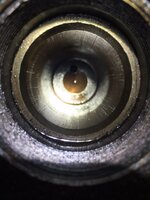
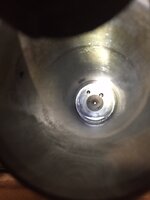
The cross hatch pattern I object is the one left by the 400 grit stone that you like so much. I am pretty sure I mentioned that particular grit size in the post. Any surface finish would be rather rough, for hydraulic applications, if any cross hatch pattern is visible to the naked eye and the cross pattern of the 400 grit is quite visible. If it leaves the surface visibly etched, then I like to call that a scratched surface, you may call it something else if you want. But the good thing about honing is that it removes scratches from the surface; at least that is what it says in one of the links you posted.
I also mentioned that the cylinders and rams have to be highly polished but not to a mirror smooth finish because the surface needs to retain oil to properly lubricate the seal. A mirror finished surface does not retain oil, so there would be seal failure in the future. You probably did not read that either. So that implies that there is some type of micro finish in the surface with enough texture to retain oil. If you insist, we can call this a micro finish cross hatch pattern. There, I gave you one. But this pattern should no be visible to the naked eye. This pattern should also produce a highly reflective surface, in which, if you hold the cylinder over a newspaper, for example, you are able to see the letters reasonably clearly. This is not the type of finish produced by the 400 grit stone you like. A 400 grit produces like a satin surface finish, meaning this that is not very reflective, you may see the letters reflected but these look kind of fuzzy instead of sharp edged. If anyone applies little pressure to the 400 grit it may leave a less marked pattern, but what is the use? Why not instead use a finer grit. I did mention that a 800 grit, whether it is a Flexhone, or anything else, will produce a much better finish suitable for hydraulic applications than what the 400 grit, stones would produce. Why, even a 600 grit finish would be superior to the 400 grit. Just don't over do it. I really can’t understand your fixation with the 400 grit stones. Weird, isn’t it? Better call Dr. Phil…
No one has to super polish the cylinders, but the fact is that the smoother the surface, the better is for the seal longevity. As I mentioned in the other post, a ram seal, like an u-cup, runs compressed against the cylinder wall under load, so the surface finish is very important. So, the smoother the finish, the better the sealing quality and the longer the seals last sealing properly.
If you insist using 400 grit stones, that is your choice, but it is not mine. A 400 grit finish is okay, I guess, if the hydraulic equipment is going to be used like 6 or 7 times per year or so. For hydraulic equipment used daily for many hours, finer and smoother finishes are required.
And anyway, have you, or anyone, ever seen a cross hatch pattern on any ram? Probably not. What applies for cylinder surface finishes also applies for ram surface finishes. In both of these, there are seals making contact with the metal surfaces, so a smooth surface is required in both of these situations when there is movement between the seals and the metal surfaces.
A surface may feel smooth to your finger and yet be rough enough for a seal surface of an o-ring, for example, and this "smooth" roughness can catch the o-ring and make it twist in its groove and cause it to fail in very short order. So the surface has to be smooth enough to prevent this but a 400 grit cross hatch pattern is not smooth enough to prevent this. Look at any new pump piston surface and tell me if the finish on the piston is the same as the finish made by the 400 grit stone. It is not. There is a lot of distance between those two.
And you know what? Smooth files have cross patterns on them and these do abrade the surface of the material it is used on. Maybe a 400 grit cross hatch pattern on a cylinder surface could work like smoother file on the seal edge and wear it away faster than what a smoother cylinder surface finish, achieved with finer grits, could. Just a thought.
If you want to do a video, do one comparing two cylinders of the same type, one with the 400 grit cross hatch pattern that you like so much and one with a polished surface. Test them until failure and lets see which one fails first. Want to guess?
And, if you believe me or not, I could not care less.
I rest my case.




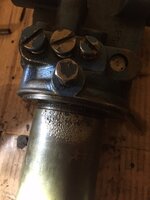
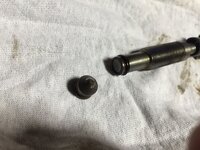
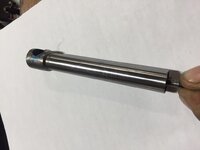
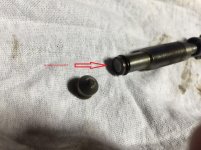
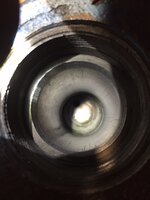
I have no idea what to do here.


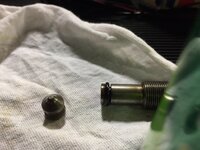
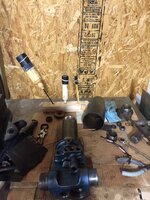
 Any idea where to get an impact bit for that plug? I've never seen one that big.