
You are using an out of date browser. It may not display this or other websites correctly.
You should upgrade or use an alternative browser.
You should upgrade or use an alternative browser.
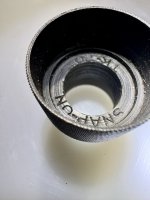
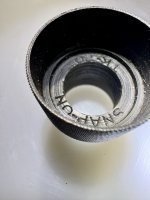
What’sit?
- Thread starter dffay
- Start date

Old Man Roger
Well-known member
Sure you got the TK-20 right? Google image search says that’s not a snap on #
Subsequently I suspect it isnt a saw set.
Subsequently I suspect it isnt a saw set.
Johnny chaos
Well-known member
google lens says fork seal driver? It does sort of look correct?
Old Man Roger
Well-known member
Too small for any forks I’ve ever worked on. And there wouldn’t need to be a smaller diameter towards the middle.
senlow
Well-known member
In the past, Snap-on used the TK prefix on part numbers for torque adaptors. In the dim and distant past, TK was used on distributor tools.
Old Man Roger
Well-known member
Is it threaded inside? If it is it might be part of a puller for motorcycle stators.
senlow
Well-known member
Sometimes I think that the AI's name should be Clod.AI(Claude) wasn't of much help and was suggesting some sort of ignition service tool or part of some type of set for seals etc. It did actually cite this very thread though which I thought was more interesting
3baygarage
Well-known member
Senlow was on the right track. Distributor tool.
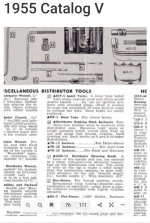
Apparently it's a "Distributor Rubbing Block Surfacer".
Letter H seen and described her in this 1955 catalog. Credit to collectinsnapon.com
Apparently it's a "Distributor Rubbing Block Surfacer".
Letter H seen and described her in this 1955 catalog. Credit to collectinsnapon.com
Old Man Roger
Well-known member
So it’s used to grind the cam that actuates the points?
RTM
Well-known member
I thought the points themselves, thanks for asking for clarity. Outside edge is coarse.So it’s used to grind the cam that actuates the points?
Beerhippie
Well-known member
Oh, man! I completely forgot to surface the follower on my Hall sensor!
Wrench97
Well-known member
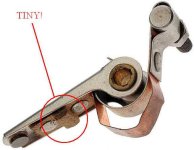
The rubbing block is on the points so it would have to be to clean that up, I don't imagine it was used a lot by the late 50's in shops it was common to replace them as opposed to filing and cleaning up/oiling the wick and rubbing block.
Old Man Roger
Well-known member
I don’t remember them being contoured? Back then I switched to HEI most of the time so my memory of working on points distributors is vague.
Old Man Roger
Well-known member
driftpin
Well-known member
The reason you replace points is that the rubbing block on the distributor wears, why would you want or need to 'surface' one? There is always the points pitting, and wearing because of the capacitor's energy characteristic is changing, causing the pitting on one point or the other. (Charges the capacitor)"Here, kid, catch!"
An electrifying moment.
An electrifying moment.
four.cycle
Well-known member
^ The rubbing block on the breaker points set was a much softer material than the steel cam lobes inside a distributor.
This is the first time I've ever heard of "resurfacing" distributor rubbing blocks or breaker point rubbing blocks.
We sold "cam lube" made specifically for lubricating the steel cam lobes on distributors to prevent premature wear of the rubbing block on the points (NL2 Niehoff - NL2D was the display card of 12 tubes.)
I can't imagine "resurfacing" the rubbing block on a set of points in 1955, because (a) point sets were relatively cheap and (b) in many cases, you could buy the stationary arm and the contact arm separately - the cost of replacing the piece with the rubbing block would be pennies.
Long ago we sold "commutator smoother" tools to re-surface commutators on starters and generators.
This is the first time I've ever heard of "resurfacing" distributor rubbing blocks or breaker point rubbing blocks.
We sold "cam lube" made specifically for lubricating the steel cam lobes on distributors to prevent premature wear of the rubbing block on the points (NL2 Niehoff - NL2D was the display card of 12 tubes.)
I can't imagine "resurfacing" the rubbing block on a set of points in 1955, because (a) point sets were relatively cheap and (b) in many cases, you could buy the stationary arm and the contact arm separately - the cost of replacing the piece with the rubbing block would be pennies.
Long ago we sold "commutator smoother" tools to re-surface commutators on starters and generators.
rust in the eye
Well-known member
If the rubbing block isn't parallel to the cam it might wear quickly on the "high" point hence altering dwell and timing. Explained in the catalog description posted up by 3baygarage. The tool ostensibly put over the cam and rotated, the knurling removing material from the soft rubbing block until full contact is made.
This procedure never occured to me but it makes sense. I only have one engine with breaker points but I'm going to check the contact.
This procedure never occured to me but it makes sense. I only have one engine with breaker points but I'm going to check the contact.