
You are using an out of date browser. It may not display this or other websites correctly.
You should upgrade or use an alternative browser.
You should upgrade or use an alternative browser.
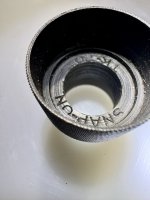
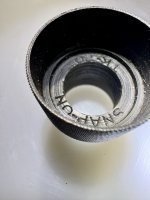
What’sit?
- Thread starter dffay
- Start date

Old Man Roger
Well-known member
Sure you got the TK-20 right? Google image search says that’s not a snap on #
Subsequently I suspect it isnt a saw set.
Subsequently I suspect it isnt a saw set.
Johnny chaos
Well-known member
google lens says fork seal driver? It does sort of look correct?
Old Man Roger
Well-known member
Too small for any forks I’ve ever worked on. And there wouldn’t need to be a smaller diameter towards the middle.
senlow
Well-known member
In the past, Snap-on used the TK prefix on part numbers for torque adaptors. In the dim and distant past, TK was used on distributor tools.
Old Man Roger
Well-known member
Is it threaded inside? If it is it might be part of a puller for motorcycle stators.
senlow
Well-known member
Sometimes I think that the AI's name should be Clod.AI(Claude) wasn't of much help and was suggesting some sort of ignition service tool or part of some type of set for seals etc. It did actually cite this very thread though which I thought was more interesting
3baygarage
Well-known member
Senlow was on the right track. Distributor tool.
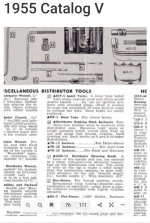
Apparently it's a "Distributor Rubbing Block Surfacer".
Letter H seen and described her in this 1955 catalog. Credit to collectinsnapon.com
Apparently it's a "Distributor Rubbing Block Surfacer".
Letter H seen and described her in this 1955 catalog. Credit to collectinsnapon.com
Old Man Roger
Well-known member
So it’s used to grind the cam that actuates the points?
RTM
Well-known member
I thought the points themselves, thanks for asking for clarity. Outside edge is coarse.So it’s used to grind the cam that actuates the points?
Beerhippie
Well-known member
Oh, man! I completely forgot to surface the follower on my Hall sensor!
Wrench97
Well-known member
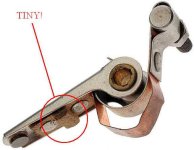
The rubbing block is on the points so it would have to be to clean that up, I don't imagine it was used a lot by the late 50's in shops it was common to replace them as opposed to filing and cleaning up/oiling the wick and rubbing block.
Old Man Roger
Well-known member
I don’t remember them being contoured? Back then I switched to HEI most of the time so my memory of working on points distributors is vague.
Old Man Roger
Well-known member
driftpin
Well-known member
The reason you replace points is that the rubbing block on the distributor wears, why would you want or need to 'surface' one? There is always the points pitting, and wearing because of the capacitor's energy characteristic is changing, causing the pitting on one point or the other. (Charges the capacitor)"Here, kid, catch!"
An electrifying moment.
An electrifying moment.
four.cycle
Well-known member
^ The rubbing block on the breaker points set was a much softer material than the steel cam lobes inside a distributor.
This is the first time I've ever heard of "resurfacing" distributor rubbing blocks or breaker point rubbing blocks.
We sold "cam lube" made specifically for lubricating the steel cam lobes on distributors to prevent premature wear of the rubbing block on the points (NL2 Niehoff - NL2D was the display card of 12 tubes.)
I can't imagine "resurfacing" the rubbing block on a set of points in 1955, because (a) point sets were relatively cheap and (b) in many cases, you could buy the stationary arm and the contact arm separately - the cost of replacing the piece with the rubbing block would be pennies.
Long ago we sold "commutator smoother" tools to re-surface commutators on starters and generators.
This is the first time I've ever heard of "resurfacing" distributor rubbing blocks or breaker point rubbing blocks.
We sold "cam lube" made specifically for lubricating the steel cam lobes on distributors to prevent premature wear of the rubbing block on the points (NL2 Niehoff - NL2D was the display card of 12 tubes.)
I can't imagine "resurfacing" the rubbing block on a set of points in 1955, because (a) point sets were relatively cheap and (b) in many cases, you could buy the stationary arm and the contact arm separately - the cost of replacing the piece with the rubbing block would be pennies.
Long ago we sold "commutator smoother" tools to re-surface commutators on starters and generators.
rust in the eye
Well-known member
If the rubbing block isn't parallel to the cam it might wear quickly on the "high" point hence altering dwell and timing. Explained in the catalog description posted up by 3baygarage. The tool ostensibly put over the cam and rotated, the knurling removing material from the soft rubbing block until full contact is made.
This procedure never occured to me but it makes sense. I only have one engine with breaker points but I'm going to check the contact.
This procedure never occured to me but it makes sense. I only have one engine with breaker points but I'm going to check the contact.
Old Man Roger
Well-known member
I guess it would lessen the time between adjusting the points?
I feel like this tool is required more now than before. So many points I get now have issues such as poor alignment or only a very small contact area on the cam.
I don't know about the labour costs vs parts cost back then but there were and still are people who will sit there filing worn points instead of replacing them.
I don't know about the labour costs vs parts cost back then but there were and still are people who will sit there filing worn points instead of replacing them.
Beerhippie
Well-known member
For the five out of a hundred that still run points.I feel like this tool is required more now than before.
Out of the people using points, obviously not the entire population.For the five out of a hundred that still run points.
When points were current, decent ones were available but now it is mostly cheap garbage with plastic cams. So many I get have the wrong tension too.
Private Lugnutz
Well-known member
With tools like this, in the back of the catalog, in the various special tools and sets sections (valves, brakes, wheels, etc), I always like to look at the evolution. The history of a tool. What did mechanics use before Snap-on (or any other mfgr) offered a "Distributor Rubbing Block Surfacer"? Flexstones wrapped around a socket? A light film of high temp distributor grease on the cam? Or nothing?
Snap-on introduced this in 1955 and it appears in catalogs until 1967. They still had a whole page devoted to miscellaneous distributor tools well into the 70's, but this tool was no longer offered. I am guessing a third party mfgr (such as Clark-Feather, etc) talked them into it.
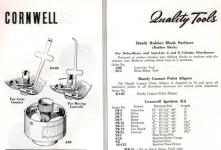
Same story with Cornwell. They introduced it even earlier (1950) and it vanished earlier (1964), too.
Not to be outdone, MAC also offered it (starting in 1952). Note the same ("Dandy") merchandising language...
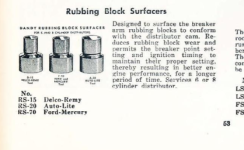
Snap-on introduced this in 1955 and it appears in catalogs until 1967. They still had a whole page devoted to miscellaneous distributor tools well into the 70's, but this tool was no longer offered. I am guessing a third party mfgr (such as Clark-Feather, etc) talked them into it.
Same story with Cornwell. They introduced it even earlier (1950) and it vanished earlier (1964), too.
Not to be outdone, MAC also offered it (starting in 1952). Note the same ("Dandy") merchandising language...
Interesting. So, would there have been a committee that would meet with the Board and somehow convince them that a specific tool was no longer needed or marketable in the changing evolution of autos?
That era still had plentiful points and condensers. I wonder why certain tools were phased in or out.
Just my random neural firings…
That era still had plentiful points and condensers. I wonder why certain tools were phased in or out.
Just my random neural firings…
Wrench97
Well-known member
Interesting. So, would there have been a committee that would meet with the Board and somehow convince them that a specific tool was no longer needed or marketable in the changing evolution of autos?
That era still had plentiful points and condensers. I wonder why certain tools were phased in or out.
Just my random neural firings…
Usually when they stop selling, Snap On use to have overstock/discontinued items sales once or twice a year at a distribution center by invite only fro your route salesman. I bought a set of round handle metric offset box wrenches once for 70% off, still lifetime warranty but there was a catch since they were 18mm - 19mm and if the 18mm end broke no problem you got 16-18mm flat handle replacement but had to buy a 17-19mm if you needed that end......
Beerhippie
Well-known member
I think it's much simpler. A tool stops selling--or sales go way down. Marketing tells management, management tell the factory to stop producing.Interesting. So, would there have been a committee that would meet with the Board and somehow convince them that a specific tool was no longer needed or marketable in the changing evolution of autos?
That era still had plentiful points and condensers. I wonder why certain tools were phased in or out.
Just my random neural firings…
I imagine a tool made to abrade a cotton/Bakelite cam follower would last a looooong time. How many more can you sell once you reach saturation?
Sure, there were points long after sales stopped--but the shops that worked on those rigs already had the tools.
four.cycle
Well-known member
bingo.Usually when they stop selling
Yes, some people actually bought point files to file distributor contact points - clear into the late 1980s (long after points had been made obsolete on most automobiles.)
But in all my years of working in parts, I've never heard of such a widget. (But then, we didn't sell Snap-on, Mac, or Cornwell.) These widgets do not appear in other tool catalogs, and my best guess would be for good reason. This is a "penny wise, pound foolish" thing.
In 1975 the manufacturer's suggest retail price for DR8HV Niehoff contact points (1957-1974 GM V8) was $7.62
We sold them for $4.99.
But we could also sell them the equivalent (generic D106P from Hong Kong) for $1.99.
Wells-Ampco was somewhere in the middle there.
When you go back to 1955, the stuff was significantly cheaper, and (again) for most distributors of the 1940s and early 1950s, you could buy the stationary arm and the contact arm separately.
RoninB4
Well-known member
-A curious tool. I'm old enough to have had a few cars with points, I ran a Volvo P-1800 equipped with points well into 1985. I don't recall ever needing such a tool, I just replaced the points as needed. Yes I still have a point file. An interesting bit of automotive tool history.
RTM
Well-known member
Yes, some people actually bought point files to file distributor contact points - clear into the late 1980s (long after points had been made obsolete on most automobiles.)
I love that points files are still being resurrected from toolboxes. When I started working on cars in 1974? I used a points file more times than I cared to admit. Was working on a used car lot, and many of our vehicles benefitted from a points clean up.Yes I still have a point file.
Now I grab those files anytime I see them in decent shape (often NOS!): disposable, fit in a small space, flexible if you need them to be.
But never smoothed the points block
d42jeep
Well-known member


four.cycle
Well-known member
^ dang! I NEVER see those things anywhere!
and as for "resurfacing rubbing blocks" - again, it's just not something I ever heard of or saw.
and as for "resurfacing rubbing blocks" - again, it's just not something I ever heard of or saw.
Private Lugnutz
Well-known member
Thanks.Interesting.
I agree with this...So, would there have been a committee that would meet with the Board and somehow convince them that a specific tool was no longer needed or marketable in the changing evolution of autos?
That era still had plentiful points and condensers. I wonder why certain tools were phased in or out.
...which is what @Wrench97 also implied here earlier...Usually when they stop selling,
But all of this ensuing discussion to my post discovering the same tool being offered in the catalogs of the other Tool Truck distributors, Cornwell and MAC, in the roughly same timeframe, is about the tool being discontinued, and why.I don't imagine it was used a lot by the late 50's in shops it was common to replace them as opposed to filing and cleaning up/oiling the wick and rubbing block.
I was more interested in, and my point about a third party mfgr idea goes more to, its introduction.
Re-quoting myself...
I am still convinced the historically accurate answer is mainly confined to the latter two notions.What did mechanics use before Snap-on (or any other mfgr) offered a "Distributor Rubbing Block Surfacer"? Flexstones wrapped around a socket? A light film of high temp distributor grease on the cam? Or nothing?
Google Books is chock full of automotive maintenance references from the 1920's through the 1940's. From general mechanics manuals to owner's manuals (especially Ford) to third party manuals and even the tips sections of all kinds of trade mags, including Popular Mechanics, which always contained some pearls of mechanical wisdom and improvisation. There is NO evidence of mechanics, civilian or military, doing anything to rubbing blocks other than making sure the wick is active or a light lube if no wick.
The Post-War Boom saw a sharp rise in the types and variety of automotive hand tools, especially specials. I think it was always a case of replacing the entire component if the rubbing blocks went awry and, despite the relatively low cost, someone convinced Snap-on, Cornwell, and MAC, perhaps others, who convinced some shops, at least for several years, that they could get away with surfacing the rubbing block to extend its useful life cycle.
I was convinced it was some outfit like C-F, KD, KMO, or the like.
But lo and behold - it may have been the electrical side parts suppliers themselves.
This is from 1926!


Go back and review the Snap-on, Cornwell, and MAC catalogs. References to Delco-Remy, etc.
It seems quaintly counter-intuitive to me - look at the starter, magneto, ignition, and distributor company with tips and tools helping the consumer get more mileage out of their parts!
 - but I think this is where the idea for this tool may have come from.
Last edited: