To avoid these ads, REGISTER NOW!

Woodworking 101--Tools and Tips

Craptain

Well-known member
Joined
Apr 18, 2013
Messages
4,028
Location
Tampa Bay FL
I need to get a new feather board that locks in the track. I have a magswitch feather board that I like a lot. But it is limited to the iron part of the table and I can't get it close enough to the blade for small part cuts. The cuts when it is important to keep fingers away.

Sent from my SM-G900T using Tapatalk
 
To avoid these ads, REGISTER NOW!

ALinCarolina

Well-known member
Joined
Dec 29, 2014
Messages
757
Location
NC Piedmont
Hope this thread inspires some other members to get into woodworking and acquire some power tools. But this might be the place to suggest some safety rules for them. The tablesaw is the centerpiece of our woodshops but may be the most dangerous one.

Here are some pointers I give to new owners. Feel free to inject any others.
Never stand in front of the blade or the off-cut (kick-back)
Never let your hand get close to the blade. Maybe not less than 8 to 12"
Use push sticks if you need apply any force nearer than that
Never reach over or behind the blade. Never.
Never push a board with your hand in line with the blade.
Don't put your hand near the blade until the blade completely stops moving
If you can't turn the machine off with your leg/knee, make it so you can
When ripping keep the pressure against the fence at all times
Use or install a riving knife if possible. I added an aftermarket one to my Unisaw
Keep your balance on don't lean over the blade
When using the rip fence the width of the board needs to be less than the length
Use a featherboard whenever possible. I usually use the type with magnetic knobs
Don't rip a crooked board that won't contact the fence evenly or at both ends of the cut
 

ztorres

Well-known member
Joined
Sep 22, 2016
Messages
195
Location
Iowa
To add to what Al said
Unplug the machine when making adjustments to blade
Unplug the machine when adjusting the fence


Zach
 

cheechi

Well-known member
Joined
Feb 29, 2012
Messages
4,384
Location
Triad, NC
antique stores... Just make sure all the parts are there
Thanks Turbo. I was pretty sure that was the right answer, my issue is I've never owned one so it's hard to know if all the parts are there. I might pick up an inexpensive new one to have a frame of reference but your logic is solid.

All For those of you who still have an RAS in use what do you choose for it vs other tools? I've always wanted one but I probably can't justify the footprint for it in my shop.
 

drivesitfar

Well-known member
Joined
Oct 23, 2013
Messages
36,007
Location
Pacific Northwest
Cheechi: take a look back at the beginning of this thread and you'll see Jim's pictures showing planes and their parts and CRS even put up a page out of a book with all the parts. just pay attention when you go to a garage sale and you'll find a good old plane and most of them were not used much so just a little spiffing up and you have one to start using.

AL: i started a safety 101 thread that could really use some of that information. most of it was new to me and maybe because i rarely use a table saw. i haven't had the space for one or made space and i've used skill saw, worm saw, jig saw and miter saws and chain saws most of my 60 years. hence me wanting to learn so i'm not a wood butcherer and maybe more of a wood worker.

thanks for thinking of safety. i've also heard radial saws are even more dangerous. are they? here's the link to the SAFETY 101 thread for those of you that might need some good tips and for those of you that want to share a few like AL just did here is great and also ad over on the 101 thread so especially the NEWBYS can find them.

http://www.garagejournal.com/forum/showthread.php?t=338827&highlight=safety+101

ALL: to summarize some of the Safety 101 thread here are maybe the leading tips mentioned by GJ members so far:

1) THINK
2) SLOW DOWN
3) USE YOUR BEST JUDGEMENT
4) OWN OR BUY PROPER SAFETY GEAR AND USE THEM
5) THINK AGAIN
6) ASK QUESTIONS BEFORE DOING SOMETHING THAT DOESN'T SEEM RIGHT (and not the guy next to you calling you names)


anybody want to add to this list just say so and let us know why. any other good safety tips

have a safe great day everybody!!
 

Craptain

Well-known member
Joined
Apr 18, 2013
Messages
4,028
Location
Tampa Bay FL
Thanks Turbo. I was pretty sure that was the right answer, my issue is I've never owned one so it's hard to know if all the parts are there. I might pick up an inexpensive new one to have a frame of reference but your logic is solid.

All For those of you who still have an RAS in use what do you choose for it vs other tools? I've always wanted one but I probably can't justify the footprint for it in my shop.
I don't own a RAS but have access to a couple if I need to. The last time I used one was cutting dado's. I don't mount dado blades in my table saw as I don't have a sacrificial insert for it.
But honestly I don't find any use for a RAS that I can't do by some other method. Even if I had the space I am not sure I would buy one.

Sent from my SM-G900T using Tapatalk
 

86turbodsl

Well-known member
Joined
Jul 1, 2005
Messages
6,556
Location
Michigan
Thanks Turbo. I was pretty sure that was the right answer, my issue is I've never owned one so it's hard to know if all the parts are there. I might pick up an inexpensive new one to have a frame of reference but your logic is solid.

All For those of you who still have an RAS in use what do you choose for it vs other tools? I've always wanted one but I probably can't justify the footprint for it in my shop.
I will never be without a RAS. A properly setup vintage RAS can be an incredible tool, for the right operations. Crosscut dado's where you can see the operation while you make it. Any crosscutting really they excel at. I save my PM66 for ripping and do most crosscutting on the RAS. I currently have 3, a couple of vintage 10" machines, and a giant 16" Delta. Avoid the cheapies and any Sears/Crapsman RAS if you can help it. Iron is king here, the early Dewalts and Deltas are the only common ones you're likely to see daily. There are others that are good though. A Dewalt will keep it's setup when the cheapie Sears will not. A Monarch Unipoint is my holy grail. :)

Sent from my SM-N910T using Tapatalk
 

turbowoodworker

Well-known member
Joined
Mar 18, 2012
Messages
3,531
Location
Apex NC
RAS---

I never had one until recently. I kept seeing how cheap they are on CL so I got one. A nice CMan in great shape for about $125.

Now I have a lot of WW experience, especially with my go to saw the TS (and now with my new addition, a 5 HP 22v Delta WITH the new riving knife- much safer saw) but I never realized how dangerous the RAS really is. On first pass, the RAS just looks like a big sliding miter saw right? Well the blade spins in the opposite direction.The problem with the RAS is the direction of the saw blade. When it cuts, it digs into the wood and actually accelerates through the cut towards YOU!! If you didn't read the safety info, (it's available on line if you buy a used saw), and your hand is holding the workpiece in line with the blade-- well that is a big ouchee! The miter saw spins in a way that pulls or exerts force on the wood to pull it towards the fence, not your hand.

This is an exceptional safety issue when ripping on the RAS as the workpiece is actually pulled into the blade. This can pull your hands closer to the blade than you ever intended. And that can happen FAST.

General wisdom now is to never rip with the RAS. And that means you need a second saw for ripping...the TS. So that begs the question why not just get the TS? And that is probably the right answer. And that is why the RAS has fallen out of favor and not made nor marketed to any large degree. And also why there are so many good deals on CL.

Now I have an RAS and the room for the saw, so now I have a dedicated dado machine setup for 23/32" plywood (yah 3/4" ply is not 3/4", surprise, surprise). It works great for that and I never have to adjust it. But I also know to keep my hands out of the front of the blade even when I think I have a firm grip on the yoke.

Bottom line, there is a place for an RAS, especially in a shop where it can have a dedicated single use. Just know your saw, its characteristics and limitations...like any power tool.

Be Safe!
Rick
 

86turbodsl

Well-known member
Joined
Jul 1, 2005
Messages
6,556
Location
Michigan
I have to slightly disagree with Rick on this. The reason RAS fell out of favor is they are expensive to make properly. The CRAFTSMAN RAS is the primary reason they have such a bad name. There is a proper blade for a RAS, that has negative rake. Those don't self feed. If you're using a table saw blade on a RAS, you're asking for trouble. The reason there's so many RAS on craigslist is they are crappy craftsman. I keep an eye out for them on CL, and probably 95% of them are craftsman, flimsy junk, and 3% are old roundtop dewalts or delta, and the remaining 2% are other. I cannot overstate this: GET AN OLD DEWALT/DELTA and properly set it up and tell me again that RAS's don't have a place. Crosscutting of long boards on a table saw is a very tough chore. Not on a RAS. Sure you can setup a hand saw, cut to a close dimension, but then you still have to get to your final dim, and without a miter or RAS, that can be tough to be accurate.

Sent from my SM-N910T using Tapatalk
 

drivesitfar

Well-known member
Joined
Oct 23, 2013
Messages
36,007
Location
Pacific Northwest
Turbo: i've never wanted to own a RAS (RADIAL ARM SAW) for those of you that didn't know. i actually bought an old delta and had room on my desk and after reading up on it i decided it might be an accident waiting to happen for me.

after AL's safety tips on a table saw i'll have to learn quite a bit more before using one regularly.

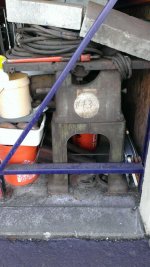
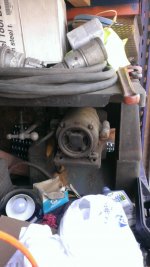
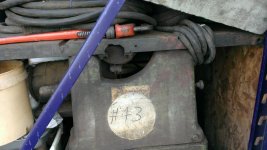
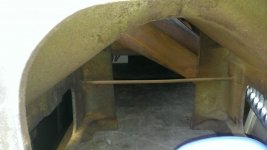
ALL: speaking of table saws i found this old WALKER TURNER that works, but could use a lot of spiffing up. anybody own one and how do you like it. anybody restored one? sorry for the terrible pictures. if anybody would like better pictures to maybe help me know what i own i'm hoping to move the saw out of it's cubby hole i made for it next week and i can take a few pictures so just ask.

cheers all
 

Attachments

  • WP_20160630_020.jpg
    WP_20160630_020.jpg
    149.5 KB · Views: 88
  • WP_20160407_063.jpg
    WP_20160407_063.jpg
    140.7 KB · Views: 77
  • WP_20160630_019.jpg
    WP_20160630_019.jpg
    145.7 KB · Views: 78
  • WP_20160407_069.jpg
    WP_20160407_069.jpg
    109.1 KB · Views: 80

86turbodsl

Well-known member
Joined
Jul 1, 2005
Messages
6,556
Location
Michigan
Drives, the answers you seek on the WT saw are contained at owwm.org. I'm sure there's a few restored over there.

Sent from my SM-N910T using Tapatalk
 

ez-duzit

Well-known member
Joined
Jun 24, 2013
Messages
5,096
Location
Marina del Rey
...Never let your hand get close to the blade. Maybe not less than 8 to 12"...
Don't put your hand near the blade until the blade completely stops moving
If you can't turn the machine off with your leg/knee, make it so you can
...

To add to what Al said
Unplug the machine when making adjustments to blade
Unplug the machine when adjusting the fence...

I must take exception to these tips.

When ripping against a fence, it is an every day occurrence for your hand to get close to the blade. The keys to safety are to always know where the blade and your fingers are, to never place your hand or fingers in-line with the blade, and to keep several fingers wrapped around the fence (to guide your hand) when ripping stock as narrow as about 1". For narrower stock use a push-stick. For short, narrow stock I use a block of plywood cut to both push and hold down the stock.

When making blade or fence adjustments (something one does very frequently throughout the day) it is perfectly safe to leave the saw plugged in. However when changing blades it is recommended to unplug (though I don't).

None of my 4 table saws can be turned off with my knee.

------

Regarding radial arm saws, I will always have one. They are extremely handy for crosscutting. Mine always remains set to produce precise 90* crosscuts. It is NOT a substitute for a table saw. The key to safety is to always brace yourself for the self-feeding nature. And to use a carbide blade whenever possible (same on table saw).
 
Last edited:
OP
J

jimreed2160

Well-known member
Joined
Aug 7, 2016
Messages
3,589
Location
Tallahassee FL
Cheechi--Your questions about how to acquire a handplane are great for general discussion. Having acquired hundreds of handplanes, I consider myself qualified to pose a few answers.

I think the most important ingredient for success with handplanes is knowledge. With sufficient knowledge, a woodworker can produce good work with almost any handplane.

This handplane knowledge includes the ability to evaluate tools and that is the main issue with used planes. Whether antique shop, yard sale, or swap meet, the issues are the same. Is the plane complete? Is it defect free? Was it a good quality product when made? Is it appropriate for my tasks? Is it a good value? Well that evaluation takes knowledge. Sometimes used planes are bargains and sometimes they are priced to the moon. So there is a conundrum. Without knowledge, buying used is risky. Used tools generally need to be refurbished for use. That refurbishment also requires knowledge.

Buying a newly manufactured plane costs more but has less risk. The catalog description educates you on the intended use and the product comes ready to use. But new planes are pricy. Buying down risk costs money.

So there are my two strategies--buy cheap and learn or buy expensive and go to work. I have used both of these strategies myself. My original strategy was education and I bought loads of inexpensive iron. The cost of a few college credits will teach you a lot about handplanes.

And then there is the new. My first new plane was a Lie Nielsen scrub plane. It is one of my favorites and I use it frequently. It is a wonderful tool Many vintage scrubs have passed through my hands but none come close to the quality of the LN.

I bought a HF plane for $19. It is sturdy and tight. The blade was flimsy so I made a new one. That plane performs as good as any money can buy. Planes do not have to be expensive to work well. BUT the ww needs to understand planes to know how to coax good performance from non-premium planes.

Bottom line--If you have a trusted source of vintage planes, buy one in confidence. If you find an inexpensive vintage plane, buy it and learn. If you want to get to work, buy a new premium plane. Get some clear construction lumber and start making shavings. Jump in there somewhere and begin accumulating that knowledge. The learning curve is small and wispy shavings are just around the corner.
 

drivesitfar

Well-known member
Joined
Oct 23, 2013
Messages
36,007
Location
Pacific Northwest
86: thanks for the tip on the OWWM site but i joined years ago and it wasn't nearly as active as this site. some very handy guys over there that is for certain, but a lot of them joined here so one of the reasons we have a Woodworking 101 thread is to get GJ's members ideas on this site. i might go over there to take a peek, but it used to take a week or two to get an answer on a simple question where here it might only take a few minutes if you ask on the right thread or know the right guy to PM.

EZ: i know a lot of guys that swear by their RAS like you do, but the SAFETY information needs to be plastered all over those saws for a new guy to use one safely.

i have to ask since i don't have room to set up one table saw tell us what is the advantage of having more than one and in your case 5? i would maybe be able to answer that about a vise or grinders when members ask me why you'd need more than one, but you'd need a warehouse or huge shop to have 5 table saws with all different set ups. do tell?

thanks
 

ez-duzit

Well-known member
Joined
Jun 24, 2013
Messages
5,096
Location
Marina del Rey
...
EZ: ...since i don't have room to set up one table saw tell us what is the advantage of having more than one and in your case 5?...

Thought I said 4.

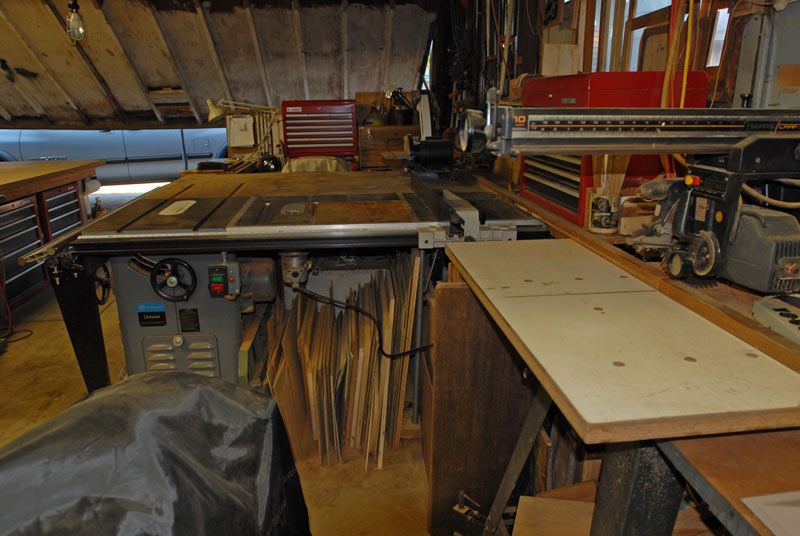
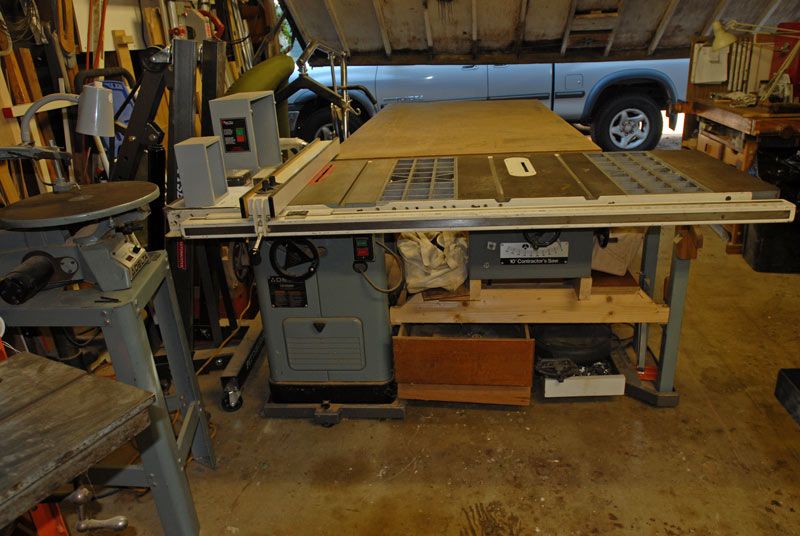
But to answer your question, 1 has a 60(?)-tooth x 10" carbide crosscut blade; 1 has a 24(?)-tooth x 10" carbide ripping blade; 1 has a 1/2" x 8" wide carbide dado (this saw is built onto the ripping table saw); 1 has a 40-tooth x 4" ultra-narrow-kerf carbide blade (for doing very small and precise work). This is all so I never have to make blade changes (which also likely would require resetting the fence measurement cursor).

shop-1_zpswjliawky.jpg

shop-2_zpsn3iobisa.jpg

sears-saw-1_zps55dcda34.jpg
 
Last edited:

drivesitfar

Well-known member
Joined
Oct 23, 2013
Messages
36,007
Location
Pacific Northwest
EZ: sorry i guess i added your RAS as the 5th one. :dunno:

WOW is all i can say and feel free to post up more of your shop projects, how to's and other stuff as you can.

thanks
 

ez-duzit

Well-known member
Joined
Jun 24, 2013
Messages
5,096
Location
Marina del Rey
Though I love photography, it seems I'm always too preoccupied with getting the job done to think of stopping to take photos. Then, once the job is finished, the priority seems to always be getting paid and moving onto the next job. Also, when my last laptop crashed it took all my scans with it. But there might be a few more photos around.

BTW, that small, ancient Sears table saw is far too heavy to really be considered portable. But it's what I have. It is extremely precise and is used for my model building.

cub-41_zpsp9aoslfl.jpg
 
Last edited:
OP
J

jimreed2160

Well-known member
Joined
Aug 7, 2016
Messages
3,589
Location
Tallahassee FL
I am really digging this thread. Keep those posts coming. Here is a followup on my previous plane post. Here is a proposal for some really inexpensive plane knowledge.

So I was an Education major and learning has always been close to my heart. Training and experience will provide an average ww with enough knowledge to use planes effectively. The question is how to acquire that knowledge and here is one way. Go to HF and get one of their handplanes. For $15 you will receive a #3 size plane. Here is mine alongside a Stanley Bedrock #603.

DSCN0955.jpg


This plane comes with a blade that is 1/16" thick. It is not good for precision work but is plenty good for training. Here is the blade along with two I made. Mine are 1/8" thick and are harder. One is ground on a radius and can be used as a scrub. You can see the original blade in the center. It is thinner than the others.

DSCN0962.jpg


If you do not know how to sharpen, go on line and learn that. This blade is good to start with. Sharpening skills can be part of your education. If you know how to sharpen--good--you are ahead of the game. Once you sharpen this blade, get some construction lumber. Look for clear grade--remember our knot lesson yesterday. Twists and bows do not matter but knots are a no-no. Chop off a 24" section, clamp it in your bench, and go to town.

If you do not have a bench, improvise. Using the plane will help you understand both the importance of a bench as well as the type of bench you need.

By now you should have a plane with a blade that is sharp enough to shave hairs from your arm. You should have some soft construction lumber. And you should have a bench. Adjust the blade so that it is EVENLY exposed through the mouth. It should just barely touch the wood. You are looking for some whisper thin shavings. Now you can do this.

DSCN0960.jpg


You are on your way to acquiring valuable plane work knowledge. Some of us missed shop class. Or training from dad. Some of us do not live close to a handtool woodworker. Don't despair. You can teach yourself. It is easy and it is fun. Then you can teach your your kids, your grand kids, and anyone else who wanders into your woodshop. The student can quickly transform to teacher. So get busy and make some shavings. You can do it. :3gears:
 

turbowoodworker

Well-known member
Joined
Mar 18, 2012
Messages
3,531
Location
Apex NC
86 Turbo,
I can't argue with your points. What is interesting is I put a -5* Freud blade on my RAS and still experience some pull or self feeding. Also, the blades that came with the saws originally were not negative rakes blades.
The bottom line we agree on is how good the RAS is for cross cutting.
Not my favorite saw, but I won't get rid of mine either.
 

ALinCarolina

Well-known member
Joined
Dec 29, 2014
Messages
757
Location
NC Piedmont
I must take exception to these tips.

When ripping against a fence, it is an every day occurrence for your hand to get close to the blade. The keys to safety are to always know where the blade and your fingers are, to never place your hand or fingers in-line with the blade, and to keep several fingers wrapped around the fence (to guide your hand) when ripping stock as narrow as about 1". For narrower stock use a push-stick. For short, narrow stock I use a block of plywood cut to both push and hold down the stock.

When making blade or fence adjustments (something one does very frequently throughout the day) it is perfectly safe to leave the saw plugged in. However when changing blades it is recommended to unplug (though I don't).

None of my 4 table saws can be turned off with my knee.

------
Yeah, you are probably right about the distance, that's why I said maybe. I went conservative because I didn't want to feel guilty about someone getting injured. ;)
I push rips through with my hand but if it gets down to 5' or less out comes the push stick. The thought of ripping a one inch strip with my hand between the blade and fence though gives me the willies. And good point about curling some fingers over the fence.

My saw has similar switch to the one in your photo and in the same spot and I touch it with my thigh or knee to turn it off. It's magnetic so just a touch is all it takes and I don't have to take my hands off the work-piece. I have seen photos of a paddle type board hanging down over the switch to make if easier but I don't have any trouble with out such a board.

Here is another tip I thought of: When pushing a rip with either your hand or a push stick always keep a clockwise torque applied to the board in addition to pushing forward, down and towards the fence. This helps keep the far part of the board against the fence. Kick-back happens when the part of the board that has already passed the blade moves back to the left a little and the teeth of the blade that are rising and moving toward you grabs it and throws it at you.
Adding a little silicone caulk or rubber to the end of your push stick helps it grab the work-piece and able to apply this pressure to the work-piece.

I admit I don't unplug my machine when changing blades and such. But not saying I shouldn't
 
To avoid these ads, REGISTER NOW!

cheechi

Well-known member
Joined
Feb 29, 2012
Messages
4,384
Location
Triad, NC
Jim thanks for the comparison.
Could any #3 Stanley serve as a replacement blade for the HF plane? If so are there brands or sources you'd recommend over others?

As far as the RAS, the answers I got were exactly what I was expecting. I have wanted one for the 'wow' factor in my shop for years, but also wouldn't really want to use it for small cuts or small pieces that can be thrown unexpectedly. They're hard to get dust collection to cooperate. But they do dado better than most other tools I currently have. I have a lot of router bits but not as many that can really be used for dadoes, at least the last few cuts I have needed I have not had the right bit.

I wish I had seen any for $125 or even twice that, ever. The asking price around here is closer to $1000. I'd love to find an old Dewalt (grey & black) 12" whether or not it needed restoration, if I had all the parts would be enough for me. But they are effectively unicorns now, except the floor model one Sears has been trying to sell for close to a decade I only know of 3 others offered in the past few years.

As far as sharpening. this is how I do it.
<iframe width="560" height="315" src="https://www.youtube.com/embed/n5QDKMrGrqI" frameborder="0" allowfullscreen></iframe>
 

turbowoodworker

Well-known member
Joined
Mar 18, 2012
Messages
3,531
Location
Apex NC
Cheechi,
I see you are in the Triad. I got myRAS in Greensboro three yrs ago for $125.
I just did a search and there are dozens to choose from. In Greensboro and Thomasville, several ranging from $75-140. There is even one big steel Delta that 86turbo is talking about near Charlotte for $500, but it is 3 phase. Some look really trashed. I would stay far away from the CMan electronic ones.

I have never seen that HF plane before but the blades I doubt are interchangeable. It is the only one I've ever seen with those two cuts at the top. Not sure they would get in the way of a standard plane. But a Stanly type blade would definitely not work in the HF.

Begs the question for Jim. What are you making your blades out of? Are you tempering them? I know you can buy thicker, harder blades from Hock but they are really pricey.
 

86turbodsl

Well-known member
Joined
Jul 1, 2005
Messages
6,556
Location
Michigan
86 Turbo,
I can't argue with your points. What is interesting is I put a -5* Freud blade on my RAS and still experience some pull or self feeding. Also, the blades that came with the saws originally were not negative rakes blades.
The bottom line we agree on is how good the RAS is for cross cutting.
Not my favorite saw, but I won't get rid of mine either.
Interesting. I've never had one self feed . I suppose it is possible. The Woodworker II is the one i keep getting advised to get. I don't even have a neg rake blade on mine and they still don't self feed. I still stiff arm them just in case.

Sent from my SM-N910T using Tapatalk
 

CRSINMICH

Well-known member
Joined
Aug 15, 2015
Messages
2,397
Location
Southeastern Michigan
MYSTERY PLANE​
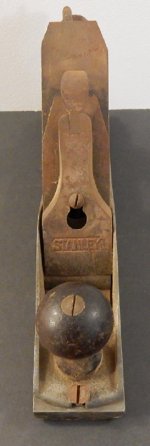
Last spring, I saw a grainy photo of 20 or 30 tools piled in a heap at a nearby estate sale. I could only see part of a plane but I thought it might be a 4 1/2. When I found it I was quite surprised at what I saw. I was able to identify it after I got home. I thought it might start a discussion to have people guess at it.

WOULD ANYONE LIKE TO IDENTIFY THIS PLANE? Hint: It's wasn't made to be a molding plane​
If no one guesses correctly, or if there is not much interest, I'll just tell you.
 

Attachments

  • Mystery plane 4.jpg
    Mystery plane 4.jpg
    81.4 KB · Views: 89
  • Mystery plane 3.jpg
    Mystery plane 3.jpg
    142.1 KB · Views: 91
  • Mystery plane 2.jpg
    Mystery plane 2.jpg
    72.4 KB · Views: 96
  • Mystery plane 1.jpg
    Mystery plane 1.jpg
    69.1 KB · Views: 92
Last edited:

CRSINMICH

Well-known member
Joined
Aug 15, 2015
Messages
2,397
Location
Southeastern Michigan
jar: I did teach myself to sharpen saws but I found out I don't really like doing it. It is nice to have well functioning saws though. I even made a sharpening vise. Pretty simple thing to make.
 

cheechi

Well-known member
Joined
Feb 29, 2012
Messages
4,384
Location
Triad, NC
Sorry you're right. What I meant was other than the CM ones, RAS is pretty rare. Out of those, a decent one that I can find info about to know if it's worth buying is rare too.

One of these days a top tier 12 or 14" one is going to pop in my lap when I can't afford it.
 

Craptain

Well-known member
Joined
Apr 18, 2013
Messages
4,028
Location
Tampa Bay FL
So does anyone else here sharpen their hand saws?

I have but don't make a habit of it. I do touch them up once in a while but have only once done a full sharpening. I honestly don't have the patience. But I am getting to the stage where a couple of my saws need it. Now I have to make a financial decision whether to do the job myself or send it out.

Sent from my SM-G900T using Tapatalk
 

jar944

Well-known member
Joined
Jul 26, 2010
Messages
5,912
Location
Northern VA
jar: I did teach myself to sharpen saws but I found out I don't really like doing it. It is nice to have well functioning saws though. I even made a sharpening vise. Pretty simple thing to make.

I have but don't make a habit of it. I do touch them up once in a while but have only once done a full sharpening. I honestly don't have the patience. But I am getting to the stage where a couple of my saws need it. Now I have to make a financial decision whether to do the job myself or send it out.

Sent from my SM-G900T using Tapatalk

I agree it's a bit monotonous, but most of the vintage saws I've picked up were very dull. Most have needed significant jointing before they could be sharpened.
 

CRSINMICH

Well-known member
Joined
Aug 15, 2015
Messages
2,397
Location
Southeastern Michigan
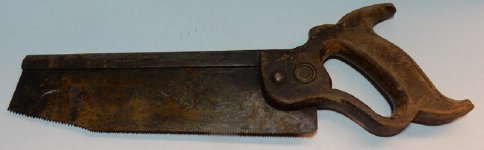
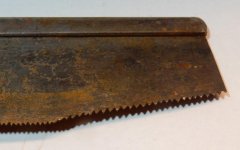
jar: I collected a lot of vintage saws that needed sharpening just to have something to practice on. What do you think of this one? I've never seen another one like it.
 

Attachments

  • Jackson back saw left before.jpg
    Jackson back saw left before.jpg
    91.1 KB · Views: 83
  • Jackson back saw odd teeth.jpg
    Jackson back saw odd teeth.jpg
    56.1 KB · Views: 76
  • Jackson back saw name after.jpg
    Jackson back saw name after.jpg
    85 KB · Views: 79
Last edited:
OP
J

jimreed2160

Well-known member
Joined
Aug 7, 2016
Messages
3,589
Location
Tallahassee FL
CRS--That plane looks to me like a Stanley #5 bench plane that has been modified by a patternmaker. There should be more bottoms with matching blades. Most patternmaker sets I have seen have up to ten or more bottoms--all having a graduated radius.

BLADEMAKING
Here is the short version of plane blade making. I purchased a load of Stanley #46 skew dado combination planes in the late 1990s. Blades were scarce and the blades I had were pretty toasty and rusted. So, says I, let's make some cutters. How hard can it be? Well, as it turns out--VERY. The skew dado plane cutters are some of the hardest plane blades to reproduce. All of that is a whole different subject. Back to easy blades. Go to your favorite industrial supplier. I used MSC. Buy some O-1 precision ground flat stock. Make sure it is close to the dimensions of what your blade is. Cut it using a cut off wheel in an angle grinder. Use safety glasses, ear muffs, breathing protection, AND an apron. I set my tee shirt on fire before I learned that tip.

Many blades and cutters can be made with just an angle grinder and a bench grinder. The Stanley bench plane slot can be done with the angle grinder and a drill, but I use a small milling machine.

Once your blade is cut to size, bevel the blade and clean up the rough edges with a file. The only metalwork you can do after hardening is final sharpening.

Then heat treat your blades. The Rockwell scale is helpful here. Stanley bench plane blades are about RC 52-54. That is pretty soft. Since I use my planes in hardwood, I wanted something a little harder so I made mine RC 58-60 and even RC 60-62. I never pushed O-1 further than that. Too hard and the edge crumbles. Remember I did this as a business. I made blades in batches of about 100 and sent them out for professional heat treating. Those guys use special atmosphere ovens and carefully controlled quenching. It worked exceptionally well for me and added only $1 to the cost of each blade.

But you can do heat treating in your driveway by using olive oil or turkey fry oil to quench. Use those because they smell better. Search on line for tempering info.

Once your blade is hard and also tempered, you can grind the final edge. Pre-heat grinding uses gray wheels. Post heat grinding uses white or pink wheels. Also use plenty of water. O-1 steel temper changes about 350-400 degrees. Water boils at 220. I used that as my safety point and quenched when the blade got hot but before it caused the quench water to sizzle. Final grinding can take awhile.

Summary of process
1. Acquire O-1 flat stock
2. Cut and shape. Grind bevel with gray wheel.
3. Harden by heating to 2000 degrees and quenching in oil.
4. Temper from brittle hard to user hard by heating to a range of 450-650 degrees.
5. Final bevel grinding using pink or white wheel
 
OP
J

jimreed2160

Well-known member
Joined
Aug 7, 2016
Messages
3,589
Location
Tallahassee FL
CRS--Interesting saw. I am sure others will chime in. Looks to me like previous owner modified the tip so he could start a kerf his way. I use the heel of the saw for that but guess he liked to use the tip.
 

CRSINMICH

Well-known member
Joined
Aug 15, 2015
Messages
2,397
Location
Southeastern Michigan
Jim: In fact, that plane is for patternmakers. This one was done by a guy named Phelps in the late 50's I think. I hope he got releases from Stanley. I wondered how common this type of plane was. Now I know.

I thought the same thing about that Jackson saw. It's curious that the Starter Teeth are much coarser than the cutting teeth. It would be hard to set too. The coarse front teeth would have to have the same set as the finer teeth. That's probably why that style didn't catch on.

I'll get right on that blade making thing. Could probably knock out a dozen or so before dinner.
 

Attachments

  • Phelps-Stanley core box left exploded illustrated.jpg
    Phelps-Stanley core box left exploded illustrated.jpg
    71.9 KB · Views: 75
  • Phelps-Stanley core box front.jpg
    Phelps-Stanley core box front.jpg
    95.4 KB · Views: 67
Last edited:

jar944

Well-known member
Joined
Jul 26, 2010
Messages
5,912
Location
Northern VA
jar: I collected a lot of vintage saws that needed sharpening just to have something to practice on. What do you think of this one? I've never seen another one like it.

Its was certainly modified by the owner, though I can't come up with a reason other than the saw plate suffered serious damage and this was an attempt at salvaging it. The teeth on the front are filed at a coarser lower tooth count and not done particularly well.
 

CRSINMICH

Well-known member
Joined
Aug 15, 2015
Messages
2,397
Location
Southeastern Michigan
jar: The other teeth weren't done especially well either. It would take an entire retoothing to get it right again. That's why it's now officially a DECORATION in my shop.
 

Attachments

  • Jackson back saw left after.jpg
    Jackson back saw left after.jpg
    100.1 KB · Views: 59

86turbodsl

Well-known member
Joined
Jul 1, 2005
Messages
6,556
Location
Michigan
Sorry you're right. What I meant was other than the CM ones, RAS is pretty rare. Out of those, a decent one that I can find info about to know if it's worth buying is rare too.

One of these days a top tier 12 or 14" one is going to pop in my lap when I can't afford it.
The beauty of ras is not many folks want em. Prices are cheap. My 16in delta was 150.

Sent from my SM-N910T using Tapatalk
 

ez-duzit

Well-known member
Joined
Jun 24, 2013
Messages
5,096
Location
Marina del Rey
...When pushing a rip with either your hand or a push stick always keep a clockwise torque applied to the board in addition to pushing forward, down and towards the fence...

I have never used or even heard of torquing the stock.

Just keep it pressed against the fence--that's all you need to do.
 

drivesitfar

Well-known member
Joined
Oct 23, 2013
Messages
36,007
Location
Pacific Northwest
Jar: i haven't sharpened any of my old handsaws yet, but i picked up a WTF is this tool a few weeks ago and found out it's for setting the KERF on the saw blades so while researching it i watched a few YOUTUBE videos on how to sharpen them. i like the lines you have on the board you use so you know what angles to hold your file. how often does it take you to sharpen a saw and any tips to provide? i also own maybe 100 files and what's the best way to tell if one is sharp or dull or good for sharpening?

Jim: loving all the plane instruction posts. Well done. while we are talking about planing wood can you and maybe the other members mention where they get their quality wood?

ALL: speaking of acquiring wood any thoughts on how to use get lumber or boards out of a good old tree? anybody just start planing a log or branch to get some quality wood?
 

Autonomous

Well-known member
Joined
Dec 26, 2015
Messages
66
@Drivesitfar Check out YouTube for "homemade band saw mill" and you can see some great videos of various techniques for getting usable wood from logs. Finding a suitable place to store the wood properly while it dries can be a chore, though.

Sent from my XT1254 using Tapatalk
 
OP
J

jimreed2160

Well-known member
Joined
Aug 7, 2016
Messages
3,589
Location
Tallahassee FL
Drives--I posted some info earlier on pulling lumber from logs. But this thread is going at 90 mph...

First timber is squared up. Then boards are pulled off the sides. The very center is juvenile wood and is not stable so it is used for large timbers, RR ties, etc. That is why it is called a cant. You just can't get any more lumber from it.

So what does this mean to the average woodworker? It means buy your lumber. I sawed up some boards once and it was a mess.

Let's set the scene. I lived north of Atlanta in Marietta, GA, an area known for dogwoods. They are pretty trees but don't live much longer than 30-40 years and I had a dying one in my yard. Hmmm...maybe I can make some wood. So I cut it into 3 foot sections. Then my friend the landscaper brought me a large dogwood log. I have a Jet bandsaw with riser and it will cut about 14". So ww me just throws these logs thru and squares them up. It was a freekin mess. And it was dangerous. The table was not set up for the logs. I cut off slabs and the heavy log just fell off the end. I pulled off stacks of pretty 4/4 (1 inch) dogwood boards. They were cream and brown and red and yellow. I was covered in sawdust and bark. It was all over the shop and all in my hair.

I stickered up the wood and let it dry in the basement for two years. Dogwood is tightly grained and was used traditionally for loom shuttles because it does not splinter. But the pretty wood turned to a dull brown with no real grain pattern. I cut wood for hours and had two piles. It took everything I had to make a Shaker style bedside table. It looked really nice but not special. I gave it to my landscaper buddy.

Fast forward ten years. I moved to Florida. One day my ww buddy was looking in my yard. "Hey, Jim. What are you going to do with that big cherry tree in your yard?' My reply was, "Huh?" And sure enough, there was a 60 foot tall cherry tree right outside my bedroom window. It was too large to get my arms around. I estimated 900 good board feet of creamy N Florida cherry. The tree guys had a crane and they were instructed to cut it into 9 foot sections. The first ones had a hole in them and were worthless. But I kept hoping. Then they found a solid section. WooHoo! Lumber at last. But noooooo. The next two sections had holes. So there was my huge cherry tree on the ground. Rotted from the top and the bottom with one good section in the middle. I gave it to the tree guys because hiring a truck and a sawyer would not make sense for such little wood.

Lesson learned.
My advice is to find a good supplier and buy your wood. It is lots cheaper (and safer) in the long run. Going from log to lumber is hard work and takes specialized equipment.
 
To avoid these ads, REGISTER NOW!
Top Bottom