Saw sets and saw geometry
My grandfather had a master's degree in math and taught HS math, trig, etc before becoming a superintendent of schools. He loved woodworking and I think it was because ww is total immersion in solid geometry. Math, angles, and shapes abound in ww and in ww tools. That is especially true with handsaws. This is an area where I am a novice and it seems to me sometimes that I know a little and don't know a lot. So here is a brief tutorial on saw tooth terminology. Collectively, these characteristics work together to determine how a saw performs.
PITCH--Saw pitch, measured in points per inch (PPI), is really an indication of the depth of the gullet. Large gullets carry away lots of sawdust and small gullets carry away small amounts of sawdust. Aggressive saws have low pitch and fine work saws have high pitch.
RAKE--Rake is the angle of the cutting edge relative to the saw plate. Zero rake is 90 degrees to the plate, or straight up and down. Leaning forward is positive rake and leaning backward is negative rake. Positive rake is for aggressive cutting and makes the saw hard to use. More negative rake retards cutting but makes the saw easier to move.
FLEAM--Fleam is the angle of the cutting face. No fleam means the tooth cutting edge is perpendicular to the saw plate. It is like a little chisel which addresses the wood head on. More fleam turns the chisel edge into a knife edge that slices more instead of gouges.
SET--Set is the angle that the tooth projects sideways from the plate. Rip saws typically have no fleam and no set. They are like little chisels stacked in a row and each one gouges a tiny shaving. Crosscut saws can have more fleam and set. These knife like teeth sever wood fibers and make a wide path for the sawplate to follow.
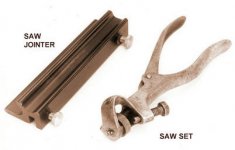
As for sets, here are mine.
They are Stanley model 42-X. They are said to be the Cadillac of vintage saw sets.
Here is a picture of the adjustable anvil piece. When you squeeze the handle, a rod projects toward the anvil. The rod is fixed and the anvil moves. Move the anvil up for less set and move it down for more set.
Here is a good shot of the rod and the tapered anvil.
And here is an action shot.
So now you have a short course in saw geometry. A specific tooth pattern should be designed for each type of wood. Woodworkers of yore used the "six tooth" rule. Simply, have six teeth in the cut for optimal cutting. The ww must take into account, the type of cutting--ripping typically is at 45 degrees, so the saw kerf is wider than the board, thickness and type of wood, and other variables.
My hat is off to ww who understand handsaws and the interplay of tooth geometry. It is a whole area of specialized knowledge. I do not even begin to know how to optimize a handsaw. I just sharpen the existing pattern and use the saw that cuts best. Most poor cutting jobs can be finished up with handplanes.