Grinding jigs
So here is some info on grinding. I sharpen lots of plane blades and even made them at one time. I use a grinder for sharpening and a grinder for roughing out raw steel. Let's start with that one. It is an 8" grinder with a grey coarse and gray fine wheel. I use the Wolverine jigs with it. They have a fixture that mounts to the base.
Here is the fine side with a flat jig mounted in the fixture.
Here is the gouge jig in place on the coarse wheel (for demo).
The end of the chisel sits in a square pocket and rotates freely during sharpening. Since the turning tools are made of high speed steel (HSS), they do not lose temper when being ground. All they really need is a quick kiss on the fine grey wheel and they are good to go.
As you can see, adjusting the jig forward and backward changes the bevel angle.
Sometimes I need to get closer to the wheel. I made this attachment that allows me to grind on the corners.
The Veritas jig is pretty handy and is easy to adjust. There are two levers--one on each side--which make it easy to hit the correct location with the right angle.
It has an accessory for holding blades.
This holder slides back and forth in the slot.
I do everything freehand and never use the blade holder. Once you get a feel for it, you can tell when the blade is flat against the flat of the wheel. But I do use an angle gauge.
I noticed that my pink wheel was getting clogged.
So I dressed it.
And exposed clean grit.
Grinding wheels NEED to be DRESSED. How often? FREQUENTLY. Grinding steel against the wheel causes abrasive to drop off and expose fresh grit. That makes the surface less than flat. And sometimes steel and worn out abrasive gets stuck in the matrix. Dressing makes the wheel surface flat, cleans off the goo and also exposes fresh and sharp abrasive. A clean wheel cuts more accurately and faster. Do yourself a favor and dress often.
There are many different tools that can be used to dress a wheel.
Here you see the diamond tee dresser, an abrasive dresser, and a wheel dresser. Most of these can be had for less than $20 each and are well worth the investment. I like the diamond tee and have worn out many of them through the years. They are quick and accurate.
Just hold the dresser against the wheel and slide back and forth. It takes about 5-10 seconds.
The other side of this grinder has a white wheel. It is coarser than the pink and I use it for coarse grinding. Coarse as in taking out nicks. The best way to deal with a nick is to grind it at 90 degrees and then reestablish the bevel. Grinding on the bevel heats up the thin edge too much. You can see that I use the grinder supplied tool rest on this side. It is just fine for my 90 degree grinding.
I keep the Cool Whip container with water between these two fine work wheels. Remember that body temp is 98.6 F, water boils at 212 F and temper of O-1 tools steel changes begin around 400 degrees. Steel that is warm to the touch is higher than 100F. If you keep the temp below steam making you are not going to lose temper. If you plunge the blade into water and great hissing follows, you have probably already ruined the temper of the blade.
My first grinder blade guide was a long wooden dowel. I do not recommend that for obvious reasons. Sometimes I like to learn by doing and this educational experience involved smoke. You might be able to use the tool rest that comes with your grinder, but you will quickly want something that is easier and quicker to adjust. Best to fast forward and go for a Veritas or a Wolverine.
Keep one grinder with gray wheels for lawnmower blades and raw steel. Outfit your good grinder with pink and/or white wheels. Get a wheel dresser and use it.
Also wear eye protection and DO NOT stand in front of the wheel because sometimes they EXPLODE. Those wheel covers on the end have a purpose--don't leave them off. Good luck with your grinding.


 I am pissed and ready to explode!
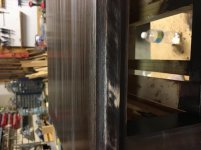
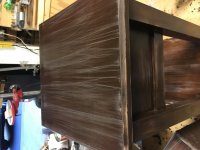




 but I ended up stripping the project and completely sanding it down to all raw wood before starting all over.











 And then I pull out my chisels to finish a corner where my router rounds them, I kind of look over my shoulder to make sure some Amish Carpenter God isn't about to smite me.