Had the opportunity this past week to use a homemade fixture I hadn't used in at least a decade . . .
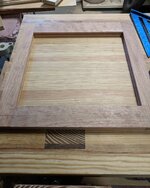
This door (turned sideways on the work bench), made of particle board (ugh!) was part of a computer desk on the side pedestal to be used for a PC in a tower case or as storage space. I use it for storage as I've got a horizontal desktop case I've used for my PC builds for nearly two decades, not a vertical. It hinges on pins extending from the top and bottom of its right side into the shelf above it and into the bottom of the cabinet below it. The side of the cabinet only allows the door to open about 135 degrees from its closed position. It was open and inadvertently hit, pushing the door against the right side of the cabinet and breaking the hinge pins out of the top and bottom right corners. Predictable failure mode for its particle board construction and how the hinge pins are mounted to the door with plates on the back of the door.

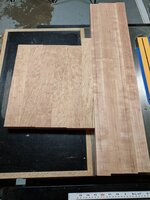
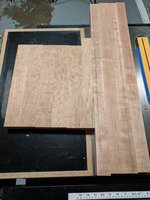
Note the blonde color of the wood. The "ex" bought the computer desk, assembled it, and put my computer on it while I was gone on a business trip. I haven't found any manufacturer markings but it has all trappings of Ikea or a clone thereof. The door's dimensions are 11-1/2" wide x 19-1/4" tall and 1/2" thick. Got a 1' x 2' piece of 1/2" birch plywood made for cabinetry with finish grade birch veneer layer on both sides and 7 interior layers. I've used it before and it's fairly strong stuff, orders of magnitude stronger than particle board with fake birch plastic veneer. I inherited my father's 1954 Craftsman 10" table saw when he passed away in 1984. More than sufficient to create a panel the same dimensions as the broken particle board door.

The rip fence is obviously not original. That's barely visible just below it. The handle and mechanism to lock it down fractured at some time before I inherited the saw and my father jury-rigged a way of locking it down using a long bolt and wing nut. It was a royal PITA to use and was time consuming to lock down with any appreciable precision for the width of the rip. The replacement, bought and installed about ten years after I inherited it, is an order of magnitude improvement and includes a vernier adjustment. Also added the left and right bed extensions at about the same time. The original miter gauge is below the bed on the left. What makes this saw special are two features:
- A massively thick cast iron bed that's still still dead flat after nearly 65 years and several cross-country moves.
- An indirect belt drive arbor that can be raised until it's just below the blade change panel in the bed. You get to use a whole lot more of that 10" saw blade than a direct drive saw. I can cut 4 inch thick wood on it with plenty of saw blade still showing.
They don't make 'em like this any more.
Checking the blade to ensure it's a true vertical 90 degrees to the saw bed. Blade is a fine tooth combination blade with carbide teeth that I've used on birch and oak veneer plywood before. Leaves extremely smooth and clean cuts. A finer tooth crosscut finishing blade I've got tends to burn the edges of plywood a little if you don't feed quickly enough.
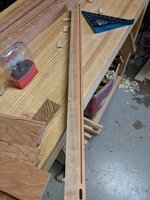
Ripping the panel was straightforward. It is making the crosscuts square to the rip that is the reason for posting this. I've done mission style furniture and cabinetry with rail and stile panels before, and some of the doors on those pieces are solid without a rail and stile around them. Getting them truly square is essential to having a very thin, visually even gap around the door. If it and the cabinet around it aren't perfectly square, it will show immediately. I built a fixture for cutting panels as perfectly square as I can measure years ago when making the furniture. I called it a panel cutter. Others call it a crosscut sled. The sliding panel is, yup, a 2'x2' panel of 1/2" birch plywood. The leading edge stop is a strip of 1" x 2" ash, sold for making exterior door thresholds.

Note the hole with no screw in the photo above. There's a second one hidden by the panel that's about to be crosscut and they have a purpose to be explained later. Has a metal rail on the bottom that rides in the miter gauge groove in the saw bed.
To make the fixture:
- I first ensured I had a true straight edge for the leading edge. Simple enough to rip a strip using the fence.
- Next, I attached the metal rail to the bottom side ensuring it was perfectly square to the edge just ripped. The rail was placed about a half inch farther from the edge of the fixture that ran parallel to the saw blade.
- After that the 1"x 2" ash was made perfectly true on one edge using a jointer and then carefully ripped on the other edge to make it parallel.
- As the leading edge of the fixture was already square to the rail, the leading edge of the stop only needed to be perfectly aligned with the leading edge of the fixture.
- Note the two square nuts in the rail. These are just below the two holes in the fixture and are used to tweak the precise width of the rail, to ensure it rides in the saw bed's miter gauge groove with no lateral play. They were adjusted for just a slight bit of friction. I don't recall where I got that rail from, or even what it's called, it's been that long ago, but it's not the standard piece of u-channel extrusion and was perfect for this fixture.

- Once the glue attaching the ash stop was completely cured, I ran the panel through the saw, ripping off the extra half-inch or so, to create an edge parallel to the blade and the rail underneath.
- It rides against the saw blade with near zero clearance. Checked for squareness of the stop to the new fixture edge, and I had done my earlier work attaching it perfectly.
One can buy a commercially made panel cutter (aka crosscut sled), but why do that when you can make your own. In addition, the distance of the miter gauge grooves do not match any table saws that I know of that were made from 1995 onward. Buying one for this vintage table saw wasn't an option either.
The first crosscut was about 1/8" wide to ensure one (top or bottom) edge is square to the ripped edge. Then it was flipped over to crosscut the other edge to the desired finished height of the door. The marked cut line can be aligned precisely with the edge of the stop. No guessing on where the left edge of the saw kerf will land.
Slide it through, pushing on the panel being crosscut to keep its leading edge firmly against the sled's stop. Gives perfectly square crosscuts on a panel every time.
The last steps were putting the door hinge, and magnet plate onto the back of the new door . . .
(the extra holes in it are from being used as a backstop on the drill press

)
. . . and then mounting the handle onto the front. This new door has machine screws running through the door holding the hinge pins onto the back, unlike the 3/16" long wood screws that were used in the original, which weren't much to hold hinge pins onto particle board.
Installed onto the computer desk for now. I will remove it and use some satin Varathane (urethane) to finish it after the weather warms enough that I can do it in the workshop. I'd do it in the house but for the two cats who would find it necessary to investigate the new horizontal surface, and there's nowhere I can put it that they cannot get to (one in particular can leap incredible heights). The finish will darken it slightly to better match the rest of the particle board desk.
I keep the panel cutter stored near vertical along its leading edge to prevent it from warping. It has remained perfectly stable dimensionally for about fifteen years, in an unheated and zero A/C workshop. I fabricate most fixtures like this as needed instead of buying commercially made ones. Provided the process by which I created this panel cutter so that someone wanting to make their own can do so successfully.
Oh, and the sawdust on the saw? It gets used routinely. Thorough cleaning beyond what's needed to do the work at hand is occasional. Pitching wood scraps is rare. There's always a use for them, if nothing else, than for pads in a vise or clamp or as a backstop on the drill press. It's not there to look pretty for a House Beautiful tour. The old door will get pitched. No use for scrap particle board!
John