To avoid these ads, REGISTER NOW!

Woodworking 101--Tools and Tips

CRSINMICH

Well-known member
Joined
Aug 15, 2015
Messages
2,397
Location
Southeastern Michigan
PLANE HOLSTERS​
I've mentioned before that I am gradually hanging things on the wall behind my bench based on which tools I find myself using most often. Here are two plane holders (holsters) that I made from scraps I took out of the waste bin. The You Tubes are full of plane holders/hangers/racks. I chose this style because it saves space on the wall. All I have to do to remove a plane is lift it about 1/2" and tilt the tail outward. Other styles of hangers require lifting almost half the length of plane in order to get it out. That would mean that I couldn't have anything hanging on the wall directly above the plane.

The planes are a Stanley #4 Type 15 (1931-1932) and a Record Marples #60 1/2 low angle block. I find myself reaching for one of these two frequently during most of my projects.
 

Attachments

  • Plane holsters.jpg
    Plane holsters.jpg
    92.7 KB · Views: 88
Last edited:
To avoid these ads, REGISTER NOW!
OP
J

jimreed2160

Well-known member
Joined
Aug 7, 2016
Messages
3,589
Location
Tallahassee FL
CRS--That is a nice space saving idea for someone with open wall space. Sure beats a hang hole.

No woodworking today as I was in the road visiting family. While at Cracker Barrel I did beat my granddaughter in checkers. She hung tough but lost in the end. I could not do my victory dance because she is only seven. With a little more practice I think she may win the rematch. :dunno:

But my chisel rack has gone into duty. You will remember that I gave it a Boca Bob update by using walnut and spalted maple. It is easy on the eyes and sure beats the plywood stand it replaced.
 

Attachments

  • DSCN6217.jpg
    DSCN6217.jpg
    149.8 KB · Views: 93

Kenstone1

Well-known member
Joined
Oct 2, 2015
Messages
734
Using Dry Wall Screws in wood projects

This thread seemed like a good place to ask the experts about these wood working/construction methods that I've been using for years, without any problems.

I don't have the talent or skill to build anything furniture grade like you, but have built benches, shelving units, storage racks, shed lofts, etc. mostly for my garage and shed.

I use drywall screws in varying lengths (sometimes glue too), usually predrill a clearance hole thru the adjoining piece, and either countersink for the screw-head or add a finish washer.

Sometimes I'll tack things together with finish nails, drill/assemble with Drywall Screws, and just leave the finish nails behind.

Recently, in another forum, I posted about using drywall screws to construct a work bench, and was cautioned about the "hazards/dangers" of using drywall screws for anything other than hanging drywall and that I should use Deck Screws, Lag bolts, or Carriage bolts.

I didn't get a lot of reasons, except that drywall screws are hard/brittle and could break, and when I asked why drywall screws came in so many different lengths if they are only meant for hanging drywall...the name calling started.

...so what do you think of my primative wood working methods?
thanks,
:D
 
Last edited:

EOC_Jason

Well-known member
Joined
Jun 25, 2012
Messages
11,388
Location
Bentonville, AR
Drywall screws are very easy to pop the heads. Deck Screws aren't that much more in cost and are a lot more durable.

If you put enough screws it's not going to matter. I really only use drywall screws for little odds & ends that won't really have any stress on them.
 

beelsr

Well-known member
Joined
May 6, 2007
Messages
1,324
Location
NE PA, USA
drywall screws are fine in softwoods and where you don't need to rely on the screw for much strength. the heads snap off easily in hardwoods and they're really brittle in shear.

if you're hanging cabinets or building something that will live outdoors or something where the screw failing would be a bad thing, use deck screws or construction screws.

i've used drywall screws to build stuff and it's been fine but for a workbench, i'd use something more appropriate. i've asked the same question about screw length, too. :)
 

EOC_Jason

Well-known member
Joined
Jun 25, 2012
Messages
11,388
Location
Bentonville, AR
I know certain firewall situations require multiple layers of sheetrock... So I can see longer screws necessary in those applications...
 
OP
J

jimreed2160

Well-known member
Joined
Aug 7, 2016
Messages
3,589
Location
Tallahassee FL
Ken--THANK YOU so much for your question about drywall screws. I cringe every time I see one of those posts warning about the dangers of drywall screws. Sometimes those nervous nellies remind me of the gluten/GMO/toxin crowd with their sharp shrills of misinformation. I avoid responding to them because I refuse to get into a battle of wits with an unarmed person.

Drywall screws
First off, a screw is a fastening device. There are literally thousands of screw fasteners that are used in a wide range of products from jewelry boxes to spaceships. Each has specific use cases and many have uses outside their main service line. That is true with drywall screws. They are fine for shop furniture and I have used them for years just like you have. Of the hundreds I have shot, only two or three have been overtorqued and failed. Each case was when I was in a hurry and too lazy to drill a pilot.

The screws need to be matched to the project. Whenever I need strength, I engineer the joint so the wood takes the stress. I use screws to hold the wood in place--usually with glue as a secondary fixation method. Since the joint is the primary and the glue is the secondary, the drywall screw is the tertiary method of fixation.

I understand the recommendation for using deck screws. But most deck screws are used the same way. Show me deck built with screws where shear is an issue and I will show you a deck to avoid. Sorry for the screed but this stuff just toasts my ......:eyecrazy:
 

EOC_Jason

Well-known member
Joined
Jun 25, 2012
Messages
11,388
Location
Bentonville, AR
The screws need to be matched to the project. Whenever I need strength, I engineer the joint so the wood takes the stress. I use screws to hold the wood in place--usually with glue as a secondary fixation method. Since the joint is the primary and the glue is the secondary, the drywall screw is the tertiary method of fixation.

I think that's one thing many people don't think about, but should. I've seen way too many shade tree projects where the screws are bearing the load / stress. I would agree, in the way you describe that is the way to go and any screw would work.
 

Bob Heine

ALLIANCE MEMBER
Joined
Oct 24, 2009
Messages
10,705
Location
Boca Raton, Florida
I have actually snapped the heads off more Kreg screws than drywall screws. Part of the problem is the choice of tool. If you are driving drywall screws in wood with a 20v drill or driver, it's hard to tell how much torque is being applied. I know they are tight when when the screw head disappears into the soft pine fence board. It reminds me of the guys in the tire stores who used 700 ft lb impact wrenches to put lug nuts on cars with steel rims (spec is around 75 ft lbs). I thought my digital torque wrench was set to 100 ft lbs when I snapped off the wheel stud on the PT Cruiser. I'm guessing it gave up at about 350.
 

EOC_Jason

Well-known member
Joined
Jun 25, 2012
Messages
11,388
Location
Bentonville, AR
Haha... Funny story... My neighbor asked me what the numbers were on his drill that you could adjust. I had to explain to him the clutch and purpose of setting a number so you got consistent results and didn't split wood or snap screw heads... hehe... good times...

I have actually snapped the heads off more Kreg screws than drywall screws. Part of the problem is the choice of tool. If you are driving drywall screws in wood with a 20v drill or driver, it's hard to tell how much torque is being applied. I know they are tight when when the screw head disappears into the soft pine fence board.
 

rossddvm

Well-known member
Joined
Feb 16, 2017
Messages
120
Location
NW Iowa
Wood screws and deck screws have an area before the head with no threads to pull the materials tight. Drywall screws have threads to the head. it does not allow the screw to "snug up" the piece you are driving through to the one you are anchoring to. And yes dry wall screws are more brittle.
 

Bob Heine

ALLIANCE MEMBER
Joined
Oct 24, 2009
Messages
10,705
Location
Boca Raton, Florida
I have enjoyed the blissful sleep of the ignorant for many decades. I am now suffering night sweats because of the screws holding the upper cabinets in my office, garage and shop. I'm going to make believe I used different screws on the workbenches.

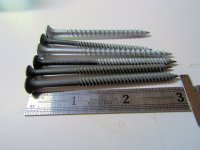
There are 9 cabinets in the office, 22 in the garage and 4 in the workshop. All of them are attached with 3-inch drywall screws (4 in each stud). I do drill two 5/32" or 11/64" holes through both the top and bottom cabinet cleats so there is less stress on the head as the screw starts. The longer drywall screws I have are not threaded all the way to the head so maybe they are not really drywall screws. Two of these are plated rather than blued and the one at the top has a thicker head. You may notice a couple of the screws in my collection have been used -- pretty sure some of my cabinets are held up with more like those.
attachment.php
 

Attachments

  • Drywall Screws.jpg
    Drywall Screws.jpg
    78 KB · Views: 275

Kenstone1

Well-known member
Joined
Oct 2, 2015
Messages
734
Wood screws and deck screws have an area before the head with no threads to pull the materials tight. Drywall screws have threads to the head. it does not allow the screw to "snug up" the piece you are driving through to the one you are anchoring to. And yes dry wall screws are more brittle.

Thanks you and all others for reading/responding to my post.
As I stated in my previous post, I drill a clearance hole in the piece I'm driving thru, so the screw can "snug up" and usually counter sink or add a finish washer.
Sorry if that was not clear,
:thumbup:
 
OP
J

jimreed2160

Well-known member
Joined
Aug 7, 2016
Messages
3,589
Location
Tallahassee FL
Cabinets, cabinets. I have redone a few kitchens and hanging top cabinets gives me the willies. Once they get crammed with dishes and other heavy stuff, those fasteners are carrying an incredible amount of weight. The top screws have pull away forces as well as shear forces. The bottom screws are subjected mostly to shear forces. It is not the best application for a brittle fastener. I always used washers on the heads and made sure the screws went into studs far enough to get a good bite. The last kitchen I did was a basement extra which had inexpensive cabinets from HD. I was so afraid the backs would fail and pull away so I left the ledger guide board in place and painted it to match. That relieved all of the shear forces and made me feel better.

Well designed cabinets have strong frames for strong attachments. But inexpensive cabinets AND homebuilt cabinets may not have an appropriate structure. Add questionable fasteners to the mix and then fill the cabinet with paint cans and wait for the big noise. Because of their high load, most garage cabinets are probably safer when hung using French cleats.
 

Autonomous

Well-known member
Joined
Dec 26, 2015
Messages
66
After far too much Garage Journal and YouTube I am comfortable with drywall screws for any project that won't see moisture and the exposed screw head isn't an eyesore.

Anything structural with wood should have an appropriate joint that is GLUED. Screws in general are not structurally sound compared to even the lowly nail, with shear strength taken into account.

Matthias Wandel has done some great tests demonstrating Screws, Nails, and Joint strength. The tests and sample size aren't 1000% perfect, but they are good demonstrations of what folks like us might expect in similar circumstances.


Sent from my Pixel XL using Tapatalk
 
OP
J

jimreed2160

Well-known member
Joined
Aug 7, 2016
Messages
3,589
Location
Tallahassee FL
Stanley #113 plane

Stanley made their #113 circular plane from 1887 until 1939. It is interesting from a gizmosity point of view. I actually used one when I rehabbed a rocking chair and found that it works as advertised. If you need to plane curved surfaces, this is your go to tool.

I found a box of them when I was cleaning up. Here is one of the nice ones. It is a later model with a Bailey adjuster. The blade is the same size as a #3 bench plane and the blade, cap iron and lever cap are interchangable.

Tips for use
Make sure you get a later model with the Bailey adjuster and lateral. Later model #113s are easier to use. Turn the front wheel until the sole is level and adjust the blade to take a wispy shaving. Then turn the wheel until you have your desired arc. Remember that you will hold the wheel when using the plane because the wheel also serves as the front knob. It is easy to turn the wheel and inadvertently adjust the curve of the sole. Watch grain patterns and reverse the plane when you come to an against the grain situation.

Good luck making shavings.
 

Attachments

  • DSCN6220.jpg
    DSCN6220.jpg
    147.8 KB · Views: 57
  • DSCN6221.jpg
    DSCN6221.jpg
    150.5 KB · Views: 44
  • DSCN6222.jpg
    DSCN6222.jpg
    149.7 KB · Views: 47
  • DSCN6223.jpg
    DSCN6223.jpg
    133.1 KB · Views: 44
To avoid these ads, REGISTER NOW!

rlitman

Well-known member
Joined
Oct 18, 2010
Messages
24,591
Location
Long Island
After far too much Garage Journal and YouTube I am comfortable with drywall screws for any project that won't see moisture and the exposed screw head isn't an eyesore.

Anything structural with wood should have an appropriate joint that is GLUED. Screws in general are not structurally sound compared to even the lowly nail, with shear strength taken into account.

Matthias Wandel has done some great tests demonstrating Screws, Nails, and Joint strength. The tests and sample size aren't 1000% perfect, but they are good demonstrations of what folks like us might expect in similar circumstances.


Sent from my Pixel XL using Tapatalk

Matthias is great! There's a lot to be learned from his work.
He does however show how glue adds nothing to a pocket joint screwed joint. The point I'd raise, is that you need to know your joint, how it works in the overall piece, and how to execute it well. There is no one answer fits all piece of advice, short of saying you should finish with the same number of fingers as you started with.

Cabinets, cabinets. I have redone a few kitchens and hanging top cabinets gives me the willies. Once they get crammed with dishes and other heavy stuff, those fasteners are carrying an incredible amount of weight. The top screws have pull away forces as well as shear forces. The bottom screws are subjected mostly to shear forces. It is not the best application for a brittle fastener. I always used washers on the heads and made sure the screws went into studs far enough to get a good bite. The last kitchen I did was a basement extra which had inexpensive cabinets from HD. I was so afraid the backs would fail and pull away so I left the ledger guide board in place and painted it to match. That relieved all of the shear forces and made me feel better.

Well designed cabinets have strong frames for strong attachments. But inexpensive cabinets AND homebuilt cabinets may not have an appropriate structure. Add questionable fasteners to the mix and then fill the cabinet with paint cans and wait for the big noise. Because of their high load, most garage cabinets are probably safer when hung using French cleats.

Funny story about that from when I re-did my kitchen.

I have a galley kitchen, which originally had one upper cabinet on each side of the window. These were refaced before I bought my house, so formica covered up all the screws and nails. When it came time to replace them, I pried off the formica, hoping to find a bunch of hidden screws.

On the cabinet to the right of the window, I found three 3" long sheetrock screws at the bottom, with only one in a stud. On top, there were four finishing nails, again, with one in a stud (the rest in just the sheetrock). That one came down easy. To think that this held up all my dishes.

On the cabinet to the left of the window, I found just one sheetrock screw in the bottom, which didn't even hit a stud. On top, there were three finishing nails, and eventually, I discovered that none were in studs. Unable to find any more screws, I pulled on the cabinet, and it felt kind of solid. So, I used a utility knife to cut the wallpaper where it kind of overlapped the face by 1/8" or so, and as the paper was cut, the top of the cabinet came off the wall about 2" under its own weight. It seems that the wallpaper was what kept me from being brained by a falling Kitchenaid stand mixer and cabinet.
 

CRSINMICH

Well-known member
Joined
Aug 15, 2015
Messages
2,397
Location
Southeastern Michigan
Auto: Be careful recommending videos that test common things. People have their opinions and sometimes resent when they are scrutinized. For an example of what could happen, check out the reactions on the Vise Repair thread when I recommended an AvE video in which he tests bolts.

FOR THE RECORD: I have absolutely NO opinion about any bolt or screw.

https://www.garagejournal.com/forum/showthread.php?t=252830&page=298

jim: You found a BOX of #113's? While cleaning? Oh Man!

EDIT: Auto: I was only kidding. Mostly.
 
Last edited:

JBH

Well-known member
Joined
Jan 17, 2018
Messages
811
I need to make a couple 24mm (~15/16") holes in 1/2" bamboo ply. The front face needs to stay clean. I'm less concerned about the back surface, though clean is always better than chipped. Regardless, I need to buy a bit.

What's the best bit style for this job: holesaw, Forstner, or...?

I've used holesaws before on MDF and particleboard, but I've never used a Forstner bit. I've never used a standard twist bit for anything that big.
 

CRSINMICH

Well-known member
Joined
Aug 15, 2015
Messages
2,397
Location
Southeastern Michigan
JBH: I'm not a bit expert but I think Forstner bits would be your best bet especially if you can bore the holes using a drill press. One caution though. I believe I've heard bamboo is fairly high in silica particles which would tend to dull bits quickly. I know the adhesive between plys does
 
Last edited:

JBH

Well-known member
Joined
Jan 17, 2018
Messages
811
JBH: I'm not a bit expert but I think Forstner bits would be your best bet especially if you can bore the holes using a drill press.

Hmm, I did not think about the stability issue. Thanks!

I have an old Craftsman portable "drill guide," but I'm not sure it is compatible with my Fein drill. I'll have to check.
 

EOC_Jason

Well-known member
Joined
Jun 25, 2012
Messages
11,388
Location
Bentonville, AR
I've never tried using a forstner with a hand drill, only on a drill press. Run them at low RPM.

A good sharp twist bit or hole saw bit should be *okay*, I've never had them tear up the entry hole but it the exit will not be pretty. You can always put some masking tape over the front and a scrap piece of wood on the back to minimize tear-out.
 

Autonomous

Well-known member
Joined
Dec 26, 2015
Messages
66
rlitman: I'm glad you pointed that out about the pocket screw "joint" and glue. A pocket screw joint is just a countersunk **** joint with screws. Typically that's a small surface area for glue, which appears to add very little to the overall strength.

I wasn't advocating drywall screws for cabinet mounting, hope it doing come out that way. I was mainly saying for structural work you need the appropriate structural joint and fastener.

Screws are great for clamping wood together because of the threads, but are not nearly as strong against sheering vs nails, and no where as good as a real joint, ie rabbit, saddle, box, etc.

CRSINMICH: you're right for sure. I'm an expert in nothing and there are enough opinions and anecdotal evidence to send this thread spiraling out of control. Just figured I'd throw the video up because I like watching Matthias.


Sent from my Pixel XL using Tapatalk
 

ez-duzit

Well-known member
Joined
Jun 24, 2013
Messages
5,095
Location
Marina del Rey
J--they do sell 24mm Forstner bits. These will produce a cleane hole on both sides if you back up the backside with a block of scrap.
 

CRSINMICH

Well-known member
Joined
Aug 15, 2015
Messages
2,397
Location
Southeastern Michigan
J--they do sell 24mm Forstner bits. These will produce a cleane hole on both sides if you back up the backside with a block of scrap.

EZ: Thanks! I forgot to add the part about backing.

Auto: I like Mathias too and I will watch his video - just don't tell anybody. Shhhhh!
 
Last edited:

rlitman

Well-known member
Joined
Oct 18, 2010
Messages
24,591
Location
Long Island
J--they do sell 24mm Forstner bits. These will produce a cleane hole on both sides if you back up the backside with a block of scrap.

A backing is one good solution. Though on particularly splintery woods, you can still get tearout (how tightly the backing is pressed against the work piece can make a big difference). Another option is to indicate the hole with a punch, drill clean through with a 1/16" bit, then start the hole on the underside, to at least score through the grain, and finish the hole from the other side.
 

JBH

Well-known member
Joined
Jan 17, 2018
Messages
811
J--they do sell 24mm Forstner bits. These will produce a cleane hole on both sides if you back up the backside with a block of scrap.


Thanks everyone. A store a few blocks away seems to have at least two 24mm Forstner bit options, and the Craftsman drill guide just has a bit-like stub so it’ll work fine with my Fein drill. So I know where I’ll be walking Saturday morning after the farmer’s market!
 
OP
J

jimreed2160

Well-known member
Joined
Aug 7, 2016
Messages
3,589
Location
Tallahassee FL
Remember that just like fasteners, there are Forstners and there are other Forstners. Make sure you buy a good quality one for this special job. The best have sharp cutting edges and some of the inexpensive ones have sawtooth edges. In my experience the sawtooth bits make a more invasive entrance on some woods. Good luck punching your holes. Do a few test ones if you have enough material.
 
OP
J

jimreed2160

Well-known member
Joined
Aug 7, 2016
Messages
3,589
Location
Tallahassee FL
Joint strength
I was curious a few years back about my edge glue ups so I did some testing. It is pretty easy--glue something up and then break it apart. On the edge glue up, I just used the cutoffs. My highest quality table tops start with a generous 1/2" to 1" spare all around which I can square up. Some are larger on the ends and that provides a great test piece for strength.

The results can be eye opening. Good joints, of course, break at the wood with no glue visible. Poor joints are all glue. The testing helped me improve my joint strength.

None of my Kregs to date have glue because I did not think it would be worth the effort. I'll bet the Kreg strength tests show that glue brings little to the table. **** to side does not appear to be the best marriage. But I guess I need to test that theory.
 

rlitman

Well-known member
Joined
Oct 18, 2010
Messages
24,591
Location
Long Island
Thanks, any recommendations? Is this Forstner bit

https://www.highlandwoodworking.com/fish-forstner-bit.aspx

a good one?

Very. There are three elements to a forstner bit.

The pip at the center helps you start the cut, and makes it manageable, but actually serves no purpose once you start drilling.

You have two rotating chisels that rip out wood.

And finally, you have the outer edge that acts as a knife, severing the wood fibers.

That knife is where tearout can happen. If it cuts cleanly (and I'd expect that one to), then you'll get a clean cut. If it can grab, it can pull chunks.
 

ez-duzit

Well-known member
Joined
Jun 24, 2013
Messages
5,095
Location
Marina del Rey
J--I've never used one of these "wave cutting" bits. But at least it's made in Austria (not China) and is forged. I'd take a chance on it.
 
To avoid these ads, REGISTER NOW!
Top Bottom