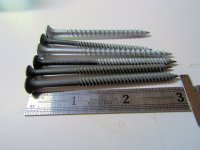
After far too much Garage Journal and YouTube I am comfortable with drywall screws for any project that won't see moisture and the exposed screw head isn't an eyesore.
Anything structural with wood should have an appropriate joint that is GLUED. Screws in general are not structurally sound compared to even the lowly nail, with shear strength taken into account.
Matthias Wandel has done some great tests demonstrating Screws, Nails, and Joint strength. The tests and sample size aren't 1000% perfect, but they are good demonstrations of what folks like us might expect in similar circumstances.
Sent from my Pixel XL using Tapatalk
Matthias is great! There's a lot to be learned from his work.
He does however show how glue adds nothing to a pocket joint screwed joint. The point I'd raise, is that you need to know your joint, how it works in the overall piece, and how to execute it well. There is no one answer fits all piece of advice, short of saying you should finish with the same number of fingers as you started with.
Cabinets, cabinets. I have redone a few kitchens and hanging top cabinets gives me the willies. Once they get crammed with dishes and other heavy stuff, those fasteners are carrying an incredible amount of weight. The top screws have pull away forces as well as shear forces. The bottom screws are subjected mostly to shear forces. It is not the best application for a brittle fastener. I always used washers on the heads and made sure the screws went into studs far enough to get a good bite. The last kitchen I did was a basement extra which had inexpensive cabinets from HD. I was so afraid the backs would fail and pull away so I left the ledger guide board in place and painted it to match. That relieved all of the shear forces and made me feel better.
Well designed cabinets have strong frames for strong attachments. But inexpensive cabinets AND homebuilt cabinets may not have an appropriate structure. Add questionable fasteners to the mix and then fill the cabinet with paint cans and wait for the big noise. Because of their high load, most garage cabinets are probably safer when hung using French cleats.
Funny story about that from when I re-did my kitchen.
I have a galley kitchen, which originally had one upper cabinet on each side of the window. These were refaced before I bought my house, so formica covered up all the screws and nails. When it came time to replace them, I pried off the formica, hoping to find a bunch of hidden screws.
On the cabinet to the right of the window, I found three 3" long sheetrock screws at the bottom, with only one in a stud. On top, there were four finishing nails, again, with one in a stud (the rest in just the sheetrock). That one came down easy. To think that this held up all my dishes.
On the cabinet to the left of the window, I found just one sheetrock screw in the bottom, which didn't even hit a stud. On top, there were three finishing nails, and eventually, I discovered that none were in studs. Unable to find any more screws, I pulled on the cabinet, and it felt kind of solid. So, I used a utility knife to cut the wallpaper where it kind of overlapped the face by 1/8" or so, and as the paper was cut, the top of the cabinet came off the wall about 2" under its own weight. It seems that the wallpaper was what kept me from being brained by a falling Kitchenaid stand mixer and cabinet.