To avoid these ads, REGISTER NOW!

Woodworking 101--Tools and Tips

acer66

Well-known member
Joined
Dec 4, 2010
Messages
4,418
Location
Western North Carolina
I still brush Minwax polyurethane with a Purdy natural bristle brush. I've played with it for years and I'm finally getting decent at it. I was always worried about overbrushing unnecessarily. As long as you get on it and off it you can pull it very, very thin.
I might have to try that, I use a lot of the poly oil modified with a specific roller which name escapes my in the moment recommended by a pro and I got pretty got at it imho once I finally got away from my usual the more the merrier .
 
To avoid these ads, REGISTER NOW!

CRSINMICH

Well-known member
Joined
Aug 15, 2015
Messages
2,397
Location
Southeastern Michigan
Sometimes refurbishing an old tool can seem like archaeology. I did some preliminary cleaning on the #12 I recently bought, especially on the extremely rusty blade. I was expecting to find some variation of the Stanley logo which might give me some idea of the age of the scraper plane.

I knew that plane parts often get swapped over the years so blade logos are not hard-and-fast indicators of age. Boy, was I right about that.
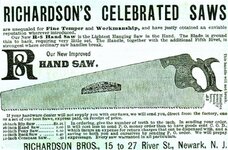
When I finally removed enough rust to reveal lettering it said, "RICHARDSON NEWARK NJ". Richardson? Who was that and what did they have to do with Stanley? A little research revealed that RICHARDSON BROS were highly regarded saw manufacturers from...well, from Newark who went out of business in 1909. I haven't found any indication that they made scraper blades too but they did make other things beside saws. Saw plate and scraper blades are basically made from the same material so it's plausible.

While cleaning the blade some more I noticed something else unexpected. Both ends of the blade had hooks which is common practice. What's not common (as far as I know) is that one end of the blade had a radius. The hook was consistent along the curve so it was not a poorly shaped blade. It was intended to be radiused. That's not common and it doesn't seem like a scraper plane would work very well with a radiused blade.

Now I know a bit more about cutting tool history and I'm left to speculate about radiused scraper plane blades. Do any of you have any information or guesses?
 

Attachments

  • 1884 Richardson ad.jpg
    1884 Richardson ad.jpg
    519.6 KB · Views: 196
  • Stanley #12 iron (1).JPG
    Stanley #12 iron (1).JPG
    395.8 KB · Views: 122
  • Stanley #12 iron radius.jpg
    Stanley #12 iron radius.jpg
    429.1 KB · Views: 141

67carl

Well-known member
Joined
Dec 10, 2013
Messages
3,893
Location
California
Sometimes refurbishing an old tool can seem like archaeology. I did some preliminary cleaning on the #12 I recently bought, especially on the extremely rusty blade. I was expecting to find some variation of the Stanley logo which might give me some idea of the age of the scraper plane.

I knew that plane parts often get swapped over the years so blade logos are not hard-and-fast indicators of age. Boy, was I right about that.
When I finally removed enough rust to reveal lettering it said, "RICHARDSON NEWARK NJ". Richardson? Who was that and what did they have to do with Stanley? A little research revealed that RICHARDSON BROS were highly regarded saw manufacturers from...well, from Newark who went out of business in 1909. I haven't found any indication that they made scraper blades too but they did make other things beside saws. Saw plate and scraper blades are basically made from the same material so it's plausible.

While cleaning the blade some more I noticed something else unexpected. Both ends of the blade had hooks which is common practice. What's not common (as far as I know) is that one end of the blade had a radius. The hook was consistent along the curve so it was not a poorly shaped blade. It was intended to be radiused. That's not common and it doesn't seem like a scraper plane would work very well with a radiused blade.

Now I know a bit more about cutting tool history and I'm left to speculate about radiused scraper plane blades. Do any of you have any information or guesses?

I've seen card scrapers that have a radius, but I think you're talking about a blade that goes in a plane?
 

CRSINMICH

Well-known member
Joined
Aug 15, 2015
Messages
2,397
Location
Southeastern Michigan
carl: That's correct. The radius is is on one end of the blade in a Stanley #12 scraper plane. It doesn't seem like it would be usable especially since there is no way to bow the blade. The blade can be tilted forward or backward but no bow.
 

Renegade1LI

Well-known member
Joined
Mar 11, 2018
Messages
4,945
Location
long island ny
Just got this set from Montana, wish i bought one sooner, it’s nice to have everything in one case. Since makita stopped making there quadriver, this seems to be equal or better quality. Nice to buy direct, no tax and free shipping.
 

Attachments

  • 5912278C-E17F-42E1-A8AD-B518E3D0A32C.jpeg
    5912278C-E17F-42E1-A8AD-B518E3D0A32C.jpeg
    534.4 KB · Views: 128
  • 5CD09EAC-19DD-47CC-AAD9-41E817450F56.jpeg
    5CD09EAC-19DD-47CC-AAD9-41E817450F56.jpeg
    445.2 KB · Views: 151

Woody1320

Well-known member
Joined
Sep 27, 2017
Messages
164
Location
Southeast Michigan
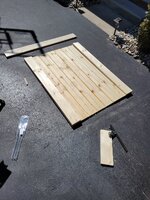
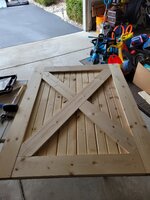
Definitely excited to post this. Finally finished the basement gate. I only have a few weekends in it, but they were spread pretty far in between lol. It came out better than expected, and it works great. There's still finishing to be done, but it's up and working for now. I used tongue and groove boards for the back and added some 1x5 for the trim and cross pieces. I used glue and a brad nailer to attach the latter. The frame pieces are attached with three inch lag screws. The hinges are heavy duty...they can hold sixty pounds each (which is good...it'a heavy). I also did more of the work with hand tools than originally intended, but that made it much more enjoyable. It's definitely boosted my confidence. For finishing, I was thinking either shellac or possibly just Murphys oil (or something similar, as I have that already) and paste wax. Either way, it came out great, and it’s definitely a step up from the ottoman tray I made last year.
 

Attachments

  • 20220114_164818.jpg
    20220114_164818.jpg
    398.3 KB · Views: 114
  • 20220307_215108.jpg
    20220307_215108.jpg
    286.2 KB · Views: 82
  • 20220320_135737.jpg
    20220320_135737.jpg
    609.4 KB · Views: 80
  • 20220410_112955.jpg
    20220410_112955.jpg
    237.8 KB · Views: 81
  • 20220410_154552.jpg
    20220410_154552.jpg
    267.1 KB · Views: 81
  • 20220410_154606.jpg
    20220410_154606.jpg
    269.8 KB · Views: 91
  • 20220320_144205.jpg
    20220320_144205.jpg
    504.8 KB · Views: 94
  • 20220320_135733.jpg
    20220320_135733.jpg
    518.6 KB · Views: 93
  • 20220409_144008.jpg
    20220409_144008.jpg
    318.2 KB · Views: 85
  • 20220410_155058.jpg
    20220410_155058.jpg
    177 KB · Views: 77

Shiftless

Well-known member
Joined
Mar 9, 2014
Messages
14,526
Location
East Bay SFO
Hi guys,
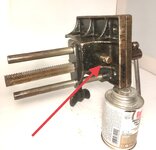
Its been a really long time since I posted here but I ran across a very unusual corner clamp or corner vise yesterday so I brought it home.

6 inches across the top and 4 inches down
It has a quick release function and now that I’ve cleaned and oiled it, it runs smoothly except that there seems to be no provision to tighten the front jaw once it is slid up snug to the workpiece. The front handle certainly seems like it should rotate to tighten things up but it doesn’t rotate at all.

I put an arrow into one of the pics to show the ratchet release pin. I bet there was originally some kind of handle attached to this pin. See the little hole near the end?

Have any of you guys ever seen or heard of this?

Maybe my vise is just broken. 😞

There are no maker marks on it except for a small “no. 800” stamped into the nose of the front handle.

I also posted in the main vise thread where I am the most active here on GJ. Here is a link.


AD13ABC3-B0B6-44ED-B540-35C992CF7169.jpegBAA19E70-E120-4D00-AB61-C55C69F7A6EE.jpeg2866C471-5C72-484E-A2EA-F87F8273ECFB.jpeg
 

CRSINMICH

Well-known member
Joined
Aug 15, 2015
Messages
2,397
Location
Southeastern Michigan
Shift: The only thing I could find about it is another picture - no information at all (except that it sold for $48 a few years ago). As you can see, it did have a long pin/handle on what must be the slide lock.
 

Attachments

  • Corner vise.jpg
    Corner vise.jpg
    268.7 KB · Views: 46
Last edited:

Shiftless

Well-known member
Joined
Mar 9, 2014
Messages
14,526
Location
East Bay SFO
Shift: The only thing I could find about it is another picture - no information at all (except that it sold for $48 a few years ago). As you can see, it did have a long pin/handle on what must be the slide lock.
Thanks a lot CRS :beer:

Yes, I’m sure that the sliding pin there originally had a handle, maybe not the exact shape you show but definitely there was some extension attached to that ratchet release pin when the vise was new. The ratchet release is an in and out action. I’d bet that the vise you pictured had the “no. 800” stamped in the nose.
The mystery continues.

You guys work with wood. Why would a manufacturer design a ratcheting quick release corner vise that couldn’t be tightened up? Did the manufacturer expect you to drive thin wedges in between the jaws and your workpiece to tighten things up?
There is the usual provision for screwing on wooden jaw pads. Nice countersinked holes.

Based on the bat wing/butterfly/mouse ear shape of the wing nut and the apparent Japanning finish on the cast iron, I’d guess that this vise is about 100 years old. What do you guys think?
 

Shiftless

Well-known member
Joined
Mar 9, 2014
Messages
14,526
Location
East Bay SFO
RTM posted this catalog page over on the main vise thread. Thanks RTM! 🍻

My vise is Goodell Pratt or Millers Falls. The GP company was absorbed by Millers Falls back in the 1940s so since mine has no markings, it is unclear. If I had to say, I’d call it a Millers Falls.

That pin doesn’t seem to rotate. It slides in and out to release the ratcheting function. There is a missing handle. Once I get a modern replacement for that, I’ll see if the action to release the ratchet involves twisting. Right now it is a bit vague when pushing in and out. Maybe rotating that pin will make the action more positive.

54249197-A8FB-4090-BDCC-1CE57EF306C9.jpeg
 
Last edited:

Shiftless

Well-known member
Joined
Mar 9, 2014
Messages
14,526
Location
East Bay SFO
SUCCESS!

I was able to get my ratcheting QR corner vise up and running. I removed the nose piece from the notched “rack” and found that there was a spring loaded adjustment for forward and back axial play. Some previous user had adjusted it all the way to one limit so that when I tried to tighten the jaws against a work piece, the handle was immoveable. Now all you have to do is shove the front jaw against the work piece and then spin the handle less than one turn and it’s tight!
 

Davefr

Well-known member
Joined
Jan 7, 2010
Messages
11,823
Location
OR
I decided to make another cribbage board out of some scrap. (The one in #7160 was my first attempt.) The playing lanes are scrap off white Corian and they're laminated to 1/2" oak. The edges are Rosewood and the center is English Walnut burl. The inlaid 5 point index markers are 1/8" brass. I made a cavity for peg storageP1100047.jpgP1100048.jpg. (wifey and I play a game of cribbage almost every night).
 
To avoid these ads, REGISTER NOW!

CRSINMICH

Well-known member
Joined
Aug 15, 2015
Messages
2,397
Location
Southeastern Michigan
THE TABLE
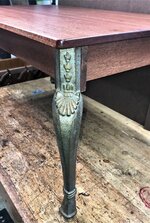
The idea was to use mahogany left over from the trestle table my son and I built last summer and to find a use for a set of decorative cast iron legs I got tired of tripping over. The result was this coffee/end/TV table. With the exception of a drill press, it was all done with hand tools.
 

Attachments

  • Small table.JPG
    Small table.JPG
    313.8 KB · Views: 56
  • Small table - corner.JPG
    Small table - corner.JPG
    413.6 KB · Views: 56
Last edited:

CRSINMICH

Well-known member
Joined
Aug 15, 2015
Messages
2,397
Location
Southeastern Michigan
THE BUILD
The cast iron legs each had two 1/4-20 tapped holes in the back. That was great because the wooden parts could be bolted to the legs.
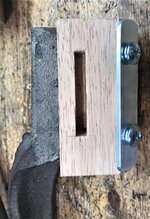
Unfortunately, the legs were meant to be mounted to the frame at 45 degrees to the corners. That meant that I had to invent, design, and build four corner blocks into which the aprons could be mortised. There also had to be two through holes for the bolts that would go diagonally from corner to corner. I made four metal plates to back up the bolt heads. If it's worth doing, it's worth overdoing.

The rest of the table was standard woodworking stuff - tenons on the aprons and flattening the top.
 

Attachments

  • Corner blocks.JPG
    Corner blocks.JPG
    580.8 KB · Views: 52
  • Drilling diagonals.JPG
    Drilling diagonals.JPG
    352.7 KB · Views: 43
  • Mortising with guide.JPG
    Mortising with guide.JPG
    390.6 KB · Views: 40
  • Corner detail.JPG
    Corner detail.JPG
    501.8 KB · Views: 79
Last edited:

Woody1320

Well-known member
Joined
Sep 27, 2017
Messages
164
Location
Southeast Michigan
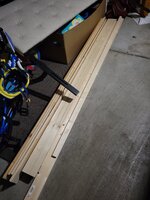
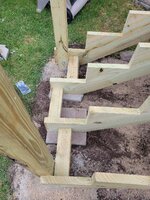
Got a new project underway a couple days ago. I'm rebuilding both sets of stairs on our deck. Both are in dire need of repair, and the price quoted was a bit much for my (and my wife's) taste. I already have the one side removed. All materials are purchased. I'll need to get another 8 step stair stringer for the other side, but I should have everything else. I'd like to add that the way the stairs were anchored was....less than ideal. But all of the decks in our subdivision (of this style anyway) were done the same way.
 

Attachments

  • 20220706_134815.jpg
    20220706_134815.jpg
    664.8 KB · Views: 68
  • 16572867272733685150005838409169.jpg
    16572867272733685150005838409169.jpg
    389.7 KB · Views: 78

CRSINMICH

Well-known member
Joined
Aug 15, 2015
Messages
2,397
Location
Southeastern Michigan
Woody: Home maintenance is not exactly fun but, at the very least, it's an opportunity to use tools and maybe justification for acquiring new tools. Some of the pieces of the old stairs seem to show signs of rot. Were they in contact with the soil?
 

dscheidt

Well-known member
Joined
Apr 26, 2017
Messages
2,888
Now I know a bit more about cutting tool history and I'm left to speculate about radiused scraper plane blades. Do any of you have any information or guesses?
scrapers are radiused so the corners don't dig in and leave lines. the 12 is pretty big, a radius would reduce the amount of cutter that's in contact with the surface, while still giving you the advantage of the big handles and big sole plate.
 

NBraun

Well-known member
Joined
Sep 14, 2020
Messages
158
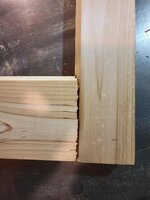
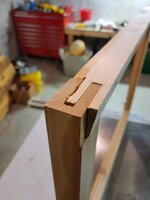
I know there's some pretty smart guys on here, so I figured I'd ask for some help. I have been stuck trying to build some replacement sashes for our house for the last year. For some reason I just can't wrap my head around the exact math for the dimensions of the rails/stiles.

I finally managed to get one built. Its ugly. It's also too big for the window casement, and too small to fit the glass. The moulding rebates aren't clean, and don't mesh well into the mortise.

I'd be curious to hear some thoughts or advice on this one.

AbCJW1ll.jpg
COAPF6dl.jpg
bxwmEEll.jpg
yk1FYZnl.jpg
 

Woody1320

Well-known member
Joined
Sep 27, 2017
Messages
164
Location
Southeast Michigan
Woody: Home maintenance is not exactly fun but, at the very least, it's an opportunity to use tools and maybe justification for acquiring new tools. Some of the pieces of the old stairs seem to show signs of rot. Were they in contact with the soil?

Part of the deck was, unfortunately. But it was also not really anchored to the ground all that well. And fastening of stringers and posts on the deck was done with nails....far too many nails.
 

HenryAZ

MEMBER EMERITUS
Joined
Sep 18, 2012
Messages
1,054
Location
South Congress AZ
I finally managed to get one built. Its ugly. It's also too big for the window casement, and too small to fit the glass. The moulding rebates aren't clean, and don't mesh well into the mortise.

I'd be curious to hear some thoughts or advice on this one.
If you do not have a good cope cutter for your mortise and tenon joints, you can always hand miter the sticking (molding). Mitering it makes a really neat job, at the cost of more time.
 

NBraun

Well-known member
Joined
Sep 14, 2020
Messages
158
Well, I'm using a rail and stile router bit set currently. And it looks like there is a discrepancy in where the stick and cope are meeting, but can't quite figure out the exact culprit.
 

CRSINMICH

Well-known member
Joined
Aug 15, 2015
Messages
2,397
Location
Southeastern Michigan
NBraun: There are multiple interconnected issues with your rail and style cutters. Most of them are likely alignment issues but some could be poor quality cutters. Here's a tip I saw many years ago. If you solve your problems, make set-up blocks from hardwood or delrin and use them to set up your cutters the next time you use them. Good luck. FULL DISCLOSURE: I haven't used my router for years and I wasn't that good with it even back then.

p.s. Don't worry too much about the glass fitting into the frame. You can always have new glass cut to fit. That would be one less dimension to deal with.
 

fartymarty

Well-known member
Joined
Nov 9, 2012
Messages
1,348
Location
Fort Worth
I'm certainly no expert wood worker, (<--I've emphasized this, perhaps unnecessarily:rolleyes:) but just looking at the photos of the cuts, it looks like either the cutters are very dull or the cutting speed (not feed, but RPM) is too slow...wood looks like it wasn't cut but rather beaten into the shape it's in. Was that the result of trying to force it together with a mallet?

Perhaps showing the cuts before it was beat on will give those here with more expertise something to work with to help you?

As for the math on how to get the frame to fit the opening...if its not estimate then keep taking light cuts until it's right..then I'd be interested on how the math works as well.
 

NBraun

Well-known member
Joined
Sep 14, 2020
Messages
158
Thanks for the input guys.

The rest of the cut looks fine, it just seems to have some tear out on the edges. I did some more messing around with it, and it definitely seems like it's a cutter setup issue.

Here's a cleaner picture.

8dm6qObl.jpg

and here's a scrap piece that I cut that does fit, just not the right height.

vzhVU0bl.jpg

Bits that I'm using..

1i3SJGYl.jpg

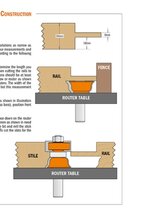
I'm following CMT's instructions for setting the bits up. Cutting a 1/4 rebate on the Tenon side, and then setting the rabbiting but up to just touch the top of the tenon. It just seems very odd that they wouldn't work.
 

Woody1320

Well-known member
Joined
Sep 27, 2017
Messages
164
Location
Southeast Michigan
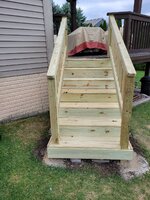
Well, one set of deck stairs is done. Time to start demo on the other set. It's a ten footer....but it's steady as all get out. I'm still proud of it lol.
 

Attachments

  • 20220714_182510.jpg
    20220714_182510.jpg
    442.5 KB · Views: 33
  • 20220715_184124.jpg
    20220715_184124.jpg
    638.4 KB · Views: 29
  • 20220715_184152.jpg
    20220715_184152.jpg
    645.8 KB · Views: 28
  • DecoPic_20220716_213343(5).jpg
    DecoPic_20220716_213343(5).jpg
    147.3 KB · Views: 27
  • 20220717_145556.jpg
    20220717_145556.jpg
    530.9 KB · Views: 29
  • 20220717_145604.jpg
    20220717_145604.jpg
    536.2 KB · Views: 33

NBraun

Well-known member
Joined
Sep 14, 2020
Messages
158
Figured I would update that I believe I figured it out. The instructions that came with the bit have it so you make a 1/4" Tenon. Well the sash that i'm replicating has a 3/8 tenon, so that's what I made. Apparently it does not work like that. I tested it following the directions exactly, and it seems to have worked much better.
 

HenryAZ

MEMBER EMERITUS
Joined
Sep 18, 2012
Messages
1,054
Location
South Congress AZ
Figured I would update that I believe I figured it out. The instructions that came with the bit have it so you make a 1/4" Tenon. Well the sash that i'm replicating has a 3/8 tenon, so that's what I made. Apparently it does not work like that. I tested it following the directions exactly, and it seems to have worked much better.
Sounds like you might have the wrong bit set. 6/4" stock (sash, interior doors, etc.) normally has a 3/8" mortise/tenon. 3/4"/4/4" stock uses the 1/4" mortise/tenon. 8/4" stock, 1/2" mortise/tenon. But sounds like you got it to work, so that is good.
 

jar944

Well-known member
Joined
Jul 26, 2010
Messages
5,911
Location
Northern VA
Figured I would update that I believe I figured it out. The instructions that came with the bit have it so you make a 1/4" Tenon. Well the sash that i'm replicating has a 3/8 tenon, so that's what I made. Apparently it does not work like that. I tested it following the directions exactly, and it seems to have worked much better.

It's a metric set, so everything in imperial will be slightly off. You could use a 3/8 tenon but it will be a slightly different construction. The cmt set needs 16mm from the inside face to the tenon cheek (where a typical American window would be 12.7mm 1/2") The tenon thickness (not centered) can be whatever you wanted.
Screenshot_20220719-094352_Chrome.jpg

Screenshot_20220719-095656_Samsung Notes.jpgScreenshot_20220719-095746_Samsung Notes.jpg
 

NBraun

Well-known member
Joined
Sep 14, 2020
Messages
158
It's a metric set, so everything in imperial will be slightly off. You could use a 3/8 tenon but it will be a slightly different construction. The cmt set needs 16mm from the inside face to the tenon cheek (where a typical American window would be 12.7mm 1/2") The tenon thickness (not centered) can be whatever you wanted.
Screenshot_20220719-094352_Chrome.jpg

Screenshot_20220719-095656_Samsung Notes.jpgScreenshot_20220719-095746_Samsung Notes.jpg
Thanks for the input!

That would make sense for the metric vs imperial. So I won't be able to make a centered 3/8 Tenon style sash with this bit set, but could do an offset 3/8 tenon? I'm having a hard time thinking about how that would work. Seems I would have to cut 3/8 on the shallower side of the tenon, which would interfere with the moulding/rabbeting bit.

On a slightly different note, do you have any recommendations on sources I can do some more reading/learning about millwork and stuff like this? This is definitely not going to be the last project like this, and I am not too bright on some of this stuff, as you can tell.
 
To avoid these ads, REGISTER NOW!
Top Bottom