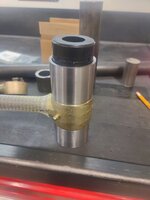
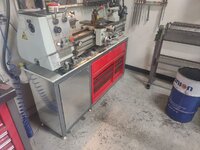
A month or so ago, I rebuilt the two upper front Johnny Joints on my Jeep as they were exhibiting some play. When I dropped the rear lower from the Jeep the other night in preparation to replace the fuel cradle/skid, I noted some play in the rear lower so I just decided that I would rebuild the remaining 6 Johnny Joints on the Jeep starting with the one I had to remove.
Just as I was beginning to tear the joint apart, the guy who was buying my engine hoist called to see if I was home. This gentleman is a friend of my cousin's and his same Model A club. I posted the engine hoist on FB MP Thursday and then just text my cousin to see if he knew anyone who could use one. I guess as soon as my cousin contacted this guy and told him it was the style that had the parallel outriggers, he said he'd take it without even seeing any pictures of it. I text my cousin some pictures anyways, but it sounded like it was a done deal based on the parallel outriggers. Seems like he feels the same way I do.

I grabbed the engine hoist and moved it from the RV/storage bay over into the main shop awaiting his arrival. It's been a great hoist, but time to go to a new home.
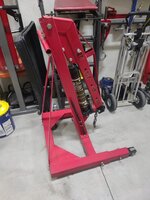
I just started disassembling the Johnny Joint when the guy arrived to pick up the engine hoist. He was thrilled with the hoist and then we stood around talking cars for nearly an hour after he wanted a tour of my shop. Turns out this gentleman owns 31 different collector cars, many of them from the 1920's era. When he spotted my welders and machining equipment, he asked if I ever take on the occasional welding or machining side job and I told him I had been known to take on a little side work.
He enjoys buying and fixing up older cars but when it comes to welding and machining, he usually has to either scrap the parts or hire out the work because it is beyond his capabilities, so I mentioned I would be interested in the future if he needs something worked on, so it turned out to be a great chance meeting and he seems like a very nice gentleman.
After he left, I continued work on the joint. Here it is disassembled and ready to be cleaned and prepped for reassembly.
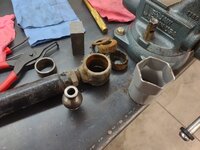
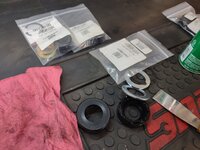
New rebuild kits at the ready.
The zerk didn't want to accept grease so I replaced it while I had it apart.
Pressed the new bushing with greased ball into the housing.

Compressed enough to install the new snap-ring.

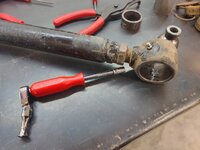
With the joint rebuilt, it was time to grease the joint. The greasing of these is critical, even though there are grease grooves/slots around the joint, I don't feel the grease gets evenly distributed around the spherical joint unless the joint is moved through its range of motion while greasing. I add a small amount of moly grease during assembly, but then once assembled I clamp it in the vise, grease the joint, then move it through the full range of motion while continuing to add a bit of grease.
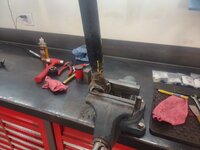
Moved to one extreme.

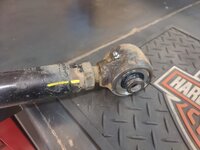
Then back to the other extreme, greased and repeat. Then after removing from the vise a final wipe to remove any excess grease.

Then it is set aside and ready for installation.
My fuel cradle/skid should be here in the next day or two so I can replace it and move on to rebuild the remaining Johnny Joints. These joints have held up the best of any I have tested and the only ones I stand behind. I've used some imitations but these are the best on the market, hands down.
I have just over 80k on these particular joints on my personal Jeep and many of the Jeeps I work on see routinely over 50k between rebuilds, with many of them seeing much more extreme use than I put mine through. Some of the imitation joints I've used over the years are lucky to get 10k-15k out of them and even less after one good off-roading trip where the Jeep flexes a lot, such as the Rubicon or a weeklong off-road trip with a lot of technical trails which can clap out a set of lesser quality joints in short order. Yet these original Johnny Joints by Currie, just keep on going and take the abuse.
Thanks for looking.
Thanks for looking.