To avoid these ads, REGISTER NOW!

Anyone know anything about JO-Line torque wrenches?

To avoid these ads, REGISTER NOW!

Old Radar

Well-known member
Joined
Apr 17, 2019
Messages
2,755
Location
San Antonio, TX
Bill--
Thanks for your detailed response! I'm sorry to hear that your dad has passed--may we all push the threshold of becoming a centenarian with our faculties mostly intact.
I couldn't find any photos on the net of a 2505 or a 50 PJ, but I'll keep my eye out for them. In the meantime, I'll store my 1/4" Jomi in the metal box.
 

Etchase

Well-known member
Joined
Nov 10, 2017
Messages
2,001
Location
Hawaii
Radar:

My apologies for the delayed response. My wife demanded that I take her somewhere where she could stick her toes in warm sand. Happy wife, happy life - so I did. I am now getting back to my correspondence.

Your box predates me. For reasons I will state below, I can no longer consult Dad. Thus, I am doing a bit of guesswork.

Your box is stamped with Jo-Line's South Gate location, with the name of the company stated as "J O Mfg.". The company changed its name from J O to Jo-Line sometime in the 1962-1963 period. It moved from South Gate to Anaheim, California in 1968. Thus, your box probably dates to the late 1950's or early 1960's.

As I have noted above (I hope), the metal boxes like yours were made for government orders. The government purchased torque wrenches on individual contracts. I will post at some point the stories I heard about how the government specs for torque wrenches were heavily influenced by Grandfather but, still, each Request for Proposal from the government was different. However, I never saw the government order ratchet torque wrenches. Thus, I will assume that your box relates to a wrench that lacked a ratchet.

Next, I will assume that the wrench that came in your box was a standard J O (OK, Jo-Line - the products didn't change much when the name changed) product. That is, the wrench that originally occupied your box was what we at Jo-Line called a Size 0, 1, 2, 3, or 4 (be happy to expand my comments on those sizes if anyone's interested). Those sizes were the ones Jo-Line sold to commercial customers. If that assumption is correct, then the wrench that was originally in your box would have been virtually identical in appearance to the wrench Fishyfool asked about in Post 186 and to which I replied in Post 195, except that Fishyfool's tool was what I would call a Size 0 and the wrench that originally occupied your box was a Size 1. Fishyfool's tool was a 2002 AIM (see post 195 for more on what that means). My guess is that your tool would have been a 2503 AI (I have no idea if the government would have ordered dual imperial/metric scale tools, that would make that "AI" into an "AIM" for metric). A 2503 differs from a 2002 in three important ways. First, a 2503's range of torque values for which it could be used went from 30 inch pounds on the low end to 250 inch pounds on the high end. The 2002 only went from 30 to 200 inch pounds. Second, the drive (some call it the "tang") on the square drive is 3/8 inch on a 2503 while it is 1/4 inch on a 2002. Third, a 2002 is 8 7/8 inches long, while a 2503 is 13 inches long. Fishyfool's tool would slide back and forth in your box, but a 2503 would not.

Now, it's possible that my assumption above was that your box held a wrench that conformed to a standard size, Size 1 in your case. What if that assumption is wrong? Well, if so, I'd put my money on your box's original wrench might have been a 50 PJ. The 50 PJ is a preset tool (one whose torque setting was set at the factory and could not be changed in the field) that could be set anywhere from 120 to 600 inch pounds. I looked online for a picture of one of these, and couldn't find one. They are pretty unusual. However, if you think of something that looked like Fishyfool's 2002 except that the handhold didn't rotate (kind of like a Jotru would look like if the Jotru didn't have a rubber handhold - I found tonight a number of photos online of Jotrus), about which there are posts above, and there was a female hex drive in place of the square drive on the 2002

That's the best I can do!

Now, I said above that I can no longer consult with Dad. Dad passed away peacefully on August 15, 2024, a couple of months shy of his 100th birthday. He and I had spoken about how much he enjoyed being that old, which is to say "not much." He made me promise that I would stand aside and let him go when his time had come, just as he had done for his mom and his wife. I promised that I would do so, and I kept my word when the time came. His death was as much a relief as it was a loss.

I am soloing from here on out.

Bill

Deepest sympathy for your loss. He sure had many accomplishments. And thank you for documenting the history.
 

Private Lugnutz

Well-known member
Joined
Mar 30, 2012
Messages
30,574
Location
The Authentic Jersey Shore
So sorry to hear about "Dad," Bill. Even though there were many miles, many electrons, and a pair of able hands and fingers between he and us, I dare say we all felt like we got to know him through your posts, and it was an honor and a privilege. Be well.
 

Steve_P

Well-known member
Joined
Sep 15, 2010
Messages
5,185
I missed this thread since I'm not into vintage tools and rarely check out that board. I'd ever heard of JO, or JO line before but I really enjoyed reading this because of the posts by Bill. Edit- I just finished reading the entire thread, straight thru.

Bill, sorry to hear about your dad, but hopefully being asked questions about the company and products over the last years of his life gave him satisfaction and pride that people were still interested in the company.
 

Jay__Dub

Well-known member
Joined
Nov 19, 2024
Messages
1,250
Location
Cold Country, Canada
I have read this thread with great interest. It is amazing that this information is out here on the internet for collectors. No doubt your Dad was an encyclopedia of information for these tools. What a history. Condolences to you on his passing.

I acquired a JO torque wrench this week, with the case. It is in amazing condition, save for the head, which appears seized. I'll have to get it out in the shop and take it apart to see what I can find out. The head is loose, but won't turn in either direction. Happy to have this tool, and find out so much great info on it.J-O.jpg
 

Jay__Dub

Well-known member
Joined
Nov 19, 2024
Messages
1,250
Location
Cold Country, Canada
So I took this wrench apart today. The top end I should say. There is a bearing on each side of the arm, they were not free. They are now. However, I don't see a ratchet device of any kind. So I don't think it ratchets. I could not get the head to turn independently of the wrench at all. If I'm wrong, I'd be happy to know it. So I put it back together and tried it out, got a click on a wheel nut on one of my vehicles. I'm not sure why there are full bearings if it doesn't ratchet. I guess that may be the only way to get the tool to work how it's required. My modern torque wrenches are ratchet wrenches so I was expecting that I guess. Anyway, live and learn.
JO-FX.jpg
 

Old Radar

Well-known member
Joined
Apr 17, 2019
Messages
2,755
Location
San Antonio, TX
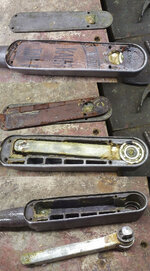
I found an empty Jo-Line steel case today at an Estate Sale.
It is embossed vs. labeled and is 12.5 x 1.75 x 1.5.
It has a full length piano hinge and the top & bottom sides meet at an angle vs. horizontally.
I was hoping Bill @Grayspoked could tell us which tool came in this case.

Nov 16 24b.jpg

Nov 16 24d.jpg

Yesterday I found this Jo-Line JOTITE 100-750 inch/pound torque wrench. I picked it up because I thought it might fit in the metal Jo-Line box I found a couple of months ago.

Jan 23 25c.jpgJan 23 25d.jpg

I know Bill thought a 2503 or a 50 PJ would be the correct wrenches to go in this box, but I haven't found either one.
He also thought the 2503 was 13" long, but this box is only 12-1/2" long.
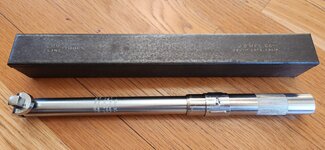
Jan 23 25e.jpg

This JOTITE Series A, Size 2, fits snugly in the full open setting. I thought perhaps it was another instance of the box supplier delivering boxes that were smaller than spec and JO needing to get the finished product out the door to meet the delivery date and therefore were forced to use the short boxes. Turning the handle from 100 to 150 makes the wrench fit comfortably. Now I just need to find some foam to fab an insert to keep the wrench safe.
Jan 23 25f.jpg
 
Last edited:

Old Radar

Well-known member
Joined
Apr 17, 2019
Messages
2,755
Location
San Antonio, TX
^^^ Yes. Absolutely. However, the spring has a base tension of 100 inch-pounds--the lowest setting on the dial. To avoid touching the tool to the inside ends of the box, I turned the handle a single revolution--which equates to an additional 50 inch-pounds, which is 7.7% of the available tension. Not nothing, but not "a lot". For long term storage, I'll heed your warning.
 

MR.X

Well-known member
Joined
Dec 13, 2010
Messages
1,792
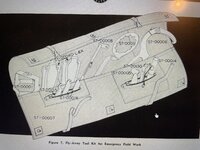
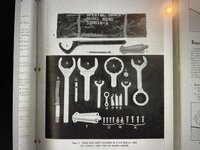
B-24 Bomber tool kits from 1943 Consolidated Vultee field service bulletins. “JOCO” next to the Dzus in the emergency kit and “JOBE” below the adj spanner in the other kit.
 

Attachments

  • IMG_7202.jpeg
    IMG_7202.jpeg
    1.2 MB · Views: 29
  • IMG_7203.jpeg
    IMG_7203.jpeg
    1.5 MB · Views: 28
  • IMG_7205.jpeg
    IMG_7205.jpeg
    1.3 MB · Views: 24
  • IMG_7207.jpeg
    IMG_7207.jpeg
    1.5 MB · Views: 24
  • IMG_7209.jpeg
    IMG_7209.jpeg
    1.2 MB · Views: 21

Grayspoked

Well-known member
Joined
Jul 5, 2019
Messages
52
Location
Pasadena
Mr. X:

Been busy of late, so I haven't been as active here as I should have been. I hope that situation will cure itself a bit over this month. We'll see.

I had heard (and had reported on a couple of times in this thread) about J O products that were used on early model B-17s. I had not heard of any used on B-24s, although given that the use of torque tools on aircraft and motor vehicles by the military was where the action (and money) was during World War II, I expect that Grandfather would have been actively beating down the doors of anyone who had the power to buy his products and who would listen in order to sell things like JOCOs and JOBEs.

Unfortunately, I can no longer go back to neither of Grandfather or Dad to get these things confirmed.

I have heard of JOBEs. I dimly recall seeing one in the ancient tool vault at Jo-Line 50 years ago. Thus, I would expect that the JOBEs that turn up in B-24 tool kits are JO products. The JOCO rings no bells.

It'd be great if you could post a photo of the manufacturer's logo on either of the JOBEs or JOCOs you may have seen, assuming you have seen them. It's possible that what you have is an eagle eye for looking at grainy old photos and notices the names, too. I appreciate those, too. On the theory that you never get what you don't ask for, I'll just note how much I'd love to see photos of the tools themselves. A reference to their having been manufactured in South Gate, California would seal the deal.

Thanks for the photos!

Bill
 

Grayspoked

Well-known member
Joined
Jul 5, 2019
Messages
52
Location
Pasadena
Yesterday I found this Jo-Line JOTITE 100-750 inch/pound torque wrench. I picked it up because I thought it might fit in the metal Jo-Line box I found a couple of months ago.

Jan 23 25c.jpgJan 23 25d.jpg

I know Bill thought a 2503 or a 50 PJ would be the correct wrenches to go in this box, but I haven't found either one.
He also thought the 2503 was 13" long, but this box is only 12-1/2" long.
Jan 23 25e.jpg

This JOTITE Series A, Size 2, fits snugly in the full open setting. I thought perhaps it was another instance of the box supplier delivering boxes that were smaller than spec and JO needing to get the finished product out the door to meet the delivery date and therefore were forced to use the short boxes. Turning the handle from 100 to 150 makes the wrench fit comfortably. Now I just need to find some foam to fab an insert to keep the wrench safe.
Jan 23 25f.jpg
Radar:

Again, my apologies for being slow with replies. I found myself sitting next to Warren Buffett's long-time, but then-retired, general counsel at a dinner in the months before I retired (this was some years ago). I went on with him at some length about how I was concerned that I would be bored and have nothing to do in retirement. His response was succinct and to the point. "Busy people stay busy." He was absolutely right.

I have several things to say about your tool.

First, and most obviously, it is what I have called a "government" tool in some posts above. Given that it is a Series A, I'd guess it dates to sometime between the late 1950's to maybe as late as 1972. I am not real good on when wrenches moved from Series A to B and finally to C, but the As are the oldest. However, it is my recall that the Series A stamping stayed on the government wrenches longer than it did with the commercial ones - but my memory may be faulty on that. Also, just in case there was any doubt, yours is a JO/Jo-Line product. I haven't seen one of these in 50 years, but I saw (and built and shipped, too) a number of these back then.

The original box would have narrowed my dating range. I would have given you an earlier date (probably ending in the 1962-1965 range) if your JO box was original with the tool. I would have given you a later date if the exact same tool showed up in a later model box. The tools didn't change much over the years but the boxes did - there were cheaper ways to manufacture them than yours, and Dad ultimately went to cheaper boxes for government tools. I would guess a later manufacturing date for your tool, but that's only because your tool is so freaking gorgeous. Looking at it makes it impossible for me to overlook some memories of a plastic pan full of these things glistening softly and sitting on the conveyor rollers in the Shipping Room, awaiting packing and shipping. Of course, your tool was clearly handled with such care over the years that it could date back to an earlier time because it simply had the good luck to fall into the hands of a serviceman who treated it well for a reaaaally long time, instead of just a really long time.

One of the aspects of a government tool that was different from a commercial/private label one is the lock ring. The lock ring is the broad thin metal band around the handhold. You use it to lock the tool at the desired torque setting. The commercial tools used a narrow (1/2"?) wide fairly thick metal band under which there was a spring mechanism to hold the desired setting. Government wrenches had this broader, thinner band that your photos show. As you can see, there is a ball mechanism here that holds the tool's setting. There is a hard steel ball bearing in there that slides down into a hole in the handhold and locks the tool.

Another thing about the government wrenches was that handhold. I'd see the tools that came back for repair, because I worked in the repair room for three years. The handholds typically came back with evidence of grease and oil deeply embedded in them. This was no surprise, given that they were most often used in some aspect of the automotive and aviation industries. The Snap-ons, with their blue anodized aluminum handholds with extensive knurling would come back smooth with grease packed in every ridge. Tools with black rubber handholds would come back a bit slippery from grease and oil. I don't recall ever seeing a government wrench coming back for repair (did they just throw the tools away when they broke?), so I can't observe from experience. I would expect that the smooth metal handhold with the very light knurling in the center f your government tool would get real slippery, real fast. However, these handholds were cheap, which is why you see them on government tools.

The settings on your tool are also unusual. They do not conform to any commercial tool of which I am aware. Looking at my 1970's era Jo-Line catalog, a 13" tool would be consistent with the 2503 AI to which I have referred above The 2503 was 13" long, as you note. It looks like your tool is about the same length, because you had to roll it up a little to get it to fit into your 12.5" box. However, I can find no record (and don't recall ever seeing) a commercial tool with a range from 100-750 inch pounds. I have plans (hopes?) of writing a separate post about what Dad told me about how he came up with the performance specs for JO/Jo-Line products. Basically, he talked to the line guys in the auto industry to find out what they wanted, and then created a tool that met those needs. The commercial 2503 (which is in the range of tools I'd call a "Size 2," so that labelling on your tool fits) had a range of 30-250 inch pounds. Yours has a range from 100-750 inch pounds. Jo-Line had a Size 3 wrench whose scale was measured in inch pounds - 300-2500. It sold miserably, but it existed. Yours is therefore in the middle between what I would think of as a Size 2 and a Size 3. Call it a Size 2 1/2. The government had some specific torque need in mind when it issued a Request For Proposal (maybe they didn't use that term yet, but that's the one I've heard) for this tool. The thing is, you'd need an entirely different spring and pivot for this tool than you needed for a a regular Size 2 or Size 3. The spring would have to be about the same size as a Size 2 in order to fit into your tool's spring tube (the "spring tube" is the main body of the tool - it's south end is inserted into the handhold and its north end holds the drive). However, it would have to have the ability to start at and go much higher in its tension than a 2503. This would cause the relationship between the spring and the pivot to change. Making the pivot would be the easy part. The pivots were of standard height and width, differing only in length. The pivot-making machine could easily be set to cut them at a different length than usual. My recall is that the springs were outsourced, so their manufacturer would have to be in on this.

My guess is that my Dad, Ziggy Sopinski (the engineer/designer) and Lester Trimble (the metal miracle worker out in the shop) had a number of meetings and tests to get your tool to work.

There are two interesting things about the drive on your tool

First, the design of the head is unique to government tools after about 1950. Here's the problem. The design of your tool is the most accurate torque tool out there. Why, and why do I make such a big deal about that? Well, the micrometer torque wrenches "broke," or, in English, felt like they gave way and stopped tightening for a few degrees with a tactile and sometimes audible "click," indicating that the desired torque tension had been reached. This is what made them superior to the "beam-type" torque wrenches. You could set and forget a micrometer wrench and know that you couldn't screw up your tightening. The user of a "beamer" had to read the force being applied where the beam was indicating on the scale near the handhold. Of course, the user's bending his body to read the scale changed the readings. Thus, the beamers had built-in inaccuracies that were simply unavoidable.

The issue concerning accuracy was how you designed a micrometer tool so that it was really accurate. Resolving this issue required some physics. The first question was where, as a matter of physics, was the fulcrum of the tension between the force-applying user and the bolt being tightened at which the torque was actually being measured. The act of the user's tightening a nut created a tension in the tool that eventually caused it to "break." Where was the focal point of that tension that caused the tool to "break"? Answer: at the pin (called a "hinge pin") holding the "hinge" (that's the top part of your tool where the drive is located) to the spring tube. You can't see your tool's hinge pin in the photos you attached, because the tang assembly covers it from this angle. However, you can see it from the other side of the tool. It ought to be about 1/8" wide and made of dark metal.

OK, so what do we do with that information? Well, physics then tells us that putting the tang on the square drive right over the hinge pin is exactly the right place to put it. The physics of the "break" place the fulcrum of force right there, so putting the tang at that point conforms how the tool measures tension in the system to where that tension is being applied. Voila! an accurate tool.

Thus, your tool has that interesting assembly for the drive. There is a (mostly) cylindrical piece of metal (called the "hinge") that goes into the spring tube and touches the pivot. The hinge pin to which I referred above holds the hinge to the rest of your tool. To that hinge is soldered a flat-headed tang assembly that bends at a 90 degree angle as soon as it clears the spring tube. That assembly drops down the spring tube so as to position the tang directly above the aforementioned hinge pin. BINGO! The tang is over the hinge pin, thus allowing a level of accuracy in torque measurement that was (and remains) truly amazing.

So, problem solved, right? American engineering triumphs again, right? An assembly of steel and grease and American ingenuity that produces amazing levels of accuracy with none of the technological wizardry we see these days that, for example, allows for a miracle of modern tech like Garage Journal, right?

Not exactly.

The problem was that the market assumed that micrometer torque wrenches it bought were sufficiently accurate for their intended purposes. What the guys who bought tools demanded was a micrometer torque tool that looked bitchen (that's the word we used in the old days. It was made obsolete by cool, which itself was obsoleted by awesome) in a guy's tool box. The market decreed that tools like yours were ugly, and not bitchen.

Guys didn't buy ugly tools, and so they refused to buy tools that had the amazingly accurate tang assembly that yours has. Instead, they demanded torque wrenches that had the tang/drive at the very top of the tool, so that the handhold of the tool was at one end, and the drive with which he tightened his nuts (pun intended) was at the other, in a straight linear fashion. They wanted a torque wrench that looked like the other wrenches in their tool boxes, just a little more bitchen because it was clearly a precision tool (thus implying that its user was really precise).

Dad was horrified. He couldn't buy my mom a house or my sister and me college educations if he couldn't sell his torque wrenches to the guys who bought tools. However, what the guys wanted to buy was inaccurate. Dad also didn't want to be on the receiving end of a string of lawyers' letters alleging negligence because an improperly tightened nut had caused a car to fall apart on the freeway or an airplane to fall out of the sky (I know - too soon, but true). What to do?

Dad gathered Ziggy and Les together yet again to figure out how inaccurate was a torque tool that was linear in form (and therefore both bitchen and marketable) as compared to one with the tang over the hinge pin (ugly and unmarketable), like yours. Cutting to the chase, they found that a linear tool introduced inaccuracies in the 2-4% range as compared to your tool. Thus, a guy with a bitchen linear torque wrench set to 100 foot pounds had a tool that would actually break at somewhere between 98 and 102 foot pounds to between 96 and 104 foot pounds. It could also break at exactly 100 foot pounds, but you could never be sure.

Then Dad made an even more horrifying discovery. The American automotive and aviation industries did not care about these inaccuracies. These ranges of inaccuracy were within their ranges of tolerance. What they wanted more than the most accurate tool on the market was a tool that looked bitchen in their tool chests. Americans would not buy accurate wrenches. They would only buy bitchen ones.

Then Dad made the ultimate horrifying discovery. The buyers who wanted their torque tools to be bitchen rather than accurate were right. The ranges of inaccuracy brought about by the linear form made no difference to the ultimate objective - a properly tightened fastener. Dad found that American industry tended to overtighten fasteners. He further found that users of his torque tools didn't actually apply engineering principles or principles of physics to determine how tight a fastener should be. Instead, users tended to get an old experienced guy in the shop to tighten a fastener with a torque wrench and pronounce it properly tightened. Then, everyone in the shop would set their torque wrenches to what the old guy had pronounced and go to work. Old guys had learned how much tension meant that you never got in trouble, which meant that American fasteners were typically a little more tightened than they needed to be - a practical safety factor, if you will. Workmen didn't overtighten to the point of stripping fasteners, but they could have gotten away with materially less tightened fasteners and still had safe cars and airplanes. A torque wrench that read high (e.g., 102 or 104 foot pounds) wouldn't strip the fasteners. A torque wrench that read low would still likely overtighten the fasteners to which it was applied; the old guy's overtightening was typically more than 4% of the minimum safe tolerance for tightening. The low-reading torque wrench did not result in an inappropriately tightened fastener.

The government was different. Procurement officers were not guys with tool chests and bitchen tools. They were guys with specifications and clipboards and clean fingernails. The specifications mandated accuracy, not bitchen-ness. So, the military demanded wrenches with the "drop-down" hinges like yours has. I do not recall a Size 0-3 torque wrench with your drop-down tang assembly on any commercial tool, only the government ones. All government wrenches that I recall had your head assembly.

Long story. I hope it was interesting.

Your tool is unusual for another reason. It looks like your tool has a 1/2" drive on it. This is the first Size 2 that I have seen with a 1/2" tang on it. Size 2's typically had 3/8" drives on them. I saw some that had 1/4" drives, but not many. Yours is a tool produced for a very specific need. Wish I knew what that need was.

One last point before I go take out the trash. There has been some commentary in the thread above about how rolling a micrometer torque wrench above its minimum setting for long-term storage is a bad idea. That commentary is philosophically correct. Increasing tension on the spring (sometimes called the "load spring") in long-term storage wears out the spring, and makes the tool unnecessarily inaccurate over time. However, the tool as built puts a small amount of pressure on the spring at its lowest setting. The tool would come apart internally if this was not true. I don't think there is a problem with yours rolling it up from 100 inch pounds to 150. The extra tension at that level is not great on a spring that scales up to 750 inch pounds. We had to roll the 2503s about which I told my story above much higher than that, which was the cause of my concern that I noted there.

I'll be back!

Bill
 
To avoid these ads, REGISTER NOW!

Old Radar

Well-known member
Joined
Apr 17, 2019
Messages
2,755
Location
San Antonio, TX
Long story. I hope it was interesting.
It was and it most certainly was!

It looks like your tool is about the same length, because you had to roll it up a little to get it to fit into your 12.5" box.
At the minimum 100 in-lb setting the wrench is exactly 12.5 inches long and fits into the box, but scrapes the ends.
Rolling it up to 150 in-lbs shortens it by 1/16" and makes if fit--if not altogether comfortably.

You can't see your tool's hinge pin in the photos you attached, because the tang assembly covers it from this angle.
The design of your tool is the most accurate torque tool out there.
Being fairly ****--which is what it was called before OCD--I love having the most accurate tool vs. a bitchen one!
Here is a shot of the pin and shows how it aligns straight through the tang to the center of the drive stud.
BTW, the drive stud does look like a 1/2" in the previous pictures, but it is a 3/8".
Jan 23 25j.jpg

Thanks, Bill, for your thoughtful and insightful responses to our posts!

Another example of the importance of Marketing.
:+1:
 

MR.X

Well-known member
Joined
Dec 13, 2010
Messages
1,792
Mr. X:

Been busy of late, so I haven't been as active here as I should have been. I hope that situation will cure itself a bit over this month. We'll see.

I had heard (and had reported on a couple of times in this thread) about J O products that were used on early model B-17s. I had not heard of any used on B-24s, although given that the use of torque tools on aircraft and motor vehicles by the military was where the action (and money) was during World War II, I expect that Grandfather would have been actively beating down the doors of anyone who had the power to buy his products and who would listen in order to sell things like JOCOs and JOBEs.

Unfortunately, I can no longer go back to neither of Grandfather or Dad to get these things confirmed.

I have heard of JOBEs. I dimly recall seeing one in the ancient tool vault at Jo-Line 50 years ago. Thus, I would expect that the JOBEs that turn up in B-24 tool kits are JO products. The JOCO rings no bells.

It'd be great if you could post a photo of the manufacturer's logo on either of the JOBEs or JOCOs you may have seen, assuming you have seen them. It's possible that what you have is an eagle eye for looking at grainy old photos and notices the names, too. I appreciate those, too. On the theory that you never get what you don't ask for, I'll just note how much I'd love to see photos of the tools themselves. A reference to their having been manufactured in South Gate, California would seal the deal.

Thanks for the photos!

Bill
JOCO message 18 of this thread. I have tools marked South Gate but I don’t think that one is.
 

Grayspoked

Well-known member
Joined
Jul 5, 2019
Messages
52
Location
Pasadena
JOCO message 18 of this thread. I have tools marked South Gate but I don’t think that one is.
Mr. X:

Coincidences are funny things. I had gone back to look at the early posts in this thread a couple of nights ago out of curiosity concerning all the places this thread has visited over the years. I can see some loose ends there that I should tie up.

I saw your Post 18 when I was strolling down memory lane. I didn't dig deeply enough into it then to see the JOCO you depicted there. I went back after seeing your Post 224 (this thread's been active!) to look at it again.

I still don't recognize the JOCO that's in Post 18, as I noted in Post 19 and again in Post 219. My recall of things JO/Jo-Line and my review of my own collection of JO and Jo-Line products indicates that both Grandfather and Dad were monotonously consistent in branding their products. In the case of the private label business that Dad pioneered, the branding was of the private label customer. Even there, though, he put the JO/Jo-Line patent numbers on the spring tube or some other prominent spot so that a sufficiently determined sleuth could figure out who was really behind these tools. I intend to post a photo of the one example I have of Grandfather's pre-JO/Jo-Line manufacturing operations, and even that has a brand name on it (TEASER TO ALL: that brand name does not have either a "j" or an "o" in it).

Grandfather started JO as the onset of World War II opened up possibilities for making lots of money by selling things to the government. Lugz depicts wingnut sockets and a JODA set of pliers that both date to the earliest days of JO in Post 10. Grandfather figured out how to get both "JO Mfg" and "South Gate" onto those tools, which wouldn't have been any easier than putting those same brands on your JOCO had the JOCO been a JO Mfg product. See also the "egg beater" drill in Post 29, that also dates back to this period. It looks comparatively easy to put the "JO" and the "South Gate" on that tool compared to your JOCO and Lugz' wingnut sockets and, sho 'nuff, there they are.

You noted in Post 18 that you didn't think that the JOCO had anything about South Gate on it. Of course, now I can no longer ask Grandfather or Dad about JOCOs as I promised to do at Post 19 (but apparently didn't), but I'd be inclined to doubt its JO/Jo-Line provenance if the tool doesn't have some reference to either JO Mfg. or South Gate on it.

Bill
 

nk15268

Member
Joined
Aug 10, 2025
Messages
16
Hi, I'm new here and I just randomly came across this incredible thread. It reads like a detective novel/mini-series with Grayspoked starring as Dr. Moriarty. Simply amazing.

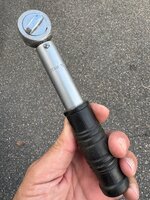
I just came across this JOTRU 10A in my father-in-laws tool box. I am currently sorting through his old tools after he went into a memory care unit last week. I initially couldn't figure out what this was but googled it and wound up here. I seems to be a preset torque wrench. I initially thought it was something with a built-in extension so I placed the male end in a vice and gently finagled with it. That's when I felt the click to the right and then the left and figured it must be a torque wrench so I ceased my finaglings. Very cool!

Can you tell me what this was for and what year vintage it was? My father-in-law was a helicopter mechanic in Viet Nam. He was drafted at age 19 and served his tour and came home a different person from what I hear. Sadly he now has Agent Orange-related Parkinsons Disease and memory issues that prevent him from answering any questions about his belongings and his past. Thank you for any assistance you may render to this mystery. Steve


IMG_1508.JPGIMG_1509.JPGIMG_1510.JPGIMG_1511.JPGIMG_1512.JPGIMG_1513.JPG
 

Outlawmws

Well-known member
Joined
Aug 9, 2011
Messages
39,241
Location
The Badlands
Sorry for your father's predicament, and thanks for his service.

That could be for anything; is there a stated setting on it? For presets, there usually is.

Bottom line is whatever its set for, it good for that torque setting anywhere.
 

nk15268

Member
Joined
Aug 10, 2025
Messages
16
No other information on the tool. I thought (from reading this thread) that the "10A" might be 10 foot pounds?
 

Outlawmws

Well-known member
Joined
Aug 9, 2011
Messages
39,241
Location
The Badlands
No clue, but if you have a pointer type Torque wrench you might be able to check one with the other? It needs a square socket the same size as the drive.
 

Grayspoked

Well-known member
Joined
Jul 5, 2019
Messages
52
Location
Pasadena
Hi, I'm new here and I just randomly came across this incredible thread. It reads like a detective novel/mini-series with Grayspoked starring as Dr. Moriarty. Simply amazing.

I just came across this JOTRU 10A in my father-in-laws tool box. I am currently sorting through his old tools after he went into a memory care unit last week. I initially couldn't figure out what this was but googled it and wound up here. I seems to be a preset torque wrench. I initially thought it was something with a built-in extension so I placed the male end in a vice and gently finagled with it. That's when I felt the click to the right and then the left and figured it must be a torque wrench so I ceased my finaglings. Very cool!

Can you tell me what this was for and what year vintage it was? My father-in-law was a helicopter mechanic in Viet Nam. He was drafted at age 19 and served his tour and came home a different person from what I hear. Sadly he now has Agent Orange-related Parkinsons Disease and memory issues that prevent him from answering any questions about his belongings and his past. Thank you for any assistance you may render to this mystery. Steve


IMG_1508.JPGIMG_1509.JPGIMG_1510.JPGIMG_1511.JPGIMG_1512.JPGIMG_1513.JPG
Steve (NK15268):

Welcome to at least this thread, and maybe to the Board!

I can maybe add some background to your father's tool.

Generally, I refer to the Jotrus generally, and Jotru 10s in particular, as "Van Belknap specials." I'll briefly summarize here, and then cross reference you to some posts above in this thread that can give you some more detail.

Van Belknap was my Dad's Detroit salesman in the late 1950's through at least the late 1960's (I met him in 1968) and maybe even the early 1970's. Dad had identified the automotive and aircraft industries as his most likely customer base by the early 1950's. The government had been the HUUUUGE customer of the company that became Jo-Line during WWII, but had become a non-factor as a customer by, oh, say 1946. The automotive industry in the United States was centered in and around Detroit in this era. Dad needed someone on the ground in Detroit. That someone was Van Belknap. Van founded his own company around the end of this era, which is still out there. You can find it on the Web.

Anyway, Van's approach was to come up with brilliant ideas for torque tools, for which he needed samples. He would call Dad, and promote his latest great idea. If Dad agreed with him, he would call Ziggy Sopinski from the design/engineering team and Les Trimble, miracle worker with metal, from the machine shop to execute on this great idea. Ziggy would design a tool meeting Van's specifications, and Les would make it. Dad wasn't terribly interested in spending gobs of money on tools for which there were no orders, so Les would cannibalize parts to make Van's prototypes. This accounts for their somewhat raw look.

Les and Ziggy would make between 1 and 15-20 of each kind of prototype tool. These would be shipped to Van who, reliably, would fail to sell them. This led to the breakdown in the relationship between Dad and Van.

I can no longer consult with any of the people who would know for sure about these matters. Dad, Grandfather, Les, and Ziggy are all gone now. However, I was able to ask Dad enough questions before he died, and to rely on my own (very youthful) memories of working at Jo-Line , to respond to a lot of the questions I get here.

As best I can tell, these prototype tools were all referred to as "Jotrus." The thread above has revealed Jotru 5s and Jotru 10s, and differently numbered Jotru 10s.

I expect that the raw nature of your father's tool (notice the bespoke welding job that keeps the tang attached to the body of the tool, and the unpolished look of the rubber handhold) reveals its provenance as a Van Belknap special. That means that it is pretty rare.

I speculate that it was manufactured sometime between the fairly late 1950's and 1968. Your tool reflects that it was manufactured by Jo-Line Tools, in South Gate, California. The company was generally referred to as "J O Mfg." on the spring tubes before the late 1950's. It then changed its name to Jo-Line. The company moved from South Gate to Anaheim, California in 1968 (there are references to this, and pictures of Anaheim spring tubes in the thread above). Hence my guess.

As Outlaw noted above, your tool is a preset torque wrench. This is typical of Van Belknap specials.

You noted that your tool "broke" at 50 inch pounds. I suspect that means that you could have bought a cleaner version of your tool from Jo-Line back in the day as a "9PJ" torque handle. I mean, as long as Dad was going to go to the expense of making a prototype, he might as well make it easy for someone to actually buy one. That said, I never saw any 9PJs shipped to customers in 9 years of working off-and-on at Jo-Line. 9PJs were presets that could be set anywhere between 36 and 108 inch pounds, with sockets into which you could put different drive attachments. That's another point that makes me think you have a Van Belknap special; the tang is welded onto the tool, and not attached to the tool by a drive attachment inserted into a socket. I have looked at other Jotru 10s in this thread, and all have looked like 9PJs.

None of this, unfortunately, tells me anything about what Van Belknap had in mind when he asked Dad, Ziggy, and Les to make your tool.

I doubt that your Dad's tool had anything to do with your Dad's military service. Jo-Line products were certainly used by the military during the Vietnam era, but any of those resembling yours would have been more like the 9 PJs, with sockets at the end of the tools and attachments having the drive/tang/ratchet. The bespoke welding job that attaches the tang to the body of your tool was simply too expensive to make for the relatively large orders that the military made (when it made orders at all). I reflect on military orders in a post above in this thread. The military was CHEAP, which is why Dad did not really pursue doing business with it. I wonder if your Dad liked to hang out at flea markets or had a wider tool collection. Van Belknap specials seem most frequently to pop up in these circumstances.

I am impressed, but not surprised, that your tool is still breaking at 50 inch pounds. A lot of the old Jo-Line products have held their settings well.

You can see more posts regarding Jotru 10s in this thread at Post Nos. 22, 23, 25, 28, 43, 48, 56, 75, 163, and 168.

I'd be interested in hearing about the size of the tang on your tool, Steve.

For everyone else, I have many more tales to tell. Life has just been really busy - in a good way, but still busy. I'll be back!

Bill
 

nk15268

Member
Joined
Aug 10, 2025
Messages
16
That is so cool! You are an amazing source of information. By tang do you mean the socket attachment point? It is 3/8" drive.
 

Outlawmws

Well-known member
Joined
Aug 9, 2011
Messages
39,241
Location
The Badlands
Thanks Bill for you time "filling in the blanks" - this is so important in the longer term, as this gets documentation where none existed before.
 

Grayspoked

Well-known member
Joined
Jul 5, 2019
Messages
52
Location
Pasadena
That is so cool! You are an amazing source of information. By tang do you mean the socket attachment point? It is 3/8" drive.
Steve:

The 3/8" drive supports my view that your Jotru 10A is a kissin' cousin to the 9PJ. The 9PJ came with other sizes of tangs, but few others came with the 3/8".

Outlaw: This board has given me the opportunity to tell stories I have long wanted to tell, but I knew of no one who was interested in hearing them. I intend to take full advantage of this opportunity. It'll take me some time - life has a multitude of things going on in it - but I will tell as many as I can and to which you guys are willing to listen/read.

Bill
 

Grayspoked

Well-known member
Joined
Jul 5, 2019
Messages
52
Location
Pasadena
No markings other than what's in the photos. It's a mystery tool. :)
All:

Oooops. I have to correct myself.

I said in response to Steve above that JO changed to Jo-Line in the late 1950's. I was perusing old posts, and ran into Post 198. I said there that the name change occurred in 1962-1963. I recalled upon reading that post that I got that dating from Dad, who will always be to me more accurate than my poor memory.

Thus, Steve, I can narrow my speculation as to when your Dad's tool was made. My revised speculation is sometime between 1962 and 1968.

Live and learn!

Bill
 

nk15268

Member
Joined
Aug 10, 2025
Messages
16
That's great. I was made in 1962 as well. Mom went into labor during the Cuban Missile Crisis. Gee, no stress there!
 

nk15268

Member
Joined
Aug 10, 2025
Messages
16
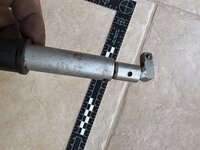
My wife came back from the in-laws house with more tools from my father-in-law. I found another JOTRU 10A!!!. This one has a ratcheting head and breaks at 75 inch pounds. It also has an interesting hand etched series of numbers on the shank: "527A04007-13". What say you, Grayspoked?
 

Attachments

  • IMG_1596.JPG
    IMG_1596.JPG
    658.4 KB · Views: 9
  • IMG_1598.JPG
    IMG_1598.JPG
    538.6 KB · Views: 9
  • IMG_1599.JPG
    IMG_1599.JPG
    627.4 KB · Views: 9
  • IMG_1600.JPG
    IMG_1600.JPG
    641.8 KB · Views: 8
  • IMG_1601.JPG
    IMG_1601.JPG
    595.3 KB · Views: 7
Last edited:
To avoid these ads, REGISTER NOW!
Top Bottom