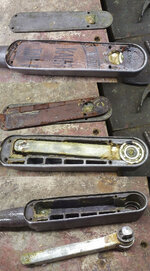
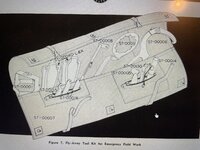
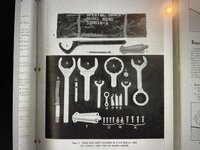
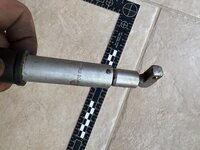
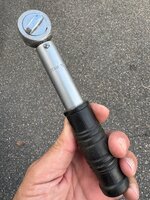
Yesterday I found this Jo-Line JOTITE 100-750 inch/pound torque wrench. I picked it up because I thought it might fit in the metal Jo-Line box I found a couple of months ago.


I know Bill thought a 2503 or a 50 PJ would be the correct wrenches to go in this box, but I haven't found either one.
He also thought the 2503 was 13" long, but this box is only 12-1/2" long.
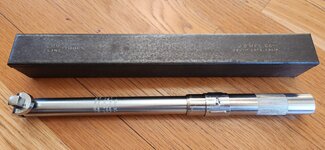
This JOTITE Series A, Size 2, fits snugly in the full open setting. I thought perhaps it was another instance of the box supplier delivering boxes that were smaller than spec and JO needing to get the finished product out the door to meet the delivery date and therefore were forced to use the short boxes. Turning the handle from 100 to 150 makes the wrench fit comfortably. Now I just need to find some foam to fab an insert to keep the wrench safe.

Radar:
Again, my apologies for being slow with replies. I found myself sitting next to Warren Buffett's long-time, but then-retired, general counsel at a dinner in the months before I retired (this was some years ago). I went on with him at some length about how I was concerned that I would be bored and have nothing to do in retirement. His response was succinct and to the point. "Busy people stay busy." He was absolutely right.
I have several things to say about your tool.
First, and most obviously, it is what I have called a "government" tool in some posts above. Given that it is a Series A, I'd guess it dates to sometime between the late 1950's to maybe as late as 1972. I am not real good on when wrenches moved from Series A to B and finally to C, but the As are the oldest. However, it is my recall that the Series A stamping stayed on the government wrenches longer than it did with the commercial ones - but my memory may be faulty on that. Also, just in case there was any doubt, yours is a JO/Jo-Line product. I haven't seen one of these in 50 years, but I saw (and built and shipped, too) a number of these back then.
The original box would have narrowed my dating range. I would have given you an earlier date (probably ending in the 1962-1965 range) if your JO box was original with the tool. I would have given you a later date if the exact same tool showed up in a later model box. The tools didn't change much over the years but the boxes did - there were cheaper ways to manufacture them than yours, and Dad ultimately went to cheaper boxes for government tools. I would guess a later manufacturing date for your tool, but that's only because your tool is so freaking gorgeous. Looking at it makes it impossible for me to overlook some memories of a plastic pan full of these things glistening softly and sitting on the conveyor rollers in the Shipping Room, awaiting packing and shipping. Of course, your tool was clearly handled with such care over the years that it could date back to an earlier time because it simply had the good luck to fall into the hands of a serviceman who treated it well for a
reaaaally long time, instead of just a really long time.
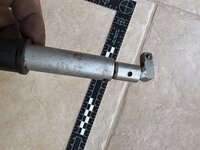
One of the aspects of a government tool that was different from a commercial/private label one is the lock ring. The lock ring is the broad thin metal band around the handhold. You use it to lock the tool at the desired torque setting. The commercial tools used a narrow (1/2"?) wide fairly thick metal band under which there was a spring mechanism to hold the desired setting. Government wrenches had this broader, thinner band that your photos show. As you can see, there is a ball mechanism here that holds the tool's setting. There is a hard steel ball bearing in there that slides down into a hole in the handhold and locks the tool.
Another thing about the government wrenches was that handhold. I'd see the tools that came back for repair, because I worked in the repair room for three years. The handholds typically came back with evidence of grease and oil deeply embedded in them. This was no surprise, given that they were most often used in some aspect of the automotive and aviation industries. The Snap-ons, with their blue anodized aluminum handholds with extensive knurling would come back smooth with grease packed in every ridge. Tools with black rubber handholds would come back a bit slippery from grease and oil. I don't recall ever seeing a government wrench coming back for repair (did they just throw the tools away when they broke?), so I can't observe from experience. I would expect that the smooth metal handhold with the very light knurling in the center f your government tool would get real slippery, real fast. However, these handholds
were cheap, which is why you see them on government tools.
The settings on your tool are also unusual. They do not conform to any commercial tool of which I am aware. Looking at my 1970's era Jo-Line catalog, a 13" tool would be consistent with the 2503 AI to which I have referred above The 2503 was 13" long, as you note. It looks like your tool is about the same length, because you had to roll it up a little to get it to fit into your 12.5" box. However, I can find no record (and don't recall ever seeing) a commercial tool with a range from 100-750 inch pounds. I have plans (hopes?) of writing a separate post about what Dad told me about how he came up with the performance specs for JO/Jo-Line products. Basically, he talked to the line guys in the auto industry to find out what they wanted, and then created a tool that met those needs. The commercial 2503 (which is in the range of tools I'd call a "Size 2," so that labelling on your tool fits) had a range of 30-250 inch pounds. Yours has a range from 100-750 inch pounds. Jo-Line had a Size 3 wrench whose scale was measured in inch pounds - 300-2500. It sold miserably, but it existed. Yours is therefore in the middle between what I would think of as a Size 2 and a Size 3. Call it a Size 2 1/2. The government had some specific torque need in mind when it issued a Request For Proposal (maybe they didn't use that term yet, but that's the one I've heard) for this tool. The thing is, you'd need an entirely different spring and pivot for this tool than you needed for a a regular Size 2 or Size 3. The spring would have to be about the same size as a Size 2 in order to fit into your tool's spring tube (the "spring tube" is the main body of the tool - it's south end is inserted into the handhold and its north end holds the drive). However, it would have to have the ability to start at and go much higher in its tension than a 2503. This would cause the relationship between the spring and the pivot to change. Making the pivot would be the easy part. The pivots were of standard height and width, differing only in length. The pivot-making machine could easily be set to cut them at a different length than usual. My recall is that the springs were outsourced, so their manufacturer would have to be in on this.
My guess is that my Dad, Ziggy Sopinski (the engineer/designer) and Lester Trimble (the metal miracle worker out in the shop) had a number of meetings and tests to get your tool to work.
There are two interesting things about the drive on your tool
First, the design of the head is unique to government tools after about 1950. Here's the problem. The design of your tool is the
most accurate torque tool out there. Why, and why do I make such a big deal about that? Well, the micrometer torque wrenches "broke," or, in English, felt like they gave way and stopped tightening for a few degrees with a tactile and sometimes audible "click," indicating that the desired torque tension had been reached. This is what made them superior to the "beam-type" torque wrenches. You could set and forget a micrometer wrench and know that you couldn't screw up your tightening. The user of a "beamer" had to read the force being applied where the beam was indicating on the scale near the handhold. Of course, the user's bending his body to read the scale changed the readings. Thus, the beamers had built-in inaccuracies that were simply unavoidable.
The issue concerning accuracy was how you designed a micrometer tool so that it was really accurate. Resolving this issue required some physics. The first question was where, as a matter of physics, was the fulcrum of the tension between the force-applying user and the bolt being tightened at which the torque was actually being measured. The act of the user's tightening a nut created a tension in the tool that eventually caused it to "break." Where was the focal point of that tension that caused the tool to "break"? Answer: at the pin (called a "hinge pin") holding the "hinge" (that's the top part of your tool where the drive is located) to the spring tube. You can't see your tool's hinge pin in the photos you attached, because the tang assembly covers it from this angle. However, you can see it from the other side of the tool. It ought to be about 1/8" wide and made of dark metal.
OK, so what do we do with that information? Well, physics then tells us that putting the tang on the square drive right over the hinge pin is
exactly the right place to put it. The physics of the "break" place the fulcrum of force right there, so putting the tang at that point conforms how the tool measures tension in the system to where that tension is being applied.
Voila! an accurate tool.
Thus, your tool has that interesting assembly for the drive. There is a (mostly) cylindrical piece of metal (called the "hinge") that goes into the spring tube and touches the pivot. The hinge pin to which I referred above holds the hinge to the rest of your tool. To that hinge is soldered a flat-headed tang assembly that bends at a 90 degree angle as soon as it clears the spring tube. That assembly drops down the spring tube so as to position the tang directly above the aforementioned hinge pin. BINGO! The tang is over the hinge pin, thus allowing a level of accuracy in torque measurement that was (and remains) truly amazing.
So, problem solved, right? American engineering triumphs again, right? An assembly of steel and grease and American ingenuity that produces amazing levels of accuracy with none of the technological wizardry we see these days that, for example, allows for a miracle of modern tech like
Garage Journal, right?
Not exactly.
The problem was that the market assumed that micrometer torque wrenches it bought were sufficiently accurate for their intended purposes. What the guys who bought tools demanded was a micrometer torque tool that looked
bitchen (that's the word we used in the old days. It was made obsolete by
cool, which itself was obsoleted by
awesome) in a guy's tool box. The market decreed that tools like yours were
ugly, and not
bitchen.
Guys didn't buy ugly tools, and so they refused to buy tools that had the amazingly accurate tang assembly that yours has. Instead, they demanded torque wrenches that had the tang/drive at the very top of the tool, so that the handhold of the tool was at one end, and the drive with which he tightened his nuts (pun intended) was at the other, in a straight linear fashion. They wanted a torque wrench that looked like the other wrenches in their tool boxes, just a little more bitchen because it was clearly a precision tool (thus implying that its user was really precise).
Dad was horrified. He couldn't buy my mom a house or my sister and me college educations if he couldn't sell his torque wrenches to the guys who bought tools. However, what the guys wanted to buy was inaccurate. Dad also didn't want to be on the receiving end of a string of lawyers' letters alleging negligence because an improperly tightened nut had caused a car to fall apart on the freeway or an airplane to fall out of the sky (I know - too soon, but true). What to do?
Dad gathered Ziggy and Les together yet again to figure out how inaccurate was a torque tool that was linear in form (and therefore both bitchen and marketable) as compared to one with the tang over the hinge pin (ugly and unmarketable), like yours. Cutting to the chase, they found that a linear tool introduced inaccuracies in the 2-4% range as compared to your tool. Thus, a guy with a bitchen linear torque wrench set to 100 foot pounds had a tool that would actually break at somewhere between 98 and 102 foot pounds to between 96 and 104 foot pounds. It could also break at exactly 100 foot pounds, but you could never be sure.
Then Dad made an even more horrifying discovery.
The American automotive and aviation industries did not care about these inaccuracies. These ranges of inaccuracy were within their ranges of tolerance. What they wanted more than the most accurate tool on the market was a tool that looked bitchen in their tool chests. Americans would not buy accurate wrenches. They would only buy bitchen ones.
Then Dad made the ultimate horrifying discovery.
The buyers who wanted their torque tools to be bitchen rather than accurate were right. The ranges of inaccuracy brought about by the linear form made no difference to the ultimate objective - a properly tightened fastener. Dad found that American industry tended to overtighten fasteners. He further found that users of his torque tools didn't actually apply engineering principles or principles of physics to determine how tight a fastener should be. Instead, users tended to get an old experienced guy in the shop to tighten a fastener with a torque wrench and pronounce it properly tightened. Then, everyone in the shop would set their torque wrenches to what the old guy had pronounced and go to work. Old guys had learned how much tension meant that you never got in trouble, which meant that American fasteners were typically a little more tightened than they needed to be - a practical safety factor, if you will. Workmen didn't overtighten to the point of stripping fasteners, but they could have gotten away with materially less tightened fasteners and still had safe cars and airplanes. A torque wrench that read high (e.g., 102 or 104 foot pounds) wouldn't strip the fasteners. A torque wrench that read low would still likely overtighten the fasteners to which it was applied; the old guy's overtightening was typically more than 4% of the minimum safe tolerance for tightening. The low-reading torque wrench did not result in an inappropriately tightened fastener.
The government was different. Procurement officers were not guys with tool chests and bitchen tools. They were guys with specifications and clipboards and clean fingernails. The specifications mandated accuracy, not bitchen-ness. So, the military demanded wrenches with the "drop-down" hinges like yours has. I do not recall a Size 0-3 torque wrench with your drop-down tang assembly on any commercial tool, only the government ones.
All government wrenches that I recall had your head assembly.
Long story. I hope it was interesting.
Your tool is unusual for another reason. It looks like your tool has a 1/2" drive on it. This is the first Size 2 that I have seen with a 1/2" tang on it. Size 2's typically had 3/8" drives on them. I saw some that had 1/4" drives, but not many. Yours is a tool produced for a very specific need. Wish I knew what that need was.
One last point before I go take out the trash. There has been some commentary in the thread above about how rolling a micrometer torque wrench above its minimum setting for long-term storage is a bad idea. That commentary is philosophically correct. Increasing tension on the spring (sometimes called the "load spring") in long-term storage wears out the spring, and makes the tool unnecessarily inaccurate over time. However, the tool as built puts a small amount of pressure on the spring at its lowest setting. The tool would come apart internally if this was not true. I don't think there is a problem with yours rolling it up from 100 inch pounds to 150. The extra tension at that level is not great on a spring that scales up to 750 inch pounds. We had to roll the 2503s about which I told my story above much higher than that, which was the cause of my concern that I noted there.
I'll be back!
Bill