To avoid these ads, REGISTER NOW!

Above 1200 Sq/FT Restored 1930's Auto Shop

Wokspaces above 1200 squarefeet.

XJSuperman

Well-known member
Joined
Jan 26, 2018
Messages
3,087
Location
Central Iowa
Thomas, I'll attempt to clean up a couple "mistakes" in your answer if that's ok. Just for sake of keeping good info out there.

I work at Deere and enjoy agriculture and equipment we make for it. I am by no means a grain cart expert, but I can't say I have ever seen a cart that was propelled by the pto. Actually, I don't think it can, simply because PTOs are a single constant speed (either 540 or 1000RPM), and aren't capable of matching a tractor's varying speeds of movement. The PTO powers the unloading augers. Spout control is done via hydraulics. Anyhow, if you haven't, look into MachineSync from JohnDeere. Its amazing. I did a lot of testing on it for the current displays and the amount of stress it can take off a cart operator is impressive. All of the equipment in your pics can be setup to run it (with some additional rather expensive hardware and software). Not that your farmer needs it, but its cool to see regardless.

As for yield mapping, in today's machines, you can map it all, from a little blip of coverage to the whole field. If there is grain flowing through the machine, its getting monitored for weight, moisture, debris, etc. We can tell you how fast you're going, how much fuel is in your machine, where you are and what you are doing....all by remote access from a phone or computer. Makes it easy for a farmer to oversee machines spread across several fields/farms. We even have technology to share coverage so multiple machines can see where each other have been and where they are in live time.

Your corn looks good! Im glad you are sharing the farming side of your property!
 
Last edited:
To avoid these ads, REGISTER NOW!

Sifan

Well-known member
Joined
Jul 10, 2018
Messages
582
Location
Southern Illinois
Two more corrections, hope you don't mind...
"each corn plant produces only 1 ear of corn." Most only produce one ear but they can have more than one, takes a lot of fertilizer and moisture. Yields were down this year because of drought at the end of the growing season leaving ears 5"-6" long versus 7"-8" long. And not enough moisture for second ears.

"PTO powers the unloading augers and the position of the spout." PTO only job is to power the unloading auger/s The tractor's hydraulics move the spout.

:) Once a farm boy, always a farm boy :)
 

stonesg

Well-known member
Joined
Jun 13, 2016
Messages
249
Location
SE Georgia
Re: Farming.......Who Knew.......Alfalfa to Corn-Part 2

stonesg when we have the Garage Journal old shop open house here I agree, we just might need some overflow parking1! Now as to the "Center Of The Universe Classic Cruise/Fly in, BBQ, and Corn Roast" or COTUCC/FIBBQACR, perhaps we should rethink that title. :)

Learn something new every day.

City boy here knew it was field corn but didn't know that it was not edible.

Guess we could still roast corn, just not from the actual field.
 

jsaw

Well-known member
Joined
Oct 11, 2008
Messages
1,787
Location
Geneva, N.Y.
In my part of the world, corn plants have
1 or 2 ears, and plants are planted in 30" rows.
The machinery looks the same as you have pictured, unless it is harvested for silage, in which case the entire plant is chopped into silage using a forage harvester instead of a combine.
 
Last edited:
OP
B

BB767

Well-known member
Joined
Dec 24, 2009
Messages
3,724
Location
Philo, IL
Restored 1930's Auto Shop & Farm Central

Many thanks to all for the corrections. I knew I could count on our gang here to keep me honest. You've never let me down. I have re-edited those posts now with correct information. ;)

Around here nobody irrigates their fields, and the fertilizer, luck with rain needed to produce a 2nd ear isn't worth the effort, it just isn't done that I know of personally. Doesn't mean it's not done though. It's generally accepted in my neck of the woods that corn plants only produce 1 ear. I should have made that more clear however. Thanks for pointing that out.

After the corn harvest last year, 2019, we did soybeans this year, 2020. Let's see how I do with that! Stand by. Get your keyboards warmed up! :D


"Ko-tuck/Fibb-kwakker". What could be simpler? No re-thinking needed.
Joe

Brilliant Joe, of course. Let's just go with it. "Ko-tuck/Fibb-kwakker" it shall be!! (Say that fast 3 times!) :willy_nil

Thomas
 
Last edited:

TR6SR650

Well-known member
Joined
Dec 13, 2012
Messages
65
Thomas, you are correct regarding my question "what kind of corn did you plant?" I was thinking sweet corn. Here in Indiana we found sweet corn that was great. The best it has been for years. My dad could tell the difference between field and sweet corn just by a glance. To bad I never got around to asking him how he did it. Your 30 foot setback of your crop is good too. Around here they plant as close to the road as they can git. The problem with that is when we come to a cross road we can't see if any cars are coming. Thanks for staying with this thread like you have. Calvin
 

jsaw

Well-known member
Joined
Oct 11, 2008
Messages
1,787
Location
Geneva, N.Y.
Thomas, you are correct regarding my question "what kind of corn did you plant?" I was thinking sweet corn. Here in Indiana we found sweet corn that was great. The best it has been for years. My dad could tell the difference between field and sweet corn just by a glance. To bad I never got around to asking him how he did it. Your 30 foot setback of your crop is good too. Around here they plant as close to the road as they can git. The problem with that is when we come to a cross road we can't see if any cars are coming. Thanks for staying with this thread like you have. Calvin

Around here, sweet corn is not as tall.as field corn, and the tassel looks different. It is more "fuzzy" than field corn tassels
 

MG David

Well-known member
Joined
Apr 14, 2009
Messages
192
Location
Warwick UK
Thomas, what do you do with the yield information? Does it lead to selective manuring of areas where the yield has dropped?

I no some of the farms around here do soil compaction tests. They then only plough etc where the testing indicates a need.
 

stillp

Well-known member
Joined
May 5, 2015
Messages
428
Location
Midlands, UK
As for yield mapping, in today's machines, you can map it all, from a little blip of coverage to the whole field. If there is grain flowing through the machine, its getting monitored for weight, moisture, debris, etc.

Amazing how far yield mapping has come since I was supplying sensors to a UK company that was developing systems. That was before GPS so was using dead reckoning via wheel rotation sensors to estimate area. We could compare volume against mass but that was about the limit.
Pete
 

stillp

Well-known member
Joined
May 5, 2015
Messages
428
Location
Midlands, UK
Re: Farming.......Who Knew.......Alfalfa to Corn-Part 2

Pete, with no till you have to do something about residual plants. At least we don't use Dicamba! That stuff is wicked nasty with volatility that's off the charts! I'm not a big fan of chemicals in general, be it fertilizer or herbicide, but used responsibly and with restraint, I think there is a place for them.

OK, I guess there's no alternative.
I hadn't heard of Dicamba, but it sounds nasty stuff"
Pete
 

stillp

Well-known member
Joined
May 5, 2015
Messages
428
Location
Midlands, UK
Farmers are very conscious of what they use when it comes to herbicide and fertilizer. They are not wasteful nor do they just dump it all over. They use only what they need to use to get the job done.


You might be quite surprised to know what a farmer shells out for herbicide and fertilizer in a years time.

Indeed, I've never known a farmer waste expensive materials!
Pete
 
OP
B

BB767

Well-known member
Joined
Dec 24, 2009
Messages
3,724
Location
Philo, IL
Restored 1930's Auto Shop: Farm Edition

If I may Pete, I'll try to head off the subject of Dicamba before too many folks post in about it. The problem with Dicamba seems to be on really hot days, it evaporates and then drifts and settles back on areas and plants it wasn't intended for, even in light to calm winds. I've heard of drift problems over a mile away from the field that was originally sprayed. Some farmers, out of self defense, have now gone so far as they felt they had to plant Dicamba ready crops because neighboring area fields are being sprayed with it and with drift, it was damaging their own, non- Dicamba ready crops. While unwanted drift with pesticides/herbicides has always been a problem, with Dicamba even more so. It's a very difficult product to control.

https://www.npr.org/sections/thesal...helmed-by-dicamba-complaints-ask-epa-for-help

This a real hot button issue in the Midwest. It's a very divisive topic that I hope doesn't get side tracked here. :eek:


For David, asking about yield map information and what we do with it.


The corn yield map showed very poor yield along the north property line. As you move further from the property line, the yields increased in direct proportion to the distance from the property line. My neighbor to the north lets his side of the line grow naturally for several feet from the line. There are large trees and bushes there that we suspect are sucking much of the moisture from that part of the field. I keep my side cleared back to the line except for grass. I didn't realize the impact those trees and bushes were having on the crop until I saw the yield map. The reality is, there is no need for me to plant too close to that line since the crop won't do well due to lack of moisture. It doesn't affect alfalfa to any large degree, but it certainly had an impact on the corn production.

I can see the same problem to the east side of the field (right side) where there are hedge trees, but to a much lesser extent.


That's because I already keep the edge of the planting 30' or more away from those trees.

A yield map can also show problem areas in a field such as poor drainage. That can be from the lack of drain tile lines or a collapsed tile. It also can help with seed variety selection, management of nutrients and herbicides/pesticides which could be targeted into that area. Going forward, research is being done to tailor crops for specific fields and their soil conditions. As I understand it, it's all theoretical right now, but GPS is making it possible. World leading crop research at the University of Illinois, less than 10 miles away from here, is ongoing. There's some exciting stuff on the horizon.

https://www.ag.ndsu.edu/publications/crops/yield-mapping-and-use-of-yield-map-data

Others here might add what they're doing with yield map data too.

I now return you to our regularly scheduled programing. ;)

Thomas
 

W_A_Watson_II

Well-known member
Joined
Jan 3, 2010
Messages
369
Location
South East MO
The Dicamba drift and re-evaporation issue here in South East MO has been so bad the Pecan Trees as well as most others have been damaged, not to mention the local and small commercial produce gardens.
 
OP
B

BB767

Well-known member
Joined
Dec 24, 2009
Messages
3,724
Location
Philo, IL
Honey House Final

Hi everyone, for today's subject, I hope this is going to be a fun post for all of you, especially those who are long time readers. Here's a little bit of a reminder/background information because it's been a while since this topic was on here.

Mr Johnson was a bee keeper of the first rank, with dozens of bee hives kept on the property at one point. You can see many of those hives on the YouTube video, Restored 1930's Auto Shop:


To store hive material and to aid in harvesting all that honey, he built a small, dedicated building next to his detached 2 car garage. It can be seen in it's original size, 16 and again at 56 seconds into the video. It was always referred to affectionately as The Honey House.


Above is the Honey House (HH) in 2006, after I had refreshed it, repairing rotted boards, new siding and roof, rear roll-up overhead door, etc. This was it's final size, about 22' (6.7 m) long, overall. Originally it was roughly 1/2 this size.


Looking inside the HH in the above picture, right in the middle of the picture is a double wall stud. To the left of that stud, the interior is painted and the walls are unpainted to the right. The right side is where the rear, approximate 11' (3.3 m) was added to the building at some point. You'll see why this information is important in a moment.

Looking back at page 495, post # 9896 you get to see the HH in 2016...


...being prepped, placed on a trailer and then moved off the property, rather than be torn down. Throughout this whole property resurrection, from day 1, I've tried to save, restore or recycle as much material as possible and not waste anything.


So the Honey House was placed on a trailer and moved to a friends house, 7 miles away to begin a new chapter in it's life.

Steve, the new HH owner, had the building initially placed on the side of his driveway. He then proceeded to cut the building into 2 parts, right where it was originally spliced together. That left him with 2 smaller building about the same size. After he installed new walls on the ends where it was cut apart and did a few other minor modifications, he had them moved onto their final resting spots. Here's a look, present day, of Mr Johnson's wonderful, little Honey House.


Above is the front half today, 2020, while below...


... this is from back in 2006 for comparison.


His wife uses it for a potting shed.


He added an extra window to the left of the door and in the back for more natural lighting. It still wears the siding on 3 sides and roof I installed in 2006.

The back half of the Honey House had a new front end installed and it now looks like...


...this. Steve installed the new front wall 2' back from where he cut it apart to create the 2' overhang. It looks like it has always been that way. On the front windows of the building...


...note he installed Beeline gas and Johnson Gasoline decals in the windows. He's got a very nice Johnson Gasoline gas pump that will be installed out front next spring. He gets the whole Honey House history and heritage thing and has embraced it. Steve knew Virgil from back in the day.

In the back...


...I had installed a roll up overhead door on the original building seen above. That same door...


...is still there and used.


So Mr Johnson's Honey House lives on...


...in two buildings with double the fun!! My heartfelt thanks to my friend, Steve for doing such a wonderful job with this. I'm confident Mr Johnson would be most pleased. But wait, there's more coming this way. Please check back, we're not done yet.


Thomas
 

MrScott99

Well-known member
Joined
Jan 25, 2019
Messages
60
Location
North Idaho
Love it. So great that your friend embraced the character and history of the Honey House and that it was repurposed so well.
 
To avoid these ads, REGISTER NOW!

offroadtoad

New member
Joined
Apr 1, 2020
Messages
4
Location
Coquitlam, B.C
Greetings Thomas and Chris, everyone else as well.

Started reading this mid November sometime and finally reached atp.

Loved every minute of it, you have a amazing way of posting on any topic that informs and entertains at the same time

I feel as though I have graduated with a degree from Payne University. You should create shirts!

Hope everyone is doing well and we can collectively put this crazy year in the rear view.

Cheers, Todd.
 

tj675

Well-known member
Joined
Apr 9, 2019
Messages
905
Location
The Mitten
It was well worth the time to read through this one. You are an inspiration and thank you for sharing the journey with us.
 
OP
B

BB767

Well-known member
Joined
Dec 24, 2009
Messages
3,724
Location
Philo, IL
2 Car Garage; The Final Chapter

Many thanks guys for your post's of approval and positive support. To our newest members, a hearty welcome to the group here in TCOTU. I've said in the past, reading through this thread may be the equivalent to a college degree?! :dunno: There is a wide range of information to be found here. For those of you who have read through it all, congratulations on your graduation and degree.

Today, for those of you wondering, I want to follow up with...


...whatever happen to the 2 car garage. It is seen in the top photo around October in 2005 just before I closed on the property. In the 2nd, above photo, it is seen in the center. This was taken in late December, 2005.


Here's a look at it in 2006 after I had rehabilitated it with a new roof, siding and garage doors among other enhancements. It was built in the early 1950's by Mr Johnson and a couple of his sons. It had good "bones" as evidenced by how straight the walls and roof line are. Because of that, when the time came to build our new house and it needed to be removed, I wanted to donate it to a new owner and not just tear it down.

In 2016, one of my son's friends, stepped up and volunteered to accept the challenge of removing the building and relocating it about 20 miles away.


This is Rian from the Garage Journal thread "Mixed Grill - From London , England."
https://www.garagejournal.com/forum/showthread.php?t=52970

during a visit here in 2016, sorting through treasures that were stored in the garage.


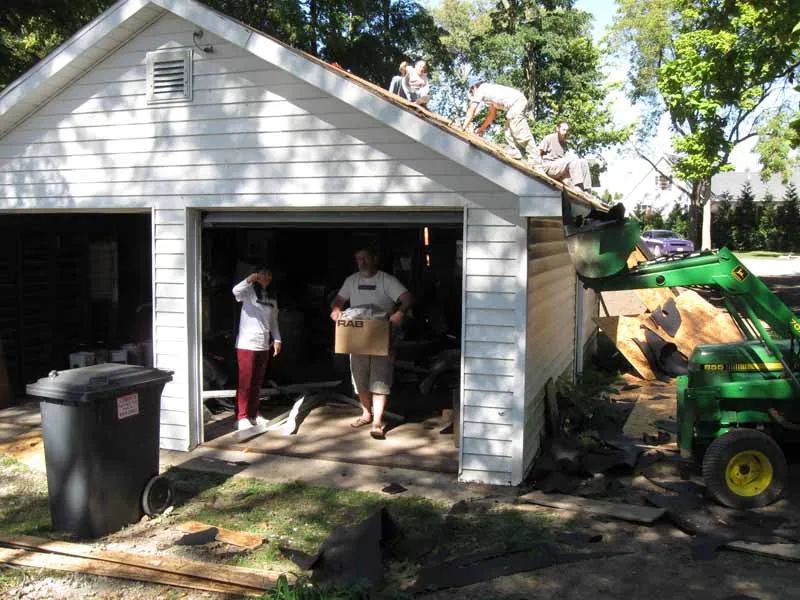
Trooper that he is, risking life and limb, Rian did this sorting even as the building was being de-constructed. Here, under Chris's helpful direction, he is walking out of the garage with a box of material, even as the roof above his head is being torn off in preparation for the garage being moved.


Slowly, Mr Johnson's 2 car garage...


...was taken apart piece by piece, to be saved and rebuilt in another location. The trailer in the foreground is how the various...


...pieces/parts were transported. These are wall sections loaded up on the trailer. It took several trips.


Soon, all that was left was the concrete slab the garage stood on. Note in the background, the exterior of our house is nearing completion.


In another small town, 20 miles away, a new concrete slab was poured for the garage's new location. Here the old wall sections have been placed on the slab in preparation for the rebirth of the 2 car garage.


In the end, because the garage was so well built, removing the outer shiplap walls and sub-roof couldn't be done without destroying them. That necessitated new OSB siding and sub-roof but the heart of the old building remained. The wall studs, roof rafters and the new garage doors that I had installed in 2006.

Today, fall 2020...


...is Mr Johnson's 2 car garage, renewed and rehabilitated as it now looks some 65 years later. The new owner has done a marvelous job saving the old garage. So like the old shop, Honey House, 2 car garage and many, many tools and equipment have been saved, repurposed and will live on. I find that all most satisfying.

Thank you all for coming with me here on this journey. But wait, there's more in store so please check back. Stay safe.

Thomas
 

Grizz1963

Well-known member
Joined
Jan 7, 2010
Messages
12,012
Location
Rochester, KENT. UK
What a flashback Thomas.

And a great visit for Dennis and I.

Eating Pumpkin pie, operating the lift, pop, drunk like it should be.

What a great day it was, 2016...... how time had flown.


Digging out treasures.


Mrs H&S , Chris making sure I don’t fall on my head, or get a bucket on my head.


And still one of my favourite items from my travels, after I restored this special, staggered valve cover, it has always lived indoors and been a talking point


Thank you both.
 

realvc

Well-known member
Joined
Jan 7, 2011
Messages
394
Location
Lake Norrell, AR
Is it O.K. to tell people to call me Doctor Vince?
If reading the thread is the same as a degree. It makes since that we would all be doctors now. Doctors of what I'm not sure. I'll leave that up to others to determine.

Vince
 

XJSuperman

Well-known member
Joined
Jan 26, 2018
Messages
3,087
Location
Central Iowa
Is it O.K. to tell people to call me Doctor Vince?
If reading the thread is the same as a degree. It makes since that we would all be doctors now. Doctors of what I'm not sure. I'll leave that up to others to determine.

Vince

Doctors of Property Restoration and Powdercoat Appreciation. hahaha

Its really cool not only that you managed to recycle those old buildings, but that someone had the time and interest in taking them and repurposing them Thomas. Sometimes the latter is the hard part in a task such as that.
 

MG David

Well-known member
Joined
Apr 14, 2009
Messages
192
Location
Warwick UK
I don't know about "Powdercoat Appreciation". Since this thread started I have bought a powdercoating gun, consumables and a halogen oven for curing. Now I can even manage 2 layer powdercoating! Much easier than spraying paint and much neater than brushing paint when you have small bits to do in the winter.
 

rmalkow2

Well-known member
Joined
Jun 26, 2009
Messages
4,087
Location
Brighton, MI
I love the story of Mr. Johnson’s 2 car garage rebuild. Yes, it is very satisfying to see good older items get restored and repurposed. Thanks for sharing that story.

Bob
 

tj675

Well-known member
Joined
Apr 9, 2019
Messages
905
Location
The Mitten
Re: Free Standing Chimney - Fireplace Details

If anyone is interested I can do additional information on the smoke shelf construction...


...or not. Maybe this was juussst about enough on fireplace construction. :) There are a lot of details that go into a relatively efficient, well constructed fireplace. I suspect that's one of the reasons you don't see them being constructed very often anymore.

The temperature locally is going to be below 0º for the next couple of days (late January) but that fireplace will completely take any chill off of our great room. I'll use it during the afternoon/evenings and then during the night, all the stored heat in the thermal mass will radiate back into the room. I've been taking temperature readings with my infrared laser thermometer as I slowly build heat, day after day into the mass. I'll let you know how it's working.

Toasty Thomas

Thomas,

I’m definitely interested in the smoke shelf when you have time. Thanks in advance.

TJ
 

bluestripe67

Well-known member
Joined
Jul 11, 2007
Messages
156
Location
Close enough to Wash. DC
Great reading on the farming side of the thread Thomas. I also appreciate the fact that the two car garage was saved and relocated. I guess I missed that way back. For anyone wanting to see some in-depth farming, check out Cole the Cornstar on YT. Amazing!
 
OP
B

BB767

Well-known member
Joined
Dec 24, 2009
Messages
3,724
Location
Philo, IL
Splitting Firewood

I hope everyone understands when I don't respond right away to questions it's not that I'm being rude, it's usually because I'm busy. I do check this thread every day so continue to ask away. Lately...


...for the last several days I've been helping a friend sort out the hydraulics on his log splitter...


...and once that was up and running as it should, we've been creating just a bunch of firewood. I just love looking at the walnut wood grain as it's split. Weather looks very nice for a couple more days and hope to finish all my and his splitting for the year.

XJSuperman, you are quite right about how hard it is trying to find someone with the time and interest to recycle old buildings. It took me almost 8 years to find a new home for the 2 car garage. I was getting mighty close to having to demolish it.

TJ, I'll be happy to put together information on not only the Rumford fireplace smoke shelf, but more information in general in the fireplace construction. Back when I was building the house and posting, those were some super long, tiring days and I don't think I did it justice. I'll correct that over-site soon, and yes Pete, the saga of the TR4 has not been forgotten. Not to worry! ;)

Firewood Splitting Thomas
 

Spareparts

Well-known member
Joined
Mar 12, 2010
Messages
2,042
Location
Lansing Ks.
First, I love Walnut wood for the few projects I get to do, beautiful wood, Second, I got a new Timberline wood burning furnace and in the instructions and Warnings was a warning about burning walnut in a airtight furnace. They said that walnut produces an acid that will affect the metal firebox and if their is a problem they have tests to check for walnut being used and void the warranty.
 
OP
B

BB767

Well-known member
Joined
Dec 24, 2009
Messages
3,724
Location
Philo, IL
Thomas

Did you ever finish the time lapse video....?

Or was I too busy and missed it.

Lyndon
BTW 2021 Route 66 is off....... Bummer!

No Lyndon, I have not edited my time lapse video yet. Each day produced about 2 min and 23 sec. I have over 7 hours of raw footage that needs to be edited down to 5 minutes or so. My son has volunteered to assist me so we'll find a nice, miserable day this winter, stay inside and get that going. It's a hoot to see all the trusses get set in a few seconds for example.

Bummer indeed about your route 66 trip this coming year. A friend of mine did it last August, 2020. Because of the virus he said many places were closed as well as most museums. Probably just as well to wait. The welcome mat will still be out for you in 2022! :)

I was just going to remind you!
Pete

I know you well Pete and thought I'd beat you to the punch. I haven't forgotten!

First, I love Walnut wood for the few projects I get to do, beautiful wood, Second, I got a new Timberline wood burning furnace and in the instructions and Warnings was a warning about burning walnut in a airtight furnace. They said that walnut produces an acid that will affect the metal firebox and if their is a problem they have tests to check for walnut being used and void the warranty.

Well that's an absolute first for me Spareparts. Of course I have no experience with wood burning, airtight furnaces. I did a quick Google check and read through over 12 articles on wood stoves and firewood. Not one of them mentioned a problem with burning walnut. It might be due to some special metal or coating Timberline is using on those furnaces. For masonry fireplaces and almost all wood stoves that I know of, walnut is not a problem. People have been using it with good results for decades.

Thomas
 
OP
B

BB767

Well-known member
Joined
Dec 24, 2009
Messages
3,724
Location
Philo, IL
Thomas,

I’m definitely interested in the smoke shelf when you have time. Thanks in advance.

TJ

Hi TJ, sure I'd be happy to post additional material on the fireplace construction methodology. Everything that goes into a proper and efficient Rumford design is much more technical than you think.

While I put that information together you might be interested and find it a bit fun with the following.
Steve, who was the master fireplace mason on this project, is a long time friend of mine. Over 40 years worth of steadfast friendship in fact. In 1980, he and I successfully constructed a very similar Rumford design fireplace in my first house. We refined that design, plus knowledge he gained in the intervening years, to aid with the successful fireplace in my current house.


This is a young Steve standing next to the foundation of that first fireplace. This is just before the concrete pour of the monolithic slab that will underlie the hearth and fireplace stone. BTW, this is in the living room of our first house, in Dec/Jan, while Chris and I were living there. Also note the the entire firebox is within the heated envelope of the house, just as it is on my new house.


The slab is all formed and ready to pour with the re-bar in place. In the middle toward the back is a form for the ash pit dump.


Here's a much older Steve during a similar construction stage 35 years later on my house.


The slab is all formed up here, re-bar in place, ready to pour. 2 combustion air ducts and center ash pit dump. The air ducts are plugged to keep concrete out during the pour.


This is a much younger Thomas! troweling concrete during the slab pour. Those silver objects are the ducts for the external combustion air openings. We had to bring the concrete in the house using 5 gallon buckets.


At a similar stage, this is the monolithic pour of the slab on my new house, again, about 35 years later.


Slab poured, 2 air ducts and in the center is the ash pit dump door.


New house fireplace slab poured and done.


Behind a partially completed firebox, I am standing with a plywood template that was made to guide Steve with the construction of the curved back of the firebox. Note the knothole in the lower left part of the plywood...


...and here I am 35 years later, the very same plywood template, note the knothole in the bottom left edge of the plywood. Since the new fireplace was dimensioned slightly smaller that the one from 1980, this template was cut down slightly in size.


A completed firebox with the damper set on top, 1980.


A completed firebox with the damper set on top, 2016.


The backing construction, with the beginning of laying the outer stone, bottom left.


Roughly the same stage with the new fireplace. We used concrete block for backing material. Note the wall ties in the block which will be used to tie the stone to the block. On the left, inside bottom of the firebox is a pipe fitting for natural gas. I plumbed that in should someone in the future ever want to use natural gas to assist in starting a fire. Using dry wood, starting a fire with the great draw of the chimney in this fireplace is extremely easy, hence that gas line has never been used and is capped.


The stone work is in progress now. Steve is getting ready to install the lintel stone. He's leveling the angle iron that will under lie the lintel stone.


2016, just prior to installing the lintel stone. I did powder coat the angle iron matt black. :)


This is the solid walnut mantel I made in 1980...


...and I finished making this solid walnut mantle in 2016.


The mantle has now been installed, 1980. It was wrapped in clear visqueen plastic to protect the finish during construction.


In 2016 we used a wood plug (seen wrapped in black plastic) in place of the actual mantel during construction. The finished mantel would be installed after all the finish work on the masonry was done.


The interior masonry work is all done. Note we wrapped the mantel in cardboard to further protect it. You can see, our living room was a mess but never a word of complaint from Chris!! See why I love that young lady so much?!


2016, all that was left to do inside was to install the mantel and hearth.


Coming through the roof, January, 1980. The wood structure is support used under the copper saddle.


Coming through the roof, September, 2016. To the left of the flue is coiled copper wire that will be used for the lightening rods on the chimney cap.


This is the copper saddle Steve and I made that will be installed on the roof to divert water away from the back side of the chimney. On the left is the wood support for under the saddle.


The copper saddle used in 2016...


...and a view of the saddle installed.


Nearing completion of the 1980 chimney.


Sort of nearing completion of the 2016 chimney.


Done outside, January 1980.


Done outside, October, 2016.


In use 1980.


In use, 2018.

Many similarities and a few differences and refinements in the intervening 36 years. Steve retired after he finished my fireplace after over 40 years as a mason. To both of our delights, he feels this last one is easily the best Rumford fireplace he has ever constructed. A double bonus is he comes over here 3-4 times a week (we ride bikes or walk several miles weekly) and in the winter, he gets to enjoy it in all its glory.

Stand by for more construction details.

As we close out this past year, 2020, and as I look through the many cards and emails that you have sent me, I am struck by 1 underlying theme. Though 2020 was a trying year, everyone was thankful for their many blessings and looking forward to the coming year. Hope springs eternal! Have a safe and joyful holiday. You can bet Chris and I will be cuddled up by the fireplace.

Thomas
 
To avoid these ads, REGISTER NOW!
Top Bottom