txlonghorn1989
Well-known member
- Joined
- Feb 27, 2017
- Messages
- 2,786
He wants a little more than I'm willing to pay CRS. I'm going to pass on it.


vwpieces: I don't have any specific hinge information for you. There must be someplace near you that can give tell you what you need to know. I hope it's someplace other than a big box store. I'm lucky to live near a neighborhood hardware store (remember those?) which has been voted one of the 12 best in the US. I do my best to keep them in business. You might have to take the plunge and just buy a pair of hinges and try to make them work. Good luck.Need some cabinet hinge help. What to buy... Blum site just makes my head spin.
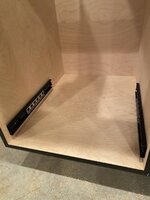
Only need a pair.
Don't need soft close but if a set is reasonable... and it will be a small door, 10X11.5in ish.
Concealed hinge, overlay, panel cabinet type with only 1/4in overlay, reveal 1/4in.
the reveal 1/4in, will be the gap next to an overlay drawer.
Any chance you might share the name of the place? I'm always looking for good B&M hardwares close enough to utilize.I'm lucky to live near a neighborhood hardware store (remember those?) which has been voted one of the 12 best in the US. I do my best to keep them in business.
Sounds like Frentz & Sons.lardy1: I once told people about a local greasy spoon and soon found that it was too crowded to get in so I'm a little hesitant to name the hardware store. I will give some clues though. Are you near Royal Oak? The & Sons on the sign are actually now & Grandsons. When we first moved in to our early 20th century house, one of the grandsons helped me find a cast iron toilet hub that hadn't been made since 1947. He found it in an upper storage room way at the back. This is such a neighborhood store that I met a future & Great Grandson at a local park when Dad took him out to play.
I saw this tip in a couple of woodworking videos and this morning I had a need for it. While preparing a workpiece for an in-progress project, I saw several round dents in the show face of the project. I have no idea where they came from but I was able to remove them by steaming. I laid a very damp, not wet, piece of cloth over the dent and then held a moderately hot iron on it for a few seconds. The steam made the crushed wood fibers swell and they returned to their original position. I'll have to test this method on several other type of surface marring but I'm fairly certain that it will only work on dents and not gashes or slashes or anything that severs the fibers. In any case, it saved me from having to remake the piece or doing a lot of scraping and/or sanding. Here's a before and after of one of the dents.
p.s. I did tell my wife that I used her iron - after the fact.
I remember that tip from high school wood shop! What wood species did you use it on? I vaguely remember it works better on some types of wood (soft like pine) and not so good on others (hardwood), but that was 35 years ago, so...

You did soak it in boiling water first, right?...Getting it on was... a workout...
You did soak it in boiling water first, right?




Too late now. but a trick I learned in a motorcycle shop is acetone. It makes handle grip and urethane slippery and then evaporates like it was never there.I did and it was still truculent, but clamps, an MDF persuader and colorful language won the day.

My preference would be to use a down cut spiral from the face with a backer like MDF or a upcut spiral from the back with a backer like MDF. And if it’s only 1/4” thick material that should be no issue in one pass or at most two passes. Just use a decent dust extractor to remove the waste and go for it.Fellas, I need to plunge cut some 1/4" wide ventilation slots in a vintage stereo receiver cabinet I'm making out of 1/2" walnut. I've made the template and am using my plunge router for the first time. I can use either a downcut spiral bit and route from the top face of the cabinet. Or I can use an upcut spiral bit and route from the bottom side of the cabinet. In each case I assume the cut on the top will be the cleanest with no tearout. Which method would you choose?
If I downcut, how deep could I plunge a 1/4" downcut spiral bit for the first pass without chips clogging up the bit?
Thanks. I decided to use a down spiral bit and made 4 shallow plunge passes. I'm pretty happy with the result. (no tearout)My preference would be to use a down cut spiral from the face with a backer like MDF or a upcut spiral from the back with a backer like MDF. And if it’s only 1/4” thick material that should be no issue in one pass or at most two passes. Just use a decent dust extractor to remove the waste and go for it.

Thanks! It is jointed. Approx. 8" + 5". I tried the match the grain pattern as best I could and I staggered the side joints from the top joints.Dave,
That looks great! Is that just some extra wide walnut? That doesn't look jointed. Nice!
Tx

Carl, that walnut and the finish is perfect. Unless you are making a coffee table where poly may be a good, durable finish, I much prefer the oil finishes. Great piece. Love the miter feathers(splines) too.



Try a good sanding sealer on that poplar. It should cut down on blotchiness and even out the finish. Great work you’re doing.
Rick

I love the your Danish oil finish. I would leave it alone, personally, and occasionally refresh the finish with another 2-3 coats on top, after a very light wipe down first.After the 4th and final application of danish oil has completely dried, I have to say this is the exact look and feel I wanted. It feels warm... you can feel the wood. It's not plasticky, but smooth in a way that you can feel the grain/pores. I was contemplating a protective layer of Arm R Seal satin but now, not so sure.
carl: Nice boxes. I built a mahogany table and gave it a finish similar to Danish oil. I did top it off with two coats of Arm-R-Seal. It probably made the finish more durable but it had minimal effect on the look or feel of the table top.
I love the your Danish oil finish. I would leave it alone, personally, and occasionally refresh the finish with another 2-3 coats on top, after a very light wipe down first.
Since I am forced to walk with a cane, I bought a couple of heartwood hickory canes from Canemasters, and finished them myself with Danish (the Tried and True brand, which is polymerized linseed oil). The finish is hardy, but wonderful to feel. It is also easy to keep clean, which becomes a concern with something you have your hand around all the time.
carl: Yes I did use Arm-R-Seal satin. I posted about the table on this thread back in September posts numbers 7035, 7036 and 7038. The first coats were of Tried & True Varnish Oil. It's similar to their Danish Oil but it has natural pine resins added. I've use it on several projects and have always been happy with the results.