mattthemuppet
Well-known member
any of those larger knee mills other than the M head would be my choice too. Pick whichever has the most tooling and is in the best useable condition.

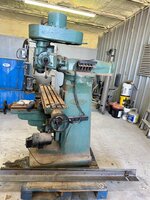
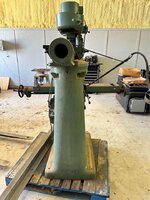
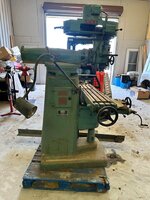
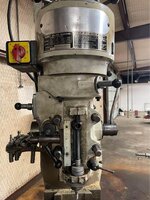
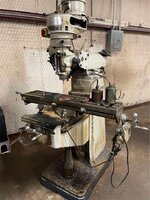
That's a proper mill. Do not be scared of 3phase. Easy to get aroundOk, whoever mentioned Index mills, here you go. This one is north of Dallas, so 6 hours each way. Looks like a heavy sumbitch, too. $2k, and don't know if it's single phase or 3 phase.
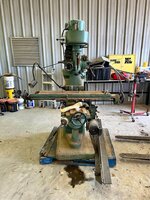
-Quoting the above post for the OP- Agree that the Exacto, Meehanite (brand name or type of cast iron?), or Wells Index would be preferable to any mill/drill or round column machine. Do not agree that a variable speed head is better because repair to these is more complicated, expensive to repair, and not as sturdy as a manual-change-pulley type (J head). Yes changing pulley-to-belt takes more time and is a minor PITA but simplicity has less repair costs and usually lasts longer than a variable speed head. JMO and JMEThe Exacto in Dallas or the Houston Meenhite are both Bridgeport clones and should be far better machines than the Enco. Lot of parts are interchangeable between brands on those. If you find one with a variable speed head instead of pulley swaps that's even better.
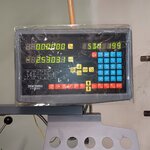
Once you find one... A DRO, power drawbar and some tooling will get you setup and good to go
Do not agree that a variable speed head is better because repair to these is more complicated, expensive to repair, and not as sturdy as a manual-change-pulley type (J head). Yes changing pulley-to-belt takes more time and is a minor PITA but simplicity has less repair costs and usually lasts longer than a variable speed head. JMO and JME
included, it can be expensive.
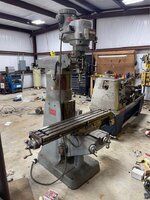
This looks like a Webb. Nice machines and parts are still available from WebbAnother big cheap one - $950 in Houston. Don't know make or model.
If the motor is rated for 440-460v, and you're running on a vfd at 230v, it won't matter inverter duty or not. The insulation will be sufficient for the higher voltage the inverter inflicts.If it's going to get a vfd anyway, between the 2 speed motor and the vfd control, I find that I can run almost everything I want to without moving the belt. I am not saying that's ideal because I doubt the motor is rated for inverter use, but I keep the freq above 30 hz almost all of the time. So far, is been ok.
Milling machines are good for milling and making small to medium sized holes. Research the manufacturer’s recommended max drill size for your desired material. It will not be as large as you would think.
For larger holes, I usually use a spot drill on the mill with a DRO mark the holes. Then I drill the holes on a large drill press.
An old school camel back drill press can drill much larger holes than most milling machines.
-Quoting the above post for the OP- Agree that the Exacto, Meehanite (brand name or type of cast iron?), or Wells Index would be preferable to any mill/drill or round column machine. Do not agree that a variable speed head is better because repair to these is more complicated, expensive to repair, and not as sturdy as a manual-change-pulley type (J head). Yes changing pulley-to-belt takes more time and is a minor PITA but simplicity has less repair costs and usually lasts longer than a variable speed head. JMO and JME
The Exacto is a Taiwan based machine, better than a Chinese made machine. The Supermill and the Exacto look like clones of the Bridgeport and likely share component specs for bearings, lead screw, gibs, etc. The Wells-Index is a well thought of mill that should still have parts available and may still be in business.
For any of these candidates (or others not mentioned) the first and most important thing is condition. How much backlash is the lead screws of the X/Y axis? How much visible wear is on the dovetails? cranking the table part way out you grab the table free end and try moving it back/forth while recording the play (with a plunger type dial indicator), now do the same to the opposite end. Run the machine through ALL the spindle speeds (look up changing from low-to-high procedure) and power feed (if there is one). Check for quill feed operation. Listen for excessively noisy bearings and/or vibration in head.
After machine condition see how much tooling is included, it can be expensive. Pick the machine that suits your budget. If you have more questions about machinery or how to move it just ask. Good luck.


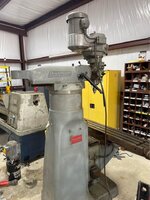
Does he say what is wrong with the power? If it is a lack of 3-ph, doesn't always mean there is an issue. If a lack, see if he would be willing to let you/help you dismount the motor, and see if it rope-starts on the bench.
The power feed on that one is much beefier than the import versions. That looks to have a 120V plug, so it could be worth the difference right there. Couldn't tell if you mean the mill doesn't work, or the power feed doesn't.
That is bad advice, a round ram B-port is really not much of a machine. The asking price is only a starting point!They are all overpriced IMO
The enco is the best deal as long as it’s in decent shape.
You would be better off with an older round ram Bridgeport if you can fine one, the round rams are not as valuable as the later J series
I mean, there is an off/on switch in the bottom right, that is currently "Off"...The top handle then has to move to engage L or R.
Could be as simple as a bad key, could be the entire board is shot. Or could be he never realized there is a switch and rocker arm.
Well the power feed isn't necessary to use the machine. Really doubt the motor doesn't work.The problem is that something like this would likely end up gathering dust in the shop. I really need to pick something up that's ready to go, preferably with some tooling.
Thanks
Almost never isn't never. I was given a 2 hp motor that somebody let the smoke out of. It sits on the back of a shelf. Too much effort to dig it out to get rid of it.... 3ph motors are almost never toast. I've never bought one that was damaged in any significant way, even sight unseen. They just don't have problems.

I use that as a bargaining chip. I would like to pay more but without seeing it running, I just don't knowIn this day age, I don't know why these doofuses don't take a freeking video of the machine running *before* removing it from power.
DRO is a time saving device, there really isn't anything much that can't be done without one, but so much you can get done faster with one.^^ the more wear, the more a dro helps. I would hate to run a mill without one. They cost a fair bit so if you can get one with the mill, all the better.
Tip of the hat to those who can make a mill sing without one. I aint that guy.
DRO is a time saving device, there really isn't anything much that can't be done without one, but so much you can get done faster with one.
Those Enco type mills are still available (Chinese built versions) and are reasonably popular with hobby types, they really need a riser block because as they come they have very little Z capacity, you won't be doing much drilling on one in standard configuration.
The Mill Drills are glorified drilling machines that can also do some milling, if you're actual use case for a machine is mostly drilling then they are not the worst choice.
All the small benchtop type machines are overpriced as the hobby types will always be after them.
A Bridgeport or clone in good condition makes a fine and versatile milling machine for the home user.
Normally what you end up with is largely determined by which machine becomes available when you're looking for one.
Scott I wouldn’t argue the benefits of a knee mil over a bench top round column mill, what everyone has said is true. However you can perform probably 90% of anything you might want to do off one. I’ve had my 2hp rongfu unit with power down feed, table and a dro for going on 25yrs. It’s amazing the thousands of parts I’ve made with it thru the years. Ya there’s times it was a ***** to do some operations but nothing that couldn’t be handle with a little ingenuity.
I also had a 9/49 supermax knee mill. But there came a day when I was completely out of space and had to make a decision as to footprint verses ability and needs. And considering that my so-called toy lived on top of a bench I built with two lista cabinets buried into the design with all my tooling and whatnots living in one compact space gave my knee mill to a buddy. I’ve only regretted that decision a couple times.
Point is you really need to consider your needs.
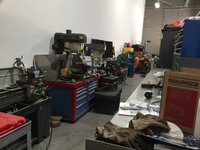
This seems to be the only pic I have on this phone and it was right when I was moving into the shop in Phoenix. I’m only posting it to give you an idea of why I made this choice.
I have been biting my tongue (OK, fingers) a bit to not add too much detail to the drill press/mill-drill/milling machine discussion, but I guess I should play another card as in GJ tradition we should answer questions as completely as possible. I have already noted that by far my busiest machine tool is my old Taiwan drill, but I should add why it gets so much more use than mill: I do a LOT of bolt circles and have my drill table set up with two rows of indexed holes on the perimeter - one 24 and one 10. I can center clamp a blank, rough in the BC dia on machinist's blue with dead center in chuck, measure result and move against dial indicator to correct, scribe new ref arcs until they measure out, chuck up a center drill and do a pair of reference holes, verify dia, and select the number of final holes needed and center drill away. If to be threaded I can start taps from chuck in all holes then be free to finish in bench vise. I routinely do size-on-size mating circles and almost always get a good fit just using allowance from undersize of nominal sized fasteners.That being said, if your goal is to make holes, a drill press is a better tool every day. They take a third of the time to setup, they have a better work envelop, and they take up less space. Honestly I hate drilling on my mill. Unless it needs to be very precise, I go to the drill press every time. It is so much easier to throw it on the table and put a C clamp or vice grip.....
-A telephone call with specific questions regarding functionality, backlash at the dials, bearing noise, and condition may weed out some of the candidates. I wouldn't want to do that drive on a "maybe" either. I had to drive 360 miles for my surface grinder. If a seller can't demonstrate the machine under power I wouldn't consider it more than a project and priced accordingly. Get something that's working.Yeah, a Bridgeport or clone would be a lot more tempting if I didn't have to drive 3-6 hours to check it out. If one popped up in San Antonio reasonably priced, that would be tough to pass up.
-This is an example of selecting the machine for the work and adapting the process for the tolerance required. It is an often overlooked consideration when purchasing a machine. I've advocated better quality machinery BUT the buyer really needs to estimate what type of work will be encountered. My Mitsui jig borer can make holes all day long on +/- .0005 location. Would that be a good choice for clearance holes in a cover plate? Not really, a drill press would be faster/cheaper. Use the B-port for multiple dowel pin holes on a progressive stamping die? Not nearly accurate enough and poor interface is to be expected. Both instances point to appropriate machinery, a clear idea of what you expect to do (or will do) helps to decide what the appropriate machine choice should be.I do a LOT of bolt circles and have my drill table set up with two rows of indexed holes on the perimeter - one 24 and one 10. I can center clamp a blank, rough in the BC dia on machinist's blue with dead center in chuck, measure result and move against dial indicator to correct, scribe new ref arcs until they measure out, chuck up a center drill and do a pair of reference holes, verify dia, and select the number of final holes needed and center drill away. If to be threaded I can start taps from chuck in all holes then be free to finish in bench vise. I routinely do size-on-size mating circles and almost always get a good fit just using allowance from undersize of nominal sized fasteners.
Yeah, I could do SOME of this on a mill, but it is extremely easy to center clamp to do on drill and not very yard to clamp from slots on OD if not an open center blank. VERY quick and easy on a drill table.
Here is how you make that happen. Spend all your money on another machine.Yeah, a Bridgeport or clone would be a lot more tempting if I didn't have to drive 3-6 hours to check it out. If one popped up in San Antonio reasonably priced, that would be tough to pass up.
Thanks
A few thoughts some of you may agree or disagree with.
1) A vari-drive you can't hear running through ALL the speeds can mean problems with the drive.
2) Non-Asian motors last a long time, the bearings may not. I need to hear all operational functions or I negotiate price as non-working
3) Round ram B-port is arguably inferior to dovetail. What is not arguable is that it is a much older design and likely has more wear on it
4) Any feed drive that can't be seen running at all feeds can be presumed dead if it has a 110v plug that can easily be plugged in anywhere
5) A DRO is more than just a speed convenience. All lead screws, even new, have an error factor that's a multiple of the wear/inaccuracy. It's even in new/expensive CNC machines and is compensated for during initial set-up. A table/saddle feed is convenience/speed, a DRO is not. Is the DRO essential? No, it depends upon distance traveled and the allowable tolerance required. They are nice to have at times.
6) The riser in the "school B-port" can be a PITA to have. It's useful for long tooling or tall fixtures but I've only needed one a few times in decades of machine shop work. It can also require excessive hang-out of the quill to reach the workpiece with an end mill which can induce excessive vibration and a poor machined finish. There are other methods to use when the "Z" envelope isn't enough.
7) Castings are NOT all equal. Almost all of the machinery from China uses an inferior. porous casting with thinner cross sections. The fitment/fitting of machined mating surfaces is also decidedly incomplete/inferior to most older iron from recognized name brands like B-port, Wells-Index, Webb, Clausing, etc. There is no substitute for mass in machinery. Perhaps it's different now but almost every Chinese machine (including Enco) weighs/weighed less due to an inferior casting with thinner cross sections.
8) Stories about a machine being from a school or research facility are often lies. They do exist but are quite uncommon since most schools ditched the industrial arts programs at least 15-20 years ago. Claims of "rebuilt" should also be viewed with scepticism.
Does any of this matter? That's up to the individual and the type of work they do. I have some really good industrial level machinery but I also made a fork brace for my motorcycle on the crappiest of tiny Chinese machinery when there was no other option. Buy and use what suits your budget/circumstances. Poorly made machinery can/will disappoint sooner or later, better made equipment is almost never the wrong choice, JMO