To avoid these ads, REGISTER NOW!

Generator Selection and Install

To avoid these ads, REGISTER NOW!

dave*99

Well-known member
Joined
May 5, 2009
Messages
4,246
Location
Coastal NJ
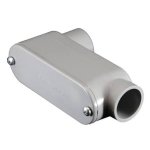
I have two open knockouts in the panel - I was thinking of using the top right knock out with some flexible conduit although I'm not sure it is flexible enough. This is a picture of a piece of conduit that I had as an example (top right of panel)
How about using a KO on the side of the panel nearest the hole to the exterior? Straight over to an LB and out the wall. Rigid PVC would be easy.
 
OP
R

Rick_Br

Well-known member
Joined
Apr 8, 2014
Messages
407
Location
Winston Salem, NC
Are you using that spot for another breaker? You will need fillers otherwise. There is no issue with having an unused breaker in the panel.
Not sure what you are asking Dave. That spot held a two pole 50 amps breaker - i am assuming the interlock kit will have a 2 pole 30 amps breaker. Why would I need spacers.
 

dave*99

Well-known member
Joined
May 5, 2009
Messages
4,246
Location
Coastal NJ
Not sure what you are asking Dave. That spot held a two pole 50 amps breaker - i am assuming the interlock kit will have a 2 pole 30 amps breaker. Why would I need spacers.
I assumed the top left spot was empty - my bad. Seems you removed the 50 to put in a 30 for the Genny.
 

dave*99

Well-known member
Joined
May 5, 2009
Messages
4,246
Location
Coastal NJ
Not sure what you are asking Dave. That spot held a two pole 50 amps breaker - i am assuming the interlock kit will have a 2 pole 30 amps breaker. Why would I need spacers.
Did the interlock kit specify that it comes with a breaker?
 
OP
R

Rick_Br

Well-known member
Joined
Apr 8, 2014
Messages
407
Location
Winston Salem, NC
Did the interlock kit specify that it comes with a breaker?
I was going to say for $70 of course it did - but I looked again and I don't think it does. They kind of deceptively pictured the kit with a breaker installed but now I don't think that is included. If I had known that I would not have bought. Justa piece of plastic screwed to the panel for $70 - what a rip off
 

larry4406

Well-known member
Joined
Jan 27, 2006
Messages
18,943
Location
Northern Virginia
I would not cut the original 8 wire, rather I would just nut them off and place them to the side.

You never know when you might want to use it for something, assuming you know where the other end is.

Me, I would go whole hog and put wiring in that would support 50A backfeed, so if and when you upgrade the generator, its just a matter of changing the breaker and the inlet plug.
 

mike93lx

ALLIANCE MEMBER
Joined
Dec 9, 2013
Messages
37,337
Location
Richmond, VA
I was going to say for $70 of course it did - but I looked again and I don't think it does. They kind of deceptively pictured the kit with a breaker installed but now I don't think that is included. If I had known that I would not have bought. Justa piece of plastic screwed to the panel for $70 - what a rip off
Whats the alternative? Could make one, but if you care about code, then that's a problem

A 30a breaker is pretty cheap anyway
 

larry4406

Well-known member
Joined
Jan 27, 2006
Messages
18,943
Location
Northern Virginia
Dumb question here....

IF the generator has its own 30A 240V breaker, AND he uses #6 wire, AND he uses the 50A breaker he has as the inlet breaker, AND he retains his 30A inlet receptical, then all he would need to buy would be the upsized wire correct?

Generator breaker protects everything.

EDIT - I only mentioned this as the OP seemed upset that he would now have to go buy a breaker as he felt mis-lead that the interlock included it and does not @mike93lx @dave*99
 
Last edited:

mike93lx

ALLIANCE MEMBER
Joined
Dec 9, 2013
Messages
37,337
Location
Richmond, VA
Dumb question here....

IF the generator has its own 30A 240V breaker, AND he uses #6 wire, AND he uses the 50A breaker he has as the inlet breaker, AND he retains his 30A inlet receptical, then all he would need to buy would be the upsized wire correct?

Generator breaker protects everything.
I'd argue that since it's an inlet, the breaker size really doesn't matter anyway. But since it is connected in the panel, and with the cover removed it could flow power out, code may require sizing the breaker to the wire.

Did the OP say he intends to upgrade to a 50a generator? If so I missed it, but if not, I don't think I would spend the money to do that if this was my house. You can run a lot of stuff on a 30a, including 3+tons of a/c
 

dave*99

Well-known member
Joined
May 5, 2009
Messages
4,246
Location
Coastal NJ
Dumb question here....

IF the generator has its own 30A 240V breaker, AND he uses #6 wire, AND he uses the 50A breaker he has as the inlet breaker, AND he retains his 30A inlet receptical, then all he would need to buy would be the upsized wire correct?

Generator breaker protects everything.
Generator breaker protects generator and cable connecting it to inlet.

Inlet breaker protects wire in the house and the inlet plug.
6 gauge wire and 50A inlet and 50A breaker is fine. 30A inlet on 50A breaker - not fine.

The OP had 1 outage in the last 10 years. Maybe sticking with 30A system is fine.
 
Last edited:

dave*99

Well-known member
Joined
May 5, 2009
Messages
4,246
Location
Coastal NJ
I'd argue that since it's an inlet, the breaker size really doesn't matter anyway. But since it is connected in the panel, and with the cover removed it could flow power out, code may require sizing the breaker to the wire.

Did the OP say he intends to upgrade to a 50a generator? If so I missed it, but if not, I don't think I would spend the money to do that if this was my house. You can run a lot of stuff on a 30a, including 3+tons of a/c
The inspector would look at the wire and the inlet and require the breaker be sized to the lowest ampacity of the connected components.
 

dave*99

Well-known member
Joined
May 5, 2009
Messages
4,246
Location
Coastal NJ
I would be using THHN 10 gauge in the conduit.
You need to find a place that sells wire by the foot. You need Black, Red, White and Green. Since they are individual conductors, you can't use colored tape to change their markings.
 
OP
R

Rick_Br

Well-known member
Joined
Apr 8, 2014
Messages
407
Location
Winston Salem, NC
Hold on fellas - I am not going to a 50 amp breaker - that is what was there and removed. 30 amp breaker will be installed with 10 gauge wire from the panel to the inlet box. I'm pretty sure the generator has its own 30 amp breaker - not sure about the inlet yet.

Am I still on the right track - 30 amp 2 pole breaker in the panel fed with 240 from the generator through the inlet. What the guy I got this from had was 10 gauge MTW wire from the panel to the inlet. I have used MTW for replacing motor leads before - my understanding is that MTW has more strands and therefore is more flexible. Do I need MTW or would standard THHN be sufficient. With regard to colors - I understand I need 4 wires - I'm thinking black and red to the circuit breaker, green to panel ground and white to panel neutral? I( am definitely out of my element for this so feel free to jump all over it.

Rick
 
To avoid these ads, REGISTER NOW!

mike93lx

ALLIANCE MEMBER
Joined
Dec 9, 2013
Messages
37,337
Location
Richmond, VA
The inspector would look at the wire and the inlet and require the breaker be sized to the lowest ampacity of the connected components.
I would expect that as well. But I'm wondering if code could support a larger breaker for this application, but I suspect not.

To be clear, I'm not advocating this, just asking the question
 

mike93lx

ALLIANCE MEMBER
Joined
Dec 9, 2013
Messages
37,337
Location
Richmond, VA
Hold on fellas - I am not going to a 50 amp breaker - that is what was there and removed. 30 amp breaker will be installed with 10 gauge wire from the panel to the inlet box. I'm pretty sure the generator has its own 30 amp breaker - not sure about the inlet yet.

Am I still on the right track - 30 amp 2 pole breaker in the panel fed with 240 from the generator through the inlet. What the guy I got this from had was 10 gauge MTW wire from the panel to the inlet. I have used MTW for replacing motor leads before - my understanding is that MTW has more strands and therefore is more flexible. Do I need MTW or would standard THHN be sufficient. With regard to colors - I understand I need 4 wires - I'm thinking black and red to the circuit breaker, green to panel ground and white to panel neutral? I( am definitely out of my element for this so feel free to jump all over it.

Rick
I would use stranded #10 thhn, in the colors you listed
 

dave*99

Well-known member
Joined
May 5, 2009
Messages
4,246
Location
Coastal NJ
Difference between THHN and THWN seems to be THWN is rated for wet locations. Given this is going to be inside, 3 feet off the ground at least or outside in conduit high up - would either on be OK?
Most of what you will find in the store is dual rated.
 
Last edited:

dscheidt

Well-known member
Joined
Apr 26, 2017
Messages
2,880
Difference between THHN and THWN seems to be THWN is rated for wet locations. Given this is going to be inside, 3 feet off the ground at least or outside in conduit high up - would either on be OK?

If it's outside, it's a wet location, even in a conduit. US made THHN is also listed as THWN or THWN-2, so getting the correct wire shouldn't be an issue. (imported stuff is sometimes dual listed, sometimes not. )

edit: the first spool of wire i looked at is 10 awg stranded. THHN/THWN-2/MTW listed.
 
OP
R

Rick_Br

Well-known member
Joined
Apr 8, 2014
Messages
407
Location
Winston Salem, NC
Thanks guys!

Back to the breaker - 30 AMP 2 pole CH breaker as linked above - no problem with that? I want to be able to use any of the 120 circuits in the panel without having to do any additional wiring - not saying I want to run everything in the house but would like the option to select what gets run. My understanding from up thread is that to do that I would need to feed 240 into panel

Rick
 

mike93lx

ALLIANCE MEMBER
Joined
Dec 9, 2013
Messages
37,337
Location
Richmond, VA
Thanks guys!

Back to the breaker - 30 AMP 2 pole CH breaker as linked above - no problem with that? I want to be able to use any of the 120 circuits in the panel without having to do any additional wiring - not saying I want to run everything in the house but would like the option to select what gets run. My understanding from up thread is that to do that I would need to feed 240 into panel

Rick
Yes. Good to go on that
 

wyliesdiesels

Well-known member
Joined
Aug 14, 2012
Messages
19,983
Location
Modesto, CA
Difference between THHN and THWN seems to be THWN is rated for wet locations. Given this is going to be inside, 3 feet off the ground at least or outside in conduit high up - would either on be OK?

you would be hard pressed to find single rated THHN. everything on store shelves nowadays is dual rated THHN-2/THWN-2
 

larry4406

Well-known member
Joined
Jan 27, 2006
Messages
18,943
Location
Northern Virginia
@Rick_Br says his generator is a Honda EM5000SX.

Attached is the manual I found.

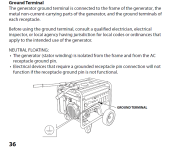
On PDF Page 43 (manual page 36), it states the unit has a floating neutral, which is good for the OP's connection to the home. The wiring diagram is on PDF Page 102 (manual page 95). I did not study the wiring diagram to confirm the neutral was floating. This floating ground is reiterated on Page 68/61.

1771583384174.png

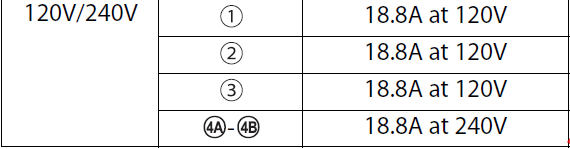
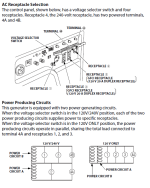
PDF Page 63 (manual page 56) talks about a voltage selector switch to fully enable the 240V receptacle (L14-30R per the wiring diagram) on the generator. This is also discussed on PDF Page 35 (manual 28). The switch must be positioned to "120/240" to enable both legs of the 4-prong receptacle. Looks like the 240V outlet is limited to 18.8A (both legs) if I read this correctly (Page 64/57).

Looks like if the selector switch is inadvertently left in the "120V" position, it enables one leg only of the 240V receptacle (Leg 4A would get 120V30A while Leg 4B would get zero). Study Page 64/57.
 

Attachments

  • Honda EM5000SX Owners Manual.pdf
    6.1 MB · Views: 2
OP
R

Rick_Br

Well-known member
Joined
Apr 8, 2014
Messages
407
Location
Winston Salem, NC
Larry - I certainly appreciate your research and the time it took but I gotta say I don't get it :).

Can you talk more about the "floating neutral" - not sure what that is and how it might affect me in terms of hook up.

I mostly understand the 120/240 volt selection. For my education -
1. if the selector switch is inadvertently left on 120 then the panel would receive only 120 and only one side of the panel would be active?
2. With the selector on 240 would the other 120 outlets on the generator also be active?

Rick
 

larry4406

Well-known member
Joined
Jan 27, 2006
Messages
18,943
Location
Northern Virginia
Larry - I certainly appreciate your research and the time it took but I gotta say I don't get it :).

Can you talk more about the "floating neutral" - not sure what that is and how it might affect me in terms of hook up.
Your main panel has the neutral and ground bonded. This is the only place it should be bonded.

Many generators come with the neutral and ground bonded for use standalone. This becomes a problem when connected for house backup. To solve this, one studies the wiring diagram to determine where the bond is so it can be disabled or made switched. When not connected together, the neutral is referred to as "floating".

My generator came bonded. I added a switch to disable the bond (floating for standby connection to house) or bonded (portable standalone use).

Your generator does not have this bond (neutral is floating) which is good for home backup use without modification. A sparky is needed to explain why this works standalone as it seems odd to me.
I mostly understand the 120/240 volt selection. For my education -
1. if the selector switch is inadvertently left on 120 then the panel would receive only 120 and only one side of the panel would be active?
That is my read as well assuming you are using the 4-prong outlet on the generator.
1771590977830.png
2. With the selector on 240 would the other 120 outlets on the generator also be active?

Rick
That is my read as well.
1771591039284.png

Also note the amperage limitation for the 240A outlet of 18.8A.

1771591076849.png
 

dave*99

Well-known member
Joined
May 5, 2009
Messages
4,246
Location
Coastal NJ
The generator is correctly configured with a floating neutral for connection to your house.

Set the selector to 120/240 when using your inlet on the house.

The 120 only setting puts all available power into the 120 receptacle on the generator. It has a 30A 120V receptacle If you had a camping trailer with a 120V 30A inlet you would use that feature.

If you were using the generator stand alone and not connected to the house you would want the generator neutral bonded to the generator frame. This can be done with a bonding plug.

I see Larry and I were typing simultaneously.
 
OP
R

Rick_Br

Well-known member
Joined
Apr 8, 2014
Messages
407
Location
Winston Salem, NC
Thanks Dave and Larry7 for the education - now another code related question (and I know I am all over the place) :)

Does code allow a 10-4 SO cable from the panel, through the wall and into the inlet box? I suspect not but thought I'd ask.

Rick
 
OP
R

Rick_Br

Well-known member
Joined
Apr 8, 2014
Messages
407
Location
Winston Salem, NC
conduit - OK I am planning on using two conduit bodies - one on each side of the wall with the back side protrusion going into the wall and a piece of 1/2 conduit connecting them. Does that make sense/is it legal? I would likely put some sealant on the back side to prevent water intrusion. If that works then all I need is an 1-1/8 masonary bit - yikes they are expensive

Rick
 

mike93lx

ALLIANCE MEMBER
Joined
Dec 9, 2013
Messages
37,337
Location
Richmond, VA
conduit - OK I am planning on using two conduit bodies - one on each side of the wall with the back side protrusion going into the wall and a piece of 1/2 conduit connecting them. Does that make sense/is it legal? I would likely put some sealant on the back side to prevent water intrusion. If that works then all I need is an 1-1/8 masonary bit - yikes they are expensive

Rick
The conduit body will have a gasket. Don't seal the cover on, but do seal the penetration
 
To avoid these ads, REGISTER NOW!
Top Bottom