Ok, a small diversion in to the house.
Before we would move in, there was some work required. Although there are longer term plans, the work we wanted to do was to be enough to make it comfortable to live in for 3-4 years, until a more extensive refurb could take place.
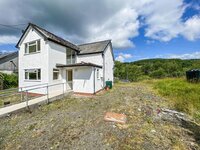
The house itself, as can be seen has been extended at the rear. The front part, dates from circa 1850, we think, though there is no actual evidence available. This is solid stone wall construction as is traditional here. Circa 18 inches to 2 ft thick. The extension on the back was late 70's early eighties and conventional cavity wall construction.
The inside of most of it has been lined with plasterboard attached to timber stud work. A **** idea, especially in the old part, but we decided this would stay for now. There were a lot of damp patches on the east gable end. Turns out, that whilst unoccupied, a pipe bust in the loft and cascaded water down for who knows how long. This went behind the plasterboard.
Although it had been painted over, it was pretty obvious.
Also in the main room downstairs, the room had been divided up with a stad wall and a sliding door. This created a useless space, so we wanted to remove that.
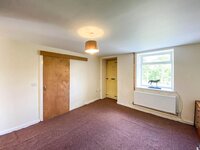
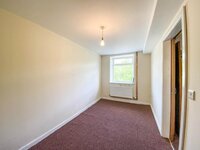
So this room, which was to be our living room, was the first part of our work.
It quickly became obvious that the plasterboard was stil damp on the gable end. It was also clear that there had been a fire place here. And there was a vent at floor level.

So we removed a section to take peek. What we found was the original fireplace. Not in bad shape either. So, despite being on a tight timeline, we removed the plaster board to reveal the fireplace.
However, damp doesnt really cover it !!
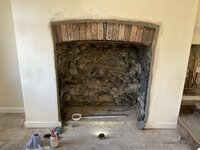
Also, the chimney had been lined with a lightweight concrete, but the more observant of you will see no external chimney. Although it had been removed externally, it terminated in the attic, still open.
However, it was blocked off. I removed the wood, and all sorts of **** fell down. That was wet too. Borrowed a sweep brush and cleared it all out. There was a resonable updraught so we left it open for now to dry out.
One of the issues with these old stone houses was that they were built with lime mortar, with no damp proof course. Water would wick up from the ground, then evaprate both inside and out. Sadly, then cement arrived on the scene. Just like many others, this has been re-pointed in cement. (which we knew prior to purchase) . The problem is, it traps the moisture within the wall, leaving it saturated. The solution is to remove the cement, allow to dry, and repoint in lime.
Whilst we know this will be necessary, i thought id use the now exposed fireplace as a test to see just what we were dealing with. So out came the chisels, and needle gun to remove the cement pointing. It was tough, and pretty deep. And it took a very long time! Not quite the quick tidy up we had planned.
The lime mortar behind, especially low down was in places so wet you could push your finger into it. The stones at the bottom, depending on stone type so cold due to being damp, that moisture would condense on them.
We set up a dehumidifier there and let it start. In the end, it fully dried out, the mortar went hard and all is well. I have yet to repoint it however.
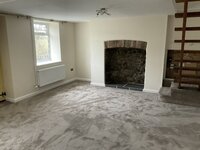
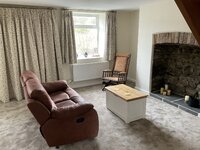
And a pic as it was after id put in hearth, and we got carpet.
More to follow.....