To avoid these ads, REGISTER NOW!

Homemade electrolysis. What do you use?

Filson

Well-known member
Joined
Jun 14, 2013
Messages
1,218
Location
NE WA
Jason - Thanks for the answers! So how "slow" and how "low" is recommended?

Drivesitfar - I read through most of this thread before posting, but admittingly skimmed a few posts lol. I hope to find another place to pick up a few vises other than the "treasure trove" that is asking full retail. Half of the fun of picking up a big vise is scoring a good deal on it. :thumbup:

Back to electrolysis baths...

I seen you guys clean off your rebar and stuff afterwards, do you throw out the water too? Is there any issue with making a more permanent set up where you don't rotate in fresh water every use?

Outlaw - It sounds like line-of-sight is important, correct?
 
Last edited:
To avoid these ads, REGISTER NOW!

Outlawmws

Well-known member
Joined
Aug 9, 2011
Messages
39,148
Location
The Badlands
Fretters: yes the pointed ones or at least they used to be a few sidewalk and footing projects ago. i'll take good pictures and probably have a few more questions before i actually get cooking and always appreciate all the help i can get from the experts. at this point i have the container that also has a lid if i choose to use it, battery charger, stakes, wire, half inch rubber for bottom of container in case i accidentally drop something and that should be about it. all i need to do is wire it up, add about 10 gallons of water and a maybe a cup of spa chemical and drop something old and rusty in it and let it cook. sound about right?

Filson: glad you can join the thread and maybe ask a few more questions i and others haven't thought of. I've been going to fire up an E tank for a few months now so had a bunch of questions stored up when Tex started this a few weeks ago. read through and you'll see some great answers to all of the questions and some great pictures too. it should be a nice addition to your shop especially when you find out who is hoarding all those old vises on your side of the mountains.

Yup! Go start something cooking! :beer:

Last bit of reminder advise: Red to rust (Meaning the sacrificial anode) and Black to the part you want clean!
 

Outlawmws

Well-known member
Joined
Aug 9, 2011
Messages
39,148
Location
The Badlands
I don't clean my anodes until the stop working well. Then its just a quick wire brushing to get the loose scale off, except for where I clip the battery charger; that gets done to bare metal. (I've had more issues with that connection that anything else...).

The water I keep using and simply add more water as it evaporates. (you generally don't need to add more spa-kem it doesn't evaporate...) My setup gets a full cleaning maybe once a year.
 

drivesitfar

Well-known member
Joined
Oct 23, 2013
Messages
36,003
Location
Pacific Northwest
thanks again Outlaw and before i actually fire it up i'll post a few pictures for any more tips or suggestions.

just wondering if you have had a chance or a need to fire up the new "E" bath you made for bigger items with the graphite instead of steel anodes?
 

Filson

Well-known member
Joined
Jun 14, 2013
Messages
1,218
Location
NE WA
Very cool. Sounds like pretty low maintenance which is aces in my book lol.

I edited a new question into my last post, but will just ask again as it may go un-noticed:

It's sounding like line-of-sight matters, is that true? Would having extra pieces of rebar set up help cover the angles of large and complicated pieces? Any negative to doing this?
 

drivesitfar

Well-known member
Joined
Oct 23, 2013
Messages
36,003
Location
Pacific Northwest
Filson: what i'm learning is that maybe a flat thinner piece of metal wrapped around the edges of the tank might be best. then maybe a piece of rebar through the middle if the item has a hole in it. that said you need to make sure not to let the positive metals touch the negative or you'll short out your power source.

i do have a bunch of flat stock i can cut up to get in the tank if the cement form stakes don't work as well as i like, but the form stakes have holes in them already so i can wire up a circuit easier.

also Outlaw and a few others are going to try graphite which isn't just laying around and a little pricey to see if they can get better results and less junk floating in the water that the steel will do.

good luck
 

taumac

Well-known member
Joined
Aug 30, 2011
Messages
8,104
Location
Brooksville, Fl

spongerich

Well-known member
Joined
Apr 17, 2010
Messages
2,339
Location
Monroe, NY
Jumping in a bit late here... I wrote a How-To guide a while back that might be useful.

http://garagejournal.com/forum/showthread.php?t=154196

A couple of highlights/observations.

- Graphite anodes are much nicer to use than steel. Steel leaves a thick layer of nasty orange sludge floating in your tank. Graphite is a LOT less messy, the anodes last a very long time and they're essentially self-cleaning, so if you're doing an especially rusty or large part, there's no need to stop and clean them.

- Electrolysis works better "line of sight" so large flat anodes usually work better than skinny rods/rebar. If you're just doing smaller parts then it doesn't matter much. When the process "runs out" of line of sight rust to convert, it does get into nooks, crannies, recesses, hollows etc, but it's slow going. To get into hard to reach areas, (like the inside of a motorcycle gas tank), wrap an anode in nylon window screen and slip it in, making sure it's well insulated to prevent shorts.

- Low voltage/low amperage is best. Higher voltage/amperage can cause pitting, particularly on high carbon steel. It's also safer. I generally run mine at 6 volts using an ancient $2.00 garage sale battery charger. Even the largest, rustiest parts don't usually take more than a few days. I did a very rusty 150lb anvil last year and in a week it looked like new.

- Stainless steel really should not be used. Hexavalent Chromium is nasty stuff. It's not necessarily immediately dangerous in the quantities you'll produce, but it needs to be disposed of properly so as not to contaminate soils and water supplies. Other non-ferrous metals should also be kept out.

- Sometimes it's impossible to get rid of all of the grease/dirt/crud. Washing soda is actually a pretty good degreaser. When I have to process a dirty part, I usually start with very warm water and add an extra cup of washing soda to the tank.

- It's always best to work in a well ventilated area. Those little bubbles are hydrogen which, if you remember The Hindenburg, is rather flammable. You're not making large quantities, but playing it safe is easier than explaining that little explosion to your wife.
 
Last edited:

Filson

Well-known member
Joined
Jun 14, 2013
Messages
1,218
Location
NE WA
Jumping in a bit late here... I wrote a How-To guide a while back that might be useful.

http://garagejournal.com/forum/showthread.php?t=154196

A couple of highlights/observations.

- Graphite anodes are much nicer to use than steel. Steel leaves a thick layer of nasty orange sludge floating in your tank. Graphite is a LOT less messy, the anodes last a very long time and they're essentially self-cleaning, so if you're doing an especially rusty or large part, there's no need to stop and clean them.

- Electrolysis works better "line of sight" so large flat anodes usually work better than skinny rods/rebar. If you're just doing smaller parts then it doesn't matter much. When the process "runs out" of line of sight rust to convert, it does get into nooks, crannies, recesses, hollows etc, but it's slow going. To get into hard to reach areas, (like the inside of a motorcycle gas tank), wrap an anode in nylon window screen and slip it in, making sure it's well insulated to prevent shorts.

- Low voltage/low amperage is best. Higher voltage/amperage can cause pitting, particularly on high carbon steel. It's also safer. I generally run mine at 6 volts using an ancient $2.00 garage sale battery charger. Even the largest, rustiest parts don't usually take more than a few days. I did a very rusty 150lb anvil last year and in a week it looked like new.

- Stainless steel really should not be used. Hexavalent Chromium is nasty stuff. It's not necessarily immediately dangerous in the quantities you'll produce, but it needs to be disposed of properly so as not to contaminate soils and water supplies. Other non-ferrous metals should also be kept out.

- Sometimes it's impossible to get rid of all of the grease/dirt/crud. Washing soda is actually a pretty good degreaser. When I have to process a dirty part, I usually start with very warm water and add an extra cup of washing soda to the tank.

- It's always best to work in a well ventilated area. Those little bubbles are hydrogen which, if you remember The Hindenburg, is rather flammable. You're not making large quantities, but playing it safe is easier than explaining that little explosion to your wife.

Very cool write up bud! I'll have to check your guide here in a few minutes.

I wouldn't be in any hurry, and so I wouldn't mind it taking a few days/week so long as that doesn't do anything bad to the metal.

Considering how much I'd probably use it, right off the bat I'm thinking about making a fairly permanent setup outside my shop, and I'll have to look around for some graphite to use. :beer: Thanks again!
 

Filson

Well-known member
Joined
Jun 14, 2013
Messages
1,218
Location
NE WA
Just read your write up - holy **** man, that's gold, thank you for sharing!
 

EOC_Jason

Well-known member
Joined
Jun 25, 2012
Messages
11,388
Location
Bentonville, AR
I think his writeup covered most of it...

The old battery chargers seem to work better than new ones that are digital and all that. Literally I could watch more bubbles (hydrogen) being produced and the water swirling around on a little 5-amp charger than I could with a bigger charger that was set to 20 amps (and I think it was pulling around 10-15)... The work-around is to put a battery in parallel to ensure you are getting a pure DC current.

Like the other person said too, it's kind of line-of-site... I'm sure it's more technical than that, but for simplicity's sake, just go with that as a rule of thumb if you want to get effective cleaning.

I usually wipe off my rebar pieces to get all the gunk off first (there is a lot!), then hit them with the wire wheel to get back to clean metal.

You don't have to clean your tank out per-say, the rust will settle to the bottom over-night with the setup turned off. Though you will probably have to add some water over time. I just dumped mine when not in use because I don't really have a permanent spot for it and we are only talking about using less than a dollar's worth of washing soda.
 

Outlawmws

Well-known member
Joined
Aug 9, 2011
Messages
39,148
Location
The Badlands
What Rich said, line of site generally matters, esp at first, but I've unlocked rust frozen crescent wrenches surprising well.

Personally, I think the real issue with small rods is they gunge up faster. I have a U shaped 4" wide piece and it lasts a awhile but the available surface area on rebar isn't big, so having 6 of them is 50% better than 4.... 8 would be 100% better! ;)
 

Outlawmws

Well-known member
Joined
Aug 9, 2011
Messages
39,148
Location
The Badlands
DIF, No not yet, between winter and the "life" that's been happening in my life, no time to set up the new larger graphite Etank.
 

zkling

Well-known member
Joined
Jan 23, 2007
Messages
16,939
This thread seems to be going in circles. :dunno:

I also found that you can reverse process to clean anaodes rods also.

That's called etching. Use with caution. :evil:

Supposedly low and slow is the way to do it... I think if you crank it up too high you run the risk of hydrogen embrittlement for thin / small parts.

Finally, I was wondering how long it would take before someone would bring this up. :headscrat:
 
Last edited:

Fretters

Well-known member
Joined
Jan 25, 2014
Messages
4,217
Location
South Yorkshire, England
It's sounding like line-of-sight matters, is that true? Would having extra pieces of rebar set up help cover the angles of large and complicated pieces? Any negative to doing this?

It simply makes the process more consistent and quicker across the piece, but it'll generally work regardless. It'll just take longer to sort certain spots if area is limited.


also Outlaw and a few others are going to try graphite which isn't just laying around and a little pricey to see if they can get better results and less junk floating in the water that the steel will do.

Tried it once and it does work well, without all of the **** getting into the solution from the anode rusting/corroding. The solution just gets the black dust as it softens and breaks down. Saying that though, lead plate works extremely well too, but I'm sure that suggestion won't go down well. :evil:


The old battery chargers seem to work better than new ones that are digital and all that.

A lot of the new chargers aren't constant current. They use PWM techniques, so are pretty much useless for the process
 

taumac

Well-known member
Joined
Aug 30, 2011
Messages
8,104
Location
Brooksville, Fl

drivesitfar

Well-known member
Joined
Oct 23, 2013
Messages
36,003
Location
Pacific Northwest
Taumac: i like the sound of that with a few flat pieces welded together surrounding the project you want to de rust instead of the wiring up of all the steel posts or rebar. i also understand the cleaning method should work to clean up the anodes by reversing the positive and negative and putting the positive to the new piece of scrap. the water should still have residue in it that can either sink or go to the bottom I'm guessing.

can you post some pictures of your tank with your welded pieces in it for us to see what you have set up? also how often do you drain it or do you just add water and chemical as needed?

Outlaw mentioned a downside to that so have you experienced any downside or Outlaw can you elaborate?

Fretters: Lead scraps are not easily found. would there be any fumes or chemical releasing in the water that might be harmful if the tank wasn't outside?
 

Fretters

Well-known member
Joined
Jan 25, 2014
Messages
4,217
Location
South Yorkshire, England
Fretters: Lead scraps are not easily found.

Don't know if you use lead flashing across there, but that's the perfect stuff for it.


would there be any fumes or chemical releasing in the water that might be harmful if the tank wasn't outside?

That is a question to which I'd love to know the answer too. Fume wise, no concern on that front as far as I'm aware. What components it may leave in the solution as it breaks down, however, I've no idea, and I have tried my damnedest to find out on that point. If it was known safe, lead would be my anode of choice, as it does work and last well. Pretty much comparable to carbon.
 

drivesitfar

Well-known member
Joined
Oct 23, 2013
Messages
36,003
Location
Pacific Northwest
Now you wouldn't find that lead flashing in the "skip" everyday around here, but i think they used a lot of it around old brick chimneys so will see if i can grab a few. some contractors throw stuff in the skips (dumpsters) as we all know without really knowing what it is.

i think there might be some on my 2 chimneys that will have to go on the next re roof because there are better roofing options to prevent water from seeping down a chimney now.

it would definitely be easy to form into a plastic or wood tub and if it doesn't disintegrate and leave the excess on top of the water might be an option. anybody know the answer to the possible lead fumes??
 
To avoid these ads, REGISTER NOW!

Outlawmws

Well-known member
Joined
Aug 9, 2011
Messages
39,148
Location
The Badlands
Taumac: i like the sound of that with a few flat pieces welded together surrounding the project you want to de rust instead of the wiring up of all the steel posts or rebar. i also understand the cleaning method should work to clean up the anodes by reversing the positive and negative and putting the positive to the new piece of scrap. the water should still have residue in it that can either sink or go to the bottom I'm guessing.

can you post some pictures of your tank with your welded pieces in it for us to see what you have set up? also how often do you drain it or do you just add water and chemical as needed?

Outlaw mentioned a downside to that so have you experienced any downside or Outlaw can you elaborate?

Fretters: Lead scraps are not easily found. would there be any fumes or chemical releasing in the water that might be harmful if the tank wasn't outside?

The down side I was alluding to was the fact that most that have experienced it was because they got the battery cable bas ackward and were cleaning the anodes with a piece they wanted to de-rust... :evil:
 

Outlawmws

Well-known member
Joined
Aug 9, 2011
Messages
39,148
Location
The Badlands
I have to vote no on the Lead anodes. Reason is lead is still a heavy metal. Some lead is bound to get into the sludge and/or water.
 

Outlawmws

Well-known member
Joined
Aug 9, 2011
Messages
39,148
Location
The Badlands
SNIP

A lot of the new chargers aren't constant current. They use PWM techniques, so are pretty much useless for the process

One way to beat the modern solid state chargers is to connect it to a battery and the connect both to your part/Anode. The battery provides the load the charger needs, and away you go.
 
Last edited:

taumac

Well-known member
Joined
Aug 30, 2011
Messages
8,104
Location
Brooksville, Fl
Ok here's what I use. Please note that crossbar isnt welded at moment.
uploadfromtaptalk1394760295889.jpg
This is also my garage mop bucket. Everything in my garage usually serves many rolls. I needed to find some hinges to fold this setup when not in use.
Here's my smaller setup I use. Its just parts of a tv backet. Think it was suppose to hold a tv box. I just welded a scrap piece to put positive to.
uploadfromtaptalk1394760564003.jpg
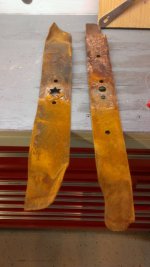
Last time I was lazy and used to old mower blades in a 5 gal bucket and a jumper wire.
uploadfromtaptalk1394760667504.jpg
It probably worked the best I never have. Lots of rusty crude was on top. Now I cant be sure of it was cause I used the blade or cause I pure some vinegar in with mixed. I usually run my charger on its 55 amp start feature. Someone said that it would pit the metal but I havnt seen that happen yet. Although I only done a couple of cheap vises in it. I only use mine to restore vises so far and they really wernt rusty more than I want to remove all the paint and start from bare metal. I havnt really got into different anaodes and such. I'm cheap and couple of old mower blades or rebar works for me. If charger dies on 55amp mode oh well. Its old and it was free. Its not my good one. All and all its a good process slow yes but also depends on piece your working on.


Have a good one, Gerard

Florida GJers ( FGJ)
http://www.garagejournal.com/forum/group.php?groupid=117

The 5 Stitches Garage
http://www.garagejournal.com/forum/showthread.php?t=211899
 

TheWizard

New member
Joined
Mar 2, 2012
Messages
1
I use a 1/4" thick graphite plate i found on ebay, legal pad sized. Lie it flat in the bottom of a rubbermaid tub and put the parts in a plastic grated basket that sits on top. Transformer based 24v/15a rectifier for an old radio room with one anode alligator clip and 3 daisy chained cathode clips. Zzzap


Sent from my iPhone using Tapatalk
 

alxdgr8

Well-known member
Joined
Mar 27, 2012
Messages
668
Location
Seattle, WA
If anyone is having trouble finding washing soda (sodium carbonate), check Walmart. It was the only local store I could find that had it (and of course it was the last place I checked since I hate going there).
 

wild cowboy

Banned
Joined
Mar 11, 2014
Messages
1,650
Location
Birmingham
ok, I guess I am the weirdo here, but I use a giant 3-legged cast iron cauldron (think witches brew) and I have a rubber mat in the floor of it. I do not have a sacrificial piece of iron in the brew, the whole friggin cauldron is iron! (and rusty inside! - lol)
 

Fretters

Well-known member
Joined
Jan 25, 2014
Messages
4,217
Location
South Yorkshire, England
I have to vote no on the Lead anodes. Reason is lead is still a heavy metal. Some lead is bound to get into the sludge and/or water.

That's what I'm thinking too. Possibly lead oxide as it perishes too. Would just be nice to get further info on that one though, but it seems to be that no-one really pays much attention to how lead decomposes. Last time I asked advice on the subject, (and it was from someone who definitely knows his chemistry extremely well :D), I just drew a complete blank, other than being pointed towards the probable galvanic, (there is another table too which I can't recall the name of offhand), effect. Aluminium was suggested as a possible alternative, but that's just a metal I avoid on principle, so never tried that as an anode.


One way to beat the modern solid state chargers is to connect it to a battery and the connect both to your part/Anode. The battery provides the load the charger needs, and away you go.

True, but seems somewhat overkill, IMHO. :D Can't beat a good old transformer based supply. Damned sight more reliable than the solid state stuff too, and even better if it's variable output limited.
 

wild cowboy

Banned
Joined
Mar 11, 2014
Messages
1,650
Location
Birmingham
It'll work fine for a while, then one day you'll find your cauldron is nothing more than wafer thin rust. It's called a sacrificial anode for a reason. :D

nah, been using it like this for 25 years to de-rust cast iron skillets, tools etc. - yes, it has some surface rust but is still 20mm thick everywhere and solid as a rock, I have probably lost a mm of thickness, so it might be a concern, if I live to be 400 years old ;)
 

zkling

Well-known member
Joined
Jan 23, 2007
Messages
16,939
That's what I'm thinking too. Possibly lead oxide as it perishes too. Would just be nice to get further info on that one though, but it seems to be that no-one really pays much attention to how lead decomposes. Last time I asked advice on the subject, (and it was from someone who definitely knows his chemistry extremely well :D), I just drew a complete blank, other than being pointed towards the probable galvanic, (there is another table too which I can't recall the name of offhand), effect. Aluminium was suggested as a possible alternative, but that's just a metal I avoid on principle, so never tried that as an anode.

It's a general not too good idea, but not to the extreme as chromium. Remember guys lead was used in plumbing pipes for years and still is on occasion (ex, lead caulked joints). You also have to take into consideration that the carbonate (If I am remembering my chemistry correctly) acts as a catalyst to decomposition. If you want an in depth break down pull up a civil engineering article on waste water from old lead farm pipes. Quite honestly the average person probably pours more harmful stuff down the drains and into the soil than what a small lead plate electrolysis setup would produce.
 
Last edited:

Outlawmws

Well-known member
Joined
Aug 9, 2011
Messages
39,148
Location
The Badlands
It's a general not too good idea, but not to the extreme as chromium. Remember guys lead was used in plumbing pipes for years and still is on occasion (ex, lead caulked joints). You also have to take into consideration that the carbonate (If I am remembering my chemistry correctly) acts as a catalyst to decomposition. If you want an in depth break down pull up a civil engineering article on waste water from old lead farm pipes. Quite honestly the average person probably pours more harmful stuff down the drains and into the soil than what a small lead plate electrolysis setup would produce.

Yup, agree, but I try to stay as green as I can considering the sheer volume of nasty **** I tend to use. (Bet most of you never saw the thread/post I made some time back on how much "toxic material" I have on hand in my garage... :evil: )
 

drivesitfar

Well-known member
Joined
Oct 23, 2013
Messages
36,003
Location
Pacific Northwest
ok, I guess I am the weirdo here, but I use a giant 3-legged cast iron cauldron (think witches brew) and I have a rubber mat in the floor of it. I do not have a sacrificial piece of iron in the brew, the whole friggin cauldron is iron! (and rusty inside! - lol)

Cowboy that makes total sense so a few pictures of your caldron with it empty and or brewing would be awesome to see.

Fretters: i agree with you, but it's his caldron and he doesn't think his great, great, great, great grandsons will be de rusting things when it finally disintegrates.

Wizard: any chance you can post a few pictures of yours too. We newbies would enjoy seeing these E tanks in action and maybe we'll come up with a little better idea.

WalMart for chemicals i guess if they are the only ones carrying it that could work. some do just Baking soda and have even heard nothing at all works too. i was thinking of asking for some hot tub or pool chemicals from my clients that have 50 gallon barrels of the stuff or going to the pool supply store if not too expensive.

since i mentioned lead flashing on old chimneys and houses i wanted to add that they may have galvanized paint on them so would that just strip off in the tank if using as an anode or should the paint be removed prior to sending it in the tank.

Tex: maybe the bathtub might work if you can strip the enamel and make it like a huge caldron? with it not being the anode i would still use something else in case the porcelain get removed while cooking something.

one thing we don't have enough pictures of is all these non battery charger power supply set ups. anyone care to share pictures with more comments on how to set up and use their type?
 
Last edited:

zkling

Well-known member
Joined
Jan 23, 2007
Messages
16,939
Yup, agree, but I try to stay as green as I can considering the sheer volume of nasty **** I tend to use. (Bet most of you never saw the thread/post I made some time back on how much "toxic material" I have on hand in my garage... :evil: )

Couple years back we had a city wide no questions asked free chemical dump. I decided to do a bit cleaning out. Thinking back I'm glad I made it to the drop location. Had I gotten rear ended it could have been bad. The fireman receiving the chemicals had a real WTF look on his face. One of my prouder moments.

Honestly though, there is some nasty stuff between a hardware store and a grocery store.

WalMart for chemicals i guess if they are the only ones carrying it that could work. some do just Baking soda and have even heard nothing at all works too. i was thinking of asking for some hot tub or pool chemicals from my clients that have 50 gallon barrels of the stuff or going to the pool supply store if not too expensive.

Walmart is where I usually get the washing soda (cheapest by the larger 3lb? box). Otherwise you can get (PH+ IIRC) for pool and spa. Or if you can't find any of those you can actually turn baking soda (sodium bicarb) into washing soda (sodium carb). But unless you just can't find bicarb otherwise it is not worth the effort to go that route.
 
Last edited:

Outlawmws

Well-known member
Joined
Aug 9, 2011
Messages
39,148
Location
The Badlands
SNIP

since i mentioned lead flashing on old chimneys and houses i wanted to add that they may have galvanized paint on them so would that just strip off in the tank if using as an anode or should the paint be removed prior to sending it in the tank.

Tex: maybe the bathtub might work if you can strip the enamel and make it like a huge caldron? with it not being the anode i would still use something else in case the porcelain get removed while cooking something.
SNIP

Two types of flashing on chimney's: Galvanized Sheet metal, and Sheet lead. Sheet lead ousts the roof generally, Galvanize should unless you are near the ocean and have salt air issues...

Hmm: CI bathtub... I wonder if reversing the polarity would take the porcelain off? probably not...
 

Outlawmws

Well-known member
Joined
Aug 9, 2011
Messages
39,148
Location
The Badlands
Couple years back we had a city wide no questions asked free chemical dump. I decided to do a bit cleaning out. Thinking back I'm glad I made it to the drop location. Had I gotten rear ended it could have been bad. The fireman receiving the chemicals had a real WTF look on his face. One of my prouder moments.
SNIP

That was me about 25 years ago before they setup drop off stations. :spit:

Now I can drop up to 10 gallons of the stuff at a time. as a homeowner, for free. (10 gallons as that is all you are technically allowed to transport at a time unless you are licensed...) I wonder what they say when a homeowner goes to the store and buys 15-12 gallons of paint for their house? :evil:
 

zkling

Well-known member
Joined
Jan 23, 2007
Messages
16,939
That was me about 25 years ago before they setup drop off stations. :spit:

They still do it here once a year. Otherwise you can take it on certain days of the week but you have to pay a disposal fee depending on what all you have and volume. It's really becoming a pain as the fire department no longer takes used motor oil for free so at home oil and fluid changes become a pain in the rear.

It's a sad double edged sword, because I know there are many a people that just say F it and dump their chemicals down the storm drain to avoid the fee and hassle of proper recycling. Hence why I'm a fan of rather mild cleaners such as electrolysis, dawn, acetone.
 
Last edited:

Outlawmws

Well-known member
Joined
Aug 9, 2011
Messages
39,148
Location
The Badlands
We can drop oil and filters at most any parts store, as well as a tank at the waste processing station (They train everything to the "dumps" from here now)
 

Fretters

Well-known member
Joined
Jan 25, 2014
Messages
4,217
Location
South Yorkshire, England
It's a general not too good idea, but not to the extreme as chromium. Remember guys lead was used in plumbing pipes for years and still is on occasion (ex, lead caulked joints). You also have to take into consideration that the carbonate (If I am remembering my chemistry correctly) acts as a catalyst to decomposition. If you want an in depth break down pull up a civil engineering article on waste water from old lead farm pipes. Quite honestly the average person probably pours more harmful stuff down the drains and into the soil than what a small lead plate electrolysis setup would produce.

Cheers. That's the most useful info I've had on the subject so far. It's allayed my concerns markedly. :)


Or if you can't find any of those you can actually turn baking soda (sodium bicarb) into washing soda (sodium carb). But unless you just can't find bicarb otherwise it is not worth the effort to go that route.

Can always just use bicarb as is too. That's what I use in mine, and the results appear just as good as using sodium carbonate. Bicarb is one of those multiple use powders, hence why I tend to keep plenty of it to hand, so I just use that.
 

Fretters

Well-known member
Joined
Jan 25, 2014
Messages
4,217
Location
South Yorkshire, England
nah, been using it like this for 25 years to de-rust cast iron skillets, tools etc. - yes, it has some surface rust but is still 20mm thick everywhere and solid as a rock, I have probably lost a mm of thickness, so it might be a concern, if I live to be 400 years old ;)

Does it tend to erode at a slower pace than steel and such then? Might keep an eye out for a cast iron cylinder of some type if it can take more punishment than steel when used as the anode.
 
Last edited:
To avoid these ads, REGISTER NOW!
Top Bottom