To avoid these ads, REGISTER NOW!

Homemade electrolysis. What do you use?

taumac

Well-known member
Joined
Aug 30, 2011
Messages
8,104
Location
Brooksville, Fl
Fretters: just curious since you have your Electrolysis tank outside. do you leave it on 24/7 or pull it off and bring in the electrical portion at night? also are you done cooking that cast iron leg to your lathe and did the cast iron anode make it a bit less of a mess?

i dropped this Prentiss vise that might have been sitting outside for most of it's 80 years in 3 gallons of vinegar to see what would happen. after 4 weeks i pulled it out and it unscrewed so back in the vinegar for more rust removal until i get my "E" tank set up and running. i'm guessing the E bath will take maybe 3 days to get the same results, but this vise was pretty rusty.

WOW, that's rusty. Can't wait it see that after E tank.


Have a good one, Gerard

Florida GJers ( FGJ)
http://www.garagejournal.com/forum/group.php?groupid=117

The 5 Stitches Garage
http://www.garagejournal.com/forum/showthread.php?t=211899
 
To avoid these ads, REGISTER NOW!

Coolabah

Well-known member
Joined
Jun 6, 2010
Messages
1,370
Location
2nd Floor, 3rd on the Right,Narooma, Australia
I think this thread is finally going where the OP hoped.

Sure ! But, might I add that it really is a very, very, simple process and unless you fall into your tank I am struggling to think of ANYTHING that can go wrong ? ...

Just throw it ( rusted metal item of value) into the tank , I use a plastic tub, I use rebar or simple metal sacrificial anodes , hook up to your piece with thick wire ( I use metal coathanger ) , ramp up the amps , reposition piece as needed ... when the amps decrease then you know it is either "cooked" or you need to rotate item. I never bother to really care if item touches tank floor but it is usually easy to elevate it above floor ( I use metal rods on top of tank , wire coathanger to item , bend as needed. )

Its actually not rocket science in a home environment where , what the heck just leave it untill tomorrow. I do appreciate that this would be a different matter in commercial environment where time = $$

Just MHI ! :thumbup:
 

Coolabah

Well-known member
Joined
Jun 6, 2010
Messages
1,370
Location
2nd Floor, 3rd on the Right,Narooma, Australia
Yes it does. That is like saying why own a wrench set when there exist an adjustable wrench. Different chemicals may work, some are just better than others.


I've thought about it, but never got around to doing it. Ideally I think a surface feed overflow into a pump with mechanical filtration would would be good. Not sure about the sediment at the bottom though, if you could keep it suspended long enough to get it through water column and into the filter via the overflow. Basically run it like a sumped aquarium. :headscrat

strewth !! guys, it is a very simple chemical process using cheap chemicals . I am not aware that what you are discussing has any chemical basis for concern. Talk about a solution looking for a problem ?? If it bothers you, Just throw away the $1 solution , don't buy the $40 pump.

Having said that. I just pour the solution into a bucket after each project, sometimes throw away the rusty sediment if I can be bothered. Lasted for years so far ( 5 Us gallons) just occasionally top up with a few ounces of fresh washing soda ( I think that is what you guys call it on your side of the world ?)

My metal sacrificial anodes last a very long time - I have used the same bits of rebar for over 12 months. Never thought of using cast iron , you guys must use this process way more than me !!!

cheers,

Mr Walter White
 
Last edited:

Sheriff Roscoe

Well-known member
Joined
Feb 6, 2014
Messages
189
Location
Great Lakes State
Awesome sheriff and thanks for sharing your process. also now that you have your DP free of rust for the most part let us know what method you choose to keep it rust free if you are not going to paint it. i heard mineral oils and wax are great ways and you may have another method in mind.

once i get the hang of the E bath and i know i'm not going to destroy the piece i'm cleaning then i'm planning on dipping my "old" vise in there for a dip so i can clean it up and put it on my bench at home.

Those pics look like the vise may have been brought up from the Titanic or perhaps in my neck of the woods from the Edmund Fitzgerald :D. Whatever it's origin, kudos to you for taking the ol' girl in for some TLC as some would have likely tossed it without a second thought. Looking forward to the results :thumbup:

For now, I just sprayed the Craftsman DP base and table down with WD-40. Long term, I suspect I'll paint it and use Johnsons paste wax on the milled surfaces.
 

Fretters

Well-known member
Joined
Jan 25, 2014
Messages
4,217
Location
South Yorkshire, England
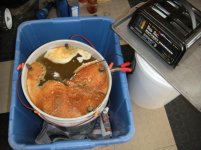
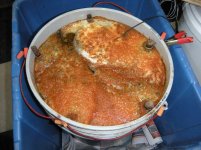
This was the second day, (yesterday), of the leg in the vat, running at fairly low current. The shape of the leg is quite visible, due to the bubbling shaping the rust from the anodes on the surface of the solution.

1395846581large_electrolysis_vat_cast_anodes2.jpg


Sure ! But, might I add that it really is a very, very, simple process and unless you fall into your tank I am struggling to think of ANYTHING that can go wrong?

...

It's actually not rocket science in a home environment where , what the heck just leave it untill tomorrow.

As much as I do agree with what you say, I can also understand the concerns of those who have never tried it as yet. Once they do, they'll realise it truly is as simple as it appears, but we all likely tend to overthink things beforehand. :D

Simple way to get ones hands dirty, so to speak, is to just get some manky, rusty piece which has no real value and try it with that. I think the first thing I ever tried was an old horseshoe. It's still hidden away above my shed door to this day, in a damn sight better condition that it was originally.


strewth !! guys, it is a very simple chemical process using cheap chemicals . I am not aware that what you are discussing has any chemical basis for concern. Talk about a solution looking for a problem ?? If it bothers you, Just throw away the $1 solution , don't buy the $40 pump.

When you have large tanks, it just becomes a bit of a pain in the **** emptying and refilling on occasion. It's not really cost or time related, more just convenience.


My metal sacrificial anodes last a very long time - I have used the same bits of rebar for over 12 months. Never thought of using cast iron , you guys must use this process way more than me !!!

Possibly. Now that the weather is getting warmer, (dunking hands and arms in freezing water ain't my first choice of how to get my jollies :D), at least one of the vats will be going pretty much constantly, over the next few months, at any given time. Again, it's a simplicity/convenience thing. The longer an anode will last the better.
 

Sheriff Roscoe

Well-known member
Joined
Feb 6, 2014
Messages
189
Location
Great Lakes State
Fretters: Interesting to see the imprint of the part on the water surface. I suspect you are using a very low current that doesn't disturb the water much. I had visible water movement due to the higher amperage. Either way, both amperage levels are certainly doing the job :thumbup:
 

Craptain

Well-known member
Joined
Apr 18, 2013
Messages
4,028
Location
Tampa Bay FL
I will have to take a picture of my tank tomorrow. I have seen a couple of other tanks that have that nasty orange froth on the top. Using carbon electrodes I don't get that. The solution turns black and there is a black residue, but not much, on the bottom and sides of the tank.The residue seems to be the same as the finish on the parts when they come out. All in all I don't get a lot of **** in the water like some of you seem to.
 

Fretters

Well-known member
Joined
Jan 25, 2014
Messages
4,217
Location
South Yorkshire, England
Fretters: Interesting to see the imprint of the part on the water surface. I suspect you are using a very low current that doesn't disturb the water much. I had visible water movement due to the higher amperage. Either way, both amperage levels are certainly doing the job :thumbup:

Aye, I keep it low. :D I try to keep bubbling to a minimum, as it's literally just an indication of wasted energy.
 

G20-Budo

Well-known member
Joined
May 31, 2013
Messages
987
Location
Chandler, AZ
Ok, so I tried setting up a tank here in my garage. I used a rubbermaid tub, put my vise in it, added around 7 gallons of water and the correct amount of PH up. I got some rebar to use, connected the positive to it and the negative to vise, but nothing happened. In fact the LED on the battery charger didn't even come on. I'm wondering if there isn't a sensor in the battery charger to know if it's connected to a battery or not?
 

Outlawmws

Well-known member
Joined
Aug 9, 2011
Messages
39,180
Location
The Badlands
Let me guess: a modern solid state "smart" charger? They won't even work on a fully discharged battery at times...

add a 12 V car battery in parallel, or a 6V MC battery and see if that helps.
 

G20-Budo

Well-known member
Joined
May 31, 2013
Messages
987
Location
Chandler, AZ
I'm thinking it's about 10 years old, but yeah Outlawmws, I think it is solid state. I saw a few articles where they had a battery in parallel, issue is, I don't have a spare battery. Perhaps I'll connect up my car battery just to see if it works? Either that or try using my old PC power supply to provide the current?
 

Outlawmws

Well-known member
Joined
Aug 9, 2011
Messages
39,180
Location
The Badlands
If you go with the PC PS. look for the notes someone made on selecting the outputs. they are not all the same, for either voltage or amps, and some have burned them up (probably by using a lower amp output...)
 

Wingnut65

Well-known member
Joined
Apr 21, 2010
Messages
3,170
Location
Tampa Bay, FL
This is an awesome thread to provide information to those that want to learn. :thumbup: I read about e-tanks probably 5 years ago and built mine with what I had in the garage - 5 gallon bucket, rebar, saw blade and some wire. Next post will have photos...

Ok, so I tried setting up a tank here in my garage. I used a rubbermaid tub, put my vise in it, added around 7 gallons of water and the correct amount of PH up. I got some rebar to use, connected the positive to it and the negative to vise, but nothing happened. In fact the LED on the battery charger didn't even come on. I'm wondering if there isn't a sensor in the battery charger to know if it's connected to a battery or not?

I needed a charger for home and the tank and bought one from Sears, and then promptly returned it when I read that it was a smart charger type. It needs the draw of a battery to function correctly. I also needed 6 volt charging capability for the Bus.

I ended up with a Schumacher Se-82-6, which I think I bought at Wally World.
94026508AL_L.jpg
 

Wingnut65

Well-known member
Joined
Apr 21, 2010
Messages
3,170
Location
Tampa Bay, FL
My tank sounds like many others on this thread - 5 gallon bucket, rebar, saw blade and some wire. I added a bent bar on the bottom to sit a saw blade on.
(Click the pix)
01_DSCN6419.jpg

This project was for the brake backer plates on my '65 VW Bus. I needed all this water to cover it completely. Just turned it on and bubbles started immediately. I added Arm & Hammer Super Washing Soda to the water.
02_DSCN6424.jpg

I didn't remember how much stuff would appear on the top, so I have the tank in a recycling bin with paper to catch anything. This is after about 2 hours at 12v/2A from my Schumacher Se-82-6 charger.
03_DSCN6425.jpg

I let it sit about 24 hours before removing it and starting the next one.
04_DSCN6428.jpg

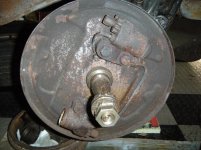
This is the 'Before' shot while it is still mounted on the Bus. I did degrease it with whatever cleaner was nearest at the time.
05_DSCN6413.jpg

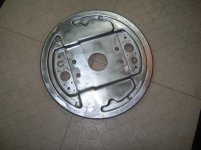
And this is just after a 24 hour E-Tank bath
06_DSCN6429.jpg

After I dried it off completely, I hit it with a wire when set up on my grinder. The rust just disappeared. The tank killed it and the brush just eased the process of cleaning it up.
07_DSCN6442.jpg

A coat of primer and black paint and it is ready to go back on.


Now I need to look at a larger tank to hit the rims...
 

G20-Budo

Well-known member
Joined
May 31, 2013
Messages
987
Location
Chandler, AZ
Hey guys.. I finally got some time to mess around in the garage. My car is currently down for repair, so I just hooked up the battery charger to the battery and then jumper cables from the battery to the electrolysis tub. As soon as I hooked it up, it started foaming at the rebar, and bubbling in the water. So I'm guessing it's working. You can see the foam at each rebar. I put pieces of rubber at the bottom of each piece of rebar so that they will not come in contact with the vise. Then I ran bare wire romex to each of the pieces of rebar and then hooked it up. Here's a pic.

IMG_20140427_103659.jpg
 
Last edited:
To avoid these ads, REGISTER NOW!

Fretters

Well-known member
Joined
Jan 25, 2014
Messages
4,217
Location
South Yorkshire, England
Hook a piece of copper wire to the piece being cleaned, protruding above the surface of the solution, and then connect your crocodile clip to that instead. You don't want to be dunking the croc clip, if possible. Won't damage it as in eroding it, but you may find your clip spring becomes a bit stiff and brittle for a while if you leave it dunked in there. :D
 

Outlawmws

Well-known member
Joined
Aug 9, 2011
Messages
39,180
Location
The Badlands
I prefer to use re-bar ty-wire. Its soft iron/steel and has no chance of leaving any heavy metals in the soup. Cheap too, in he bib box store near where Re-bar is sold.

I also commonly use a section of re-bar across the top of the bucket, and hang parts on hooks made from the iron wire.
 

G20-Budo

Well-known member
Joined
May 31, 2013
Messages
987
Location
Chandler, AZ
Well, it seems to be working. It was running for an hour or more and it looked like this.
IMG_20140427_132415.jpg


I went ahead and clamped down a piece of romex in the vise so I would have a wire that I can connect to outside of the goop. I also switched to my PC bench power supply to see how well it would work instead of the battery charger/battery parallel setup. And the PC bench power supply looks to be working great too.

IMG_20140427_132442.jpg


I might be slow getting to some of my projects, but I am finally making some progress! :)

Now I have a question, what do I do when I pull it out? I understand there will be a layer of black residue on the vise after its been in the electro-tub. What do I need to do to it to keep it from rusting right away? Also, I'm planning to fill a few of the deep gashes on the face of the vise with JB weld. How do I prep the surface before starting my work?

I realize this might not be the correct thread to ask these questions, but it is related to ("fter electro-tub".

Thanks.
 

Outlawmws

Well-known member
Joined
Aug 9, 2011
Messages
39,180
Location
The Badlands
several ways:

You can scrub with a wire brush, (use SS or the ordinary wire brushes rust out) use a stiff nylon scrub brush (I like the ones with a handle on the back so /i can bear down) use scotch bright pads. or just dry it off and wire wheel it off.

I prefer to wear rubber gloves as the black comes off on your hands just as easy. (almost like graphite that way)
 

Fretters

Well-known member
Joined
Jan 25, 2014
Messages
4,217
Location
South Yorkshire, England
several ways:

You can scrub with a wire brush, (use SS or the ordinary wire brushes rust out) use a stiff nylon scrub brush (I like the ones with a handle on the back so /i can bear down) use scotch bright pads. or just dry it off and wire wheel it off.

I prefer to wear rubber gloves as the black comes off on your hands just as easy. (almost like graphite that way)

Pretty much the same here. Soft brass or stainless brush else those green pan scourers, the soft plasticy type. Tub of water to either dunk the piece in else to just keep dunking the brush/scourer in if it's a large piece, and go to work scrubbing. Then either pour boiling water over it or wipe down and then go over it with a rag soaked with white spirit, to just get it dry as quickly as possible. Any fine rust which may appear then is easily removed by a wipe down with a spirit soaked rag before painting.

That black stuff is a cow to get off your hands, ain't it. :D
 

Craptain

Well-known member
Joined
Apr 18, 2013
Messages
4,028
Location
Tampa Bay FL
Congratulations G20-Budo, you now know, or soon will, how easy it is. Post up some pictures of the vise as you progress. If not in this thread at least put a link here. And, inquiring minds would like to know what vise is in the tank?
 

G20-Budo

Well-known member
Joined
May 31, 2013
Messages
987
Location
Chandler, AZ
Craptain,

That's just my little Hollands 24 1/2 vice. 4.5" jaw that opens 8". It might not look that dirty in the pictures, but I took a brush and a a few pick's to it, and was able to get the pile of dirt/old grease oil and I don't know what else out of it BEFORE I put it in the electrolysis tub. There was a good deal of old grease on either side of the slide inside the static jaw area.

Holland+Left.jpg

Holland+Label.jpg

Holland+Side.jpg

IMG_20140407_212550.jpg
 

drivesitfar

Well-known member
Joined
Oct 23, 2013
Messages
36,007
Location
Pacific Northwest
G20: glad to see you got the brew cooking with that big old Holland's vise in the tub. i think the picture you emailed me had the negative lead out of the water and that's why i asked if you had a nail in the jaws with the negative attached to it. you also changed the power source when you changed the leads and if my old battery charger on wheels doesn't work without a battery in the loop i may ask you how you did that. nice work and would love to see pictures of Mr. Holland's after he is done bathing before any paint or work done to him.

Everybody: i know a lot of you hang the parts from a wire attached to a piece of rebar or metal rod resting on the bucket or tub and others do like G20 did by putting a wire into or around the part you are cleaning. others like Fretters even has a metal basket that has the small parts in it that has the negative attached to it. correct so far??

i was just wondering if say you are doing a vise if you clamped a piece of steel or a nail in the jaw and attached the clamp to it if that would work as well? i was thinking of running a wire though the vise parts after taking it pretty much apart and then hanging the wires from a piece of steel sitting on top of my tub that the negative lead will attach too.

also would the copper wire attaching the rebar really have any issues leaching into the water if it doesn't touch the water or is the rebar cooking it so it will eventually needing to be replaced too?

i'm anxious to start the cooking and hopefully the rain will stop here long enough for me to organize my shop so i can have a permanent spot for my tub.
 

G20-Budo

Well-known member
Joined
May 31, 2013
Messages
987
Location
Chandler, AZ
drivesitfar,

GREAT eye! You are correct. When I first hooked it up and took a pic it was backwards (negative to the vise, positive to the rebar). I switched it around when I made one of the changes. Oh and I did clamp down the copper wire in the vise, and connected the positive lead to it.

It is working GREAT. In fact I'm shocked at how well it's working. I plan to pull the vise out tomorrow and see how it looks.
 

taumac

Well-known member
Joined
Aug 30, 2011
Messages
8,104
Location
Brooksville, Fl
Your sacrificial rods I hear after time will need to be replaced. I've ran my system a dozen times and and seen some deterioration in material. When they get real dirty I reverse leads and use piece of scrap to collect all the ****. I use a welded frame of rebar so I only use one positive lead. I also used old mower blades jumping from blade to blade . The only problem I see or had with wrapping copper wire around rebar is getting a good connection and set up and break down since I dont use too often For the neg I usually have a piece of wood and hang parts from that and neg on that for small parts. For say a vise. I take my vise apart and do big parts separate although you could run them whole. I just find is easier to run them separate and I think it does process quicker. I never ran it just for heavy rust yet but mostly for paint and grease removal to start of with bare iron.


Have a good one, Gerard

Florida GJers ( FGJ)
http://www.garagejournal.com/forum/group.php?groupid=117

The 5 Stitches Garage
http://www.garagejournal.com/forum/showthread.php?t=211899
 

Outlawmws

Well-known member
Joined
Aug 9, 2011
Messages
39,180
Location
The Badlands
Just remember whatever has red (positive) connected will be getting rusty... Black (Neg) will lose the rust.

I don't like getting any copper in the soup on either wire. Re-bar tie wire is cheap.
 

Fretters

Well-known member
Joined
Jan 25, 2014
Messages
4,217
Location
South Yorkshire, England
Just remember whatever has red (positive) connected will be getting rusty... Black (Neg) will lose the rust.

I'm just hoping he hasn't gone to bed, (no idea what time it is currently across there), and won't see this thread for a few hours.


I don't like getting any copper in the soup on either wire. Re-bar tie wire is cheap.

On the anode side, I always keep it clear. On the cathode side, I'll merrily dunk the copper wire in there. It'd be pointless me keeping it out seeing as I occasionally clean brass and copper bits in the tank too. :D Not noticed any degradation whatsoever in any of the connecting/hook wires which are suspended in the solution, in all this time of utilising the process. That's one of those potential minor risks I'm quite willing to take. :D
 

Outlawmws

Well-known member
Joined
Aug 9, 2011
Messages
39,180
Location
The Badlands
G20: SNIP
Everybody: i know a lot of you hang the parts from a wire attached to a piece of rebar or metal rod resting on the bucket or tub and others do like G20 did by putting a wire into or around the part you are cleaning. others like Fretters even has a metal basket that has the small parts in it that has the negative attached to it. correct so far?? YES

i was just wondering if say you are doing a vise if you clamped a piece of steel or a nail in the jaw and attached the clamp to it if that would work as well? i was thinking of running a wire though the vise parts after taking it pretty much apart and then hanging the wires from a piece of steel sitting on top of my tub that the negative lead will attach too.

also would the copper wire attaching the rebar really have any issues leaching into the water if it doesn't touch the water or is the rebar cooking it so it will eventually needing to be replaced too?

i'm anxious to start the cooking and hopefully the rain will stop here long enough for me to organize my shop so i can have a permanent spot for my tub.

Clamping something in the vise jaws would work, but I usually put the parts in separately unless the parts are frozen.

As to copper wire in the soup with the re-bar or the part:

A: they are dissimilar metals, so "something" will happen. B: plating shops have to go through all sorts of **** to keep "heavy metals" out of their waste stream. - Why risk it? Use iron wire

The ONLY issues I ever had with the process not working was:

1. Poor continuity (the rust was keeping the wire from making contact) and a couple of times i had a rusty two part something, where one part de-rusted and the other didn't have good electrical contact with the part that was connected to the wire, and only the wire connected part was cleaned; I had to run a "jumper wire" as even though the parts were theoretically connected, the rust kept then from being properly connected.

2. Loaded up anodes, gone too far and they do stop the process, a rough wire brushing will refresh them.

Comment on the erosion of the anodes: I've been using mine (1/4" thick steel plates) for near ten years off and on. They looks a hundred years old, but still work fine.
 

Fretters

Well-known member
Joined
Jan 25, 2014
Messages
4,217
Location
South Yorkshire, England
As to copper wire in the soup with the re-bar or the part:

A: they are dissimilar metals, so "something" will happen. B: plating shops have to go through all sorts of **** to keep "heavy metals" out of their waste stream. - Why risk it? Use iron wire

Much as I usually agree with what you say, that is still the one thing where I'd say otherwise. On the anode side, absolutely, keep the copper out of the solution. On the neg side however, it is harmless, and galvanic corrosion due to dissimilar metals won't happen whilst ever contacts are good and current is flowing.

Edit: Btw, I will just add that if you posted something disproving my stance in the past, apologies. I have a shonky memory. :D If so, any chance you could link to it again?
 
Last edited:
To avoid these ads, REGISTER NOW!
Top Bottom