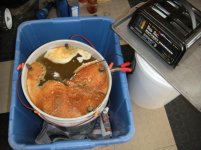
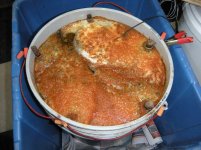
This was the second day, (yesterday), of the leg in the vat, running at fairly low current. The shape of the leg is quite visible, due to the bubbling shaping the rust from the anodes on the surface of the solution.
Sure ! But, might I add that it really is a very, very, simple process and unless you fall into your tank I am struggling to think of ANYTHING that can go wrong?
...
It's actually not rocket science in a home environment where , what the heck just leave it untill tomorrow.
As much as I do agree with what you say, I can also understand the concerns of those who have never tried it as yet. Once they do, they'll realise it truly is as simple as it appears, but we all likely tend to overthink things beforehand.

Simple way to get ones hands dirty, so to speak, is to just get some manky, rusty piece which has no real value and try it with that. I think the first thing I ever tried was an old horseshoe. It's still hidden away above my shed door to this day, in a damn sight better condition that it was originally.
strewth !! guys, it is a very simple chemical process using cheap chemicals . I am not aware that what you are discussing has any chemical basis for concern. Talk about a solution looking for a problem ?? If it bothers you, Just throw away the $1 solution , don't buy the $40 pump.
When you have large tanks, it just becomes a bit of a pain in the **** emptying and refilling on occasion. It's not really cost or time related, more just convenience.
My metal sacrificial anodes last a very long time - I have used the same bits of rebar for over 12 months. Never thought of using cast iron , you guys must use this process way more than me !!!
Possibly. Now that the weather is getting warmer, (dunking hands and arms in freezing water ain't my first choice of how to get my jollies
), at least one of the vats will be going pretty much constantly, over the next few months, at any given time. Again, it's a simplicity/convenience thing. The longer an anode will last the better.