Chadwilliam1
Well-known member
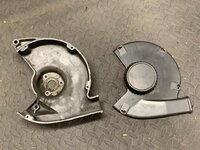
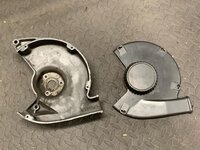
Did you patch the side of the plastic cover?
yes i did. Ill have a write up soon

Did you patch the side of the plastic cover?
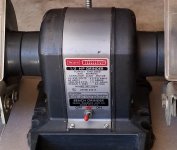
Looks like the molded max wattage statement around the perimeter has been "erased".
garage clean out on block grinder parts. I have inner guards and housing parts for 6” block. I also have housing parts and one side guard set for a 7” block. I don’t know what’s wrong with the windings in the second to last pic. make me an offer if you need anything. I just want these gone.

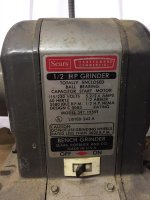
I acquired a 397 19591. Came with no wheel guards. What size wheel does this grinder come with? If available, does your guards fit this model?
Vintage Machinery website has owners manuals for many of the CM Block grinders in their "Publication Reprints" section.I acquired a 397 19591. Came with no wheel guards. What size wheel does this grinder come with? If available, does your guards fit this model?

Yup, 7", 1/2" arbor, dual voltage.I believe it’s for a 7”

I believe it’s for a 7”
As previously promised, here is an "after" pic of the red and gray block with the new sticker from #mattblast. Super pleased!
https://www.garagejournal.com/forum/showpost.php?p=8443140&postcount=12243
I did erase it, my original plan was to keep it but i wanted to make sure the paint stuck so i just sanded it off.

Vintage Machinery website has owners manuals for many of the CM Block grinders in their "Publication Reprints" section.
The manuals have the part numbers for the respective parts.
http://vintagemachinery.org/mfgindex/detail.aspx?id=222&tab=3

As previously promised, here is an "after" pic of the red and gray block with the new sticker from #mattblast. Super pleased!
https://www.garagejournal.com/forum/showpost.php?p=8443140&postcount=12243
i love how it matches the tool box, nice!
wow that’s pretty awesome!
Get you a 16 or 14 AWG 3 prong extension cord, and Hack the female end off.I've contributed to the vise restoration thread, and as I acquire tools for my first home purchase, I've become fascinated with older USA tools. Naturally that led me to my next project, a Craftsman block grinder, thanks GJ. I went out and bought two on CL, figured I could use one for parts if need be. I've decided I'm going to restore both and give one away to family. I will post a full restoration from start to finish. Please bear with me, I have a bunch of questions.
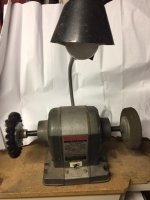
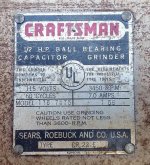
Grinder 1: What I believe to be pre-block? It's cast iron and very heavy. Model #397.19501 1/4 HP with a manufacture date of 1/1962. I paid $35 for it.
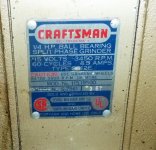
And my second grinder, is this considered a 'block'? It's model #397.19580 1/3 HP and appears to be complete (both tool rests, shields, side covers, coolant tray, light) and relatively fully loaded. I paid $90 for it, it came with the original stand, which I consider to be immaculate. I was weary to pay that much for a 1/3 HP model, but at least this one was complete and came with the stand. The steel on the stand has original paint and is perfect, the cast iron base will need to be cleaned up.
Can my 1/4 HP model be fitted with wheel guards? I found a 1963 Craftsman catalog and it doesn't look like it came with them.
Probably a common question, does anyone have a matching 1/4 HP metal shield enclosure w/ glass they'd sell me?
Does anyone have a write-up on replacing the power cord and which cord you used? I'd like to buy a nice cord but I don't know where to start. I'd also like to ground the 1/4 model, the 1/3 model came with a 3 prong.
Where can I find the year of manufacture for the 1/3 model? Not listed on the label or underside.
Is there a write-up on replacing bearings? I think both of mine need replacement, both grinders come to a complete stop after 30 seconds, indicating bearings need replacement, correct?
Lastly, just my own eye test, but the 1/4 HP model beyond having a more robust exterior material just seems to be much more powerful than the 1/3 HP, just by standing next to both of them turned on at the same time. Does that sound right? I'm trying to decide which one I will keep. I thought it would be easy with the features on the 1/3 HP but now I'm not sure.
For now, I will ring test the included stones, start disassembling, painting, degreasing, etc. Thanks so much for reading my litany of questions.
Me too, $125.00 I think, OEM stand and light!I paid more then $90 for my first 1/3 with stand, but it was in prestine condition. 1/3 pre block housings should fit if you want outer covers... eBay is your best bet for parts.
Take pictures as you take them apart so you can put them back together correctly. Very simple machines to work on.
Sent from my Pixel 3 XL using Tapatalk
I have a bunch of questions.
Does anyone have a write-up...
Where can I find...
Is there a write-up...
Maddog1337 - nice scores!
I consider both of your grinders Blocks.
You might be able to add side wheel guard covers to a 1/4-HP IF it has the cast screw bosses on the wheel guards already. You'd need the cast covers and then drill and tap the guards.
The metal framed eye shields come in 2 sizes, and can be found on eBay and occasionally from GJ members:
Small 4 3/8" x 4 1/2"
Large 4 1/4" x 5 1/4"
The following thread shows bearing removal/replacement, start-up centrifugal switch (newer models use a relay), install of a 3-wire power cord and source - IIRC.
Be sure to keep us informed on how you are progressing.
CM pre-Block Grinder 115.19500 restore, ver. 2
https://www.garagejournal.com/forum/showthread.php?t=447537
Also,
Craftsman Block motor Bench Grinders - What's the Fuss (with resource information)
https://www.garagejournal.com/forum/showthread.php?p=4000528#post4000528
I know my 1/2 pre block is much better then my 3/4. The windings on these are substantial.Thanks so much everyone and especially the resident expert torqueman for some answers. Probably one of my more pressing questions is if it would be outlandish to think the 1/4 cast iron was built better than the 1/3 aluminum. Side by side I feel like the 1/4 cast iron runs more powerful than the 1/3 aluminum. Nothing scientific to that analysis but I thought I remembered reading somewhere on here that the cast iron models can hit out of their horsepower league per se, when compared to the aluminum models.


Thanks so much everyone and especially the resident expert torqueman for some answers. Probably one of my more pressing questions is if it would be outlandish to think the 1/4 cast iron was built better than the 1/3 aluminum. Side by side I feel like the 1/4 cast iron runs more powerful than the 1/3 aluminum. Nothing scientific to that analysis but I thought I remembered reading somewhere on here that the cast iron models can hit out of their horsepower league per se, when compared to the aluminum models.
Probably. It's easier to say when comparing apples to apples. The non-scientific analysis of my 1959 1/2hp cast iron Pre-Block and my 1972 1/2hp cast aluminum Craftsman Commercial Round Top leaves me in awe of my Pre-Block. I think someone did a side-by-side comparison in this thread of windings and the much beefier core of the Pre-Block makes all the difference. The Pre-Block draws 7 amps vs. 5.2 for the Round Top.
Thanks exmaxima1! I found it at post #126 from lafester.
"industrial use"The thing is, the 1/2 hp pre block is like an inch wider then the 1/3 and 1/4 so I'm not sure how well the smaller ones stack up. If I ever find a 1/3 for sale I'll have to get it to compare.
They really should have kept making the cast iron version for industrial use.

I have that recently restored pre-Block 1/4-HP (https://www.garagejournal.com/forum/showthread.php?t=447537) fitted with wire wheels in the basement. I've used it for some bolt thread cleaning, which it is perfect at.
It wouldn't be fair to compare it to the Baldor 7312D grinder (0.5/0.3HP, 3600/1800rpm) also recently restored (https://www.garagejournal.com/forum/showthread.php?p=8439969#post8439969) standing next to the pre-Block. I am really liking the 1800 RPM for wire wheeling.
Nor would it be fair to compare it to the ratty 1/2-HP Block with a 7" x 1/2" hd wire wheel, that remove several layers of skin on multiple fingers while restoring the Baldor.
But, I have a 1/3-HP round top Block that I will saddle-up with some 6" wheels and take it for a comparison ride.
It's a little late tonight, but I'll report back my subjective findings tomorrow.
Update - 4/30/2020
The players.
1/4-HP 4.5 AMPS m-115.19500 Date 3 57 | 6" dia. wheel, 1/2" arbor


1/3-HP 3.5 AMPS m-397.19580 Date [none noted on bottom cover] Range of dates I have worked on: May 3 1965 to "814 70" | 6" dia. wheel, 1/2" arbor


Test piece.
Before
CM drill press part with surface rust.


After wire wheeln' on 1/4-HP m-115.19500.


After wire wheeln' on 1/3-HP m-397.19580. (*)


Test Method.
The test piece was subjected to light to sever wheeln' (stalling of grinder).
(*) The 1/3-HP m-397.19580 grinder was tested 1st, for no particular reason.
Tester's Observations.
The surface rust was easily removed by both Block grinders when light to medium pressure was applied.
When heavy pressure was applied the 1/4-HP m-115.19500 grinder stalled sooner (relatively less pressure) than the 1/3-HP m-397.19580 grinder stalled.
Tester's Conclusions.
This tester believes, despite the Amperage difference, the 1/3-HP m-397.19580 delivered more 'power' in the form of rust removal with identical/similar wire wheels.
This difference is apparent only at the very extremes of operating the grinders - to the point of stalling.
It is this tester's recommendation and practice, to match the power of the grinder to the job. 75-90% of the tester's grinding and wire wheeling is performed on 1/2-HP and under grinders.
Thanks for viewing.
that's a pretty subjective test. Was the same wire wheel used? Obviously the math says that a true 1/3 HP motor should have more torque than a true 1/4 HP motor, hence the difference in stalling. Did you actually measure the current draw? I don't doubt that the bigger armature makes for a motor that will stand up to more abuse, such as locked rotor. But in terms of performance, does it matter? It will have proportionally more inertia, so should again be less subject to stalling. But are the newer motors simply more efficient? We see DCBL motors that are but a tiny fraction of bigger motors' size, but with enough RPM are able to match the HP of a larger motor. Of course longevity probably suffers, but that's not a factor in everything. I wonder if the infatuation with older motors because they are beefier is like those who lust over the old cars, the big caddys and lincolns because they felt safer, even though testing has repeatedly shown that in real life tests, the occupants are in fact far more likely to suffer injury or death in them.
Dave
I like juice!Well, at least they were both rated "back ion the day" @115V. they get about 121V today, so they probably run a bit better than back in the day... So about 5% more juice