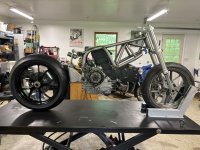
You already know that welds are going to distort whatever you are welding upon, just not sure you appreciate how to minimize and how to do final finishing. Also: some of your wall thicknesses seem awfully excessive for such a small, light structure. Where did you get the values from?
When I see people doing tube-to-tube fitups they are mostly cutting and fitting zero clearance joints. If you want really good welds, don't do that. EVERY weld shrinks as the bead cools, and a zero fit will pull the tube off square or angle as it cools. The ideal fitup on very thin tubing is closer to 1/2 wall thickness and on really thin 1x. That is easy to do in an assembly jig but as you know by now really difficult when positioning in 3D space. I suspect some of your thick walls exist to allow for machined counterbores for bearing fits, so something you might consider for high angle joints with smaller dia, thinner wall intersecting tubes is to use annular cutter of right size to get target gap and instead of coping the small tube to fit on outer surface let it penetrate a half dia or so into the larger tube. That will stop burnback at end of small tube by providing more heat sink. (look into tail boom welding procedures for Bell 47 to see what I mean).
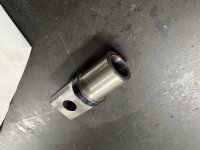
The bearing counterbores for swingarm and at frame head are another thing. You have a lot of weld near them so your carefully machined round holes are not longer very round. The solution involves a bit of tooling. Rough bore your big counterbores leaving enough cleanup to accomodate weld distortion. Finish your welding and if you can head to a boiler shop or wherever you can stress relieve the weldment. To finish the counterbores you will need shell reamers to fit over a mandrel that will have an alignment taper on one end and reamer on the other. Spin it around and do each from opposite side. Then your finish diameter will be spot on and round.
fitting up without jigging goes back to the weld gap thing. Put in place with gap shims (I use wire) and put in one tack, pull out shims and re-measure closing side opposite tack to just shy of correct location and throw on tack #2. Now measure angle 90 degrees radially to get axial location right and put #3 tack down, then measure that angle again, and if not in tolerance remove and correct (slightly over allowing for the inevitable shrinkage of the tack) then stick on #4 and measure again. You will still get distortion from the final structural weld, but it will be one hell of a lot less than just buzzing a zero fitup in place then wondering why things aren't where you thought/hoped they will be.
When I see people doing tube-to-tube fitups they are mostly cutting and fitting zero clearance joints. If you want really good welds, don't do that. EVERY weld shrinks as the bead cools, and a zero fit will pull the tube off square or angle as it cools. The ideal fitup on very thin tubing is closer to 1/2 wall thickness and on really thin 1x. That is easy to do in an assembly jig but as you know by now really difficult when positioning in 3D space. I suspect some of your thick walls exist to allow for machined counterbores for bearing fits, so something you might consider for high angle joints with smaller dia, thinner wall intersecting tubes is to use annular cutter of right size to get target gap and instead of coping the small tube to fit on outer surface let it penetrate a half dia or so into the larger tube. That will stop burnback at end of small tube by providing more heat sink. (look into tail boom welding procedures for Bell 47 to see what I mean).
The bearing counterbores for swingarm and at frame head are another thing. You have a lot of weld near them so your carefully machined round holes are not longer very round. The solution involves a bit of tooling. Rough bore your big counterbores leaving enough cleanup to accomodate weld distortion. Finish your welding and if you can head to a boiler shop or wherever you can stress relieve the weldment. To finish the counterbores you will need shell reamers to fit over a mandrel that will have an alignment taper on one end and reamer on the other. Spin it around and do each from opposite side. Then your finish diameter will be spot on and round.
fitting up without jigging goes back to the weld gap thing. Put in place with gap shims (I use wire) and put in one tack, pull out shims and re-measure closing side opposite tack to just shy of correct location and throw on tack #2. Now measure angle 90 degrees radially to get axial location right and put #3 tack down, then measure that angle again, and if not in tolerance remove and correct (slightly over allowing for the inevitable shrinkage of the tack) then stick on #4 and measure again. You will still get distortion from the final structural weld, but it will be one hell of a lot less than just buzzing a zero fitup in place then wondering why things aren't where you thought/hoped they will be.