To avoid these ads, REGISTER NOW!

Raising the Rat Shack

oldironfarmer

Well-known member
Joined
Jun 25, 2016
Messages
6,664
Location
Terlton, Oklahoma
In a typical poured concrete floor the moisture barrier is on top of the gravel to insulate from water/vapour coming from underneath and block capillary absorption into the concrete. The material used is heavy 15 mil roll (expensive) that is puncture resistant from the sharp gravel.

I used this material

And here is another source

I think that even if you don't have concrete floor you need to block/control the moisture coming from below.

Ariel

X2 on plastic under the plywood.
 
To avoid these ads, REGISTER NOW!
OP
P

Platonic Solid

Well-known member
Joined
Nov 29, 2014
Messages
3,587
Location
CT-USA
In a typical poured concrete floor the moisture barrier is on top of the gravel to insulate from water/vapour coming from underneath and block capillary absorption into the concrete. The material used is heavy 15 mil roll (expensive) that is puncture resistant from the sharp gravel.

I used this material

And here is another source

I think that even if you don't have concrete floor you need to block/control the moisture coming from below.

Ariel
Hmm... I found this site with vapor barrier options (link). I see 15 Mil vapor barrier cost: $350.00 14' x 140' roll which would leave me with 115' left over. I'm assuming I wouldn't need the Stego vapor barrier tape (cost: $42.00 4" x 180' roll) since the footprint is 12' x 24' - thus no seams to tape.
 

FMC1959

Well-known member
Joined
Feb 9, 2014
Messages
2,305
Location
Montreal, Canada / Upstate NY
I think that even if you don't have concrete floor you need to block/control the moisture coming from below.

Ariel

X2 on plastic under the plywood.

Plastic or vapor barriers are important when 2 opposing temperatures meet...e.g., the shed is heated in winter. The indoor heat hitting the winter cold floor or wall causes heavy condensation which can cause mold and rotting.

In this case the shed will be at the same temp as outside, and not being insulated will probably have good air circulation. Having gravel below the plywood does allow minimal air circulation rather than plastic that would inhibit air and allow some moisture accumulation.

If the plywood floor was sitting directly on earth or grass, plastic might help a bit in a situation which is not optimal to begin with.

Save your money, plastic or any kind of vapor barrier would definitely not help and probably make things worse.
 

bandlaw

Well-known member
Joined
Nov 23, 2016
Messages
48
Location
mid-North Carolina
If you are putting plywood down, then yes on vapor barrier... I was thinking you were doing gravel only. If gravel only then I wouldn’t, but otherwise gravel, then sheeting, then plywood. Hope that helps!


Sent from my iPad using Tapatalk
 

lakeroadster

Well-known member
Joined
Jan 19, 2015
Messages
5,166
Location
Central Colorado
So.. if you spill some liquid in the building... the vapor barrier will keep it there and not let it disperse into the gravel. Not good.

And the benefit of a vapor barrier in an unheated non insulated building is negligible.

I'd say no vapor barrier.
 
Last edited:

FMC1959

Well-known member
Joined
Feb 9, 2014
Messages
2,305
Location
Montreal, Canada / Upstate NY
Regarding the OP's original question for below gravel, what you may see is a membrane being applied. The main reason is to keep the gravel from slowly sinking into the earth over time.

Then something you might see on an uninsulated shed is Tyvek between the exterior cladding (vinyl siding, hardie board...etc.) and the wood. This is to prevent wind and drafts from coming through. Some people or misinformed and believe Tyvek is a moisture barrier, when it is not, it intentionally allows vapor to go through.

Of all the sheds you can buy, and not just HD, but places specializing in the construction of sheds that cost thousands of dollars....plain and simple, no insulation, then no vapor barrier.
 
OP
P

Platonic Solid

Well-known member
Joined
Nov 29, 2014
Messages
3,587
Location
CT-USA
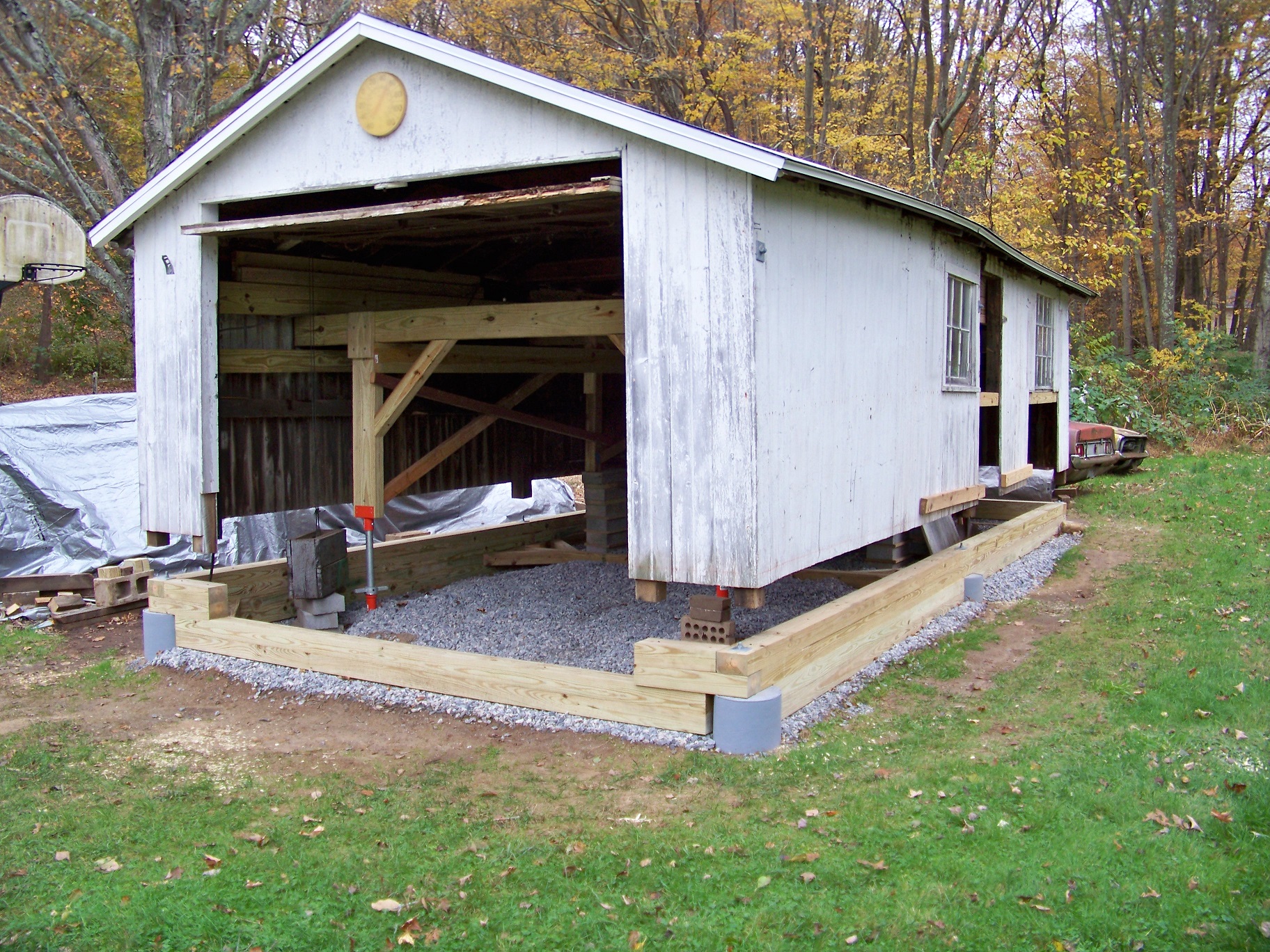
Just to be clear on the intended construction of the floor:

The gravel in below pic will be leveled off to the top of the pictured PT base.
PT Floor joists will be on top of that.
PT 3/4 Ply on top of that.

 
Last edited:

oldironfarmer

Well-known member
Joined
Jun 25, 2016
Messages
6,664
Location
Terlton, Oklahoma
Even in an unheated building a vapor barrier will stop the migration of water from the soil to the air above. This is of value if you set anything on the floor which would be better if there was not moisture under it, like a tool box or metal bucket. Moisture always migrates from an area of high moisture to areas of low moisture. In the winter you'll get moisture out of the ground into an unheated building. Not a lot and you won't notice it except under steel items stored on the floor because they will rust. In my unheated shop with no vapor barrier and a concrete floor I went to setting stuff on boards so the bottom wouldn't rust.

I think you can find plastic sheeting for a lot less than $350, and you don't need to tape any seams, just overlap it a couple of feet.
 

Motoman1100

Well-known member
Joined
Oct 2, 2014
Messages
443
Location
GA
I've been following this thread with interest since it started. Not because I'll ever do this, but because it inspires me. Thanks for sharing your project and keep up the good work!

-- Carl

Well said, my sentiments exactly!
 

lakeroadster

Well-known member
Joined
Jan 19, 2015
Messages
5,166
Location
Central Colorado
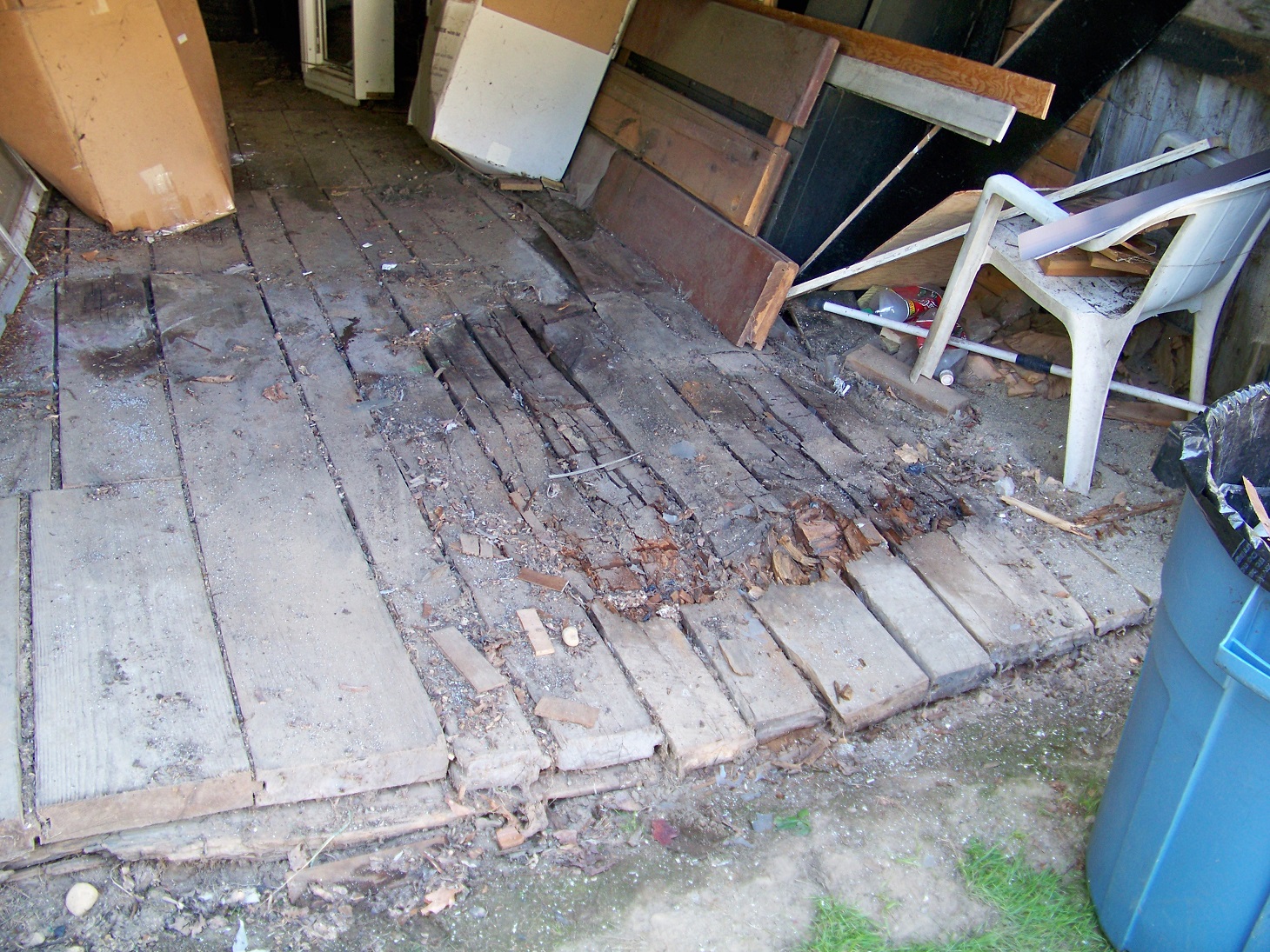
Well I certainly don't want this to happen again:

It will happen, wood rots.

But with the pressure treated you are using, it won't be in your life time.

Didn't you say there were roofing issues previously? So is the rotted floor boards from the leaky roof, or from lack of a vapor barrier, or both?
 
OP
P

Platonic Solid

Well-known member
Joined
Nov 29, 2014
Messages
3,587
Location
CT-USA
Facing the shed, the rear left roof was leaking. So yes there was moisture getting inside through the roof.

I have to say my head is spinning with this vapor barrier question. Google searches have only made it worse. So here are the options I see:

  1. No vapor barrier, no ventilation.
  2. No vapor barrier, add ventilation.
  3. Vapor barrier under gravel.
  4. Vapor barrier on top of gravel.
  5. Vapor barrier between plywood and floor joists.
  6. Closed cell styrofoam boards between joists against underside of floor.

More:
Should I be using landscape fabric under the gravel? (not applicable to option 3). Obviously too late to do that under the base that I've already installed.

This whole topic has me considering composite decking for the floor, which I believe eliminates the vapor barrier issue but would cost over $1k and it would be weird to have open slots throughout.

I've also been considering switching from PT plywood to T&G Dryply Plywood (link)
 
Last edited:

oldironfarmer

Well-known member
Joined
Jun 25, 2016
Messages
6,664
Location
Terlton, Oklahoma
Facing the shed, the rear left roof was leaking. So yes there was moisture getting inside through the roof.

I have to say my head is spinning with this vapor barrier question. Google searches have only made it worse. So here are the options I see:

  1. No vapor barrier, no ventilation. Moisture still comes up from the ground.
  2. No vapor barrier, add ventilation. Moisture still comes up from the ground and can't escape from under things like the tarp. I'm thinking this shed has been well ventilated for many years. Unless you mean ventilation under the floor, like a crawl space. With a crawl space you have less need for a vapor barrier.
  3. Vapor barrier under gravel. Only if the edge of the gravel is protected from surface water intrusion.
  4. Vapor barrier on top of gravel. Stops moisture from coming out of the ground and into the floor.
  5. Vapor barrier between plywood and floor joists. Better choice to seal the bottom of the floor from getting moisture.
  6. Closed cell styrofoam boards between rafters against underside of floor. That would help act as a vapor barrier and provide some insulation if you ever heat the building.

More:
Should I be using landscape fabric under the gravel? (not applicable to option 3). Obviously too late to do that under the base that I've already installed. Landscape fabric lets water go through and keeps fine clay and soil from migrating into the gravel. That helps avoid freeze heave as washed gravel will not heave. Important in roads and outdoor installations. I think it would be of very limited value under your building.

This whole topic has me considering composite decking for the floor, which I believe eliminates the vapor barrier issue but would cost over $1k and it would be weird to have open slots throughout.

Decking would not eliminate rusting of the bottom of stuff stored on the floor but it would help a lot. And you would never have to worry about looking for small things you drop. It would also provide a nice insect passageway for the spider population underneath to thrive. You should be able to get some plastic locally for less than $100 and put it on the joists before nailing the plywood down.
 

oldironfarmer

Well-known member
Joined
Jun 25, 2016
Messages
6,664
Location
Terlton, Oklahoma
It will happen, wood rots.

But with the pressure treated you are using, it won't be in your life time.

Didn't you say there were roofing issues previously? So is the rotted floor boards from the leaky roof, or from lack of a vapor barrier, or both?

I've never seen more floor damage from a roof leak under a tarp, cabinet, etc. than adjacent.

The physics are simple. Water migrates from high concentrations to low concentrations. In cold areas, that means water will migrate from inside a living space through walls without good vapor barriers to the low humidity cold outside. In areas of extreme long lasting cold (like the arctic) a natural vapor barrier of ice can form under siding early in the cold season. Then additional moisture from inside will be drawn to the low humidity adjacent to the ice. When the water vapor can condense and freeze that lowers the humidity of the air next to it. The ice can grow and break the siding off the building.

His building, any building, will experience the same thing. There is soil moisture in most areas, and if a building is kept dry the soil under it will lose moisture to the air above. More moisture will migrate through the soil and get under the building. An impermeable foundation to bedrock will prevent this, as will a vapor barrier, as will a building on stilts or piers with good ventilation underneath.
 

lakeroadster

Well-known member
Joined
Jan 19, 2015
Messages
5,166
Location
Central Colorado
Closed cell styrofoam boards between rafters against underside of floor.

This guy says to use foam between the floor joists, as you stated above in 6.0... That would help the floor to stay the same temperature as the shed, which would decrease any condensation issues you would have from the sun heating the building, and the floor being cool.

http://www.silive.com/homegarden/index.ssf/2012/12/when_building_a_storage_shed_p.html

Internet = information over load :eyecrazy:

I've never seen more floor damage from a roof leak under a tarp, cabinet, etc. than adjacent.

You've never had a roof leak (or a water heater etc.) and moved an object that was sitting on the floor, and noticed the floor was wet? Lack of ventilation... same reason you don't need a vapor barrier if you have good ventilation, as in under a deck.
 
Last edited:
OP
P

Platonic Solid

Well-known member
Joined
Nov 29, 2014
Messages
3,587
Location
CT-USA
oldironfarmer -
"Unless you mean ventilation under the floor, like a crawl space. With a crawl space you have less need for a vapor barrier." Yes, this is what I meant. My concern with venting under the floor is the vents would have to be very low to the ground = between 6" to 10" from grade.
 
To avoid these ads, REGISTER NOW!

LOTW

Well-known member
Joined
Oct 21, 2013
Messages
119
Location
Northern Minnesota
If it was mine id forego the floor and leave it gravel. pallets would keep your stuff off the gravel.
Its looking good to me. keep on plugging away!
 

oldironfarmer

Well-known member
Joined
Jun 25, 2016
Messages
6,664
Location
Terlton, Oklahoma
You've never had a roof leak (or a water heater etc.) and moved an object that was sitting on the floor, and noticed the floor was wet? Lack of ventilation... same reason you don't need a vapor barrier if you have good ventilation, as in under a deck.

Oh yeah, everything gets wet with a leak.

In my shop, which was unheated had drips in various spots, I have trouble with steel cans rusting on the bottom in dry areas. It has no vapor barrier. My new concrete has a vapor barrier. In my mezzanine I've had roof leaks which damaged the plywood floor unless something was laying on top of it.

My experience.
 

TractorJeff

Well-known member
Joined
Dec 8, 2013
Messages
3,309
Location
Elkhorn, WI
Loosing perspective here!
Its a shed for storage!
Put the joists down and flooring!
You were reluctant to straighten the roof which was suggested a long time ago!
Its a non-airtight shed!
Seriously, you are over thinking this!
 
OP
P

Platonic Solid

Well-known member
Joined
Nov 29, 2014
Messages
3,587
Location
CT-USA
I actually like the 2” Styrofoam boards (link) between joists against underside of floor. If the stuff is worth storing, it’s worth keeping it rust/rot free. Thank you oldironfarmer for taking the time to provide detailed responses. I’m going to use T&G Dryply Plywood (link) instead of PT plywood for the floor.

TractorJeff - Just cause the roof isn't straight doesn't mean it isn't dry. I had no intention of renovating the shed when I did the roof. Maybe someday I'll redo the roof. Certainly no reason to do it now. Plus, I'm an Engineer, I overthink everything :)
 
Last edited:

ahazi

Well-known member
Joined
Jan 4, 2015
Messages
55
Location
Los Angeles, CA
I actually like the 2” Styrofoam boards (link) between joists against underside of floor. If the stuff is worth storing, it’s worth keeping it rust/rot free.

Just one little correction, the link is for polyisocyanurate (PolyIso) which is much better and more expensive than Styrofoam. R-13 insulation for 2" is about as much as you can get from the best material. The cost is about $1 per sq ft for 2" thickness for the closed cell version (a must for wet areas) and from my experience it is worth every penny. With plastic 4"-6" wide sticky tape on the joists and the insulation before placing the plywood you will get a complete vapor barrier. This is a great way to go.

Ariel
 
OP
P

Platonic Solid

Well-known member
Joined
Nov 29, 2014
Messages
3,587
Location
CT-USA
ahazi - Good call on taping over the joists. Max width I can find for appropriate tape is 2.83 inch (link), which gives me 0.66 on either side of the joist. I don't see wider tapes like you mention.
 

Sparkynutz

Well-known member
Joined
Jul 16, 2017
Messages
409
Location
Wisconsin
With all your critter issues insulation will make nice bedding for them after they chew holes in it.
I'd second what a previous poster said.
Leave it gravel is what I'd do.
Cheaper, no chance for rot, no area for critters to dig under and live.
If you find you Need a floor throw some pallets down.
Composite decking would be asking for trouble with anything of significant weight. That stuff expands, contracts, and sags like crazy.
I have 2 sheds built on top of reinforced plastic pallets as a base on top of leveled compacted gravel. One holds my wet snowy muddy atv occasionally. It will never rot and won't have moisture issues either.
When do you plan on setting back down?

Sent from my SM-G900V using Tapatalk
 

lakeroadster

Well-known member
Joined
Jan 19, 2015
Messages
5,166
Location
Central Colorado
Those damn varmits... Once your ready to install the foam, buy a couple pails of Bait Block Peanut Butter Flavor Cubes at HD and throw the cubes on top of the gravel, between every floor joist run.

Or get a cat..
 

Attachments

  • jt-eaton-animal-rodent-control-709-pn-64_1000.jpg
    jt-eaton-animal-rodent-control-709-pn-64_1000.jpg
    74.6 KB · Views: 41

TractorJeff

Well-known member
Joined
Dec 8, 2013
Messages
3,309
Location
Elkhorn, WI
Yeah I know about Engineering and over thinking!
I too do it a lot!
Just saying that you are getting out of focus and need to rethink "a basic storage shed not on your own property".
BTW
Keep posting the updates as I have been learning a lot from you!
 
OP
P

Platonic Solid

Well-known member
Joined
Nov 29, 2014
Messages
3,587
Location
CT-USA
Since the space below the floor will be enclosed and covered with gravel I don’t think critters making bedding out of the insulation is a concern. I’ve also seen 2 different cats on different days roaming the property, so no need to get a cat. I may not have time to make a proper floor right now anyway as daylight is getting shorter, temps are dropping and I have other obligations that require my attention. So it will likely remain gravel through the winter.

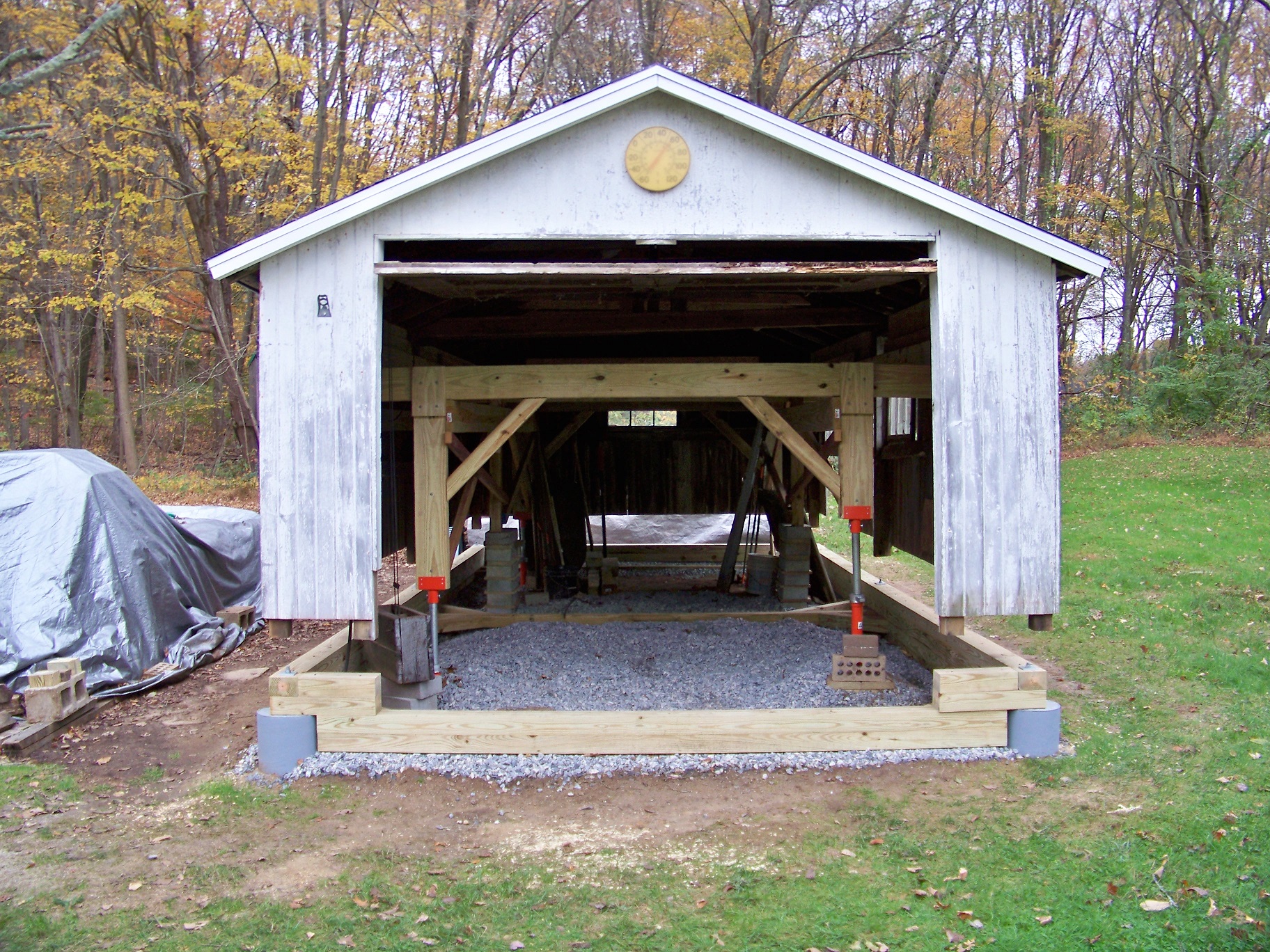
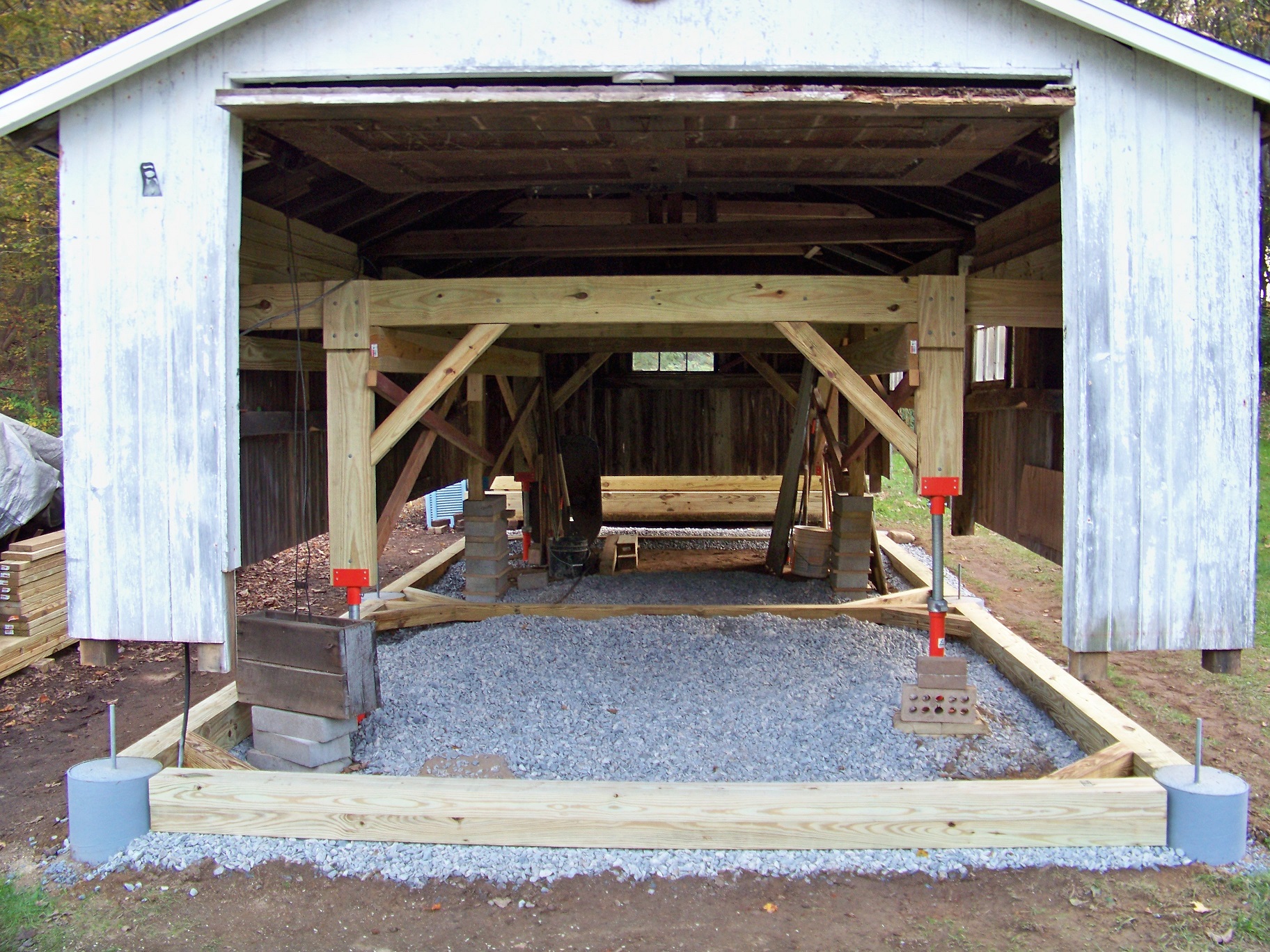
Current goal is to finish the perimeter base and attach the structure so I can remove the lifting frame and building mounted lifting supports. Then put something on the exterior to enclose the siding gap. Keep in mind the building is not being lowered, it’s staying at the current height.

Additional tasks are to put metal screen in between the rafters at the top plates to close off critter access and critter proof the garage door.
 

Sparkynutz

Well-known member
Joined
Jul 16, 2017
Messages
409
Location
Wisconsin
If it's warm and dry they will eventually find a way.
In my neck of the woods critters get in and dig in everything. Mice for sure.

Sent from my SM-G900V using Tapatalk
 
OP
P

Platonic Solid

Well-known member
Joined
Nov 29, 2014
Messages
3,587
Location
CT-USA
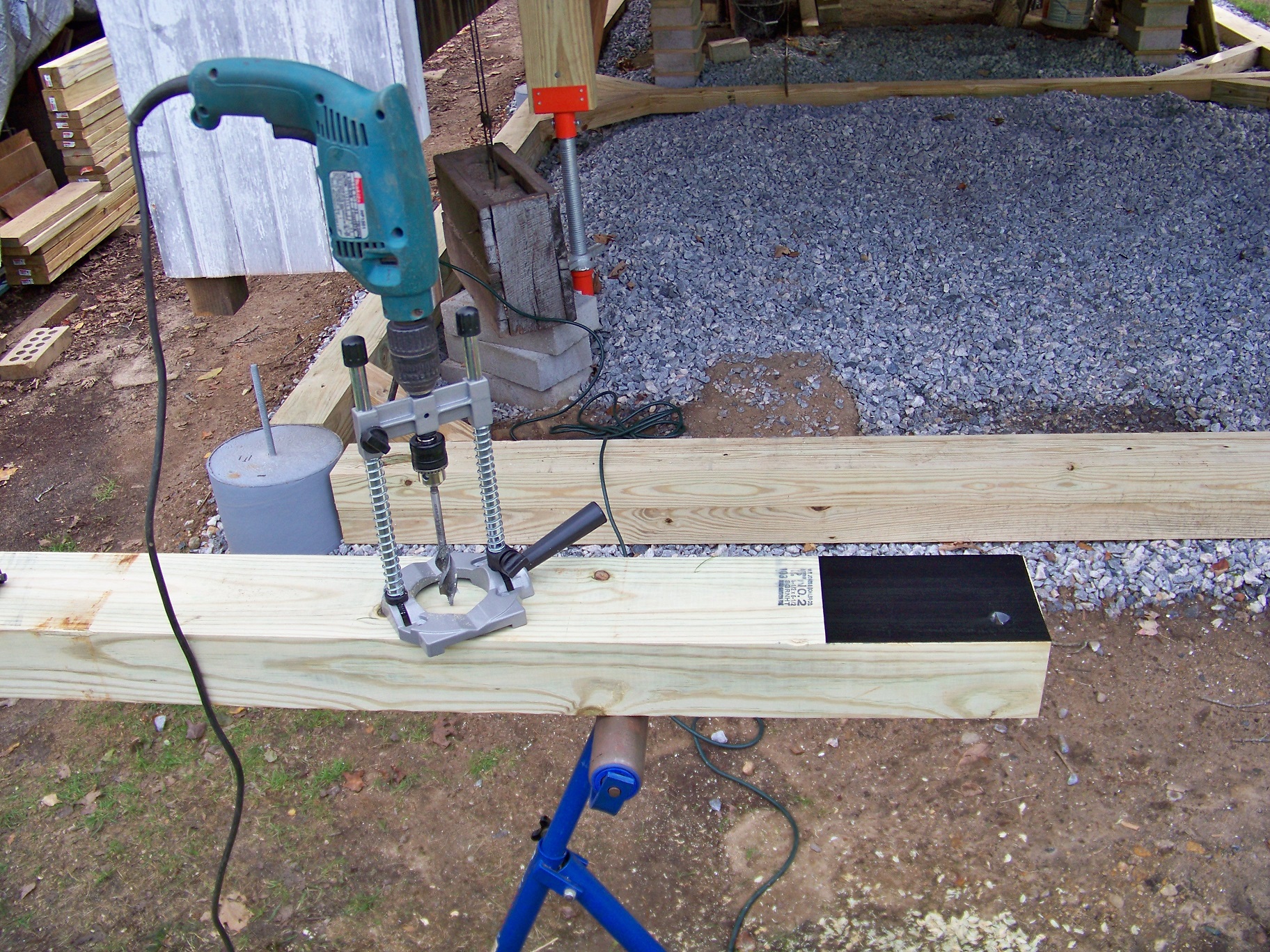
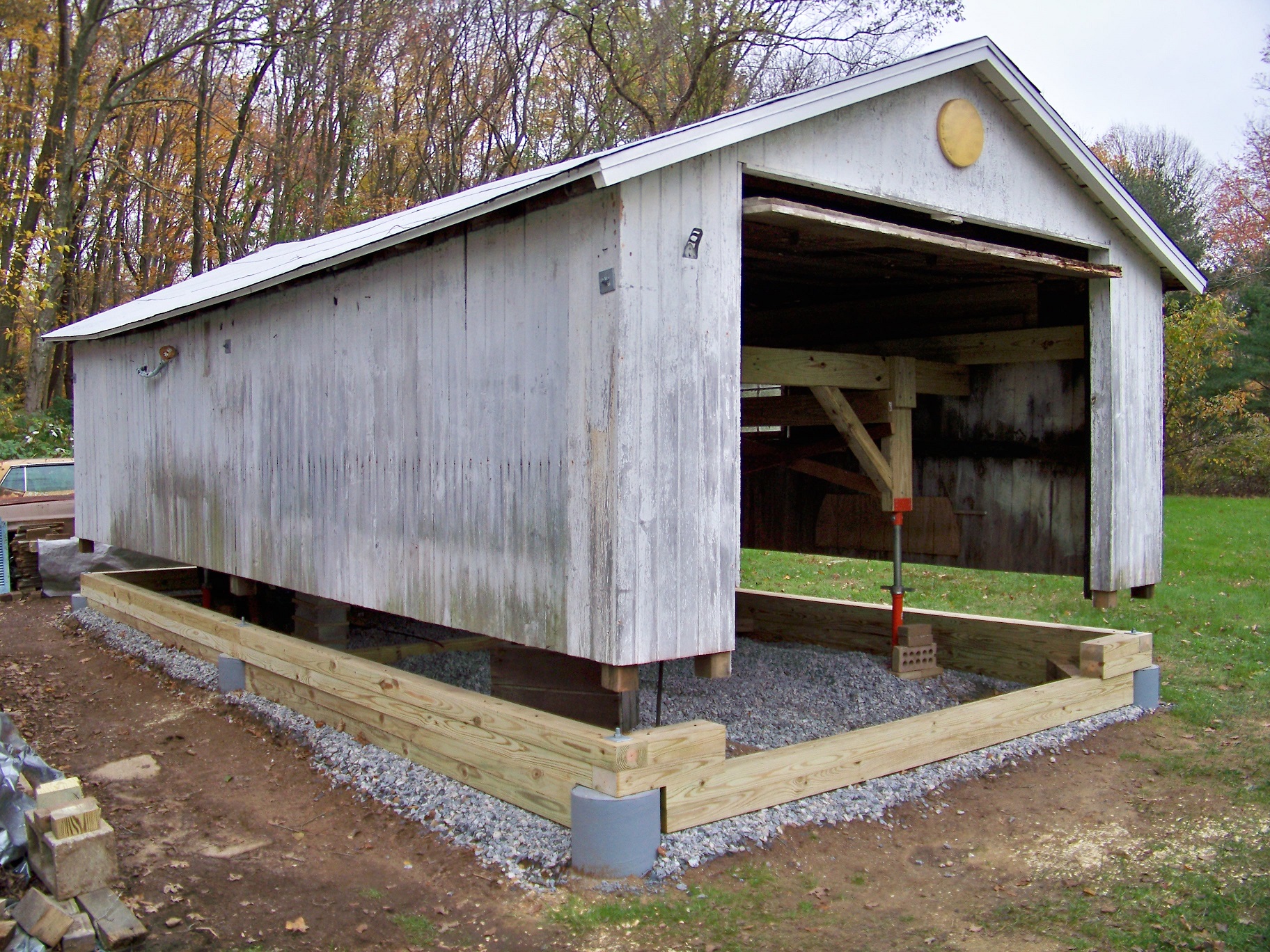
Progress Pics:


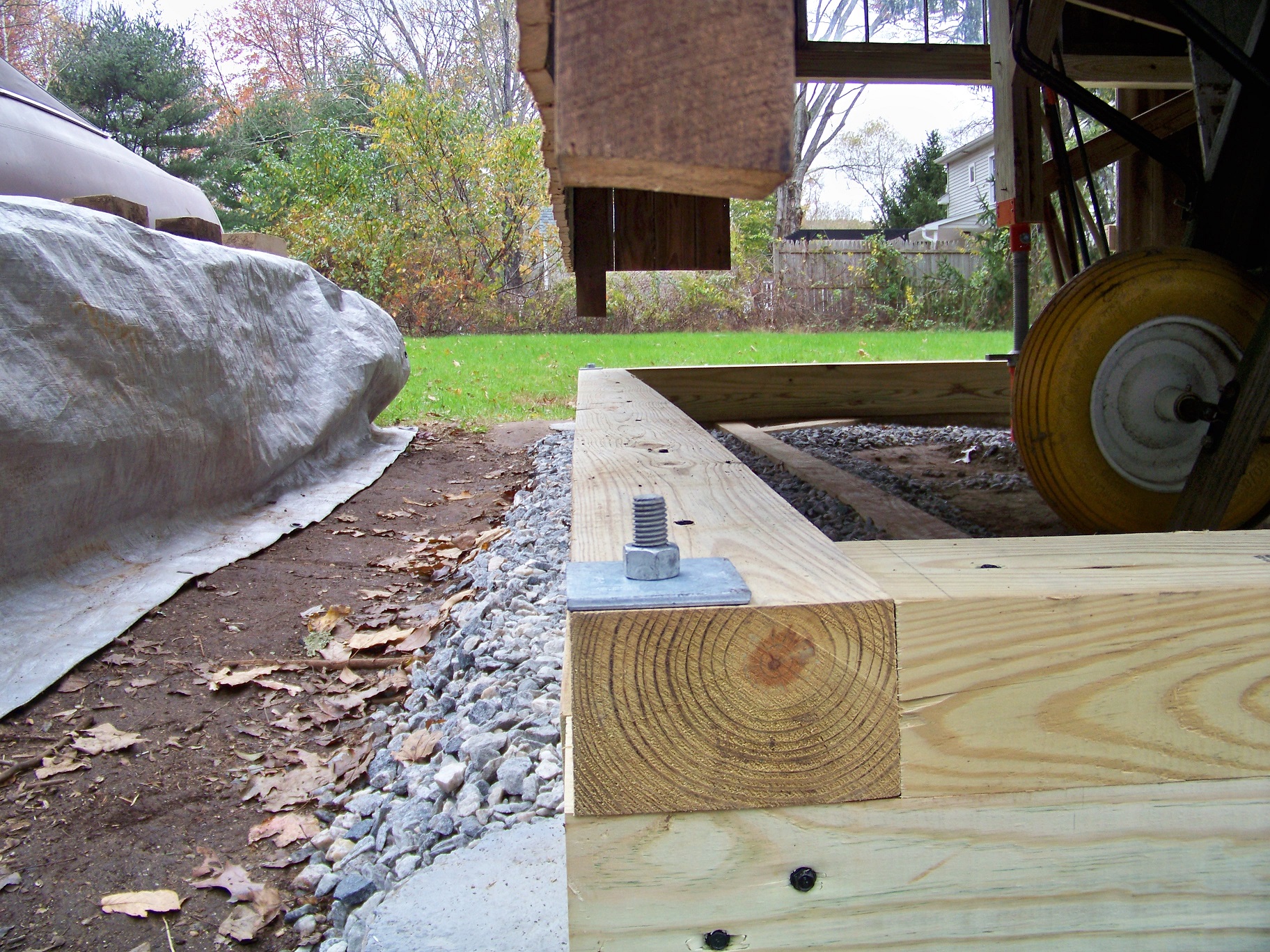
Not the best drill jig, but my holes were certainly straighter than if I’d drilled them freehand.
(That Makita drill is 20 yrs old and still going strong)

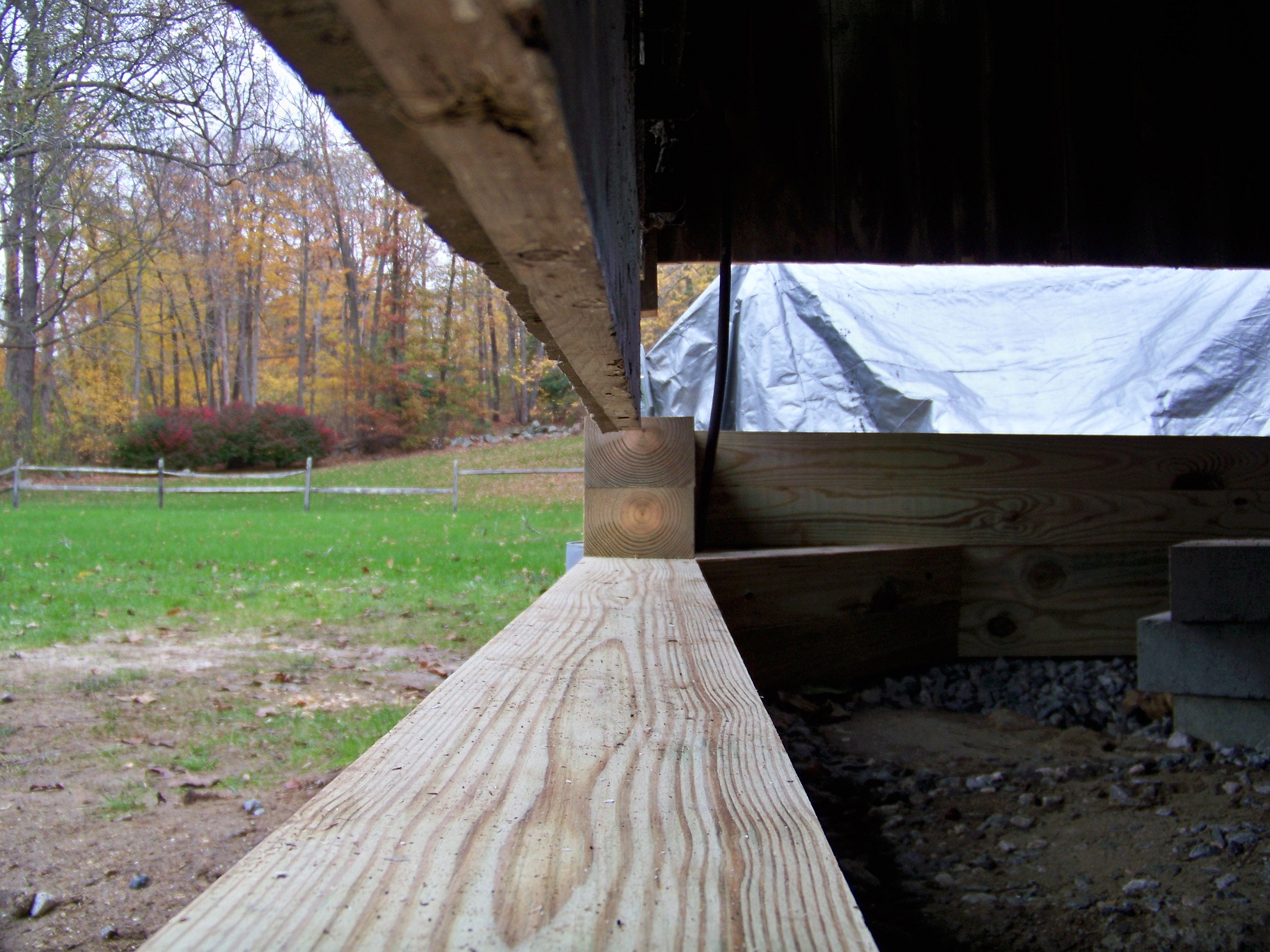
I put flashing tape on the beam surfaces that contact the concrete piers cause I had a roll on hand and it’s faster and neater than dealing with construction adhesive.

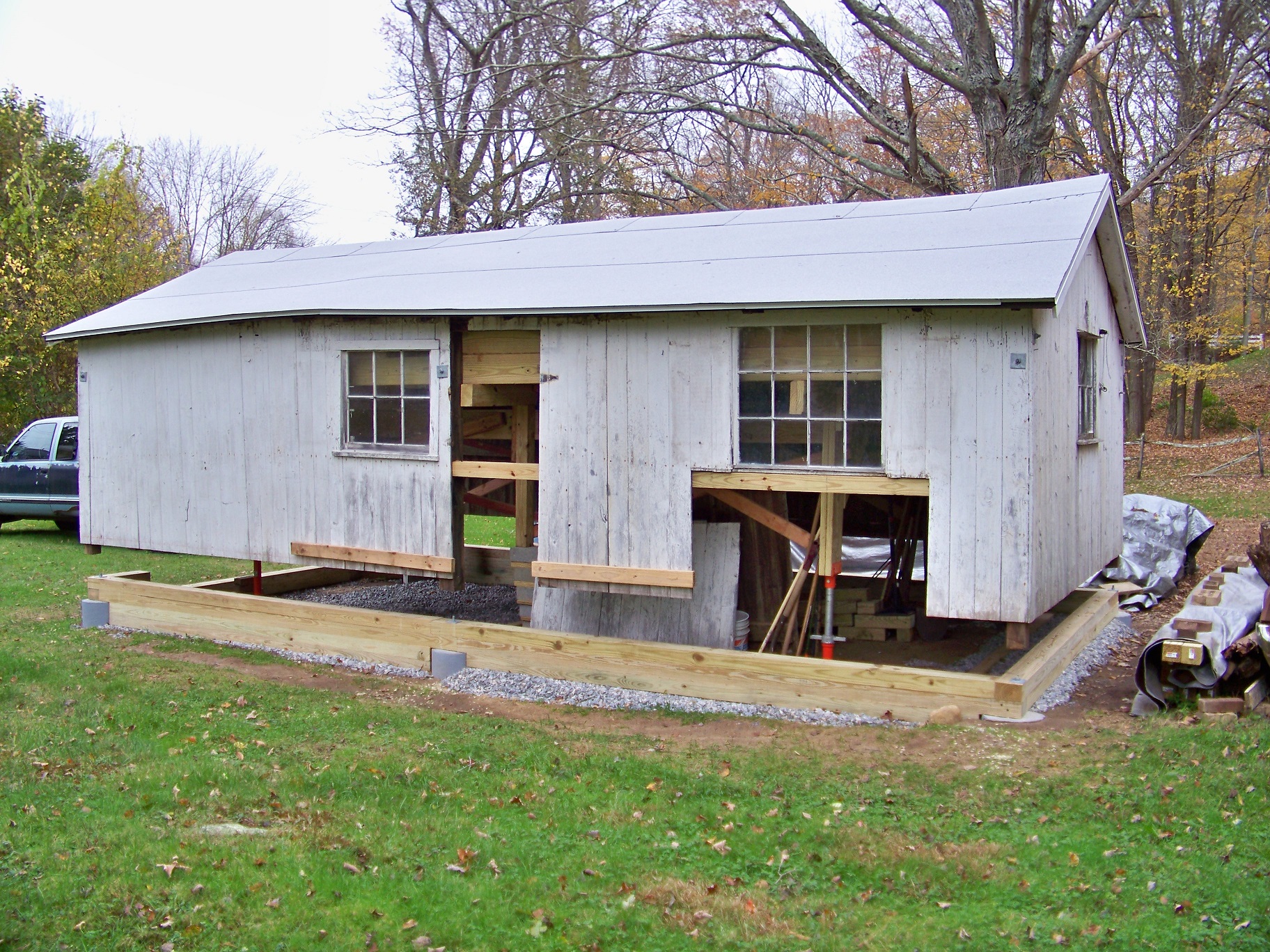
Finished the foundation (for lack of a better term). It's not perfect, but I need to pick up the pace and get-her-done.


This bearing plate ended up a tad close to the edge, but it'll work.


I’ll have to see if I can find some copper naphthenate preservative for the exposed end cuts.


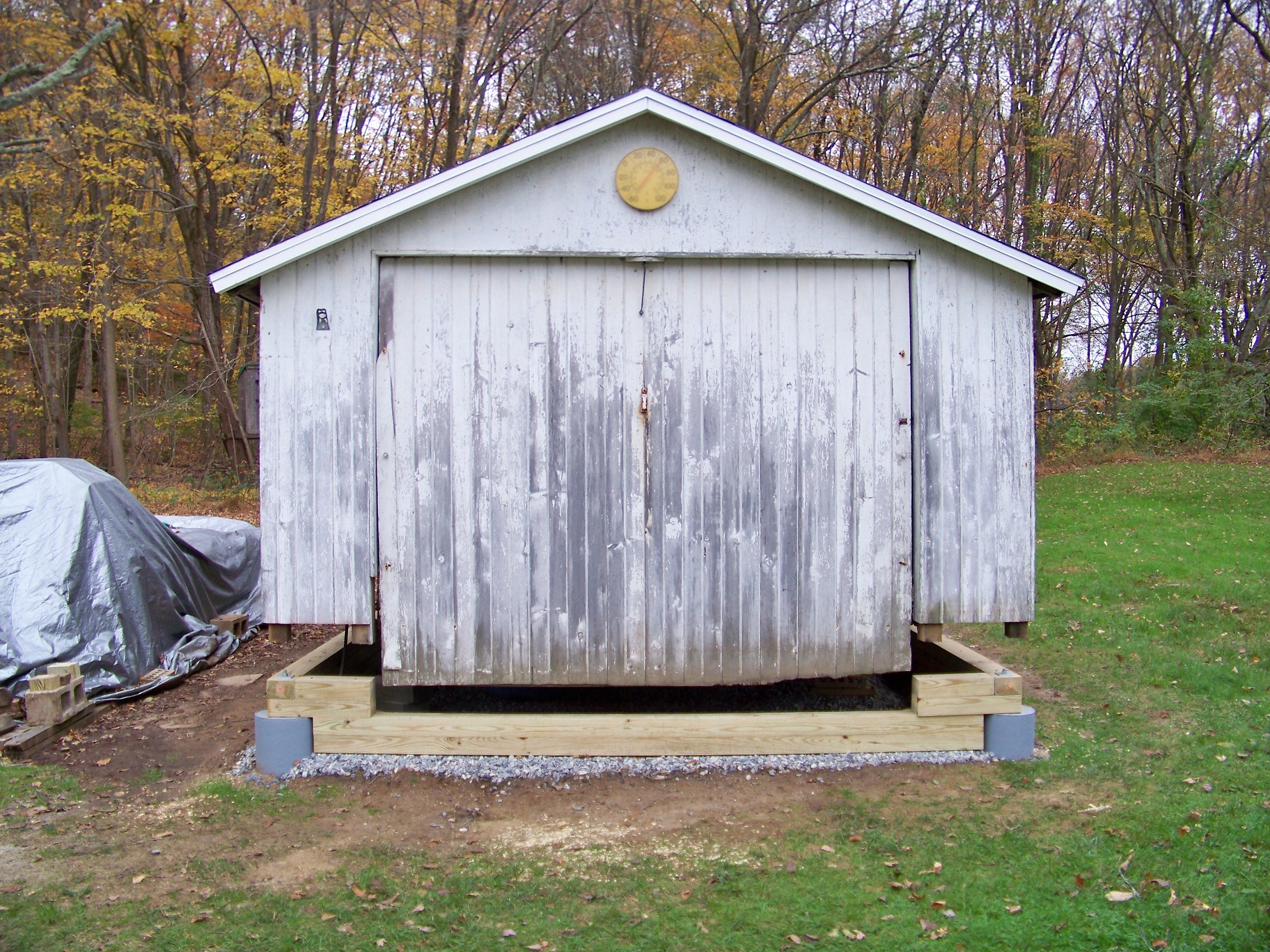
Haven't had the garage door closed for a while now. I'll be extending it. I noticed there are 2 vertical boards to the far left and right attached to the garage door. They have slotted holes and 2 wing nuts each with a knob in the center. They permit side gap adjustment. I'll be restoring that feature.


Side view of bottom of garage door to be extended.​
 
OP
P

Platonic Solid

Well-known member
Joined
Nov 29, 2014
Messages
3,587
Location
CT-USA
What's the plan for attaching the building vertical support posts to the foundation timbers?

Still playing with that in my head.

There are five ~12ft sections and the 2 sides of the garage door.
All the posts except the 2 in the middle of the 24ft walls measure ~4" square.
I forgot to confirm the measurement of those 2 center posts, but they're about 5" square.
Remaining space from foundation to existing siding is 16" +/- 1"

At the moment I'm thinking the following:
2x6 sill (pulled in 1/2" to make room for sheathing, such that sheathing is installed between and flush with exterior of existing posts)
4x4s attached to posts and every 4 ft, except might use 2x6 on each side of the two ~5" posts
Attach 4x4s from sill to center wall beams (each cut to whatever height existing beam is at that location)
Attach 1/2 x 24" x ~12ft PT sheathing to this, installed such that sheathing is behind existing siding. This gives me roughly 6" of plywood to secure existing siding to.

Still haven't decided what to put for the 16" band of siding all the way around.
Regardless, I'll need some type of trim to cover the seem between the two.
 

lakeroadster

Well-known member
Joined
Jan 19, 2015
Messages
5,166
Location
Central Colorado
What's the plan for attaching the building vertical support posts to the foundation timbers?

Still playing with that in my head.

There are five ~12ft sections and the 2 sides of the garage door.
All the posts except the 2 in the middle of the 24ft walls measure ~4" square.
I forgot to confirm the measurement of those 2 center posts, but they're about 5" square.
Remaining space from foundation to existing siding is 16" +/- 1"

At the moment I'm thinking the following:
2x6 sill (pulled in 1/2" to make room for sheathing, such that sheathing is installed between and flush with exterior of existing posts)
4x4s attached to posts and every 4 ft, except might use 2x6 on each side of the two ~5" posts
Attach 4x4s from sill to center wall beams (each cut to whatever height existing beam is at that location)
Attach 1/2 x 24" x ~12ft PT sheathing to this, installed such that sheathing is behind existing siding. This gives me roughly 6" of plywood to secure existing siding to.

Still haven't decided what to put for the 16" band of siding all the way around.
Regardless, I'll need some type of trim to cover the seem between the two.

I guess I wasn't clear. What will you use to attach the vertical posts to the foundation timbers.
 
OP
P

Platonic Solid

Well-known member
Joined
Nov 29, 2014
Messages
3,587
Location
CT-USA
PT 4x4s sistered to both surfaces of each existing post attached with four 6 in. TimberLok Hex heads (link) each PT post.

I have considered using PT 2x4s sisitered to both surfaces of each existing post which would permit me to use the stronger 3-5/8 in. LedgerLok Hex heads (link).

The center 2 existing 5x5 posts will be sistered with 2x6 using 3-5/8 in. LedgerLoks.

Cost of either fastener is not an issue as I have plenty of both.
 
OP
P

Platonic Solid

Well-known member
Joined
Nov 29, 2014
Messages
3,587
Location
CT-USA
I suppose there is a 3rd option, which would be to counterbore the PT 4x4s 2" and use the 3-5/8 in. LedgerLoks.

Probably the best method is the counterbore the PT 4x4s 1.5" and use 5" Ledgerlok (link)
 
Last edited:

lakeroadster

Well-known member
Joined
Jan 19, 2015
Messages
5,166
Location
Central Colorado
Something like this?

I was just thinking a Simpson Column Bracket.. but your plan ties the timbers together and makes for a joint that resists bending moments better. :thumbup:
 

Attachments

  • Platonic Solids Foundation.jpg
    Platonic Solids Foundation.jpg
    78.3 KB · Views: 76
Last edited:
OP
P

Platonic Solid

Well-known member
Joined
Nov 29, 2014
Messages
3,587
Location
CT-USA
I don't have the option of letting the original column rest on the foundation timbers as that is where the concrete pier threaded rods are located. I could put a piece of 4x4 or 4x6 in the space between the threaded rod and original post attached to sistered PT on sides.

The cuts on the original posts were done with a sawzall, thus are far from straight.
 
To avoid these ads, REGISTER NOW!
Top Bottom