Private Lugnutz
Well-known member
I’ve been doing some major spring cleaning and reorganizing in the Lugzsonian the last few weeks. When I had everything out of its cubby holes I took some photos, including this group shot.
View media item 83935
All these socket sets have one thing in common: they were all made in the early 1920’s.
On the left are some sets I have shown here on GJ before.
Those reddish-orange cases hold copper-coated Bethlehem “Quickway” Sets in various drive sizes. You can find more info and see more photos linked here.
In front of those is one of August C. Klopper’s Onli-1 bevel-geared offset ratchet wrench sets. The only other complete set I have ever seen in my life was recently for sale on eBay for $250! GJ thread linked here.
Next to the Only-1 case is a HOL-SET MFG CO socket wrench set. It ingeniously stores seven heavy walled sockets, a valve lapper, and a valve lifter/keeper on the shank of a speeder (in other words, the “whole set”!). GJ thread linked here.
Underneath those, in the large attache style case, is a Blackhawk Q.D. No. 18-A set. I’m not sure I’ve ever shown that one before.
View media item 83484
And all the way on the right, here…
View media item 83938
…is a Walden-Worcester No. 16 Combination Wrench Set. GJ thread linked here.
But it’s the more obscure makers in the middle of that group shot, with names that seem at times either fictional or in the wrong industry, that I want to show and talk more about. My father’s day present to myself was to lock myself in the basement to complete my thoughts on this collection.
The Roaring 1920’s was a decade of dramatic change in America, typified by Jazz, Art Deco, Prohibition, the common use of telephones, radios, and refrigerators in homes, the spread of nation-wide advertising, mail-order catalogs, and chain stores, and what’s known as the Vintage Era in automobiles. Out with the old – high-wheeled open-cab motor buggies with brass fixtures and discrete speed settings, and in with the new – closed cabs with eight cylinder engines, four wheel brakes, and balloon tires.
In the Brass Era, cars were expensive novelties, and their Ritchie Rich owners either had a wealth of knowledge about their mechanical operation or hired men to drive and maintain them. Believe it or not, in 1922, there were 175 different car makers in the U.S.. Seemingly, there were just as many companies making tools to keep them on the road. As you might expect, breakdowns were quite frequent. Garages and service stations were born, but many car owners were still do-it-yourselfers, with kits in the trunk. While Mossberg and Walden-Worcester dominated the industry, scores of copy-cats were born, making handles and detachable sockets out of pressed-steel or, in some case, malleable iron. Other men, schooled as machinists, blessed with entrepreneurial minds, and prompted by the demand for automotive service tools, tried their hand at alternative approaches. Few would succeed.
If necessity is the mother of invention, this one had an appetite for eating her own. By 1930, the number of US car manufacturers was reduced to less than 25, and three eventual giants had emerged in the automotive tools trade, toting hot-forged, cold-broached, heavy-walled socket sets: Walden, Blackhawk, and the fledgling Snap-on. These three would come to vanquish the mighty Mossberg (who would later team up with APCO) and left all the pressed-steel/malleable iron knockoffs and the innovative tinkerers in their wake. The automotive hand tools industry would never be the same. From a technology perspective, the opposite was true, for the industry would be exactly the same. Look no further than your own garage stack to understand that these early socket sets look pretty much the same as the socket sets many of us still use today.
As evidenced by some of my former GJ threads, it’s this earlier 1920’s period – and more precisely, the years 1922 to 1925, just before the major shift took hold, that seems to intrigue me the most, explicitly because the market was not so homogeneous.
View media item 83935
All these socket sets have one thing in common: they were all made in the early 1920’s.
On the left are some sets I have shown here on GJ before.
Those reddish-orange cases hold copper-coated Bethlehem “Quickway” Sets in various drive sizes. You can find more info and see more photos linked here.
In front of those is one of August C. Klopper’s Onli-1 bevel-geared offset ratchet wrench sets. The only other complete set I have ever seen in my life was recently for sale on eBay for $250! GJ thread linked here.
Next to the Only-1 case is a HOL-SET MFG CO socket wrench set. It ingeniously stores seven heavy walled sockets, a valve lapper, and a valve lifter/keeper on the shank of a speeder (in other words, the “whole set”!). GJ thread linked here.
Underneath those, in the large attache style case, is a Blackhawk Q.D. No. 18-A set. I’m not sure I’ve ever shown that one before.
View media item 83484
And all the way on the right, here…
View media item 83938
…is a Walden-Worcester No. 16 Combination Wrench Set. GJ thread linked here.
But it’s the more obscure makers in the middle of that group shot, with names that seem at times either fictional or in the wrong industry, that I want to show and talk more about. My father’s day present to myself was to lock myself in the basement to complete my thoughts on this collection.
The Roaring 1920’s was a decade of dramatic change in America, typified by Jazz, Art Deco, Prohibition, the common use of telephones, radios, and refrigerators in homes, the spread of nation-wide advertising, mail-order catalogs, and chain stores, and what’s known as the Vintage Era in automobiles. Out with the old – high-wheeled open-cab motor buggies with brass fixtures and discrete speed settings, and in with the new – closed cabs with eight cylinder engines, four wheel brakes, and balloon tires.
In the Brass Era, cars were expensive novelties, and their Ritchie Rich owners either had a wealth of knowledge about their mechanical operation or hired men to drive and maintain them. Believe it or not, in 1922, there were 175 different car makers in the U.S.. Seemingly, there were just as many companies making tools to keep them on the road. As you might expect, breakdowns were quite frequent. Garages and service stations were born, but many car owners were still do-it-yourselfers, with kits in the trunk. While Mossberg and Walden-Worcester dominated the industry, scores of copy-cats were born, making handles and detachable sockets out of pressed-steel or, in some case, malleable iron. Other men, schooled as machinists, blessed with entrepreneurial minds, and prompted by the demand for automotive service tools, tried their hand at alternative approaches. Few would succeed.
If necessity is the mother of invention, this one had an appetite for eating her own. By 1930, the number of US car manufacturers was reduced to less than 25, and three eventual giants had emerged in the automotive tools trade, toting hot-forged, cold-broached, heavy-walled socket sets: Walden, Blackhawk, and the fledgling Snap-on. These three would come to vanquish the mighty Mossberg (who would later team up with APCO) and left all the pressed-steel/malleable iron knockoffs and the innovative tinkerers in their wake. The automotive hand tools industry would never be the same. From a technology perspective, the opposite was true, for the industry would be exactly the same. Look no further than your own garage stack to understand that these early socket sets look pretty much the same as the socket sets many of us still use today.
As evidenced by some of my former GJ threads, it’s this earlier 1920’s period – and more precisely, the years 1922 to 1925, just before the major shift took hold, that seems to intrigue me the most, explicitly because the market was not so homogeneous.

 A little late for this part of my collection, believe it or not. Built in 1932.

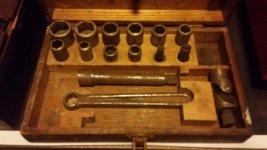
 Wow! That box and the decals are exquisite. My tools are in excellent condition, but my box and decals are fair to poor. The square sticker on the inside lid is cool! It's one of their west coast agents (distributors). I have wanted ads from newspapers in the early 1920's of Eastern Machine Screw seeking agents. I don't see any dates on it though. Looks like a phone number.