4 FN 27
ALLIANCE MEMBER
“Imitation is the sincerest form of flattery”
Thus I will be copying this!!! Nice work!!! I love the option of embedding things into prints.
I love that my idea will live in your shop!!“Imitation is the sincerest form of flattery”
Thus I will be copying this!!! Nice work!!! I love the option of embedding things into prints.
I like the magnets better. This style will work on the HF boxes, Vidmars, and other stuff I have around the shop. I’ve had an idea of what I wanted and this is how they came to life. And, I wanted something bigger than the drawer handle would allow.@slodat You're killing me with the two color drawer labels. I printed some and had to paint the letters, much to tedious for my fat fingers.
Only question is why not print to fit in the aluminum drawer handle so they don't any attachment but slide in?
If you're looking at making custom objects like you're describing, you'll need to learn a 3D modelling program. Seems like a lot of people on here used Fusion 360. Google Sketchup is also popular, but not sure if it can natively export .STL files. My suggestion would be to spend some time playing with those programs to see if you can get the hang of it, as that's the hard part (in my opinion).I've played with the idea of buying and building a 3d printer to build some parts I/want for my laundromat. I'd like to make some small boxes that hold the ignitors for my dryers. It's a two piece box that fits together and protects the ignitor from lint and dust. The other part is a bezel that attaches to the front panel surrounding the coin box. The box is about 6X5X2.25 nad the bezel is about 3.5X4.25 and is shaped like a picture frame, but with mounting points coming out of the back side.
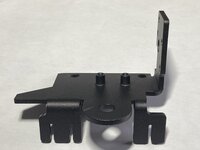
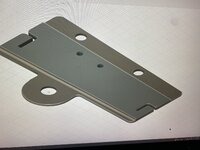
I'm not really in the mood to take on another "project". Is this something easy to make from like an iPhone picture? Is anyone out there interested in making some of these?
Nice work! That’s a great design.If you're looking at making custom objects like you're describing, you'll need to learn a 3D modelling program. Seems like a lot of people on here used Fusion 360. Google Sketchup is also popular, but not sure if it can natively export .STL files. My suggestion would be to spend some time playing with those programs to see if you can get the hang of it, as that's the hard part (in my opinion).
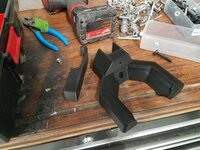
Quick weekend project - designed a custom mounting hook for my M12 rocket light that has the proper interface to snap onto my FastTrack rails. It bugged me that none of the available hooks worked well to hang this tool. Made it a 2pc design to eliminate any supports, and to allow different layer orientations for each part to keep stresses within-layer for better strength.
So I spent a couple days scratching my head with some really bad lamination quality on a set of parts. These are replacement slider bushings for the seats on my boat which are no longer available from Grady White. I made myself a set about 3 weeks ago which printed flawlessly with the PLA filament that was included with my Ender3 Max Neo. They fit "good enough" but I wanted to make a few minor refinements before offering sets up to others who need these parts.
I finally realized that my issues started when I switched over to a fresh spool of filament because the original spool didn't have enough left. I switched back to the remainder of the original filament, printed about the first 20% of it, then loaded up a spool of black PLA that I had been using for everything else. Boom - perfect prints again.
The white spool of Overture PLA was brand new in a vacuum sealed container. Did I just somehow get a bad spool of filament? The all white parts have some terrible delamination with laminations literally separating if I gripped them about as firmly as I'd hold a pencil. The white/black hybrid parts started off with a different spool of white PLA and then changed to black. These parts are the quality I'm used to. Both printed with the exact same gcode file.
Even filaments of the same brand can have slightly different optimal temperatures. The white looks like a matte filament, is that right? I had a spool of the matte white Overture PLA that like printing just a little hotter than the glossy filament I had used previously. Try raising the nozzle temp by 5* increments to see where that particular filament likes to print.Same brand, purchased and opened at the same time and stored right next to each other. I'll play around with temps a bit to see if I can't get that spool working right
Thanks, good to know. Yes, this is white Overture PLA with a somewhat matte finish. I bumped the temp up from 200 to 215 and the delamination disappeared, but there seems to be a touch of overextrusion now. I know it was a drastic jump, but I figured if a big jump in temp didn't fix it, it was probably a different issue. Time to do a bit of fine tuning and settle somewhere in-between.Even filaments of the same brand can have slightly different optimal temperatures. The white looks like a matte filament, is that right? I had a spool of the matte white Overture PLA that like printing just a little hotter than the glossy filament I had used previously. Try raising the nozzle temp by 5* increments to see where that particular filament likes to print.
There are a couple things I do with each spool of filament that I buy.Thanks, good to know. Yes, this is white Overture PLA with a somewhat matte finish. I bumped the temp up from 200 to 215 and the delamination disappeared, but there seems to be a touch of overextrusion now. I know it was a drastic jump, but I figured if a big jump in temp didn't fix it, it was probably a different issue. Time to do a bit of fine tuning and settle somewhere in-between.
My main concern was whether or not it was possible that I just got a bad spool, but that doesn't seem to be the case.
Bravo - super helpful information. I've been getting results that are perfectly adequate for my needs so I haven't fussed around too much fine tuning, but that might be this weekend's projectThere are a couple things I do with each spool of filament that I buy.
first: a temp tower, to help establish what the best temperature to run for that filament is.
next: a stringing test, at a couple three different retraction distances and speeds, to minimize stringing between jumps (enabling z-hops between extrusions helps too).
Finally: a benchy, to bring it all together.
Then, I write up the settings I used on the box so that I won't forget down the road.

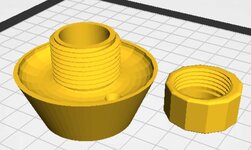
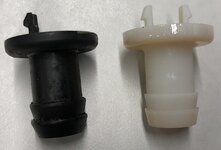
Anyone have any hints on printed threaded parts?
I used one as a negative to create the other and the thread has zero free space. Thinking of upsizing the cap slightly and reprinting. It doesn't need to be water tight.
It is just a siphon plug for emptying plastic motorsport tanks. Main hose will fit through the large hole and then compressed air will be pushed through the secondary side hole to get the siphon action started. Cap is just too tight to run off and on to compress an O-ring to hold tension on the hose.
Not yet. What concerns you?Any concerns with static electric discharge and fuel?
Machined threads usually have an allowance for assembly. I've found this thread dimension calculator helpful when specifying threads on drawings. On metal parts I'll usually spec 2A/2B class fit. 3D printed parts will be different, as alluded to earlier by @txvwnut.Anyone have any hints on printed threaded parts?
I used one as a negative to create the other and the thread has zero free space. Thinking of upsizing the cap slightly and reprinting. It doesn't need to be water tight.
It is just a siphon plug for emptying plastic motorsport tanks. Main hose will fit through the large hole and then compressed air will be pushed through the secondary side hole to get the siphon action started. Cap is just too tight to run off and on to compress an O-ring to hold tension on the hose.
Would you be willing to share or sell the STL? I have the same track system and a rocket light taking up space on my work bench . . .If you're looking at making custom objects like you're describing, you'll need to learn a 3D modelling program. Seems like a lot of people on here used Fusion 360. Google Sketchup is also popular, but not sure if it can natively export .STL files. My suggestion would be to spend some time playing with those programs to see if you can get the hang of it, as that's the hard part (in my opinion).
Quick weekend project - designed a custom mounting hook for my M12 rocket light that has the proper interface to snap onto my FastTrack rails. It bugged me that none of the available hooks worked well to hang this tool. Made it a 2pc design to eliminate any supports, and to allow different layer orientations for each part to keep stresses within-layer for better strength.
Setting up a thingaverse account and posting the STL is on my to-do list for this week. I'll ping you once I doWould you be willing to share or sell the STL? I have the same track system and a rocket light taking up space on my work bench . . .


So how hard is it for a guy with very little computer knowledge to get in to 3D printers? Would love to have one but afraid that I would struggle with the learning curve for designing items. I can sketch something in 3D easily bit have no clue how to do it with software.

What did you print it out of, and did you do a post treatment, doesn't even look printed
I learned CAD way before I bought a printer, mostly from these tutorials by a high school shop teacher:So how hard is it for a guy with very little computer knowledge to get in to 3D printers? Would love to have one but afraid that I would struggle with the learning curve for designing items. I can sketch something in 3D easily bit have no clue how to do it with software.
www.gwellwood.com