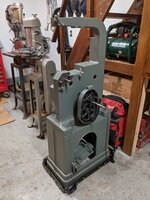
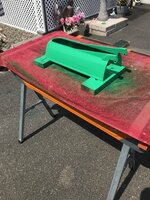
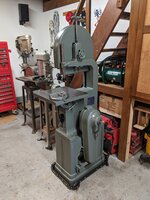
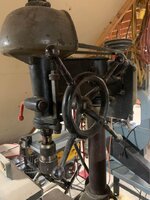
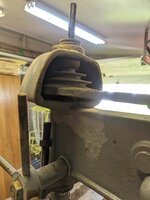
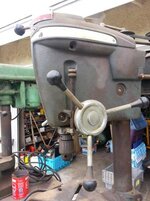
I had some time to work on my band saw today. I had given each panel of the base a coating of red oxide primer and two coats of alkyd enamel. I ordered stainless steel bolts to exactly match those specified by Walker Turner.

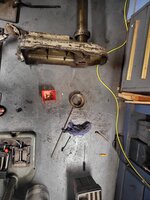
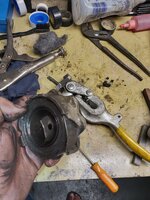
The only challenge I had was the original pin snapped off under moderate load and I had to come up with a replacement. I remove the broken pin, drilled out the original hole 1/32nd larger and cut an HSS tap to size as a replacement.
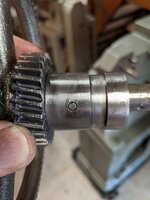
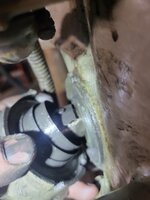
Here is that bushing as it would sit inside the gearbox housing. Note how offset it is to shift the reducer assembly out of gear.
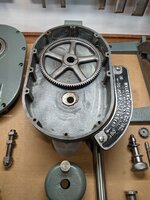
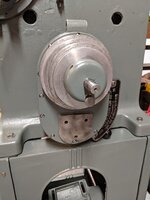
In this picture I have mounted the gearbox housing. Although WT is not breaking any new ground here, I want to show the relationship between the gears and how the reduction is accomplished.
This is not the position I will keep the gearbox. I had it in this position because it was easier to work on. Note the ball handle is in the "IN" gear position.

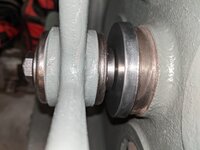
While in this position the reducer gear is meshed with the drive gear. When combined with the pulley gear, this will result in a 10 to 1 speed reduction.
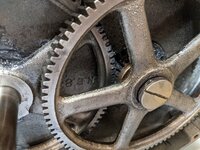
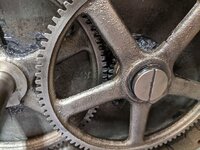
When the handle is moved to the "OUT" of gear position, the off-center mounted shaft rotates the reducer gear away. Here you can see the teeth make no contact.
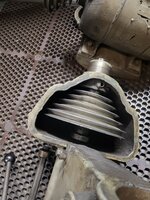
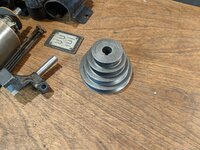
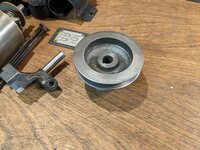
This will make more sense when the four step pulley is eventually mounted. The pulley has a small gear on the end that will mesh with the larger wheeled gear on top once it is mounted on the shaft.
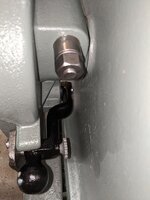
Here is a shot of the handle. You withdraw the plunger and move the ball either in or out. The plunger will then snap into place into a pre-drilled hole.
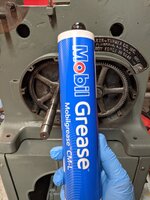
The original specifications for lubrication from Walker Turner call for a "light grease". Because of this I opted to go with an NLGI 1 grease. This one was just a bit more expensive but it's an absolutely outstanding light grease that will give me years of service.
Inching closer to a finished product. Note the casting on the mainframe. Because this was two cast iron halves fused together, there are many original patches formed during manufacture. I made no attempt to fill any of these rough parts of the casting, they're just part of the saw's history.
I find time spent like this in the workshop to be very rewarding, even when unexpected issues pop up.