To avoid these ads, REGISTER NOW!

Below 265 SQ/FT Tiny Tokyo Shop

All workspaces below 265 squarefeet.
OP
B

Bakafish

Well-known member
Joined
Feb 7, 2017
Messages
477
Location
Tokyo
Just for the record, there is nothing remedial here.
:beer:
I don't want to be the guy telling people what they already know, especially if they have a different understanding. I'm trying to explain this in the same way I would if I was telling a smart friend who is in a completely different field of work. I just worry that the GJ regulars are way ahead of me on these subjects.
Nice write-up. For the uninitiated on how CNC works, this really did well to help me understand the basics! Thanks
I'm barely scratching the surface, but I will do my best to fill things out. There are so many interesting aspects to what has to happen to make this stuff all work. But we live in a time where making such a device is just within reach if one is lucky enough and motivated enough to do so. I hope I succeed and share a little bit of CNC fever along the way. At the same time, I don't want to get lost in the tools (which is so easy to do) what the tools can make is the real end goal. The sooner I get there, the better.
 
To avoid these ads, REGISTER NOW!

nicholam77

Well-known member
Joined
Dec 18, 2016
Messages
2,655
Location
Minneapolis, MN
Sorry I haven't posted here in a bit, it's taken me awhile to catch up on all your lengthy posts!

Just for the record, there is nothing remedial here.
:beer:

I'd like to second this. But even if it isn't always with 100% comprehension I do enjoy reading about your precise tooling and detailed projects.

Basically, they repurposed the audio signaling architecture to create a high speed pulse generator to efficiently drive a buttload of stepper controllers using just the digital audio output of the microcontroller. The G-code is converted into steps, the steps are converted into a digital audio signal, that digital audio signal gets sent to the buffers, the buffers send the pulses to pins, the pins send the signal to the drivers, the drivers send the current to the motors, and the beast... it will shudder to life.

That is super interesting.

A couple overall questions (I can't remember if I asked earlier), but why the homemade CNC vs. buying one. Cost? Size? The thrill of the build?

Also, what do you plan to use it for?

🍻
 
OP
B

Bakafish

Well-known member
Joined
Feb 7, 2017
Messages
477
Location
Tokyo
A couple overall questions (I can't remember if I asked earlier), but why the homemade CNC vs. buying one. Cost? Size? The thrill of the build?
There are 3 basic options for a home CNC as I see it:

1) Buy a new or used classic milling machine and add automation.
2) Buy a turnkey system, ranging from hobbyist to industrial grade.
3) Make a custom machine from components.

If I was living anywhere other than Tokyo I suspect would be doing this very differently. My biggest constraint is space, there just isn't any possibility to house a conventional mill of any useful size. I have no garage and the wooden floors of my house wouldn't be happy with a Bridgeport even if I could find room for one. The second issue with being in Japan is that the availability and cost of 'professional' equipment is totally different than most of the industrial world. There simply is not a reservoir of indestructible post war equipment being handed down through the generations like in the US. Don't get me wrong, I've come across some beautiful used machines over here, but the costs are much much higher, and trying to convince Japanese to sell and deliver this kind of machine to a residential area would be a challenge to put it mildly. New equipment pricing is even more out of whack, there is no hobbiest or pro-sumer markets here. The only people buying these things are corporations that are used to the pricing structure over here where high equipment costs are passed through the supply chain, and are offset by support levels that are totally unknown to the Western world. I've also detailed the power constraints of residential wiring, virtually all industrial equipment over here requires 3-phase, so a lot of retrofitting (remember that cheap rotary phase converters are not a thing outside of the cozy confines of the Western world, even if I had the space to put a big motor.) Chinese suppliers are willing to ship stuff anywhere, but there is no market for them here and so you would be pretty much doing it on your own and subject to dealing with all the premiums, tariffs and whims of Japanese customs (who look at CN imports very unfavorably.) If we get a farmhouse in the country, or build an apartment building with a dedicated 'machine room' I will reconsider the first option, but it isn't a good solution for me at the moment.

So, option 2... The Shapeoko Pro was released as I was already collecting parts. It is about the closest to my ideal of a turn-key system, fairly compact and lightweight but with more traditionally practical articulation, using real linear rails and ball screws. But even with the improvements they made, the initial cost and freight charges (as well as the remote support) are all quite significant. And when you start looking at it from a component level, they have to make so many compromises for the sake of marketability and margins. If I was in the states I likely would have picked up an Avid or Shapeoko a long time ago and modded it as required, but being isolated across the Pacific really changes the way I think about these things, maybe I shouldn't feel that way, but my experience of getting stuff shipped here is reserved for when there are no other options or the cost advantage is obvious.

So that left me with option 3. I looked at the (original) Shapeoko and Avid designs and thought about what I would change on them, and came to the conclusion that it wouldn't be out of reach to just build that idealized machine from scratch. Again, I don't want to diminish the massive amount of engineering and design that these manufacturers have invested in their products, or imply that I will end up with something better, but deep down I expect that I can. I think that is just the kind of overconfident mindset old programmers develop over time that can lead to great success or great folly. When I found the industrial surplus shop, and picked up some serious parts at really steep discounts I became more convinced the home build was the correct path. And to be frank, I'm still very much a poor farm boy at heart, that's never going to go away no matter how much money my wife makes. :D Cheap DIY is in my blood.

Also, what do you plan to use it for?

"If you build it, they will come..."

I've convinced myself that this will be my next career pivot. I started life on the farm, as a boy I dreamt of (consumer) electronics and computers and miraculously made careers in both fields. I did what I loved because it was easy, it wasn't that I was following my passion, it was just a side effect of the reality that things I didn't like to do were hard. And by 'hard' I mean nearly impossible. I've just never been able to force myself to do stuff I don't want to, I have a complete mental block for it. I stopped going to school at 14, and was constantly badgered for refusing to do any homework prior to that incredibly prescient decision. I'm in my 50's and have learned that when things get too easy, it is time to make it hard again or things get stagnant. I've always been full of ideas, making the physical ones tangible has been out of reach for most of my life, but we live in the time of 3D printing and home CNC's. This new age of creation is just the beginning, it feels to me like the age of computers that I grew up in. It feels way more 'microwave oven' than 'Segway.' So I'm not yet sure what I'll make, what will allow me to retire from my current career and change gears a little, pilot my own ship, but I know what I need to get there. I'm going to do my damndest to succeed.
 

Motoman1100

Well-known member
Joined
Oct 2, 2014
Messages
443
Location
GA
There are 3 basic options for a home CNC as I see it:

1) Buy a new or used classic milling machine and add automation.
2) Buy a turnkey system, ranging from hobbyist to industrial grade.
3) Make a custom machine from components.

So I'm not yet sure what I'll make, what will allow me to retire from my current career and change gears a little, pilot my own ship, but I know what I need to get there. I'm going to do my damndest to succeed.


Our only hope is you take us along for the ride. Thanks for the updates.
 
OP
B

Bakafish

Well-known member
Joined
Feb 7, 2017
Messages
477
Location
Tokyo
So if you've read anything I've previously written, you know I bounce around a lot. Today we're going to cover my latest CNC related obsessive disorder, probing. With any Cartesian device it is really important to know where you are, and with some of them it is also important to know where the thing you are working on is. A simple X & Y laser engraver usually projects an origin spot to help you align your work object, and will often trace out the boundaries of the design you are burning. Another example is an extrusion type of 3D printer which needs to really accurately know where the bed is. Most beginners get sick of re-leveling the nozzle with a piece of paper time and time again. Fortunately the better 3D printers typically have some form of mechanical or inductive probe that will automatically measure the bed surface before starting the print, helping it maintain an even and properly applied first layer which is critical for bed adhesion. Failure to get that layer to stick or to have uneven extrusion thickness will result in a poor quality or ruined print.

With a CNC, Ideally you need to keep track of more things than you would expect. Obviously the machine needs to know where it is in 3 dimensional space. This is typically done by using limit switches and a homing command to make all the axis move to their home position, then resetting the machine coordinates to zero. But with a CNC you also need to know the exact location of the raw material you are going to work on. Depending on the material, and how you have it mounted, this can be harder to locate than you might imagine. Unlike an additive printer, we are not just creating the object out of thin air, we have to know exactly where the material we are going to machine is located. And we often have stock that is of the exact final dimensions and we need to make small modifications to it, drilling precisely located holes or slotting it. The machine may know where it is, but getting the workpiece location wrong and it is game over. That's not even counting for the workholding, the expensive vises and clamps that you might destroy due to these errors.

The last variable is the tooling, the end mill or drill or slitting saw. Even though the machine knows where it is when it homes, it doesn't actually know where the edge of tool itself is in relation to the Z axis. This is because we are always changing tools and it is nearly impossible to get every tool to be chucked in the same exact location, with the same exact length protruding from the spindle. They are going to be all different lengths, and even the same tool will be mounted differently every time you use it.

edgefinder.png

Most entry level CNC systems depend on tools from the manual milling world to help accurately resolve these variables, a precision ground rod, split in two and held together with an internal spring exhibits an almost magical behaviour when it is rotating and just contacts a surface. It will suddenly displace itself in an easy to recognize and highly repeatable way. By recording the coordinates you are at when this happens, you can map the location of the workpiece into the machine's coordinate system. Some people will use a thin slip of rolling paper in between the end mill and the work, carefully moving the mill closer and closer until the paper is trapped and pulled by the mill's rotation. (This seems dangerous, especially on a mill that has computers controlling it.) To get the height of the material (and also solving the whole "How long is this tool?" length issue) it is common to gently lower the tool until it just touches the top of the workpiece, or even better using a precision ground pin or rod of a known diameter to gently roll in between the endmill and the workpiece. You can lower the tool a little bit at a time until rolling the rod under the end mill just barely touches the edge, thereby ensuring a safe distance so you don't accidentally crash the expensive mill into the workpiece or mar it in any way (don't forget to subtract the rod diameter!).

All of these strategies are proven and workable, but they are also tedious and prone to human error when you are entering these values into the system, you forget to account for the offset or move the probe in the wrong direction crashing it. Better systems use more automated ways of gathering this information. The simplest of these is a conductive loop type of probe that can signal to the machine the exact moment contact is made so the machine can automatically record the position. However this type of device relies on the workpiece being conductive so obviously this only works for a subset of materials, wood and plastics won't work with these. This type can also be used for a tool length probe, but in the case of material probing a common design uses a long tube with a metal ball at the end. The ball is held in place by being connected to a spring inside the tube, pulling it tightly against the lip of the tube. When the ball touches the material, the circuit is completed and the LED's light up. If you move too close, the ball can move off to the side, but it is easy to pull it too far. These devices can be very accurate, but tend to be inexpensive and less precisely built than the more sophisticated probes and can be very susceptible to damage as the tube can't move. They also have no ability to absorb any forces in the Z (up and down) direction, limiting their value for Z probing. The machine can be programed to automate the movements required to probe the material or feature location. This is a real time saver, and reduces the chance of Bozo moves that destroy your probes and tools.

The more advanced probing mechanisms are based on the principals of Kinematic fixtures. This is an arrangement of precision shapes (there's more than one way to do it) that despite having a range of motion, are able to self align back to exactly the same location every time. The most common arrangement is used in Renishaw style probes that use a ball and rod arrangement. The advantage of such a system is that it works on non-conductive materials (also helpful as the best probe tips are made from non-conductive ruby balls) and the amount of deflection they can withstand reduces the chances of damage in the case of a crashed probe.

Kinematic switch 1.jpeg

So with that background in place, and despite having several high quality 'physical' style probes, ideally I want to have the system take care of probing and tool height offsets. Not interested in spending tens of thousands of dollars for the commercial devices, I began searching for alternative solutions. There are some well regarded artisan made solutions (from about $300-$800) out there, but as always my location makes the idea of purchasing, importing and getting support from New Zealand, Poland or the Czech republic kind of unpalatable. So I looked for local stuff, hopefully for a reasonable price, at the usual places.

One such local manufacturer is known globally as BIG Kaiser, but here in Japan as BIG Daishawa. They make several tiers of tool length probes and material probes, mostly focused on use in manual probing situations. That means most of their units have no direct integration with the control system, they beep or light an LED when they have achieved contact, there is no external trigger output. They make both closed circuit and the more expensive internal contact designs, but both systems use Kinematic style probes to improve accuracy, allow for Z measurements and to extend service life.
BM-50.png

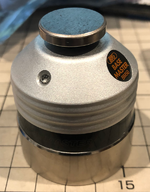
The first thing I bought was a BM-50 which is a closed circuit type of tool offset probe. My rationalization being that there was little chance I would be using non-conductive tooling, so the minor inconvenience of a closed circuit system was unlikely to be much of an issue. What was still an issue was, "How do I get the controller to know when the tool height sensor has triggered?" After receiving the unit, it was clear that these were designed to prevent any kind of repair or modification. Everything was potted, there was no way to pull the voltage off of the LED pins, no non-destructive way to get it apart... so I had to make a phototransistor based signaling circuit that triggers when the LED is lit. The height sensor has 3mm of additional travel, the little plate on the top is spring mounted (and uses a kinematic seat I believe) and is spec'ed to be accurate to within a micron (I confirmed this with my test stand.) But 3mm is not a lot of space, and if the controller didn't get the touch signal for whatever reason (say a small chip of wood or plastic that gets stuck between the plate and the tool) then the automated CNC is going to drive the tool into the little height gage until things break. Bad news. So the interface will actually need an emergency cut off micro switch that will trigger when the plunger is depressed more than a millimeter or two. More on how I will solve that as I build it.

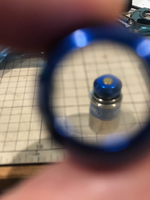
With a tool hight solution well in hand, I went forth and... bought a whole bunch more tool height sensors. 🤦‍♂️ The thing with me is, the more I get to know about something, the less I can just be happy with what I have. That coupled with the knowledge of a "too good to pass up" deal has left me with a total of 4 BIG Daishowa tool height sensors. I have 2 of the BM-50G "Gold" type, which are internal contact types that have a ceramic contact plate. And a little BMM-20 Mini unit, that is so small it comes with a built in magnifying glass, and is also internally triggered. The 3 BM-50's are all the same exact shape, so my custom signalling interface will work on all of them, and the mini is so cute and will be useful on my manual mill and lathe. I'm pretty sure I'm done buying these things, but don't believe me, I lied to you about my vise vice after all.

BM-50G.pngBMM-20.png

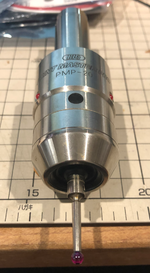
The more sophisticated workpiece probing units were all custom search bookmarked, and I camped all my favorite buying channels. I really wanted a non-conductive type of probe as I intend to work with wood and machinable plastics on my machine. The first sore member deal that came along was a closed circuit type though, and so I jumped on it as at least a backup plan. A few days later the unit I was actually looking for was posted, it was $300 but new they are $1000 so I figured it was as good as I could hope for. I know I will likely see one or two come up cheaper now that I got this one. I will likely buy more to "average out" the price, that makes sense right? Right? Send help...
PMP-20.png
 
Last edited:

gearhead1960

ALLIANCE MEMBER
Joined
Mar 21, 2019
Messages
1,793
Location
Manassas, VA, a small blot in history
Coming from the world of survey, it would seem that a solution might be based on using lasers. We use lasers to model in 3D aka LIDAR. I know that setting up a base position is critical to both survey and CNC, this might be the stumbling block to making use of this technology.
 

Vette60

Well-known member
Joined
Mar 15, 2006
Messages
447
Location
Glen Allen, VA
Thanks for sharing. I've really enjoyed your posts. We sell the products that we manufacture into Japan on a fairly regular basis and their questions can be most perplexing and quite tangential as you have mentioned - as in, why would you even care to know that? LOL. Thanks for your insights.
 
OP
B

Bakafish

Well-known member
Joined
Feb 7, 2017
Messages
477
Location
Tokyo
Coming from the world of survey, it would seem that a solution might be based on using lasers. We use lasers to model in 3D aka LIDAR. I know that setting up a base position is critical to both survey and CNC, this might be the stumbling block to making use of this technology.
The highest end industrial systems do use laser sensors, but just for the tool offset checking. They deploy a small laser and photoreceptor array through a little door, slowly rotate the tool between the beam and the imaging sensors and are able to determine the exact length, diameter and shape of the tool. It can then cross check that with what the tool is supposed to look like and previous scans and can identify abnormal wear, breakage or incorrect tooling.

With all the chips and spray lubrication, optical systems face challenges in the CNC environment. The physical probes are surprisingly fast and accurate, but this is still an evolving space and faster solutions would be quickly embraced.

Thanks for sharing. I've really enjoyed your posts. We sell the products that we manufacture into Japan on a fairly regular basis and their questions can be most perplexing and quite tangential as you have mentioned - as in, why would you even care to know that? LOL. Thanks for your insights.
Yes, it is good to be open with them about the process. There is little differentiation of severity when a problem is identified, so treat all issues (no matter how minor) seriously and expeditiously. Where a Western company knows that a minor issue is a low priority for everyone, a Japanese business would conclude, "They can't even deal with this small issue, what happens when we have a big one?" Which is a very different mindset. They are going to be much more interested in the processes you put in place to ensure the issue (and any similar problems) will be avoided in the future. Closed Loop Corrective Action. They will expect you to share this internal process. All of this is extremely invasive and can come off as condescending to a Western company, but it is completely natural over here.

With all those hoops, a western company might wonder why bother to do business over here, but Japanese companies are not very cost sensitive and are loyal to a good supplier. Western companies are so used to competing on a cost basis that they leave a ton of money on the table when doing business over here, and are unprepared for the additional support costs (which should be factored in from the start.) Once a relationship is established and they have confidence in your product and support, there is very little chance you will lose them based on price, that trusted relationship has a monetary value to them and the cost of rebuilding that would be factored in to any low ball bid.
 

zanyad

ALLIANCE MEMBER
Joined
Apr 26, 2018
Messages
2,755
Location
NE Ohio
I run both manual and CNC mills on the regular. I use the spring-loaded barrel edge finder you described above regularly to find my X and Y zeroes. The audible subtype of this edge finder is very useful. It has a flat ground on the indicating barrel. Once the tip jumps, it starts clicking. Very useful if you can't easily see the edge finder.
To get the height of the material (and also solving the whole "How long is this tool?" length issue) it is common to gently lower the tool until it just touches the top of the workpiece, or even better using a precision ground pin or rod of a known diameter to gently roll in between the endmill and the workpiece. You can lower the tool a little bit at a time until rolling the rod under the end mill just barely touches the edge, thereby ensuring a safe distance so you don't accidentally crash the expensive mill into the workpiece or mar it in any way (don't forget to subtract the rod diameter!).
For Z-zero on the CNC, I use an indicating zero-setting touch-off tool from Edge Technologies (other manufacturers make similar tools). I set all my cutting tools to zero, putting the indicator directly on the machine table. This sets all tools' Z zero to exactly 4" from the table. Then I will either calculate the difference between my tool reference point 4" above the table and the workpiece (I know my vise bed's height, plus the thickness of any parallels and the piece itself), or use a 1" gage block to find my workpiece Z offset. Both methods require some calculation, but I find they work well for me. I can provide more detail on my process if you'd like.

Haimer also make a very cool piece of kit known as a 3D Taster. While I don't have one at my disposal, they have a very good reputation.

Haas has a very good series of instructional videos on machining topics. While focused on their control, most of the concepts are applicable to other machines. They have a video on indicators.
 
OP
B

Bakafish

Well-known member
Joined
Feb 7, 2017
Messages
477
Location
Tokyo
The audible subtype of this edge finder is very useful. It has a flat ground on the indicating barrel. Once the tip jumps, it starts clicking. Very useful if you can't easily see the edge finder.
I wondered what that flat was for when I saw one of these! Very clever.
Haimer also make a very cool piece of kit known as a 3D Taster. While I don't have one at my disposal, they have a very good reputation.
These clockwork style meters are the Queens of 3 axis indication. BIG Daishawa/Kaiser make a new one as well. It's a subtle thing, but these type of meters indicate the actual exact center line whereas most probes you have to account for (and subtract half of) the diameter of the contact ball or cylinder. This is an impressive feat as they can use different probe lengths, so the size of the ball needs to change to ensure the angle is preserved. The less offset math you have to do, the less chance for mistakes. The downside of most of these gage based probes is that they tend to be a bit bulky and can extend quite far in length which is a problem for small machines with limited Z height. Haimer has some new smaller ones, and the BIG is quite compact, but very few of these show up on the second hand market (although I will absolutely jump on one if I see it.)

There are a number of other systems that I left out, I really should have mentioned the Haimer though. Thanks for your comments!
 
OP
B

Bakafish

Well-known member
Joined
Feb 7, 2017
Messages
477
Location
Tokyo
My wife wasn't crazy about my plan to put the massive cast Iron surface plate on my (heavily reinforced) Ikea table, she wasn't wrong. Earthquakes are a thing here, and I wasn't enthusiastic about the idea of having a 150 kilos of machine just just waiting to crush my legs due to poor choices in furnishings. So some beefy M8 sized Aluminum profile was the solution. But that meant I had to start roughing out the plan so I knew what lengths to order... The parts for the base will arrive in a few days, I'll put it together, get the plate mounted and start checking the surface to see how much work I need to do to get it back to flat. This render is intentionally vague, I'm far from close to the final design. Just for scale, the main spar will be 100mm x 200mm x 760mm high strength M10 series extrusion.

Kaiju01.png
 
OP
B

Bakafish

Well-known member
Joined
Feb 7, 2017
Messages
477
Location
Tokyo
Aluminum Lego are the best Lego! This is M8 Profile, meaning it is based on a 40mm base unit width and its multiples and uses sturdy M8 fasteners.

Lego.png

Even though I took the time to painstakingly align all the edges, it still went together in a flash. These parts were drop shipped from the NIC Autotech warehouse, and are precision cut to the lengths I specified in my online order to Monotaro. I don't have any instrument accurate enough to measure the errors to the precision they are cut. Using a magnifying loop on my best steel rule, and measuring on the diagonals to confirm the square, the measurement was identical both ways (in addition to all the X,Y and Z measurements) and matched the CAD exactly. I didn't need this precision, but the price penalty for pre-cutting is so small it is cheaper than getting this in lengths and cutting it myself because shipping more compact cut bundles is less.

Lower stand.png

I have proper length bolts on order for these clever machine leveling casters, but I wanted to get it off the floor to keep it from scratching anything so I threw in the bolts I had handy. I need to design and make the corner clips that will attach the surface plate firmly to this stand. It is heavy enough that I think gravity would keep it in place with some basic locating pins, but we often have earthquakes here and the CNC will be flailing around so I want to over engineer every conceivable safety aspect and locking it to the stand seems best.

caster.png

Once the plate is mounted to this stand, I will start mapping the terrain and see how flat of a surface I'm really dealing with. I have some carbide scrapers and enough precision surfaces and tools to get myself in trouble with, but I'm hoping the old plate will be flat enough that we can avoid the dignity loss of me attempting to scrape it flat.

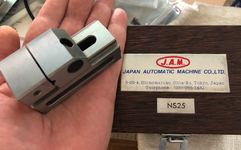
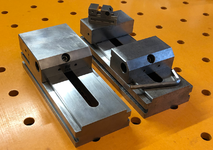
Oh..., and I bought another vise as a matching pair to my big one. Last one, I swear.*


*Bakafish should not be trusted to honor any promises of vise non-acquisition due to his well documented and seemingly incurable illness. We are comforted by the fact that there are a finite number of JAM vises in the country of Japan, and so there is likely some mathematical limit he could possibly obtain. Please consider buying any of these items you are able to locate in your own country in order to prevent possible repatriation into his domestic market, our only hope at this point is to cut off his supply.
 
OP
B

Bakafish

Well-known member
Joined
Feb 7, 2017
Messages
477
Location
Tokyo
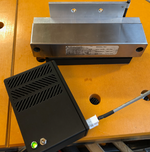
Anyone want to venture to guess what this is about? 😜

MP.png

While I was waiting for that enclosure to print, I disassembled and cleaned both of the big vises. The latest one was in even better condition finish wise, but showed more signs of use. It has a few apprentice marks, but pretty minor ones. These things are really dense little lumps of steel at 13.5 kilograms. There is one model larger than this, 200mm clamping instead of these which can grab 150mm, and it weighs close to 30 kilos (and costs $3000!) I used WD-40 and a "non-scratch" Scotch Brite pad to clean them of grit and old oil before coating them in museum wax. I'm afraid to get more aggressive since these things are precision ground and I'd rather have the stains than screw with the surface quality.

Big_Pair.png

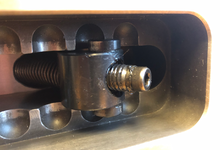
The latest vises high tensile bolt's allen head socket is a bit sloppy and I'd just replace it, but he bolt is concentrically drilled and tapped at the end, to receive a small screw and washer to serve as a stop so you can't accidentally unscrew the nut.

Close up of vise nut assembly.

The clamping nut showed some scoring from being tightened when in the wrong position. It is possible to get the nut sitting at the edge of a slot, and since the nut is not (as) hardened it will get little grooves impressed into its face. I rotated it so that the worn area is less utilized, but I couldn't flip to use the clean side of it since the 'pins' were offset from the nut's centerline. JAM here in Japan (like many manufacturers) doesn't sell parts directly to end users, and I have yet to find a good broker to deal through. Neither of these issues seem to affect the performance, and the parts are simple enough that I should be able to make them if needed. Heck, a small nut loctite bonded to the end of a standard "12-9" M8 bolt would serve the same purpose as the main bolt, although without the elegance. The main nut would be more of a challenge as I suspect it is special steel and it was post processed for strength. I'll deal with that, if and when it ever becomes a problem.

Why do I need 2 of these? Well I noticed that several experienced machinists use multiple matched vises that allow for bigger and more secure workholding. In fact JAM has a whole line of vises that use a mutual base plate and up to 5 separate moving jaws, so there is clearly some utility. You can special order individual vises that are match ground together so that you know they are identical, but despite these two being made at least 10 years apart (the older one is made before they started laser marking the logo and serial number and the newer one is using a logo from before the Y2K destroyed humankind), the construction and dimensions seem to be identical. Good enough for me anyway. I will set them up so that the beefy 200mm long parallels I have will bridge them in a useful way. More to come...
 
Last edited:
OP
B

Bakafish

Well-known member
Joined
Feb 7, 2017
Messages
477
Location
Tokyo
Another shot of the mystery sub-module assembled. I'm sure you've seen one of these a million times, just in a different context. The 3D printed enclosure came out pretty good, although the wall extrusion consistency isn't as good as I want. Either a partially clogged nozzle or I need to improve the extruder drive system. Printing lots of holes with 45 degree overhangs is asking for trouble, but I did some mitigation to the internal structure to help keep it from failing. There are a lot of improvements I want to make on the printer, but it is working well enough that I don't want to screw with it. A scratch built, high temperature, full enclosure type of printer is on my (endless) build list, I've collected some of the critical parts. I'd really like to be able to print higher strength materials like nylon, but again this little Ender 3 with Carbon Fiber PLA just does better than expected and makes it hard to go through the trouble of replacing it.

mbox.png

Back to the CNC project...

So one of the things that has been giving me concern has been the little EDM spindle I rebuilt. The issue is that the novel bearing arrangement has been eating at me, and after giving it a lot of thought I realized why. My research indicated that it is typically used for high precision (yes I know I use that term too much) grinding, and isn't really something I'd seen in any kind of machining spindle. What makes it unique is that the rear bearing is basically floating, and is preloaded against a stiff spring. The reason for this is as the spindle heats up, everything expands including the spindle shaft. In a normal design that shaft expansion will result in reducing the needed preload force between the pair of angular contact bearings, resulting in loss of concentricity and higher wear. So this spring preload design is really a great idea... for grinding. The problem with using it for milling is that a typical end mill has a lot of 'pulling' forces generated by the flutes of the end mill itself, trying to pull the tool out of the chuck. With this spring preload system, the only thing resisting that pull is the force of the spring itself, which really isn't going to be adequate except for the smallest of tooling (or the unusual down-cut type of tool used in woodworking.) For grinding, you may have some compressive forces (handled by the rigidly mounted front bearing and spindle design) but it would be very unusual to experience a lot of pulling forces.

So without any modification (replacing the spring with a pair of fixed length sleeves or adding an additional bearing to deal with any reverse thrust forces are the two solutions that come to mind) I think it isn't going to be suitable. I've got very little invested in it so far, and I can think of a lot of great uses for a precision (sorry) grinder spindle, so I'm not terribly disappointed, it was only intended to be a stop-gap measure anyway as it has been a struggle to identify a suitable Japanese made spindle beyond the tiny Nakanishi units which are expensive, tiny and intended for micro-machining at 20,000-60,000 RPM, which is a bit limiting I think. I'd like to stick with something bigger, more powerful, and lower speed, although these units are small enough to mount along side and augment a larger main spindle motor.

There has been a TAC 3-phase 200vac motor-spindle of unknown provenance listed for some time, but the price was just a little too high to speculate on it (it's marked as Junk), so I've just been camping it. A few minutes ago it finally dropped into 'worth a shot' territory, so I will give it a try. I don't intend for this to be the end game either, it's only about 1.5kW and I want to end up with a 2.2kW motor which is the maximum that single phase 200v variable frequency drives (I will detail what that is later) will support. I'm really wanting to have something with a BTT30 automatic tool change chuck as well. But if this unit works, it will buy me some time to figure out how to get to where I want to be.

I also found a used 400x450x28 steel T-slotted fixture plate, which is exactly what I needed for providing a good way to fasten my vises and other clamping tools. Drilling a bunch of holes in the surface plate itself was doable, but felt really inelegant, inflexible and was going to complicate any spray lubrication strategy, as I hear holes aren't great for keeping liquids contained.
 

loganb

ALLIANCE MEMBER
Joined
Dec 29, 2011
Messages
5,496
Location
Omaha, NE
Taking a stab at the guessing game as I do enjoy them....

Looks awfully similar to an electromagnet like used for door access control at those buildings many of us used to visit daily...oh yes..."the office"

But I'm trying to guess what it's being used here for...and assuming it's tied to the cnc project which may have me out in left field but....

Assuming it is the guessed electromagnet...and it is also cnc related

Some sort of magnetic work holding or vise holding fixture

Or since it's on wheels and concerns exist of ensuring it stays in place...magnetic lock to "dock" it into place. Maybe even tied into control power to keep you honest so it won't spool up unless it's "docked" and magnet engaged?

And matching vises...very nice! It's incredibly handy to have...well until you have something that needs them both stripped to clamp down but that just allows practice to getting them setup again fast and accurate!
 
To avoid these ads, REGISTER NOW!
OP
B

Bakafish

Well-known member
Joined
Feb 7, 2017
Messages
477
Location
Tokyo
Taking a stab at the guessing game as I do enjoy them....

Looks awfully similar to an electromagnet like used for door access control at those buildings many of us used to visit daily...oh yes..."the office"

Yep, that's what it is. How it made it here to Japan I don't know, but it was super cheap and came with a nice Omron programmable timer as a bonus.

But I'm trying to guess what it's being used here for...and assuming it's tied to the cnc project which may have me out in left field but....

Assuming it is the guessed electromagnet...and it is also cnc related

Some sort of magnetic work holding or vise holding fixture

If you look back through the thread you will see I have been building a 'magless mag-drill' which is no longer sans magnet. I made a spacer for the 'door plate' so I can mount it to a dog hole on my workbench. But it will make it easy to throw on to the CNC bed for quick manual drilling operations (and make it easy to drill the bed itself for the side rail spar attachment points and to attach the t-slot plate.)

Or since it's on wheels and concerns exist of ensuring it stays in place...magnetic lock to "dock" it into place. Maybe even tied into control power to keep you honest so it won't spool up unless it's "docked" and magnet engaged?

I didn't interlock it, but the green light only illuminates when the magnet is securely bonded using the built in sensor.

And matching vises...very nice! It's incredibly handy to have...well until you have something that needs them both stripped to clamp down but that just allows practice to getting them setup again fast and accurate!

Yes, if the CNC comes out really accurate I can drill some locating holes for pins to make setup easy. I can't wait until this sort of issue is on the top of my list of 'problems' :-D I have so much to do...
 
OP
B

Bakafish

Well-known member
Joined
Feb 7, 2017
Messages
477
Location
Tokyo
Well, she's a bit rough around the edges... I usually clean everything up before taking photos, but this just showed up and I thought I'd document it before I started scrubbing off the years.

new_old_spindle.png

What you are looking at is the TAC spindle I was talking about, torn out of the rusting corpse of some long dead machine. It weighs 33 kilograms and is 150mm in diameter x ~400mm long. It is a lot bigger and heavier than I expected, which is of course my own fault since I had access to the specifications for the last several months I've been eyeing it. I just pictured it in my head to be about half as big because of the power rating and the small spindle size. It has a high quality ER25 collet made by REGO-FIX in Switzerland, the typical collet for this model is an ER32, so this may have been a special order, or may have been the standard at the time it was made.

I checked the windings with my Fluke 87V and they look good. The bearings feel okay when hand turning, with no crunchyness, noise or thrust slop. I will know more once I have it hooked up to the VFD and can spin it up.

Now I know I humble-brag a lot about the price of things (and the 'deals' I think I got) but there is more of a point to it than just stroking my ego. I try to communicate how bat-**** crazy the price of things is over here because it is really hard to conceptualize it and how limiting it can be. This model of motor spindle is still manufactured, but like most industrial stuff over here is only sold through brokers. You can't order them directly from the manufacturer or find them online as stock items at the big supply houses like Misumi-Vona or Monotaro. I priced this model out from two different suppliers, and they both quoted about 240,000 yen (about $2100 USD at the current exchange rate) which is an awful lot for a 1.5kW spindle compared to the prices from China. I mean it is a bit apples to oranges, and to give them credit, this thing seems to be ridiculously overbuilt, but there's no real middle ground that I can find over here. I feel like in the Western world there is a lot more grey area when it comes to what is offered, $2000 would likely get me something a lot more advanced.

Anyway, I paid 23,000 yen ($200 USD) including shipping, and I still don't really know if it works, although I suspect it is unkillable. I'm hoping it will turn out to be a good decision. Compared to the little spindle I rebuilt, and the BDC motor I got to spin it, this thing is just so massive. I can't imagine moving it around at any kind of speed is going to be safe, my worries about the gearing on my steppers not being able to hit 100mm/s movement speeds are kind of of silly with this much mass. It is a 4-pole design to favor torque, so its native speed is only 1500RPM, but with the VFD the documentation says it can support from 1200 to 2700RPM so feeds and speeds are going to be pretty slow anyway. Mounting it is going to be a serious challenge as well. Their mounting bracket is $500, I will need to find an alternative.

In other news, Mechatronics Japan 2021, a giant Machining trade show will be held next week in Nagoya (a few hours away by Shinkansen) and I will attend that for at least one day. Hundreds of the best Japanese manufacturers will be demonstrating their latest and greatest. I'm hoping I can discover the existence of some 'grey area' suppliers that maybe I just haven't had the skill to find so far. I will be looking for inspiration and a little kick in the pants to keep going. Is Kaiju going to work with such a massive lump up there? Why is this spindle so frikin heavy?!!
 
Last edited:

mybigwarwagon

Well-known member
Joined
Nov 4, 2009
Messages
4,428
Location
Vale, Nc
As an ignorant redneck who thinks that an angle grinder is state of the art: this thread is amazing. I still don't understand how you put put information in, voodoo occurs, gobins get to work, and a chunk of nothing becomes something, but it is cool.
 
OP
B

Bakafish

Well-known member
Joined
Feb 7, 2017
Messages
477
Location
Tokyo
I promised some time ago for a full reveal of the Magless Mag-Drill (now with a genuine magnet) and although there are still things I want to add to it, it is serving its primary function... making holes in stuff.

mag_drill.png

There's a lot to take in here, I'll start at the bottom. This is the T-Slot plate I recently picked up, it is going to be mounted to the bed of the CNC and ease mounting my menagerie of vises. The black box is 3D printed out of Carbon-Fiber PLA, it encapsulates the 24v power supply driving the 'security door' electromagnet and uses Molex connectors to quickly disconnect it. As I mentioned earlier, the green LED indicates a secure attachment using the sensor built into the magnet, not power or enable. The angle plate is from JAM, and because of the hole pattern on it, by flipping the orientation I can raise the drill and magnet 20mm higher allowing me to use the steel striking plate mounted to a dog hole on my workbench to magnetically couple the unit to the wooden bench.

I found a Bessey heavy duty welding table clamp that I have repurposed to work with my 20mm Festool system bench. It is clamping the little stainless steel JAM precisio... It's clamping the vise which is holding a double width M8 system aluminum bracket. Moving upwards you can see the completed 3D printed nut carrier and transfer assembly. It mounts to the ball screw nut and drives the front plate which is constrained by the two linear rails. This is the largest part I've 3D printed so far, it took about 48 hours for this to complete (the first try failed due to a cable getting caught and causing the print head to shift.) It is a surprisingly effective part, the partially completed first try that I showed in earlier posts flexed quite a bit and made unhappy noises when under any kind of load, but this one just drives the drill into the material. The thick aluminum plate deflects first... so I'd call that a success.

The part that I was hinting at as the 'perfect handwheel' in a long ago post is coupled to the Ball Screw. It was $5 and was salvaged from a domestic arcade game. It is made from cast aluminum, has a thick hard rubber grip, and is very sturdy. I was really happy to find it, another junkyard kismet, as all the commercial handwheels I was seeing were either too small, too crappy or too expensive. This works perfectly, it had an 18mm hole that I drilled out to 19mm, tapped it with an M20 thread and then screwed it directly to the ball screw.

The T-Slot plate will be mounted flush with the front of the CNC bed as I want the CNC spindle to be able to extend 100mm beyond the bed. This will allow me to machine things that are taller than the ~270mm of Z height the gantry can provide by clamping them to the front of the machine. Things like drilling holes in the edge of a long plate. It also allows me to throw the Mag-Drill on the CNC for quick jobs, mounted exactly as you see it above.

wilton.png

I few months ago, I saw an interesting Wilton 3-axis vise being given away for pennies and so I rescued it. It looks unused as far as I can see, and I will make an adjustable platform for it to mount to so I can use it with the mag-drill or for tricky compound angle machining on the CNC. Below is a quick render of the CNC with some parts turned invisible, imagine a small table mounted to the front of the base supporting this vise. The drill press (and CNC Spindle) will have direct access to whatever it is viseing.

wilton_mount.png

So, back to the part I was drilling earlier today. In order to secure the surface plate bed to the stand I recently assembled, I decided that the easiest way would be to use a double height bracket, and use some M8 nutserts and pointed set screws to both align and secure it. I needed to drill out the top holes to 11mm in order to install the nutserts, so it was a perfect excuse to assemble the press and make some chips.

mount_1.pngmount_2.png

I will likely tie the base plate in even stronger once the through holes are drilled to mount the Y axis spars, but this should give a secure connection that will let me safely mount the plate tomorrow.
 
Last edited:

LeonardY

Well-known member
Joined
Apr 16, 2011
Messages
5,020
Location
Southern California
I promised some time ago for a full reveal of the Magless Mag-Drill (now with a genuine magnet) and although there are still things I want to add to it, it is serving its primary function... making holes in stuff.

mag_drill.png

There's a lot to take in here, I'll start at the bottom. This is the T-Slot plate I recently picked up, it is going to be mounted to the bed of the CNC and ease mounting my menagerie of vises. The black box is 3D printed out of Carbon-Fiber PLA, it encapsulates the 24v power supply driving the 'security door' electromagnet and uses Molex connectors to quickly disconnect it. As I mentioned earlier, the green LED indicates a secure attachment using the sensor built into the magnet, not power or enable. The angle plate is from JAM, and because of the hole pattern on it, by flipping the orientation I can raise the drill and magnet 20mm higher allowing me to use the steel striking plate mounted to a dog hole on my workbench to magnetically couple the unit to the wooden bench.

I found a Bessey heavy duty welding table clamp that I have repurposed to work with my 20mm Festool system bench. It is clamping the little stainless steel JAM precisio... It's clamping the vise which is holding a double width M8 system aluminum bracket. Moving upwards you can see the completed 3D printed nut carrier and transfer assembly. It mounts to the ball screw nut and drives the front plate which is constrained by the two linear rails. This is the largest part I've 3D printed so far, it took about 48 hours for this to complete (the first try failed due to a cable getting caught and causing the print head to shift.) It is a surprisingly effective part, the partially completed first try that I showed in earlier posts flexed quite a bit and made unhappy noises when under any kind of load, but this one just drives the drill into the material. The thick aluminum plate deflects first... so I'd call that a success.

The part that I was hinting at as the 'perfect handwheel' in a long ago post is coupled to the Ball Screw. It was $5 and was salvaged from a domestic arcade game. It is made from cast aluminum, has a thick hard rubber grip, and is very sturdy. I was really happy to find it, another junkyard kismet, as all the commercial handwheels I was seeing were either too small, too crappy or too expensive. This works perfectly, it had an 18mm hole that I drilled out to 19mm, tapped it with an M20 thread and then screwed it directly to the ball screw.

The T-Slot plate will be mounted flush with the front of the CNC bed as I want the CNC spindle to be able to extend 100mm beyond the bed. This will allow me to machine things that are taller than the ~270mm of Z height the gantry can provide by clamping them to the front of the machine. Things like drilling holes in the edge of a long plate. It also allows me to throw the Mag-Drill on the CNC for quick jobs, mounted exactly as you see it above.

wilton.png

I few months ago, I saw an interesting Wilton 3-axis vise being given away for pennies and so I rescued it. It looks unused as far as I can see, and I will make an adjustable platform for it to mount to so I can use it with the mag-drill or for tricky compound angle machining on the CNC. Below is a quick render of the CNC with some parts turned invisible, imagine a small table mounted to the front of the base supporting this vise. The drill press (and CNC Spindle) will have direct access to whatever it is viseing.

wilton_mount.png

So, back to the part I was drilling earlier today. In order to secure the surface plate bed to the stand I recently assembled, I decided that the easiest way would be to use a double height bracket, and use some M8 nutserts and pointed set screws to both align and secure it. I needed to drill out the top holes to 11mm in order to install the nutserts, so it was a perfect excuse to assemble the press and make some chips.

mount_1.pngmount_2.png

I will likely tie the base plate in even stronger once the through holes are drilled to mount the Y axis spars, but this should give a secure connection that will let me safely mount the plate tomorrow.
Nice work!
I used to live in Tokyo.I know the challenges you face can there.
I put my hobbies on hold while there. Except for buying tools.
Keep it up.
 
OP
B

Bakafish

Well-known member
Joined
Feb 7, 2017
Messages
477
Location
Tokyo
Houston, the Eagle has landed...

Base_Plate.png

My wife (who I have long suspected is an android of some kind, as she is way stronger than me despite being half my weight) assisted me to lift and couple the heavy plate to the stand. I gave the top a preliminary scrub and inspection and found nothing of any concern. A few minor divots and scratches. I will need to power scotch bright it to get the worst of the buildup removed, but it is all superficial and shouldn't be hard to deal with. I'll be pondering my options on measuring the surface, and how flat I want to try and make this. I hate that I have to drill holes in it, but that's what I bought it for, and I got the cheapest one I could find so it wouldn't feel bad, but I know it will anyway. Better than it rusting away in the mud (where it seemed to have come from.)
 
OP
B

Bakafish

Well-known member
Joined
Feb 7, 2017
Messages
477
Location
Tokyo
The Mechatronic's show was a lot of fun. I'm glad I got to see so many amazing machines up close, and I got to bend the ear of a few of my favorite manufacturers. No game changing discoveries, but it was great to be out in the world for the first time since this pandemic started.

But back to work, the next steps I have to do is to to configure the VFD in order to spool up the spindle and check the bearings. The 30A 200v circuit I installed alongside the more common 20A outlet during the shop remodel has turned out to be a prescient endeavour. But with that much danger juice I want to put all the safety systems in place. For my electrical enclosure I picked up an old Cheese Grater Mac Pro chassis for $10 a few months ago. They have great airflow, good EMF shielding and are still pretty nice looking boxes. A better (and cheaper) choice over some generic cabinet.

cheese.png

Pulling out the guts was more of a challenge then I expected. These things were designed for toolless servicing, but that's just for the user serviceable parts. Getting some of the internal supports and airflow dividers out, without damaging the slick door latch required some serious anti-monkey trap moves. That top fan bracket is not only bolted on in 6 places, it has an additional 4 pop-rivets that can only be drilled out if you completely disassemble the entire case (which I'm not about to do.) So I will try to take advantage of a nice fan located there.

The case included all the beefy PWM fans with it, they are 12v though, I would have loved them to all be 24v. I will CAD everything up, then make 1 or 2 removable Aluminum mounting plates to mount on the existing standoffs for all the drivers, power supplies, relays, the two GFI breakers, at least one magnetic contactor and all the power filters and grounding bars required. It will fill up fast, and I really hope it will hold everything. I will print 3D parts to leverage the existing openings for all the cables and controls. I left the WiFi and Bluetooth antennas in place as they will allow my controller to communicate (non-critical) info outside of that Faraday cage.

I already made the spindle and driver power cables, the system will actually be running over two seperate 200v circuits, isolating the power hungry spindle VFD from the rest of the gear. I also got some special motor cable that has built in shielding, since VFD EMF is notorious for creating havoc with all the sensors and stepper signaling. I will prototype the Spindle setup and get the motor spinning soon, I hope it is uneventful.
 
OP
B

Bakafish

Well-known member
Joined
Feb 7, 2017
Messages
477
Location
Tokyo
The latest addition to my menagere is for the sake of safety. I'm lucky enough to be up to my ears in wonderful Fluke and H/P multimeters, but one thing I was missing is a Megger, or a Mega-Ohm impedance tester for properly testing mains level insulation. The key difference is that unlike a standard multimeter, these units can generate higher voltages and detect lower resistances. This allows you to test the impedance (resistance to electrical flow) at the voltage levels that can kill you.

megger.png

As a bonus, this will able to give a good indication of the motor windings on my used spindle. My Fluke showed that the windings were intact and there was no leakage at low voltage, but this meter will confirm that at operating voltages the windings will not short out to each other, or to ground and blow everything up.
 

LeonardY

Well-known member
Joined
Apr 16, 2011
Messages
5,020
Location
Southern California
If you haven't been here to this site. You might find it interesting.
He hasn't been active for a while but he has some interesting insight on being in Tokyo and have a home shop.


There is a little more on the Japanese sight but my ability with reading Kanji is limited.

 
OP
B

Bakafish

Well-known member
Joined
Feb 7, 2017
Messages
477
Location
Tokyo
If you haven't been here to this site. You might find it interesting.
He hasn't been active for a while but he has some interesting insight on being in Tokyo and have a home shop.


There is a little more on the Japanese sight but my ability with reading Kanji is limited.

His floor reinforcement is similar to what I was planning, good to see that it worked. It is always a little scary seeing a site that has gone dark, I hope he's still making chips...
 
OP
B

Bakafish

Well-known member
Joined
Feb 7, 2017
Messages
477
Location
Tokyo
I've been putting it off, but today I did another cleaning of the surface plate base and pulled some preliminary numbers off of it. Since I didn't want to go through the effort of leveling the whole thing I used my adjustable level. The spirit tube is graduated at 0.01mm/M meaning (given the level base length of 230mm) each line shows a 2.3 micron difference between the two ends, for an effective range of about ±.01mm, so the ability to pivot and the micrometer built in to one side is critical for the gross measurements I was about to make.

2micron_level.png

Basically I calibrated the micrometer and spirit to zero a few months ago, and by using the micrometer I can record the amount each measurement deviates from that baseline. Using an open source surface mapping utility I could determine that the plate is quite far from that, with the corners fairly close, but a lot of deviation over all. Seems like about an order of magnitude more deviation than the 0.02mm target, but I will try a more accurate map (with some marked points for repeatability) tomorrow.

I pulled out the 500mm straight edge as a sanity check, and could find 0.05mm gaps and lots of light leakage, so the level seems to have been correct. I have some more precise feeler gauges coming, deep in my heart I knew this was likely going to be an issue. The mating surfaces are pretty small though and the corners are not that far off, so it may work out okay. The fact that I will be using the t-slot plate means I can shim it to be true with the spindle and shouldn't have to scrape the entire surface, although that's what should be done.
 
Last edited:
OP
B

Bakafish

Well-known member
Joined
Feb 7, 2017
Messages
477
Location
Tokyo
I just bought a meter length camel back straight edge that's been scraped, I will use it as a transfer surface. I guess the scraping is unavoidable, I will try at least. The chances are fair that I won't make it much worse, and I may actually be able to improve it. I hope it will at least look pretty...
 
OP
B

Bakafish

Well-known member
Joined
Feb 7, 2017
Messages
477
Location
Tokyo
Even though my expectations have become so high, and deep down I always fear to be dissapointed by too good to be true, Japanese still surprise me with the care they take. As I said above, I hit a bit of a stumble. In reality my base plate is probably more than flat enough, but I know a good foundation makes a strong house. The closer I start to zero, the easier I hope everything will assemble. So I decided I would attempt to scrape the cast iron surface to bring it closer to my goal.

I don't think I covered scraping in any detail, and I shouldn't assume everyone knows what I mean by it. Formalized in the 1800's and likely practiced before that time, scraping is the art of achieving the flattest possible metal surfaces by means of scraping off extremely small layers of metal with a sharp tool. To be done well it takes years of practice, superior tools and a methodical consistency.

It all starts with a master reference surface, something like my granite surface plate, you need something you know is flat. Then you need to deal with the task of comparing that reference surface to the thing you are trying to make flat. If the thing is small (or your plate is large), you can place it directly on the surface, although a true reference plate is almost never used in that way out of fear of damage, except to create secondary reference surfaces that can be used with less concern. So in most cases some secondary 'transfer' surface is used. That can be a smaller plate, or since most machinery uses long and thin bearing surfaces known as ways, straight edges with a wide bearing surface are commonly used to transfer to the workpiece.

Transfer? What are you transferring? What you transfer is an incredibly thin layer of pigment from the reference surface to the workpiece. Incredibly fine pigment, suspended in a light oil and anti-clumping additives, is applied to the reference plate and rolled to a flat transparent layer with a hand roller. The pigments traditionally used were Prussian Blue and Red Ochre, and that really hasn't changed much, as they are still the most commonly used today. So once this thin layer is made, the workpiece or the transfer tool is rubbed and the pigment is transferred in the areas that make contact. With very flat surfaces this transfer inly happens where the faces are extremely close, so you are only going to have pigment where you need it to maintain the flatness of the reference surface. Then the transfer tool is placed and rubbed on the workpiece, where only the highest spots will become colored. By carefully scraping where the color is seen, and repeating this process over and over, eventually you can create a surface where a large amount of contact area is present, and the flatness has been transferred.

The work is slow, hard and tedious, although in modern times the addition of carbide scraping tools and powered scraping has lessened the effort involved a bit. It is still something that is highly revered by the industry, and still the best of the best new machines and tools are hand scraped by master craftsmen using the skills passed down to them. What I'm intending to do feels a bit blasphemous and I'm a bit ashamed about it, but you have to start somewhere and you need to press your limitations to find them.

So back to the start, despite having a number of straight edges, none of them were very suitable to act as a useful transfer surface as they were all quite narrow, which is best suited for taking measurements, but almost useless for marking high spots across a large surface for scraping. I did a quick search and came across a very good looking used unit, selling for very little money. This is where I start getting hopeful and at the same time trying to limit my expectations. It is complicated, because the cost of it turning out to be useless isn't that high, but the hope that it is what it seems is always there, and you have to constantly push that expectation out of your head. I'm not a big gambler, I am much more likely to pay up front than even take a safe bet, but in this endeavour I've had to do a lot of risky purchases in order to achieve my goals and keep the costs contained. For the most part it has payed off, the mistakes I've made have been small enough that they haven't broken the budget. It's all an artificial constraint, but I think a healthy one as the utility of the thing I haven't even built has clearly not been proven in any way.

So what is it that some random seller did that had me so impressed? This packaging.

crate.png

The respect of carefully packing this old lump of cast iron in a sturdy wooden box, carefully nailed and bound. Inside it was braced and form fitted, with carefully cut pieces of wood and styrofoam, then wrapped in bubble wrap. The original lid was preserved, showing the stamp that this was an "A" grade unit (they still hand make these at no small cost, I estimate this one is ~30-50 years old.) Again, I paid almost nothing for this, and the former owner clearly spent hours ensuring it got to me safely.

cb1.png

Despite the layer of grime (I'm finding all too commonly in my purchases, I suspect there is some machine shop cleaning taboo that I do not know), the critical top surface was fortunately well protected by a thick layer of Cosmoline and wrapped in plastic.

I had a hard time capturing the shimmering surface patterns with my iPhone, the effect is really stunning (to nerds like me) in person, but hopefully you can get the idea what a professionally hand scraped surface looks like.

cb2.png

It's not pristine, it has some visible surface scratches, but an even coverage of those flake marks mean it still has most of its original surface intact and that means it is way more accurate than I will need for my work. The paint is chalky, and I don't think it is original, so I will likely strip and repaint it in hammertone silver to match some of my other recent restorations. I really wish I could get a nice green or blue finish, but hammertone paint is impossible to find over here and I was lucky to get a can of silver.
 

LeonardY

Well-known member
Joined
Apr 16, 2011
Messages
5,020
Location
Southern California
I really wish I could get a nice green or blue finish, but hammertone paint is impossible to find over here and I was lucky to get a can of silver.

Have you tried making you own hammer paint?
You can use mica or silicone additives.
I've played around with it years ago. It came out pretty well. I don't have a formula. I just mixed in a little of each and tested it.


mica絵のついたり添加剤
 
Last edited:

gte718p

Well-known member
Joined
Mar 12, 2009
Messages
3,950
I know scraping is the standard for small plates, transfer tooling, and machine ways. However, In my admittedly fairly small experience, larger cast iron surface plates are rarely scraped. In most cases they are lapped to near perfection with a cast iron lap and diamond grit. Lapping takes considerably less skill then scraping. Seems like it would be a good place to start. Also working a large surface in two dimensions with a camel back is a particular skill. Very easy to screw that up and end up chasing your tail.
One of the YouTube machinists did a great series on restoring a pretty shot cast iron plate to AA rating. They did a great job on both covering how to lap and how to measure a plate.
 
OP
B

Bakafish

Well-known member
Joined
Feb 7, 2017
Messages
477
Location
Tokyo
Have you tried making you own hammer paint?
I actually already have the silicone oil and metallic powder, I was preparing to try to make my own but found a liter of Silver Hammertone and decided to start with that as a reference. I may try to tint some the silver paint, but due to space constraints, and trying to not antagonize my neighbors, my painting experiments are limited and I have to set up tarps and a little tent booth to keep bugs and debris from ruining my work. It's minor friction like that that piles up and stifles my motivation, but my unwillingness to ever compromise usually overcomes my complacency. Life is like a circle...
I know scraping is the standard for small plates, transfer tooling, and machine ways. However, In my admittedly fairly small experience, larger cast iron surface plates are rarely scraped. In most cases they are lapped to near perfection with a cast iron lap and diamond grit. Lapping takes considerably less skill then scraping. Seems like it would be a good place to start. Also working a large surface in two dimensions with a camel back is a particular skill. Very easy to screw that up and end up chasing your tail.
Yes, you are correct that lapping and precision grinding are absolutely alternatives and often precursors to scraping. I feel that the novelty of scraping is that it can be done with a pointy piece of hard metal that costs a few dollars and that many believe it to be the pinnacle of accuracy beyond those other processes. It is also really pretty. Obviously I spent ~$40 each on my carbide scrapers, but the tooling costs are relatively trivial and space efficient compared to lapping and most certainly grinding. The real costs are patience and talent, both of which I'm sorely lacking in, but that's never stopped me before. In the US I could likely get someone to come out and lap this plate for a few hundred bucks, here in Japan I suspect it is much greater, but I think that defeats the spirit of the project (which seems to have loosely become a man's struggle to assemble surplus industrial detritus into a functional CNC before his wife loses her cool.)

Like any subject that I am fascinated by it is really hard for me to not attempt to regurgitate everything I (think) I know on the subject and instead edit and omit what I write to better communicate the basic ideas behind the concept. I was also trying to toss in the subtle difference between traditional surface plates and true master plates used in certain manufacturing practices over here for the more experienced reader. Here in Japan many manufacturers use master plates that are most certainly scraped as the final step, and then typically kept in environmentally controlled conditions and only used to make and recalibrate reference copies that are used in the day-to-day manufacturing processes. Japanese are old fashioned though, I don't doubt that modern practices are much different elsewhere given the state of metrology and evolution of these procedures. Other companies and products surely have different methods, I'm just conveying what is typical practice for the traditional local processes I find most interesting.

And certainly lapping is a simpler process and likely less prone to miscues if done by an inexperienced hand, but the equipment (a heavy cast iron Lap) is more cumbersome, and the process is more costly (multiple grits of diamond lapping powder are not at all cheap) and it is less flexible as it can only easily apply to exposed planer surfaces like a surface plate or raised, unobstructed bearing surfaces, which limit my possible designs. For me, the desire to true surface plates is not really appealing (I should have spent a little more on the plate), I'm just interested in getting the two bearing surfaces (relatively) flat and planar to each other. My expectation is that it will probably be easier in the long run to do the whole surface than to try and focus on just the Y axis raiser contact areas, but that is still unknown.

Based on the preliminary measurements I made (I will repeat them with more vigor to create an accurate surface map) the corners of the plate are relatively close to planer to each other. This is a pretty common wear pattern, and if the map is accurate, and I am careful, it greatly simplifies things and will allow me to target just the bearing surfaces if working the whole plate becomes tedious. There is a 53mm wide strip of contact surface between the Y axis extrusions and the base plate, and my camelback gives a 65mm wide reference area. If the extrusions I use are not as precise as I hope, I may have to create a scraped interstitial surface (a thin steel plate) on the top of them for my rails to mount to. All the X and Z axis plates may also need similar attention on their contact surfaces. So any experience I get working on the base will help me gain the skills to attempt to scrape these in as well. What I have in my favor is my tolerances are at least an order of magnitude away from what professionals are striving for, but I remain hopeful as it is always easier in one's mind than in reality.

The challenge of truing a surface plate with only a wide straight edge certainly concerned me, and I've been thinking deeply about the best ways to ensure I get the results I want and not end up putting in some awful twist or other undulation. I believe I have the tools required to avoid getting this wrong. I have both 500 and 750mm straight edges that allow me to bridge all the way across the two axis, and a plethora of hardened and ground parallels in various sizes and lengths. Ideally I would have something that could go corner to corner, but we'll see what the used tool gods have in store for me on that front. So a precision (drink!) straight edge, coupled with one of my precision (DRINK!) levels means I can directly measure (sanity check) the corners to well under 10 microns of each other. By making a grid and measuring points along that grid with the level, the accuracy goes up from that. I have a wide variety of dial and test indicators, several of them able to measure down to half a micron. Worst case scenario, I have a brand new 300x450 granite plate I can plop on there to get things back into frame. Again, reality often makes short work of the best laid plans... but we'll all see, I think that's the fun part of this.
 
OP
B

Bakafish

Well-known member
Joined
Feb 7, 2017
Messages
477
Location
Tokyo
Ah...
I understand. I would appreciate you as my neighbor.
You'd like my tool collection at least ;-)

I'm surrounded by kind elderly ladies who are perplexed at the strange foreigner who very occasionally appears outside the house to do incomprehensible things with loud power tools to oddly shaped pieces of metal while covered in PPE and a 3M respirator. I know they are praying I'm not secretly building some kind of killer robot, sadly for them that's basically exactly what I'm doing. I'll do my best not to antagonize them in the process.

Tinting would be a good option.
Yeah, I'm going to add some "Okinawa Blue" mica pigment to the silver hammertone paint, maybe try and temper it down with some Black mica pigment if the color takes well but is a little too bright. I spent the day cleaning off the old paint, which still didn't seem like factory paint (due to the drip marks and other signs of inattention I wouldn't expect from a factory finish), but there was no sign of anything under it. Anyway, it's one of the less interesting mysteries I've come across, I'm resisting the temptation to streamline the rougher parts of the casting with some Bondo, regardless it's about to get some serious sparkle.
 
To avoid these ads, REGISTER NOW!
Top Bottom