To avoid these ads, REGISTER NOW!

Vintage Combination Square

RTM

Well-known member
Joined
May 13, 2019
Messages
13,114
Location
SF Bay Area
It goes on and on in ITCL as well


Still there in 1938, but the 1948 and onward catalogs are down to ~50 pages, and no longer the magnificent reference centers of the past

Not sure any feature changes enough to warrant a type study, only single vs double bevel, but that is a different part ##.
 
To avoid these ads, REGISTER NOW!

d42jeep

Well-known member
Joined
Oct 22, 2014
Messages
16,520
Location
Northern California
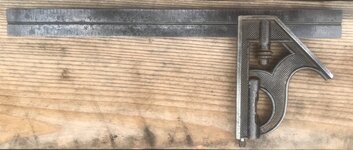
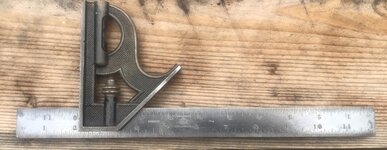
I found a Starrett square at an estate sale on May 11. IMG_4690.jpegIMG_4691.jpeg
I spent a bit of time cleaning it up. The rule is marked hardened but there isn’t a hump.
IMG_4702.jpegIMG_4699.jpegIMG_4700.jpeg

I found a Swanson square at another estate sale on May 17. There was no COO marked on the square and a little checking around indicates that it may have been made in China.IMG_4856.jpeg
-Don
 

crguy

Well-known member
Joined
Jan 24, 2016
Messages
2,650
Location
SW Washington
My dad was a welding fabricator and he had this Craftsman square. Retired in late 70s, I don't know when he bought it. Looks to be a good quality piece. AAC87CF4-6539-4EF2-950B-362C18AA96E1_1_201_a.jpeg81775A6A-6B5A-47E7-8713-3FA24393FA6C_1_201_a.jpeg98BB900E-ACF8-4CCB-8310-59082E2D6716_1_201_a.jpeg
 

Eric Brown

ALLIANCE MEMBER
Joined
Jun 14, 2024
Messages
672
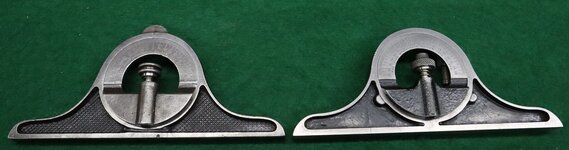
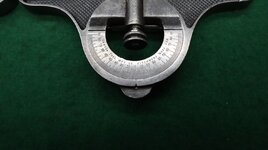
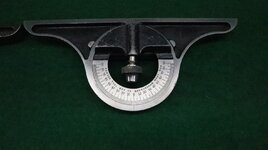
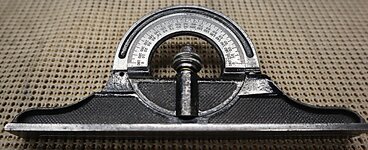
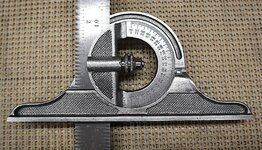
Here are my two Sawer protractor heads. The one on the left was made in Fitchburg while the right one was made in Ashburnham. The older one was listed in both catalog G (1904) and H 1910. They moved from Fitchburg to Ashburnham 1912 and changed their name to Almond in 1915. The earlier head has a single knob at the top with a stationary screw towards the bottom. The newer on uses two knobs to secure the rotation. On my older one the vial was broken so I am working on replacing.

Sawyer Protractor Heads 1.jpg

Sawyer Protractor Heads 2.jpg

Sawyer Protractor Heads 3.jpg

Sawyer Protractor Heads 4.jpg

Sawyer Protractor Heads 5.jpg

Comparing the Sawyer to an early Starrett from the top. The bases are the same, but the Starrett is much thinner towards the top.

Sawyer Protractor Heads 6.jpg
 

Eric Brown

ALLIANCE MEMBER
Joined
Jun 14, 2024
Messages
672
Two different Sawyer thread gages. This one on the left has Sawyer Tool Co. Fitchburg Mass. on one side and a patent date of Sept21, 97 on the other. It can measure from 5 to 60 TPI on 24 individual leaves. The right one has three sets of leaves.

IMG_3214.JPG

IMG_3215.JPG

IMG_3216.JPG
 

d42jeep

Well-known member
Joined
Oct 22, 2014
Messages
16,520
Location
Northern California
I found this Defiance by Stanley square with the scratch awl in place at a garage sale yesterday. It shouldn’t require too much rust removal. IMG_5855.jpegIMG_5856.jpegIMG_3405.png
-Don
 

Historyworker

Member
Joined
Sep 11, 2023
Messages
13
Don, what's your method for removing the black stain spots and areas -- those which Evapo doesn't touch?

(I'm impressed by and envious of your "assemblage" of combo squares.)
Older thread but I happened upon your question today and thought I'd chime in. I use an E tank, which will often leave the whole piece dark similar to evaporust. Once I pull it from the tank I use a tight stitched buffing wheel and the grey cutting compound from harbor freight. This is after just a couple passes. Unfortunately this rules got pretty deep pitting here and there.
1000004224.jpg1000004229.jpg1000004230.jpg1000004225.jpg
 

Eric Brown

ALLIANCE MEMBER
Joined
Jun 14, 2024
Messages
672
Stretching the definition of "combination", here are two take-down squares. The top one is an A. B. Jennings patent # 962149 (June 21, 1910) for the connecting joint. Made by C.E. Jennings. Not on Datamp.org. The other one is by Oscar R. Altwein patent 1064953 (June 17, 1913) assigned to Peck-Stow & Wilcox (PEXTO). Datamp.org shows not known to have been manufactured.
 

Attachments

  • US1064953 PEXTO 1913 square.pdf
    360.9 KB · Views: 5
  • US962149 AB Jennings 1910 square.pdf
    182.9 KB · Views: 2
  • Knock-Down 6.jpg
    Knock-Down 6.jpg
    229.8 KB · Views: 12
  • Knock-Down 5.jpg
    Knock-Down 5.jpg
    263.6 KB · Views: 11
  • Knock-Down 4.jpg
    Knock-Down 4.jpg
    725.3 KB · Views: 11
  • Knock-Down 3.jpg
    Knock-Down 3.jpg
    652.8 KB · Views: 11
  • Knock-Down 2.jpg
    Knock-Down 2.jpg
    1.1 MB · Views: 12
  • Knock-Down 1.jpg
    Knock-Down 1.jpg
    1.5 MB · Views: 17

d42jeep

Well-known member
Joined
Oct 22, 2014
Messages
16,520
Location
Northern California
Here is a recent combination square found at an estate sale. Empire is still in business making squares in the US although their current offerings don’t look much like this one. The rule looks somewhat better after it’s time in the evaporust. IMG_1970.jpeg
-Don
 

Eric Brown

ALLIANCE MEMBER
Joined
Jun 14, 2024
Messages
672
Here is a recent combination square found at an estate sale. Empire is still in business making squares in the US although their current offerings don’t look much like this one. The rule looks somewhat better after it’s time in the evaporust. IMG_1970.jpeg
-Don
It even has the notch on each end for a pencil turning it into a marking gauge. Nice job.
 

Eric Brown

ALLIANCE MEMBER
Joined
Jun 14, 2024
Messages
672
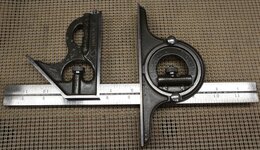
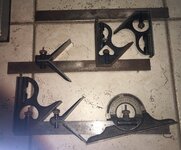
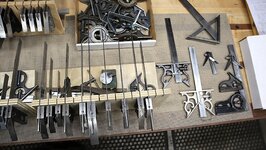
Here are a couple pictures of most my combination squares. Some unusual names in this group. Will sort and post in the near future.
 

Attachments

  • Combo Squares Group 1.jpg
    Combo Squares Group 1.jpg
    902.3 KB · Views: 27
  • Combo Squares Group 2.jpg
    Combo Squares Group 2.jpg
    884.1 KB · Views: 30

genog

Well-known member
Joined
Sep 4, 2021
Messages
2,001
Location
Silicon Valley
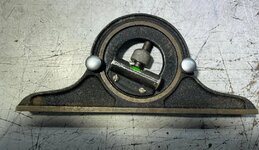
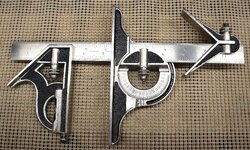
My father bought this Starrett combo square second hand in about 1948. Assuming it was purchased when a machinist retired and sold his tools it would put the original purchase prior to 1920. Anyone else have one to show?
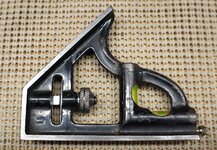
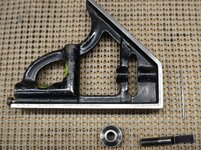
Well, I only have one part of the setup like the OP's
I use it to find angles.....
level.jpg

Someone scratched USN on the front....
 

Mintgrun

Well-known member
Joined
Oct 7, 2015
Messages
2,112
Location
Kingston, Wa.
Well, I only have one part of the setup like the OP's

The thumb nut on that one looks like the nuts on my Scherr Tumico tools. The finish and bright yellow green vial also match this combination square.
(the one on the left was made by Starrett)
IMG_1424.jpeg


IMG_1426.jpeg


Here's some company history, although he's mostly talking about micrometers.


Tom
 

Provincial

Well-known member
Joined
Sep 21, 2011
Messages
6,864
Location
Near Salem, OR
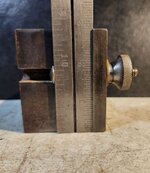
This is probably as good a place to post this as any, since it holds a rule from a combination square quite well.

Rule Holder 1.jpg

Shop-made version of a Starrett #62 Rule Holder. It allows a rule to be used as a height gauge or depth gauge. It will hold rules of various widths. Here is and example of it in use:
Rule Holder 2.jpg
And a close-up:
Rule Holder 3.jpg
 

Eric Brown

ALLIANCE MEMBER
Joined
Jun 14, 2024
Messages
672
Here is military issued protractor and square in dark olive drab green. Put together set with the rule being the only one marked with Brown & Sharpe. The protractor and square are not marked except on the rules clamping bolt is a patent #2122875 (July 5, 1938) assigned to Lufkin. The protractor has etched into it a "FT Jaffin". I did find both a Fred Jaffin Sr. and Fred Jaffin Jr. who served in the US Navy. The square has "Kenny" and "KS" etched into it. The shapes and designs of these suggest Brown & Sharpe but may have had shared designs to fulfil military contracts. The protractor has a two piece design for the main frame.
 

Attachments

  • Lufkin Military 4.jpg
    Lufkin Military 4.jpg
    560.3 KB · Views: 19
  • Lufkin Military 3.jpg
    Lufkin Military 3.jpg
    437.1 KB · Views: 19
  • Lufkin Military 2.jpg
    Lufkin Military 2.jpg
    700.2 KB · Views: 20
  • Lufkin Military 1.jpg
    Lufkin Military 1.jpg
    701.2 KB · Views: 28

Eric Brown

ALLIANCE MEMBER
Joined
Jun 14, 2024
Messages
672
Didn't see a separate topic for Union Tool Company tools, but combination squares use scribes, so here it is. I have looked in the 1923 and 1944 catalogs, but didn't see it. First picture is closed. Second apart. Third assembled for use. The only marking is Union Tool Co, Orange Mass USA just under the 3/8" hex top. The point is 1/8" at the large end. Anybody know when this might have been made? Thanks.
 

Attachments

  • Union Scribe 1.jpg
    Union Scribe 1.jpg
    526.8 KB · Views: 21
  • Union Scribe 2.jpg
    Union Scribe 2.jpg
    444.1 KB · Views: 17
  • Union Scribe 3.jpg
    Union Scribe 3.jpg
    439.1 KB · Views: 15

d42jeep

Well-known member
Joined
Oct 22, 2014
Messages
16,520
Location
Northern California
Here is a Union Tool thread that Woody started some time back if you would like to add your scribe to it.
-Don
 

Eric Brown

ALLIANCE MEMBER
Joined
Jun 14, 2024
Messages
672
Here is a Union Tool thread that Woody started some time back if you would like to add your scribe to it.
-Don
Thanks. I didn't see it. Not under the index. Posted it over there.
 
To avoid these ads, REGISTER NOW!

alinc100

Well-known member
Joined
May 26, 2013
Messages
3,025
Location
Dearborn,MI
Here is military issued protractor and square in dark olive drab green. Put together set with the rule being the only one marked with Brown & Sharpe. The protractor and square are not marked except on the rules clamping bolt is a patent #2122875 (July 5, 1938) assigned to Lufkin. The protractor has etched into it a "FT Jaffin". I did find both a Fred Jaffin Sr. and Fred Jaffin Jr. who served in the US Navy. The square has "Kenny" and "KS" etched into it. The shapes and designs of these suggest Brown & Sharpe but may have had shared designs to fulfil military contracts. The protractor has a two piece design for the main frame.
Curious how you distinguish 'military issued' versus standard Lufkin. A lot of their stuff was green.
 

Eric Brown

ALLIANCE MEMBER
Joined
Jun 14, 2024
Messages
672
Curious how you distinguish 'military issued' versus standard Lufkin. A lot of their stuff was green.
Coincidence mostly. The square is unmarked except for the patent number on the clamping bold. Can't see it unless taken apart. Patent was issued 1938. Fred Jaffin was in the Navy during WWII. Olive Drab. Military contracts usually require no markings and suppliers all make the same designs with interchangeable parts. The Brown & Sharpe designs are basically the same. Why would a manufacturer use olive drab as a color during the war except for military. Black was more available. So, coincidence. I have sent this question to Cresent as they now own the Lukin brand. Will be surprised if they respond.
 

Eric Brown

ALLIANCE MEMBER
Joined
Jun 14, 2024
Messages
672
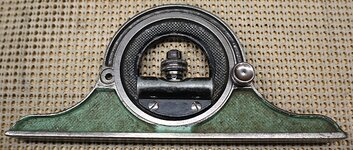
Trying to combine some Starrett protractor heads and put one into good shape. The first one, called Early, was rusted pretty bad on the exposed metal areas. The painted areas weren't too bad. Missing one small screw opposite the rotation clamp knob. Smaller than a #6 with a wide head. Starrett no longer offers these. The degree markings have a lot of pitting as does the bottom. Looks ugly to me.

The other is a #491 one painted green I called Later. Missing one rotation clamp knob and the frame is broken there. However, it has a decent center with clear markings. It also has a broken level.

So thinking it might be possible to move the center from the later to the frame of the early.

Took both apart. The center of the later was a few thousandths larger than the frame of the early. A little sandpaper sanding and it fits nicely. Then I tried to move the good level from the early to the later and nope, doesn't work. While the hole pattern is the same, the level isn't level. Side note: The early level holder is iron, the later one zinc. So now I'm fixing the level.

I'm not trying to fool anybody into thinking its all original. So I will use a plastic green bubble level. I will also drill out and tap with a 8-40 thread and use the knob off the early instead a screw so there are two knurled knobs (like the later ones).

For grins and giggle I am thinking of nickel plating this one. Will need to avoid plating the surfaces where it rotates due to tolerances.
 

Attachments

  • Later Back.jpg
    Later Back.jpg
    775.4 KB · Views: 16
  • Later Front.jpg
    Later Front.jpg
    551.8 KB · Views: 11
  • Early Back.jpg
    Early Back.jpg
    854 KB · Views: 11
  • Early front.jpg
    Early front.jpg
    568.1 KB · Views: 14

Eric Brown

ALLIANCE MEMBER
Joined
Jun 14, 2024
Messages
672
Trying to combine some Starrett protractor heads and put one into good shape. The first one, called Early, was rusted pretty bad on the exposed metal areas. The painted areas weren't too bad. Missing one small screw opposite the rotation clamp knob. Smaller than a #6 with a wide head. Starrett no longer offers these. The degree markings have a lot of pitting as does the bottom. Looks ugly to me.

The other is a #491 one painted green I called Later. Missing one rotation clamp knob and the frame is broken there. However, it has a decent center with clear markings. It also has a broken level.

So thinking it might be possible to move the center from the later to the frame of the early.

Took both apart. The center of the later was a few thousandths larger than the frame of the early. A little sandpaper sanding and it fits nicely. Then I tried to move the good level from the early to the later and nope, doesn't work. While the hole pattern is the same, the level isn't level. Side note: The early level holder is iron, the later one zinc. So now I'm fixing the level.

I'm not trying to fool anybody into thinking its all original. So I will use a plastic green bubble level. I will also drill out and tap with a 8-40 thread and use the knob off the early instead a screw so there are two knurled knobs (like the later ones).

For grins and giggle I am thinking of nickel plating this one. Will need to avoid plating the surfaces where it rotates due to tolerances.
Here are some updated progress pictures. It has been cleaned and what I call first polish. Will give it another polish before nickel plating. Waiting for a 8-40 tap to replace the one knurled screw. The level isn't set yet. May paint the holder black first.
 

Attachments

  • Starrett 1st polish front.jpg
    Starrett 1st polish front.jpg
    901.7 KB · Views: 13
  • Starrett 1st polish back.jpg
    Starrett 1st polish back.jpg
    777.3 KB · Views: 16

Eric Brown

ALLIANCE MEMBER
Joined
Jun 14, 2024
Messages
672
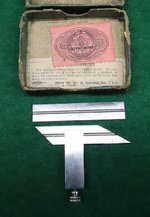
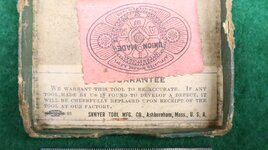
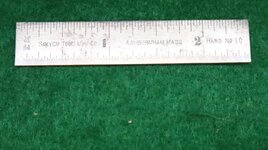
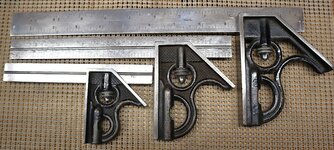
Bates Mfg. Orange Mass. Bates Mfg. was started when Sawyer Tool moved from Fitchburg MA. to Ashburnham MA. about 1908. Bates was sold to Union Caliper in 1913. 1915 name was changed to Union Tools. Also 1915 they moved to Orange MA. Looks like they kept the Bates line until the 1920's. In 1957 Union Tools was sold to Millers Falls.

The group of three Bates combination squares are all similar with the same markings indicating the Orange MA. location. None have a scribe (or even a hole for one). 12", 9" and 6" sizes. The blades not only have different lengths and widths, but also thicknesses. The blade holding nut does not use a compression spring but instead uses a wave washer. The donut shaped hole where the blade tightening nut was carried over to the Union Tool line.

The 12" stand alone is marked the same as above. Note it does have a scribe. The scribe is secured using a cam like joint.

The last picture shows a Bates center square (left) compared to a Starrett (right). The Bates does not have a raised lip on the outer edge. Compare the two knurled nuts.
 

Attachments

  • Bates 5.jpg
    Bates 5.jpg
    859.7 KB · Views: 9
  • Bates 4.jpg
    Bates 4.jpg
    864.9 KB · Views: 7
  • Bates 3.jpg
    Bates 3.jpg
    1 MB · Views: 5
  • Bates 2.jpg
    Bates 2.jpg
    779.2 KB · Views: 5
  • Bates 1.jpg
    Bates 1.jpg
    667.4 KB · Views: 4

Eric Brown

ALLIANCE MEMBER
Joined
Jun 14, 2024
Messages
672
Two different Sawyer thread gages. This one on the left has Sawyer Tool Co. Fitchburg Mass. on one side and a patent date of Sept21, 97 on the other. It can measure from 5 to 60 TPI on 24 individual leaves. The right one has three sets of leaves.

IMG_3214.JPG

IMG_3215.JPG

IMG_3216.JPG
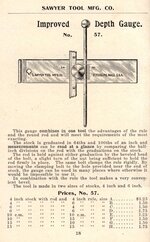
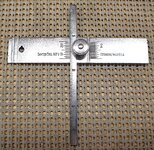
A Sawyer Depth Gage #57, also marked Fitchburg, which puts it after 1898. Sawyer was in business from 1894 to 1915.
It's listed in their catalog "G" 1904 and also in catalog "H". They added a bunch of sizes between the two catalogs.
 

Attachments

  • Sawyer Tool Catalog H.jpeg
    Sawyer Tool Catalog H.jpeg
    56.7 KB · Views: 4
  • Sawyer Tool Catalog G 1904.jpeg
    Sawyer Tool Catalog G 1904.jpeg
    57.3 KB · Views: 3
  • Sawyer Depth Gage 4.jpg
    Sawyer Depth Gage 4.jpg
    465.9 KB · Views: 4
  • Sawyer Depth Gage 3.jpg
    Sawyer Depth Gage 3.jpg
    419.5 KB · Views: 3
  • Sawyer Depth Gage 2.jpg
    Sawyer Depth Gage 2.jpg
    569.6 KB · Views: 3
  • Sawyer Depth Gage 1.jpg
    Sawyer Depth Gage 1.jpg
    610.8 KB · Views: 5

Eric Brown

ALLIANCE MEMBER
Joined
Jun 14, 2024
Messages
672
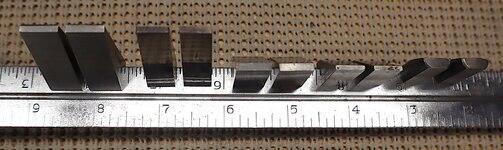
Adding functionality to combination squares are Key-Seat Rule Blocks. Made by a bunch of companies, here are five different sets. They are used to mark lines down cylindrical shafts or tubes. From left to right: Sawyer Tool, Union 310, unmarked, Starrett, Brown & Sharpe. Notice they come in various lengths and widths. Probably more important is the contact angle. The first two have about a 110 degree angle and the rest are 90 degrees. At first you might think that the short ones are for smaller work but that would not be correct. The depth the rule is inserted and the contact angle is important to the size of the work. A narrower rule for instance allows smaller diameters to be marked. The Sawyer and Union examples have a deeper groove for the rule to go into, making the rule shallower on the contact surface. They are however also larger physically. The smallest and lightest would be the Brown & Sharpe. On my next post I will have catalog pages and other info. Starrett has discontinued theirs.
 

Attachments

  • Key Seats 1.jpg
    Key Seats 1.jpg
    463.3 KB · Views: 9
  • Key Seats 2.jpg
    Key Seats 2.jpg
    366.1 KB · Views: 6
  • Key Seats 3.jpg
    Key Seats 3.jpg
    348.2 KB · Views: 7

Eric Brown

ALLIANCE MEMBER
Joined
Jun 14, 2024
Messages
672
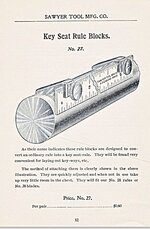
Key-Seat Rule blocks catalog pages and other info. I have not seen any of the 1922 Union blocks with curved surfaces.
 

Attachments

  • Sawyer Cat G 1904.jpeg
    Sawyer Cat G 1904.jpeg
    57.3 KB · Views: 12
  • B&S 1935 catalog 140.jpeg
    B&S 1935 catalog 140.jpeg
    35 KB · Views: 12
  • Sawyer Cat H.jpeg
    Sawyer Cat H.jpeg
    61.3 KB · Views: 12
  • Starrett 1895.jpeg
    Starrett 1895.jpeg
    70.9 KB · Views: 11
  • Starrett 2025.jpg
    Starrett 2025.jpg
    136.2 KB · Views: 12
  • Union Tools 1923 Catalog.jpg
    Union Tools 1923 Catalog.jpg
    99.9 KB · Views: 9
  • Union Tools 1944 Catalog.jpg
    Union Tools 1944 Catalog.jpg
    83.7 KB · Views: 14
  • US428890.pdf
    159.4 KB · Views: 1
  • US510494 Key Seat Rule 1893 Dayton Ohio.pdf
    190.9 KB · Views: 1
  • US568192 Key Seat Rule 1896.pdf
    189.7 KB · Views: 0

Eric Brown

ALLIANCE MEMBER
Joined
Jun 14, 2024
Messages
672
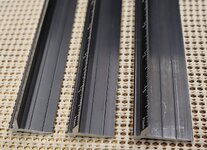
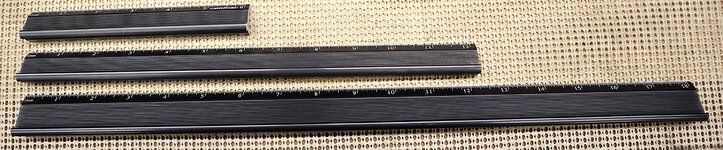
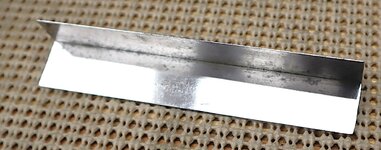
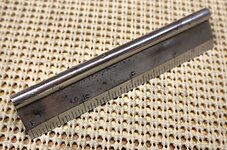
Some more Key Seat tools. The first is by Chesterman, Sheffield England. Model 802. 4" long 9/16" and 11/16" legs.
Then a group of black Lee Valley Veritas edge rules. Though not listed as for marking cylinders, they all have different lengths of legs with the long one having the longest legs. Link: https://www.leevalley.com/en-us/sho...ring/rules/111913-veritas-imperial-edge-rules

All of these have 90 degree corners.
 

Attachments

  • Chesterman 802 Key Seat 1.jpg
    Chesterman 802 Key Seat 1.jpg
    407.1 KB · Views: 10
  • Veritas Edge Rules 3.jpg
    Veritas Edge Rules 3.jpg
    380.4 KB · Views: 8
  • Veritas Edge Rules 2.jpg
    Veritas Edge Rules 2.jpg
    445.9 KB · Views: 9
  • Veritas Edge Rules 1.jpg
    Veritas Edge Rules 1.jpg
    437.1 KB · Views: 9
  • Chesterman 802 Key Seat 4.jpg
    Chesterman 802 Key Seat 4.jpg
    76.5 KB · Views: 8
  • Chesterman 802 Key Seat 3.jpg
    Chesterman 802 Key Seat 3.jpg
    169.5 KB · Views: 7
  • Chesterman 802 Key Seat 2.jpg
    Chesterman 802 Key Seat 2.jpg
    501.1 KB · Views: 8

Eric Brown

ALLIANCE MEMBER
Joined
Jun 14, 2024
Messages
672
Sorry not combination square, but there is no Sawyer tool topic either so I thought I would throw a couple of Sawyer calipers in here with the other Sawyer tools. The top one is marked with the Sawyer name, Fitchburg MA, and "Beeswax Joint" and it is about 8" long. The bottom one is Marked the same but also has a patent date of Aug, 22, 05 and is 7" long. It also has an adjustable point. Since Sawyer moved in 1908, that makes these being made between 1905 and 1908. Found the patent on Datamp.org, but they also say "not known to have been manufactured".

The patent was by James H. Cook, #797559 (Aug 22, 1905). It was assigned to Sawyer Tool MFG. of Fitchburg MA.
 

Attachments

  • Sawyer 1.jpg
    Sawyer 1.jpg
    607.3 KB · Views: 17
  • Sawyer 2.jpg
    Sawyer 2.jpg
    1.1 MB · Views: 7
  • Sawyer 3.jpg
    Sawyer 3.jpg
    561.3 KB · Views: 5
  • Sawyer 4.jpg
    Sawyer 4.jpg
    721.7 KB · Views: 11
  • US797559 Sawyer Beeswax Joint 1905.pdf
    192.9 KB · Views: 1

Eric Brown

ALLIANCE MEMBER
Joined
Jun 14, 2024
Messages
672
Here are some updated progress pictures. It has been cleaned and what I call first polish. Will give it another polish before nickel plating. Waiting for a 8-40 tap to replace the one knurled screw. The level isn't set yet. May paint the holder black first.
UPDATE: Nickel plated, vials replaced. Painted the textured areas. Added a square and center head to make set.
 

Attachments

  • Starrett Nickel Plated Set Front.jpg
    Starrett Nickel Plated Set Front.jpg
    1.2 MB · Views: 25
  • Starrett Nickel Plated Set Back.jpg
    Starrett Nickel Plated Set Back.jpg
    1.3 MB · Views: 22

Eric Brown

ALLIANCE MEMBER
Joined
Jun 14, 2024
Messages
672
Why are you nickel plating stuff that wasn't plated in the first place?
Because I can? Consider when people paint their model T Fords a color other than black. Any difference? Many tools were nickel plated because its durable and was available since the mid 1800's. Because of the amount ow work done to these I don't want to mislead anybody that they are original. Sure, I could leave a little rust and chipped paint, but hopefully someone takes better care of these for the next 100 years. I have not taken anything away from their being a useful tool. Perhaps you should consider these as an artistic effort.
 

Eric Brown

ALLIANCE MEMBER
Joined
Jun 14, 2024
Messages
672
Stanley combination squares #122 and #22 both use a wire to retain the clamping bolt. Here is my example of the #22 showing how to gently remove the wire. As can been seen in the first two pictures, the wire goes through a slot on the clamping bolt. Picture three shows on the one side a recess on the 45 degree side. Using a small screwdriver of x-acto blade, lift this end until it just clears, and then using another screwdriver push the wire towards the 45. The other end will now clear and drop down. Putting back together requires holding the wire up and the springing the wire up and moving back into the notch. Tricky, but it can be done gently.

These particular models use a rule similar to Starrett's with a groove, however, they are thinner so a standard Starrett rule won't fit.
 

Attachments

  • Stanley 22 Side 1.jpg
    Stanley 22 Side 1.jpg
    587.7 KB · Views: 16
  • Stanley 22 Side 2.jpg
    Stanley 22 Side 2.jpg
    511.9 KB · Views: 10
  • Stanley 22 Side 2 Step 1.jpg
    Stanley 22 Side 2 Step 1.jpg
    681.4 KB · Views: 9
  • Stanley 22 Side 2 Step 2.jpg
    Stanley 22 Side 2 Step 2.jpg
    439.6 KB · Views: 9
  • Stanley 22 Side 2 Step 3.jpg
    Stanley 22 Side 2 Step 3.jpg
    661.2 KB · Views: 13

Etchase

Well-known member
Joined
Nov 10, 2017
Messages
1,986
Location
Hawaii
Stanley combination squares #122 and #22 both use a wire to retain the clamping bolt. Here is my example of the #22 showing how to gently remove the wire. As can been seen in the first two pictures, the wire goes through a slot on the clamping bolt. Picture three shows on the one side a recess on the 45 degree side. Using a small screwdriver of x-acto blade, lift this end until it just clears, and then using another screwdriver push the wire towards the 45. The other end will now clear and drop down. Putting back together requires holding the wire up and the springing the wire up and moving back into the notch. Tricky, but it can be done gently.

These particular models use a rule similar to Starrett's with a groove, however, they are thinner so a standard Starrett rule won't fit.


Thanks for providing such extensive reference material for the ages!
 

Eric Brown

ALLIANCE MEMBER
Joined
Jun 14, 2024
Messages
672
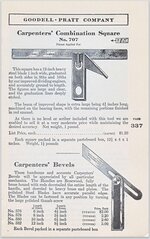
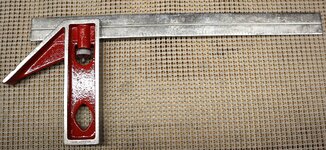
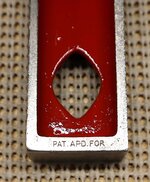
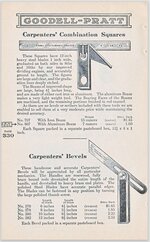
Goodell-Pratt # 707 combination square. This example is only marked "Pat Appl For" on the beam. The Rule is marked with the Goodell-Pratt information and the proper 707 model number. Have not been able to locate a patent for this design. According to the catalogs, in 1922 they refer to it as new tool and Pat Pending. By the 1926 catalog the patent is not referred to and they have a similar model 807 in aluminum. Have not see that one yet. These were sold as carpenter squares and do not have spirit levels or scribes.
 

Attachments

  • 1926 Cat 15.jpeg
    1926 Cat 15.jpeg
    148.8 KB · Views: 7
  • 1922 Cat 16.jpeg
    1922 Cat 16.jpeg
    154.1 KB · Views: 8
  • Goodell Pratt 707 1.jpg
    Goodell Pratt 707 1.jpg
    837.8 KB · Views: 6
  • Goodell Pratt 707 2.jpg
    Goodell Pratt 707 2.jpg
    918.5 KB · Views: 5
  • Goodell Pratt 707 3.jpg
    Goodell Pratt 707 3.jpg
    173.2 KB · Views: 5
  • Goodell Pratt 707 4.jpg
    Goodell Pratt 707 4.jpg
    433.8 KB · Views: 6
To avoid these ads, REGISTER NOW!
Top Bottom