To avoid these ads, REGISTER NOW!

Vise Info Thread

Outlawmws

Well-known member
Joined
Aug 9, 2011
Messages
39,085
Location
The Badlands
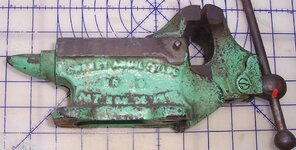
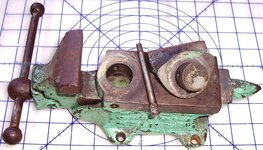
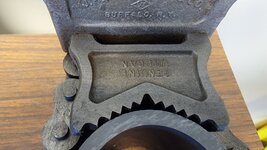
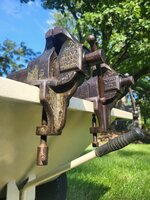
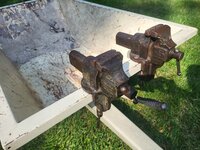
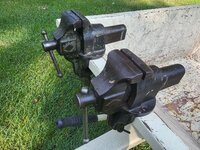
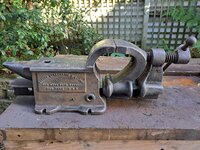
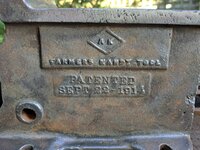
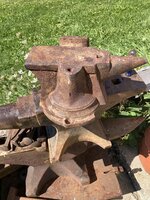
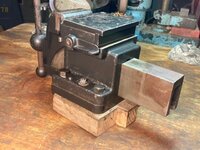
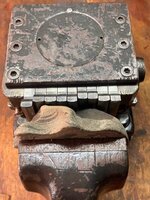
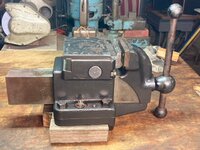
I think I have one for the Spreadsheet: Cheney Anvil and Vise Co. a No 10 I believe:

Picked it up today at a FM, Not a steal, but I don't believe retail:

2-1/4" (2-1/2 per the catalog) Jaws, I would call this 2" max opening. 8 Lbs, 14 oz.

I'm not sure if this is original paint or not? I suspect not...

I plan on using this as an "Inside vise" as while the anvil is not suitable for forging, Its fine for thin/soft metals.

EDIT I'm sure ifs between early 1879 and 1918 - certainly over 100 years old.

Cheney Vise Rt 1.jpg


Cheney Vise Rt 2.jpg


Cheney Vise Lft 1.jpg


No. 10 in the middle?

Cheney Vise Lft 2.jpg

Cheney Vise Swiv Jaw.jpg


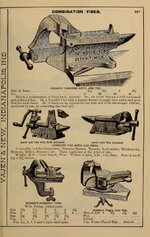
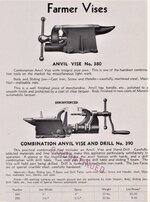
These is a catalog pg on Pg 1 of this thread, but I found another:

Cheney Combination Vises 1884_0000.jpg


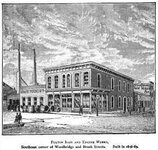
EDIT - Confirmed cast at the Fulton Foundry - See Patent below
Fulton Iron and Engine Works 1889-Cheney were made here.jpg
 

Attachments

  • Cheney Vise Rt 1.jpg
    Cheney Vise Rt 1.jpg
    146.5 KB · Views: 31
Last edited:
To avoid these ads, REGISTER NOW!

Outlawmws

Well-known member
Joined
Aug 9, 2011
Messages
39,085
Location
The Badlands
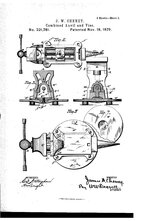
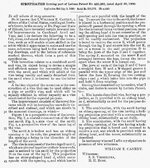
Patent info:

Patentee:
James W. Cheney (exact or similar names) - Detroit, MI

USPTO Classifications:
269/252, 269/258, 72/460


Assignees:
Armilla A. Cheney - Detroit, MI

Manufacturer:
Fulton Iron & Engine Works - Detroit, MI
Cheney Anvil & Vise Co. - Detroit, MI


pplication events
1879-11-18

Application granted
1879-11-18

Publication of US221781A
1896-11-18

Anticipated expiration
Status

Expired - Lifetime


Description​

J. W. CHENEY. Cbmbined Anvil and Vise.
Patented Nov. 18, 1879.
WITNESSS-. J. W. CHENEY.
Combined Anvil and Vise.No. 221,781. Patented Nv.18,1879.
UNITED STATES PATENT OFFICE,

JAMES W. CHENEY, OF DETROIT, MICHIGAN, ASSIGNOR TO ARMILLA A. CHENEY, OF SAME PLACE.
IMPROVEMENT lN COMBINED ANVIL AND VISE.

Specification forming part of Letters Patent No. 221,781, dated November 1B, 1879; application tiled September 1l, 1879.
To all 'whom it 'may concern

Be it known that I, JAMES W. CHENEY, of Detroit, county of Wayne, State of Michigan, have invented a new and useful Improvement in Combined Anvil and Vise; and I declare the following to be such a full, clear, and exact description thereof' as will enable others skilled in the art to which my invention pertains to make and use it, reference being had to the accompanying drawings, which make a part ot' this specification.

My invention consists in a combined anvil and vise embodying the novel construction and arrangement of parts hereinafter described, and pointed out in the claims.

In the drawings, Figure l is a perspective view of a combined anvil and vise embodying my invention. Fig. 2 is a longitudinal central section of same by a vertical plane. Fig. 3 is a cross-section by a vertical plane on the line a; x ot Fig. 2 5 Fig. 4, a similar section on line y `i/v of Fig. 2. Fig. 5 is a plan view. Fig. 6 is a plan view of the under side of the anvil with the bed-plate removed, and Fig. 7 isv a plan view of the upper surface of the bed-plate when detached from the anvil.

A is the anvil, B, a hollow space in its interior. C, is the adjustable or sliding jaw. It has a stem, C', which enters the hollow space B. The stem is provided with tongues C2 upon its upper and side faces, which lit into corresponding grooves in the body of the anvil, and a groove, C3 in its lower surface fits over a tongue, C4, on the projection A. These tongues and grooves serve to prevent all lateral displacements or tendency of the jaw C to rotate about its stem as it is caused to advance or recede by the action of the screw.

D is the screw. It passes longitudinally through the stern C/and a collar, d, serves to secure it near the handle to the jaw C in the nature of a swivel attachment, so that as the screw is run in or out it will carry the jaw with it. The screw D is tapped through a nut, E, which is prevented from moving by an arm, E', which projects into a corresponding recess in the bottom portion of the anvil, so that as the screw D is turned through the nut the jaw C is caused to advance or recede from the other jaw.

The interior space B is provided with a ridge or guide, b, against which the upper portion of the stem C or its upper tongue, C2, has a bearing throughout as it moves backward and forward. This is a matter of considerable importance in the construction of the device, because, if the stem C had a bearing only near the rear end -or heel of the anvil, it is apparent that after a little wear the jaw would be liable to tilt outward and fail to come to a snug bearing upon the interposed object, whereas the ridge or bearing b,bein g always-in contact with the stem at its inner end, affords a steady support against any such tendency. This ridge also aii'ords stiffness and strength to the upper part or face of the anvil. The screw, being entirely housed within the stem C', is kept free from dirt and grit, and is therefore always in good working order, and will wear a long time.

I provide an oil-hole, c, in such a location that when the jaw is expanded sufficiently far to expose the oil-hole the latter will be outside the nut, so that as the screw is run in it will thoroughly oil the thread of the nut. More over, the oil-hole in all ordinary use will be housed within the anvil, and cannot become stopped up with grit or dirt.

The anvil is secured to a bed-plate F, by a suitable pivotal bolt, F', which extends upward through the center of the bed plate and screws into the bearing-plate F2, which latter is constructed with straight sides that fit in grooves F3, formed in the inner sides of the anvil, and thereby prevent any rotary movement of said bearing-plate. The bed-plate is formed with a circular recess, within which is received the circular boss f2, formed on the lower end of bearing-plate F2, thereby allowing the anvil to be freely revolved on the bed plate when it is desired to adjust the anvil, and the bed-plate is, in turn, fastened to any support-as, for instance, a block or bench. Suitable bolts or screws f are provided for that purpose. This construction admits of the anvil being turned so as to present its point or vise in any desired direction for the more convenient access of the workman, and pins passed th ron gh the holes f and corresponding holes in the bed-plate will serve to fasten the anvil in any position.

G is a removable pivoted jaw. It is recessed into the face of the anvil, so as to be turned in any direction, as shown by the dotted lines in Fig. 5, thus enabling it to come to a square bearing upon the face of any interposed object,no matter whether its opposite faces be parallel or inclined to each other. Pins g, setting into corresponding holes iu the face of the anvil, serve to hold the jaw parallel to the adjustable jaw, except when it is desired to adjust it to an angle. This feature of recessing the pivoted jaw into the face of the anvil is important, inasmuch as it enables the manufacturer to readily dress off the face of the anvil, whereas, if the jaw were cast solid with the face of the anvil, or were attached to a projection extending upward from the anvil, it would be exceedingly difficult to dress and finish the face of the anvil, owing to this projection. An anvil of this character is exceedingly simple and strong, and makes a convenient tool for the workshop and farm.

The form of attachment to the block may be varied without departing from my invention. For instance, it may be fastened rigidly without having the revolving feature at all, or any suitable revolving attachment may be employed. So, also, instead of making the tongues U2 upon the stem C', the stem itself may be made square or angular and accomplish the same purpose of accurately guiding the jaw.
The orifice into which the pivoted ,jaw is set opens through into the interior space B, and any foreign matter will drop through, and not collect in the orifice to close it up and impair the fit and operation of the jaw.
The removable jaw may be replaced by any other suitable form of jaw-as, for instance, one suitable for holding a section of pipe, &c.
What I claim is- 1. In a combined anvil and vise, the combination, with the face of the anvil, of a pivoted jaw adapted to be rotated horizontally about its pivot, substantially as set forth.

2. In a combined anvil and vise, the combination, with the face of the anvil, of a readily removable pivoted jaw adapted to be rotated horizontally about its pivot, substantially as set forth.

3. In a combined anvil and vise, the combination, with the face of the anvil, of a pivoted jaw, the base of which rests upon said anvil face and is adapted to be rotated in a horizontal plane thereupon, and means for locking said pivoted jaw rigidly to the anvil, substantially as set forth.

4. A combined anvil and vise consisting of an anvil having the stationary jaw of a vise pivoted to its face and capable of horizontal rotation about its pivot, and of a movable jaw provided with a stem fitting within a recess in the anvil, and a screw for operating said movable jaw, substantially as set forth.

5. In a combined anvil and vise, a removable jaw combined with the face of the anvil, said removable jaw set into a recess which opens into the interior of the anvil, whereby dirt is prevented from collecting in the said recess, substantially as set forth.
6. In a combined anvil and vise, the combination, with the anvil provided with perforated supports or lugs and a bearing-plate secured against rotation within grooves in the anvil, ot a bed-plate provided with a circular depression for receiving a circular boss Ourthe bearing-plate, said parts connected by a pivotal bolt, the bed-plate being provided with any desired number of holes in its outer edge, and readily-removable pins for securing the anvil to the bed-plate at any desired angle of adjustment, substantially as set forth.

7. In a combined anvil and vise, a pivoted jaw combined with the face of the anvil, and pins setting into holes in the face of the anvil, or their equivalent, whereby the jaw may be set square for ordinary use, substantially as described.

Witness my hand at Detroit, Michigan, this 30th day of August, 1879.
JAMES W. CHENEY.
Witnesses:
CHARLES M. WOODRUFF, WILL M. PORTER.


Last edited:

12vx2

Well-known member
Joined
Feb 6, 2017
Messages
75
Location
Duck Creek New Mexico
Thanks Shift! I was thinking the same - it's laid on pretty thick.
I think I have one for the Spreadsheet: Cheney Anvil and Vise Co. a No 10 I believe:

Picked it up today at a FM, Not a steal, but I don't believe retail:

2-1/4" (2-1/2 per the catalog) Jaws, I would call this 2" max opening. 8 Lbs, 14 oz.

I'm not sure if this is original paint or not? I suspect not...

I plan on using this as an "Inside vise" as while the anvil is not suitable for forging, Its fine for thin/soft metals.

EDIT I'm sure ifs between early 1879 and 1918 - certainly over 100 years old.

Cheney Vise Rt 1.jpg


Cheney Vise Rt 2.jpg


Cheney Vise Lft 1.jpg


No. 10 in the middle?

Cheney Vise Lft 2.jpg

Cheney Vise Swiv Jaw.jpg


These is a catalog pg on Pg 1 of this thread, but I found another:

Cheney Combination Vises 1884_0000.jpg


EDIT - Confirmed cast at the Fulton Foundry - See Patent below
Fulton Iron and Engine Works 1889-Cheney were made here.jpg
I think I have one for the Spreadsheet: Cheney Anvil and Vise Co. a No 10 I believe:

Picked it up today at a FM, Not a steal, but I don't believe retail:

2-1/4" (2-1/2 per the catalog) Jaws, I would call this 2" max opening. 8 Lbs, 14 oz.

I'm not sure if this is original paint or not? I suspect not...

I plan on using this as an "Inside vise" as while the anvil is not suitable for forging, Its fine for thin/soft metals.

EDIT I'm sure ifs between early 1879 and 1918 - certainly over 100 years old.

Cheney Vise Rt 1.jpg


Cheney Vise Rt 2.jpg


Cheney Vise Lft 1.jpg


No. 10 in the middle?

Cheney Vise Lft 2.jpg

Cheney Vise Swiv Jaw.jpg


These is a catalog pg on Pg 1 of this thread, but I found another:

Cheney Combination Vises 1884_0000.jpg


EDIT - Confirmed cast at the Fulton Foundry - See Patent below
Fulton Iron and Engine Works 1889-Cheney were made here.jpg
That is a nice vise that incorporates some neat features.
 

CRSINMICH

Well-known member
Joined
Aug 15, 2015
Messages
2,393
Location
Southeastern Michigan

STAR/RIMCO/ROCK ISLAND
VISE-ANVIL combination (with drill attachment)
Invented and manufactured by James Conchar and later Loetscher-Ryan which was then taken over by Rock Island. For a time RIMCO also sold it as part of a vise-anvil-drill-forge combination, For a Man's Job.
 

Attachments

  • STAR to Rimco.jpg
    STAR to Rimco.jpg
    421.1 KB · Views: 17
  • 1920 Rimco (Rock Island).jpg
    1920 Rimco (Rock Island).jpg
    210.3 KB · Views: 19
  • 1934 Rock Island.jpg
    1934 Rock Island.jpg
    224 KB · Views: 15
  • 1920 Rimco (Rock Island) combination.jpg
    1920 Rimco (Rock Island) combination.jpg
    292.8 KB · Views: 14

master Zoda

Well-known member
Joined
May 31, 2014
Messages
165
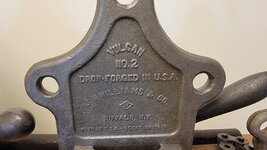
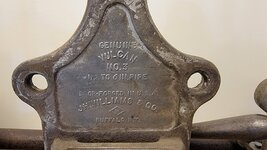
Vulcam No. 2
10.4 lbs
Capacity 1/4" to 4" pipe
Chain is 24" including the screw20230821_191442.jpg20230823_151018.jpg20230823_151014.jpg20230823_151010.jpg20230823_151904.jpg20230823_151901.jpg20230823_151858.jpgThere are some interesting differences in what the castings say on the three of these. The no.1 and no.3 are very similar. The no.2 is missing the genuine and the pipe capacity but has patented in the US and Britain. The actual jaws are all different. The no.4 onthe spreadsheet is like the n0.2 but with more patents. I wonder if this has something to do with there age.20230823_151719.jpgHere they are as part of my growing display in my office. That is my Vulcan 33 chain wrench in the front. I work for a pipe valves and fittings distributor so I try to keep the decor related to what we do.

I belive the no. 2 is the last one of these missing from the spreadsheet. The superior version is not on there at all they are pretty neat. I have never come across one yet I know one model is the c12 the handle is on top and the chain tightens via an arm acted on by a screw attached to the handle.
 

Attachments

  • 20230823_151858.jpg
    20230823_151858.jpg
    584.1 KB · Views: 7

KMScott

Well-known member
Joined
Feb 14, 2012
Messages
4,632
Location
Daufuskie Island, South Carolina
One more spec, but I guess one that belongs in the Anvil thread! I did a "Bounce test" on the Cheney's anvil today just for fun:
From 12" up a dropped steel ball got about 75% bounce back! :ROFLMAO:
That's pretty good. Can you see the hardened plate witness line? Looks like the top plate is Tool Steel. You can see that no heavy dings and rounded corners on the anvil portion. I'm liking your vise even more.
 

Fierljeppen

Well-known member
Joined
Jan 26, 2018
Messages
1,159
Karas Electric Co. Model 2-1/2. Radial slide and square slide version. 2-1/2" jaws that opens 3". Gonna say a stationary model until I am corrected. They also had a clamp on version.

They do have that base that looks like it could have been made to be used as stationary or with an optional swivel base. Similar to Record's, certain Columbian's and a few others.

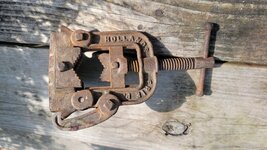
The "oval" slide Karas, I remember years back, guys on the main vise thread saying they were made by Holland, specifically their Keystone models.

@FMC1959...yeah, I always thought the Karas Electric Co. vise was a derivative of the Keystone vise and mfg. by the Hollands Mfg. Co. Then I stumbled on a post by @PghJKB, where he suggested that the Karas Electric Co. vises were produced by the Geo W. Diener Mfg. Co., only five miles straight west of them, as seen in the map below.

geo_diener_karas_electric.jpg

This was news to me, so I started collecting data to see if I could bolster @PghJKB's theory, which I did. I already had a few different versions of the Karas Electric Co. vises, and a similar Geo W. Diener Mfg. Co. vise, but not enough evidence to make a solid claim, until just recently, when I picked up a Geo W. Diener Mfg. Co. vise with the exact casting and vise specifications.

Geo W. Diener and Karas Electric clamp vise
jaw width.........2-1/2"
jaw opening....3"
weight...............7-1/2 lbs.

geo_diener_karas_electric-2.jpg geo_diener_karas_electric-1.jpg geo_diener_karas_electric-3.jpg geo_diener_clamp_vise-a03.jpg karas_electric_clamp_vise-a03.jpg

This was the smoking gun for me. It appears that Geo W. Diener Mfg. Co. also produced the exact same vises, referred to as a "Diamond vise" as early as 1907. It was offered in one size, but three different models: plain, clamp and swivel.

1910_h_channon_cat_no_50_pg.528.jpg diamond_no12_1a.jpg diamond_no12_1h.jpg

Anyway, I'm moving on to other vise puzzles. Lastly, many thanks to @PghJKB for the insight.

That was a lot of fun, let's do it again!
 

Outlawmws

Well-known member
Joined
Aug 9, 2011
Messages
39,085
Location
The Badlands
That's pretty good. Can you see the hardened plate witness line? Looks like the top plate is Tool Steel. You can see that no heavy dings and rounded corners on the anvil portion. I'm liking your vise even more.

I haven't cleaned/stripped it enough to see any distinct witness lines, but from what I think it may be, its looking like not over 1/8"? Maybe 90-100 thou?

and yep, me too Dr. Scott! I plan ot mount it on a piece of hardwood (do I have enough maple left? Hmmm) adn clamp it to my indoor workbench, and keep it portable for "remote work"...

I did another bounce test on a bigger Wards anvil vise I picked up a few months back, and it was close to a thud-stop - maybe 10-15%? pretty dead!
 

neophyte

Well-known member
Joined
Apr 23, 2012
Messages
9,530
Location
Pennsylvannia
Anyone seen a pipe vise like this? Almost looks like a Shopsmith accessory. Found at a neighbour's garage sale.
It looks like the pipe clamp adapter/accessory used with a portable electric hacksaw, or Sawzall, for making straight cuts on larger pipes.
Usually those are made for 6” or 12” pipes, but there are smaller and larger versions.
 

Attachments

  • IMG_7819.png
    IMG_7819.png
    1.4 MB · Views: 13
  • IMG_7820.png
    IMG_7820.png
    2.2 MB · Views: 15

CRSINMICH

Well-known member
Joined
Aug 15, 2015
Messages
2,393
Location
Southeastern Michigan
ranger: The patent on your vise was granted to Carl Shields. Mr. Shields had a number of vise related patents starting in March, 1912. It was for "Bench Vise Support" which was actually the nearly ubiquitous swivel lock mechanism used in many vises. In August of 1912 he was granted a patent for a "Bench Vise" which was an anvil vise style also nearly ubiquitous. In 1914, the busy Mr. Shields was given a patent for "Adjustment for Bench Vises" which was for the type of anvil vise you posted. In 1918, he got a patent for a "Combination Vise and Drill". All of his patents were assigned to Rock Island Manfacturing Co (RIMCO). See post #3327 above.
 

Attachments

  • 1918 Shields vise anvil drill forge combination.jpg
    1918 Shields vise anvil drill forge combination.jpg
    141.2 KB · Views: 11
  • 1914 Shields adjustment (2).jpg
    1914 Shields adjustment (2).jpg
    227 KB · Views: 10
  • 1914 Shields adjustment.jpg
    1914 Shields adjustment.jpg
    166.6 KB · Views: 9
  • 1912 (Aug) Shields bench vise.jpg
    1912 (Aug) Shields bench vise.jpg
    258.9 KB · Views: 11
  • 1912 (March) Shields bench vise support.jpg
    1912 (March) Shields bench vise support.jpg
    225.3 KB · Views: 27
Last edited:

plurnz

New member
Joined
Aug 29, 2023
Messages
1
To go with the Wilton 150-OS (currently mislabelled in the spreadsheet as 150-CS) and 125-OS offset vises already in the spreadsheet, here is a Wilton 100-OS as seen on ebay:

Wilton-100-OS-a.jpg
Wilton-100-OS-b.jpg

Wilton-100-OS-c.jpg
note the jaw face inserts are not original.

Made by Dawn in Australia, is a rebadge of the Dawn 100 Offset super grade (ductile cast iron) vice. "100" is the jaw width in millimetres (about 4 inches) and "OS" stands for offset,


MFR NameCOOModelPicturesWeight (pounds)Jaw Width (inches)Jaw Opening Width (Inches)AnvilReplaceable Jaw FacePipe JawsBase TypeSwivel jawScrewQuick ReleaseCategorySeriesNotesPatent Date
WiltonAustralia100-OShttps://www.garagejournal.com/forum/threads/vise-info-thread.355753/page-84#post-10292567 https://www.garagejournal.com/forum/threads/the-vises-of-garage-journal.44782/post-998493358.544.5NoYesNoStationaryNoCoveredNoEngineersstopped being made in this brand around 2006. Still made as a Dawn branded item for the Australian market. This is an offset jaws vise which allows long items to be held vertically in the full width of the jaws without obstruction from the vise itself, so rather than say a 3" throat depth it has unlimited (all the way to the floor) throat depth. Made from 70,000 psi ductile cast iron. Dawn branded parts available in Australia from Dawn distributors. Parts numbers on page 64 of the current Dawn catalogue Dawn_Catalogue_2017.pdfnot marked on vise. Relevant patent is Australian patent 6125:27 from 24th February 1927.

MFR Name;Wilton
COO;Australia
Model;100-OS
Pictures;https://www.garagejournal.com/forum/threads/vise-info-thread.355753/page-84#post-10292567 https://www.garagejournal.com/forum/threads/the-vises-of-garage-journal.44782/post-9984933
Weight (pounds);58.5
Jaw Width (inches);4
Jaw Opening Width (Inches);4.5
Anvil;No
Replaceable Jaw Face;Yes
Pipe Jaws;No
Base Type;Stationary
Swivel jaw;No
Screw;Covered
Quick Release;No
Category;Engineers
Series;
Notes; stopped being made in this brand around 2006. Still made as a Dawn branded item for the Australian market. This is an offset jaws vise which allows long items to be held vertically in the full width of the jaws without obstruction from the vise itself, so rather than say a 3" throat depth it has unlimited (all the way to the floor) throat depth. Made from 70,000 psi ductile cast iron. Dawn branded parts available in Australia from Dawn distributors. Parts numbers on page 64 of the current Dawn catalogue Dawn_Catalogue_2017.pdf
Patent Date; not marked on vise. Relevant patent is Australian patent 6125:27 from 24th February 1927, attached.
 

Attachments

  • dawn-1927-patent.pdf
    140.6 KB · Views: 6
Last edited:

KMScott

Well-known member
Joined
Feb 14, 2012
Messages
4,632
Location
Daufuskie Island, South Carolina
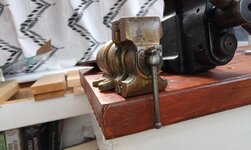
Swinden Bronze 1" Rotator Body Vise. No other spec:s. Owner claims 1" jaws.
 

Attachments

  • Swinden 1inch Bron-1 (1).jpg
    Swinden 1inch Bron-1 (1).jpg
    236.2 KB · Views: 33
  • Swinden 1inch Bron-1 (6).jpg
    Swinden 1inch Bron-1 (6).jpg
    239.5 KB · Views: 34
  • Swinden 1inch Bron-1 (5).jpg
    Swinden 1inch Bron-1 (5).jpg
    201.4 KB · Views: 33
  • Swinden 1inch Bron-1 (4).jpg
    Swinden 1inch Bron-1 (4).jpg
    240.7 KB · Views: 32
  • Swinden 1inch Bron-1 (3).jpg
    Swinden 1inch Bron-1 (3).jpg
    247.6 KB · Views: 30
  • Swinden 1inch Bron-1 (2).jpg
    Swinden 1inch Bron-1 (2).jpg
    248.6 KB · Views: 44
To avoid these ads, REGISTER NOW!

Draftpick1

Well-known member
Joined
Mar 22, 2018
Messages
326
Question for the Paramo vise collectors, a friend of mine came across an odd picture of a Paramo hi-duty No0 what's odd is that it looks like it has a plate screwed to the side with the "made in England" is that a bad casting or do you really think is has a small plate screwed to it? Can see what looks like 2 slotted screw heads and a recessed edge?
 

Attachments

  • Screenshot_20230903_105444_Samsung Internet.jpg
    Screenshot_20230903_105444_Samsung Internet.jpg
    647.7 KB · Views: 44
  • Screenshot_20230902_233154_Samsung Internet.jpg
    Screenshot_20230902_233154_Samsung Internet.jpg
    563.6 KB · Views: 41

tool_scrounge

Well-known member
Joined
Jul 20, 2010
Messages
4,168
Location
Southern California
Question for the Paramo vise collectors, a friend of mine came across an odd picture of a Paramo hi-duty No0 what's odd is that it looks like it has a plate screwed to the side with the "made in England" is that a bad casting or do you really think is has a small plate screwed to it? Can see what looks like 2 slotted screw heads and a recessed edge?
I am used to seeing plates like these screwed into the wooden masters used to make the sand castings. The the wooden one time use sand casting is used to mold the vise. So that is somewhat normal.

My Paramo 00 does not have a plate like that though.
https://www.garagejournal.com/forum/threads/vise-info-thread.355753/page-31#post-8185035
 

Draftpick1

Well-known member
Joined
Mar 22, 2018
Messages
326

Outlawmws

Well-known member
Joined
Aug 9, 2011
Messages
39,085
Location
The Badlands
Dr. Scott, some added details for the Zyliss vises in the Spreadsheet, and Noting these AFAIK are always clamp on and not Stationary:

Picked up this Zyliss Vise yesterday: Almost all aluminum, not for beating on. but these are great for light work like wood working:

Clamp on, 4-1/4" wide jaws (4-1/2 with the caps), opens to 6" only 7-1/2 lbs.

Zyless.jpg


Mocked up on my Old Samurai's rock rail:

Zyliss Rock Rail mount.jpg
 

PierceA

Well-known member
Joined
Aug 6, 2020
Messages
471
Location
SE Michigan
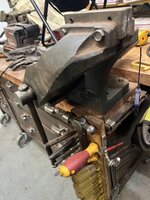
Had this broken odd-ball anvil fixture given to me. It brought to mind the many inexpensive 'anvil vises' that show up.
And like most of the inexpensive anvil vises, the mounting ears are broken off. Two of the three mounting ears are missing.

What I could not figure out was if this was some sort of 'vise' ? I kept looking at the hole on one side that had squared off notches on opposite sides of the hole.. It sure looked like a way to mount something to the 'anvil base'.

I asked CRSinMich if he had seen any such anvil vise, and sure enough, he found the patent for this vise.
It's not really restorable, but another bit of vise history.
I'd make new feet for it and restore the anvil base if I ran across the vise for it, or one that could be made to work. But that is highly unlikely. Multi:function.jpgMultifunction1.jpgMultiFunction2.jpgMultifunction3.jpg1890 Canady anvil vise patent drawing.jpg1890 Canady anvil vise patent info.jpg

PierceA
 

PierceA

Well-known member
Joined
Aug 6, 2020
Messages
471
Location
SE Michigan
I hardly believe it, but this showed up on FB this morning:

Cole or ?  .jpeg

It sure looks like the same or very close to the sketch in the patent.
If I can get the seller to answer my message and I can work out the logistics, then I might have the main missing piece for the
'Anvil vise'. A bit of a project, but since it appears to match the patent drawing, I think it's worth making an effort to put the two pieces together and have it as an 'example' of a rather different 'Anvil Vise'.
PierceA.
 

Outlawmws

Well-known member
Joined
Aug 9, 2011
Messages
39,085
Location
The Badlands
@KMScott: this mat be a few for the Spreadsheet (Not mine):

Swivel-jaw vises from London, England:

dohmstack.jpg

dohmtop.jpg dohmswivelled.jpg

This type was patented (588706 -1945) and made first by JEWilson, next by WH Colt, then DOHM-Colt, then DOHM, all with addresses in central London. The mid-sized one above (Wilson) is the oldest - a rough but solid casting, 4 3/8in jaw, 28lbs, with flip-out brass insert. There is another version with a side 'anvil' also quick release versions of some. The largest shown is weld-fabricated from plate - 6in jaw, 11in 'anvil', 44lbs, the smallest is a precision casting, 2in jaw, 3lbs. All have a brass nut and the triangular arrangement of screw and two bars, one being the brass jaw-cover pivot. Never seen these in a catalogue, but their offices were close to central government - maybe sold direct (one of those shown has a 'broad-arrow', meaning military, another a diff govt mark), they were reported in a couple of trade journals. I think they were not made past 1960.
 

KMScott

Well-known member
Joined
Feb 14, 2012
Messages
4,632
Location
Daufuskie Island, South Carolina
Avey Drilling Machine Co.

From the owner.

Avey drilling machine co
Cincinnati, Ohio
‘Berjo’ adaptive jaw bench vise
4 & 1/16 usable jaw width
5” max opening
84lbs
 

Attachments

  • Berjo (1).jpeg
    Berjo (1).jpeg
    133.1 KB · Views: 28
  • Berjo (2).jpeg
    Berjo (2).jpeg
    148.3 KB · Views: 28
  • Berjo (3).jpeg
    Berjo (3).jpeg
    138 KB · Views: 27
  • Berjo (4).jpeg
    Berjo (4).jpeg
    88.7 KB · Views: 27
  • Berjo (5).jpeg
    Berjo (5).jpeg
    69.1 KB · Views: 27
  • Berjo (6).jpeg
    Berjo (6).jpeg
    138.6 KB · Views: 27
  • Berjo (1).png
    Berjo (1).png
    571.9 KB · Views: 30
Last edited:

CRSINMICH

Well-known member
Joined
Aug 15, 2015
Messages
2,393
Location
Southeastern Michigan
master Zoda: I haven't found any ads or catalog cuts for a 5499 Craftsman Jr. vise (yet) but I did find out that Sears also sold a Samson Jr. 5499 and it was the same vise. Sampson was a Sears brand way back in the day; well before they started the Craftsman line. Good find!
 
Last edited:

master Zoda

Well-known member
Joined
May 31, 2014
Messages
165
master Zoda: I haven't found any ads or catalog cuts for a 5499 Craftsman Jr. vise (yet) but I did find out that Sears also sold a Samson Jr. 5499 and it was the same vise. Sampson was a Sears brand way back in the day; well before they started the Craftsman line. Good find!
That's interesting. Thank you.
 
To avoid these ads, REGISTER NOW!
Top Bottom