

You are using an out of date browser. It may not display this or other websites correctly.
You should upgrade or use an alternative browser.
You should upgrade or use an alternative browser.
Vise Info Thread
- Thread starter FMC1959
- Start date

akasrick
Well-known member
Obviously falls under the "Don't be fooled" tag.No. 200X Cast Hand Vise. 8oz.
THE READING SADDLE AND MANUFACTURING CO.
Reading, PA
No. 202 Heavy Cast Bench Vise. 1 3/8" jaws 1.2 lb.
No. 202H 2 1/8" jaws. 2.4 lb.
No. 210 Cast Anvil Bench Vise. 7.2 oz.
Weights are approximations since the given weight information was for a gross of vises.
Incidentally, the "Best by Test" tag line was a marketing gimmick. Many companies made the same claim. Don't be fooled!
File name identifies as a 1902 page.

akasrick
Fierljeppen
Well-known member
- Joined
- Jan 26, 2018
- Messages
- 1,159
This one is from a recent "vise puzzle" provided by @Grandpasaurus.
Smith's No. 5 "Heavy Chilled Beam Vise", manufactured by the H. B. Smith Machine Co., Smithville, New Jersey. Circa (1876-1903), based on the earliest and latest advertising found.
jaw width........5"
jaw opening...8-7/8"
weight.............64 lbs. (missing base locking hardware)
weight.............80 lbs. (catalog specs, includes base locking hardware)

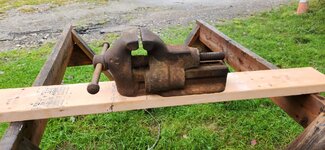


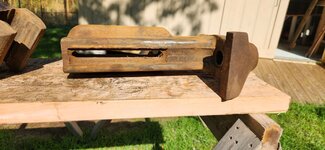
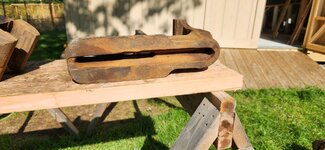

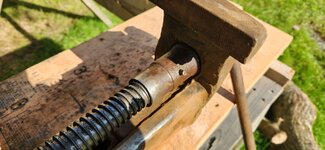
A very significant piece of American Vise History.
Smith's No. 5 "Heavy Chilled Beam Vise", manufactured by the H. B. Smith Machine Co., Smithville, New Jersey. Circa (1876-1903), based on the earliest and latest advertising found.
jaw width........5"
jaw opening...8-7/8"
weight.............64 lbs. (missing base locking hardware)
weight.............80 lbs. (catalog specs, includes base locking hardware)
A very significant piece of American Vise History.
Last edited:
CRSINMICH
Well-known member
E A BERG HAND VICE
Catalogue cut is from 1939. The vice I have is a 6" version of a No. 701, 1 5/8" jaws 1 lb 4 oz.
The catalogue cut also gives some specs for the "up to date" Model 700
Attachments


RTM
Well-known member
With things like that, I always wonder if Berg just stamped their name on it, vs custom made for them, vs made in house. That looks like a pretty standard hand vise, but could go any of the three options.I've had this hand vice in a toolbox for a few years. I wasn't until I got it out this morning that I noticed the E.A. Berg stamp. Erik Anton Berg is well known as having made very fine woodworking chisels so it was surprising to see the name on a vice.
E A BERG HAND VICE
four.cycle
Well-known member
^ Yes, quite possibly outsourced. Berg would have had no shortage of suppliers to choose from in Eskiltuna.
Berg / E.A. (Erik Anton) Berg., Eskilstuna, Sweden / pliers, chisels, snips / https://workingbyhand.wordpress.com/2015/11/15/swedish-chisels-from-e-a-berg/ /
Berg / E.A. (Erik Anton) Berg., Eskilstuna, Sweden / pliers, chisels, snips / https://workingbyhand.wordpress.com/2015/11/15/swedish-chisels-from-e-a-berg/ /
CRSINMICH
Well-known member
RTM: It's hard to know about those hand vices but it's probably telling that the 701 is described as a "usual model of hand vice". The catalog has dozens of types of tools, heavy on edge tools. They advertise Fruit and Flower Shears, Orange Nippers, Sardine tin openers, and this really cool universal tool.
Attachments

Last edited:
RTM
Well-known member
Looks similar to this one.

Meister & Schlingensiepen : Edition 1928 : Meister & Schlingensiepen : Free Download, Borrow, and Streaming : Internet Archive
182 p., illus., 23.2 cm, trade catalog
archive.org
four.cycle
Well-known member
^ amazing find, RTM. look just above that item - the 155 "pliers wrench" thingie. wonder who DRPa is (page 16?) I think Private Lugnutz owns one of those 1570 "adjustable spanners" (page 16) ....
that volume may answer a few questions.
the description makes it clear they were doing a great deal of outsourcing, but it's pretty clear they were also running drop forges.
that volume may answer a few questions.
the description makes it clear they were doing a great deal of outsourcing, but it's pretty clear they were also running drop forges.
RTM
Well-known member
D.R.P.a.. Abbreviation (German). D.R.P.a. signifies Deutsches Reichpatent angemeldet ("German Reich patent applied for").look just above that item - the 155 "pliers wrench" thingie. wonder who DRPa is (page 16?)
There is a second great catalog, similar diversity

Werkzeug-Katalog : Tool Catalogue : Lohmann & Co. : Lohmann & Co. : Free Download, Borrow, and Streaming : Internet Archive
230 p., illus., 20.1 cm, tool catalog
archive.org
CRSINMICH
Well-known member
Check out the scraubstocken beginning on page 65 of the W-K katalog and, of course, the feilkloben on page 67 - those are very familiar looking. Thanks for posting that katalog, RTM.
motorcitykid
Well-known member
Charles Parker #825. 5" jaws that opens to 8-1/2" and weights 130lbs.
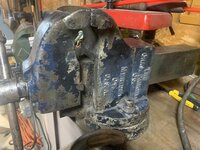
I just acquired this 825 with a 288 1/2 swivel base. The Vise nut retention pin is missing and I can’t find the hole, any chance you could share a picture of yours? If not please disregard. Carrying this 130 pound monster outside to wire wheel then back into the shop to try and figure out the mechanical issues is getting rough.
The vise nut slides down the beam then catches on what appears to be flashing from the casting, I’d just like to make it work for me.
KMScott
Well-known member
The 825 was not mine. Pull off the swivel base and you will see the pin hole that captures your nut from sliding back. It will be a nominal diameter. Make a new pin and ***** punch the end so it fits tight, most vise makers bend the pin to keep the nut from having a sloppy back and forth movement which tightens up the backlash on your spindle. I have found that it is easier to take the vise apart so ya ain’t muscling the whole vise around while cleaning it up.I just acquired this 825 with a 288 1/2 swivel base. The Vise nut retention pin is missing and I can’t find the hole, any chance you could share a picture of yours? If not please disregard. Carrying this 130 pound monster outside to wire wheel then back into the shop to try and figure out the mechanical issues is getting rough.
The vise nut slides down the beam then catches on what appears to be flashing from the casting, I’d just like to make it work for me.
Fierljeppen
Well-known member
- Joined
- Jan 26, 2018
- Messages
- 1,159
Super stoked to pickup this very rare, first generation Charles Parker no. 22 vise, before they added the patented cast anvil and steel horn. The vise is unrestored and in very good condition. It's only missing the screw spindle collar, which I'll acquire when an appropriate time period collar becomes available.
jaw width.......3-5/8"
jaw opening...4"
weight.............34 lbs.


 l
l
Initially, the Charles Parker Co. used the same model numbers for their stationary and swivel parallel vises. The following 1875 catalog scan shows the new model numbering system for the swivel models and the old model numbers that they replaced.

Beginning the very next year in 1876, all of the catalog scans I've seen, showed the swivel models with their new patent no. US-161,241 cast anvil and steel horn insert, except for models no. 23 and no.24, which would never have that feature.
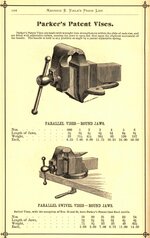
They initially added the patent casting to the new style vises as well, as seen in the photos below. Notice the very common broken and missing stationary slide shelf.


The patent was very descriptive about the cast anvil, as seen in the following quote.
"The object of this invention is to avoid the usual means of attachment, and at the same time apply a steel horn to the anvil; and the invention consists in casting the anvil with the other portion of the vise upon which the anvil is required, and inserting in the flask, prior to casting, a steel or similar metal horn, a portion of which extends into the mold for the anvil, so that the metal which forms the anvil will flow around, and, cooling, firmly hold the horn as a part of the anvil."
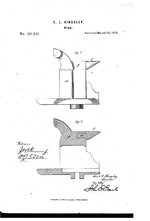
The claim about "firmly hold the horn as a part of the anvil", may have been well intended, but not necessarily a reality. Although most of these model Charles Parker vises maintained the horn on the anvil, many did not, as seen in the example from the collection of @Shiftless of his very old Charles Parker no. 20 vise.

Either way, I'm really pleased with addition of another old and rare Charles Parker vise to my collection. I recently picked up an even older and more historic Charles Parker vise, which I'll feature as soon as I remove the rattle can red paint job, graciously provided by the seller.
jaw width.......3-5/8"
jaw opening...4"
weight.............34 lbs.
lInitially, the Charles Parker Co. used the same model numbers for their stationary and swivel parallel vises. The following 1875 catalog scan shows the new model numbering system for the swivel models and the old model numbers that they replaced.
Beginning the very next year in 1876, all of the catalog scans I've seen, showed the swivel models with their new patent no. US-161,241 cast anvil and steel horn insert, except for models no. 23 and no.24, which would never have that feature.
They initially added the patent casting to the new style vises as well, as seen in the photos below. Notice the very common broken and missing stationary slide shelf.
The patent was very descriptive about the cast anvil, as seen in the following quote.
"The object of this invention is to avoid the usual means of attachment, and at the same time apply a steel horn to the anvil; and the invention consists in casting the anvil with the other portion of the vise upon which the anvil is required, and inserting in the flask, prior to casting, a steel or similar metal horn, a portion of which extends into the mold for the anvil, so that the metal which forms the anvil will flow around, and, cooling, firmly hold the horn as a part of the anvil."
The claim about "firmly hold the horn as a part of the anvil", may have been well intended, but not necessarily a reality. Although most of these model Charles Parker vises maintained the horn on the anvil, many did not, as seen in the example from the collection of @Shiftless of his very old Charles Parker no. 20 vise.
Either way, I'm really pleased with addition of another old and rare Charles Parker vise to my collection. I recently picked up an even older and more historic Charles Parker vise, which I'll feature as soon as I remove the rattle can red paint job, graciously provided by the seller.
Last edited:
motorcitykid
Well-known member
Thank you for getting back with me, I ended up snapping the bolt to remove the swivel base that ***** but not a huge deal. I’ll either sell the base or have a new bolt made. I just pushed the old rod up a bit, I will make another one at some point but for now I just want to use it.The 825 was not mine. Pull off the swivel base and you will see the pin hole that captures your nut from sliding back. It will be a nominal diameter. Make a new pin and ***** punch the end so it fits tight, most vise makers bend the pin to keep the nut from having a sloppy back and forth movement which tightens up the backlash on your spindle. I have found that it is easier to take the vise apart so ya ain’t muscling the whole vise around while cleaning it up.
KMScott
Well-known member
Awesome vise Fierljepen. It had to be on the spreadsheet.
I once had a 22 Horn version that was missing the base. I did a Kevin job restoring it. Built the base from scratch. I am not a collector like some of you here but more of a rebuilder kind of guy and try to save these old gems. Mine are not close to being original like this 22 you own and this one is not on the spreadsheet. But worth a peek.
I once had a 22 Horn version that was missing the base. I did a Kevin job restoring it. Built the base from scratch. I am not a collector like some of you here but more of a rebuilder kind of guy and try to save these old gems. Mine are not close to being original like this 22 you own and this one is not on the spreadsheet. But worth a peek.
Attachments


I already posted about this in the Main vise thread but figured it may be useful here aswell....Kevin,
As promised, please find the vises I spoke with you about listed below:
Ware Patent Vise - Maker Unknown
**EDIT** I believe I found the original maker of this vise:
No markings of any kind:
Weight:
Note - Weight of the board is negligible
Jaw Width:
Max Opening:
Option 1- This is where the jaws won't open any more due to the distortion in the square tubing from the u-bend - it's right at 5 1/2" so I tend to think that was by design
Option 2-
+ 1/2" where the vise won't fully close yet:

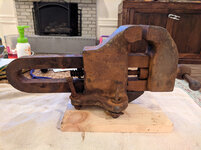
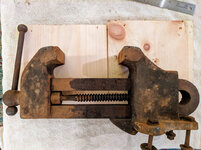
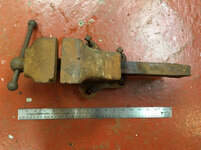
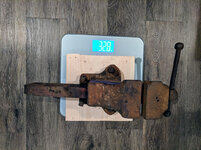

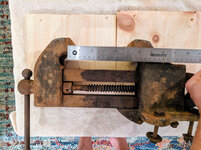

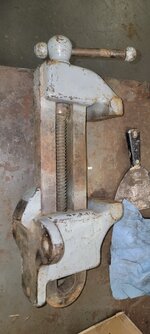
Found this Unmarked vise locally.
Would like to know if anyone has any more info on it.
So far I'm leaning towards it being a Utica vise. It seems most Utica vises are unmarked. (I've not come across any other than a picture in an advertisement which has branding on the actual vise, but we're only talking a handful of examples)
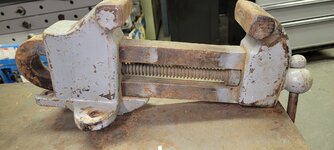
I posted in a FB group and someone has a similar but smaller version with a 4 hole base and is about half the weight.
From what I can tell there are atleast 3 different models of this vise with the square bar
-3" jaws with 4 hole base (approx 24lbs)
Jaws 3"
Height 7 1/4
Length 15 1/4
Weight 24.2
-3-1/2" Jaws with 4 hole base *can be seen in post #694 of the Vise Info thread*
Jaws 3"
Height Unknown
Length *approx 20"
Weight 32.5lbs
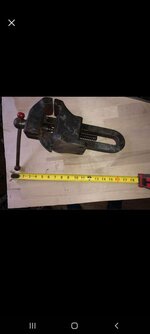
-3-3/4" Jaws with 3 hole base *seen in the pictures below*
Jaws are 3-3/4"
Height off table is 7-3/4"
Overall length is 20-3/4"
Weight is 47.6lbs
Smaller vise pic isn't mine
Attachments


Draftpick1
Well-known member
- Joined
- Mar 22, 2018
- Messages
- 326
RTM
Well-known member
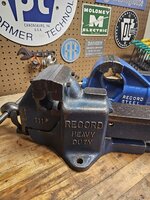
The older Record dark blue was quite cool, I have a few planes in a bit darker color than your vise. But unfortunately no idea the color.
Draftpick1
Well-known member
- Joined
- Mar 22, 2018
- Messages
- 326
I'm making a stand for the 111 and would like to paint the stand the same color or as close as i can get itThe older Record dark blue was quite cool, I have a few planes in a bit darker color than your vise. But unfortunately no idea the color.
Fierljeppen
Well-known member
- Joined
- Jan 26, 2018
- Messages
- 1,159
I already posted about this in the Main vise thread but figured it may be useful here aswell....
Found this Unmarked vise locally.
Would like to know if anyone has any more info on it.
So far I'm leaning towards it being a Utica vise. It seems most Utica vises are unmarked. (I've not come across any other than a picture in an advertisement which has branding on the actual vise, but we're only talking a handful of examples)
I posted in a FB group and someone has a similar but smaller version with a 4 hole base and is about half the weight.
From what I can tell there are atleast 3 different models of this vise with the square bar
-3" jaws with 4 hole base (approx 24lbs)
Jaws 3"
Height 7 1/4
Length 15 1/4
Weight 24.2
-3-1/2" Jaws with 4 hole base *can be seen in post #694 of the Vise Info thread*
Jaws 3"
Height Unknown
Length *approx 20"
Weight 32.5lbs
-3-3/4" Jaws with 3 hole base *seen in the pictures below*
Jaws are 3-3/4"
Height off table is 7-3/4"
Overall length is 20-3/4"
Weight is 47.6lbs
Smaller vise pic isn't mine
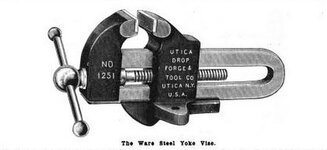
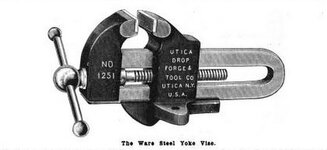
Well, we can definitively say it's a rare "J. L. Ware's patent" vise, which was more than likely manufactured by the Utica Drop Forge & Tool Co.
@MayerMR has examples of both the cast "Utica Drop Forge & Tool Co." and "Unmarked" Ware patent vises.

All of the magazine articles that I found for the Ware Patent vise, mfg. by the Utica Drop Forge & Tool Co. were between (1902-1904). The following article has the best information about your vise, including specifications and a model number.
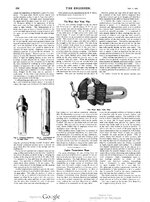
Very nice vise, thanks for sharing.
This is just what I was looking for!Well, we can definitively say it's a rare "J. L. Ware's patent" vise, which was more than likely manufactured by the Utica Drop Forge & Tool Co.
@MayerMR has examples of both the cast "Utica Drop Forge & Tool Co." and "Unmarked" Ware patent vises.
All of the magazine articles that I found for the Ware Patent vise, mfg. by the Utica Drop Forge & Tool Co. were between (1902-1904). The following article has the best information about your vise, including specifications and a model number.
Very nice vise, thanks for sharing.
Thank you!!
CRSINMICH
Well-known member
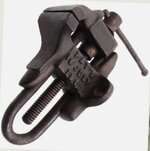
antman: Here's a little more Ware Vise information for you. James Smart, a Canadian manufacturer, had a Ware patent vise as early as July 16, 1901 under a Canadian patent (CA 72,266). The US patent #673,228 was granted April 30, 1901.
NOTE: The Ware patent Utica Drop Forge vises have squared 'rods' while the Smart vise and the Ware patent drawings have round rods. Also the MayerMR vise photo looks like it has a patent date of October 1900.
NOTE: The Ware patent Utica Drop Forge vises have squared 'rods' while the Smart vise and the Ware patent drawings have round rods. Also the MayerMR vise photo looks like it has a patent date of October 1900.
Attachments



Last edited:
Fierljeppen
Well-known member
- Joined
- Jan 26, 2018
- Messages
- 1,159
This very rare vise just sold on eBay.
Rock Island machinist vise no. 90
circa (1909-1929).
jaw width........2-1/2"
jaw opening...2-1/2"
weight.............17 lbs.


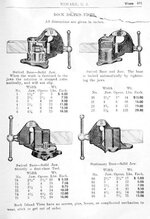

If this vise model was offered for twenty years, why is it so rare? For such a popular manufacturer, neither the Rock Island stationary or swivel (2-1/2" model) vises are currently in the "Vise Spreadsheet".
There's got to be a back story about this somewhere?
Rock Island machinist vise no. 90
circa (1909-1929).
jaw width........2-1/2"
jaw opening...2-1/2"
weight.............17 lbs.
If this vise model was offered for twenty years, why is it so rare? For such a popular manufacturer, neither the Rock Island stationary or swivel (2-1/2" model) vises are currently in the "Vise Spreadsheet".
There's got to be a back story about this somewhere?
KMScott
Well-known member
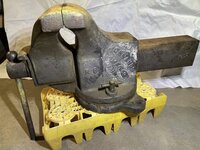
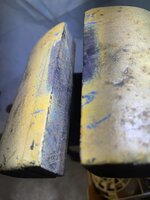
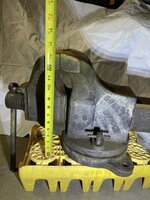
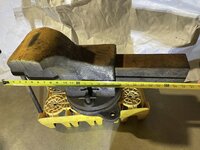
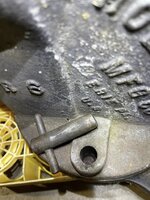
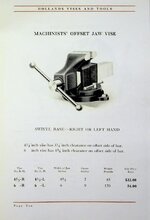
Hollands 6 R. 6" offset jaws that opens to 9" and weights 170 lbs.
Attachments
-
 Hollands R6-1.jpg384.5 KB · Views: 19
 -
 Hollands R6-2.jpg368.5 KB · Views: 17
 -
 Hollands R6-3.jpg242.2 KB · Views: 16
 -
 Hollands R6-4.jpg283.8 KB · Views: 15
 -
 Hollands R6-5.jpg331.6 KB · Views: 13
 -
 Hollands R6-6.jpg376.3 KB · Views: 12
 -
 Hollands R6-8.jpg450.6 KB · Views: 9
 -
 Hollands R6-9.jpg347.5 KB · Views: 14
 -
 Hollands R6-10.jpg34.6 KB · Views: 26
KMScott
Well-known member
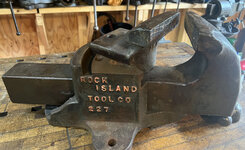
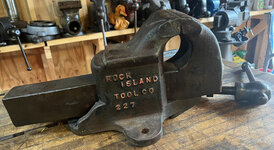
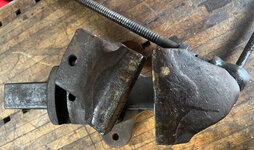
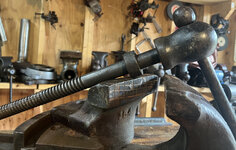
Rock Island 227. 5-1/2" swivel jaw that opens to 8-1/2" and weights 118lbs.
Attachments

PierceA
Well-known member
I purchased a large Prentiss combination vise last week. I did not know there were ANY combination vises with jaws wider than 6".
This Prentiss 185 has 7" wide jaws. There is an example of this vise in the spreadsheet, but it shows the weight to be 240#. My vise is missing the swivel base, but is 200# without it. I doubt that a swivel base and hardware add up to 40#, but i guess it might.
So: ~200#, 7" wide jaws, 15.5" tall [no base], opens 12.5", overall length 32".
This vise has had a hard life, but is still surprisingly sound.
I have another of this type of Prentiss 'open side slide' vises, a #82, a much smaller combination vise with flat pipe jaws.
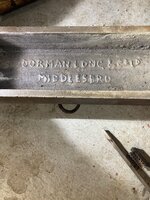
This Prentiss 185 has a maker's name on the inside of the 'wrought steel' c-channel slide. My Prentiss #82 does not.
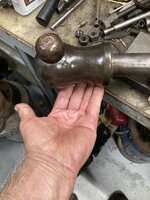
and this #185 has an interesting mainscrew nut.. the dovetail is tapered in two dimensions, something I've not seen before on a mainscrew nut.
PierceA
This Prentiss 185 has 7" wide jaws. There is an example of this vise in the spreadsheet, but it shows the weight to be 240#. My vise is missing the swivel base, but is 200# without it. I doubt that a swivel base and hardware add up to 40#, but i guess it might.
So: ~200#, 7" wide jaws, 15.5" tall [no base], opens 12.5", overall length 32".
This vise has had a hard life, but is still surprisingly sound.
I have another of this type of Prentiss 'open side slide' vises, a #82, a much smaller combination vise with flat pipe jaws.
This Prentiss 185 has a maker's name on the inside of the 'wrought steel' c-channel slide. My Prentiss #82 does not.
and this #185 has an interesting mainscrew nut.. the dovetail is tapered in two dimensions, something I've not seen before on a mainscrew nut.
PierceA
Attachments
-
 Prentiss185f.jpg845.3 KB · Views: 33
 -
 Prentiss185e.jpg792.2 KB · Views: 34
 -
 Prentiss185a.jpg869.4 KB · Views: 33
 -
 Prentiss185d.jpg697.7 KB · Views: 33
 -
 Prentiss185c.jpg751.5 KB · Views: 32
 -
 Prentiss185j.jpg1 MB · Views: 31
 -
 Prentiss185i.jpg907.7 KB · Views: 31
 -
 Prentiss185h.jpg984 KB · Views: 29
 -
 Prentiss185g.jpg704.7 KB · Views: 35
CRSINMICH
Well-known member


PierceA
Well-known member
CRS: Thank You !
It is interesting that Prentiss apparently had to import the 'c' channel to make this style vise.
PierceA
It is interesting that Prentiss apparently had to import the 'c' channel to make this style vise.
PierceA
CRSINMICH
Well-known member
infact #485
The i is not capitalized
Only model #440 is listed in the Spreadsheet
Weight - 10 lbs.
Jaw width - 3.5 inches
Opens to - 3.5 inches
Anvil - Yes
Replaceable jaw faces - Yes
Pipe jaws - No
Base - swivel
Swivel jaw - No
Screw - exposed
Quick release - No
Category - Utility
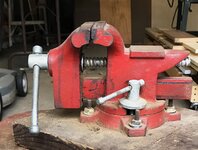
This vise was bought at an antique shop in Southern Ontario. I think the swivel lock is original but I've never seen one like that before.
Attachments


PierceA
Well-known member
CRS: that is an interesting vise! The base has 4 mounting ears, which is certainly not common, especially for a utility vise.
The hold down lock is also a good design, with it's integral heavy washer.
Good find!
PierceA.
The hold down lock is also a good design, with it's integral heavy washer.
Good find!
PierceA.
Fierljeppen
Well-known member
- Joined
- Jan 26, 2018
- Messages
- 1,159
I purchased a large Prentiss combination vise last week. I did not know there were ANY combination vises with jaws wider than 6".
This Prentiss 185 has 7" wide jaws. There is an example of this vise in the spreadsheet, but it shows the weight to be 240#. My vise is missing the swivel base, but is 200# without it. I doubt that a swivel base and hardware add up to 40#, but i guess it might.
So: ~200#, 7" wide jaws, 15.5" tall [no base], opens 12.5", overall length 32".
This vise has had a hard life, but is still surprisingly sound.
I have another of this type of Prentiss 'open side slide' vises, a #82, a much smaller combination vise with flat pipe jaws.
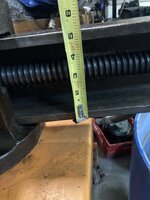
This Prentiss 185 has a maker's name on the inside of the 'wrought steel' c-channel slide. My Prentiss #82 does not.
and this #185 has an interesting mainscrew nut.. the dovetail is tapered in two dimensions, something I've not seen before on a mainscrew nut.
PierceA
Very interesting vise! I couldn't find any earlier vise manufacturers using the "wrought steel channel" as the slide.
Any comparisons between the Lewis Tool Co. and the Prentiss Tool Co. vises are completely valid, since the founders of the Prentiss Vise Co. were part owners. The very talented Mortimer G. Lewis was the brother-in-law of John E. Milford and Edwin H. Milford. So, that connection always existed.
Your Prentiss "Blake" no. 185 is the largest jaw combination vise I could find and was first offered in the earliest of 1900, as seen in the following documents.


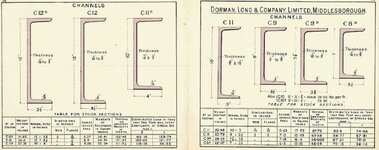
The fact that the Prentiss Vise Co. imported the "wrought steel channel" from Dorman Long is very interesting. I wonder if they marked the long raw, uncut channel once and you got real lucky to have gotten that piece or they were marked on all of the channels?
Either way, it adds a little a little more historical value to your vise.
While the "Blake" combination vises were offered well into the 1940's, they had a few design changes over that period. In the 1910 Prentiss catalog, they offered the "Blake" vises with the new Patented removeable jaws, which your vise does not have. Knowing this, I think it's safe to say that the circa for your vise is (1900-1910).
Really good stuff, thanks for sharing!
neophyte
Well-known member
Steel and wrought iron from that period may have had the manufacturers name marked by the rollers all the way down the beam.Very interesting vise! I couldn't find any earlier vise manufacturers using the "wrought steel channel" as the slide.
Any comparisons between the Lewis Tool Co. and the Prentiss Tool Co. vises are completely valid, since the founders of the Prentiss Vise Co. were part owners. The very talented Mortimer G. Lewis was the brother-in-law of John E. Milford and Edwin H. Milford. So, that connection always existed.
Your Prentiss "Blake" no. 185 is the largest jaw combination vise I could find and was first offered in the earliest of 1900, as seen in the following documents.
The fact that the Prentiss Vise Co. imported the "wrought steel channel" from Dorman Long is very interesting. I wonder if they marked the long raw, uncut channel once and you got real lucky to have gotten that piece or they were marked on all of the channels?
Either way, it adds a little a little more historical value to your vise.
While the "Blake" combination vises were offered well into the 1940's, they had a few design changes over that period. In the 1910 Prentiss catalog, they offered the "Blake" vises with the new Patented removeable jaws, which your vise does not have. Knowing this, I think it's safe to say that the circa for your vise is (1900-1910).
Really good stuff, thanks for sharing!
I know the Ben Franklin Bridge in Philadelphia has markings on the steel beams.
As for why the wrought iron came from Britain, Britain was one of the largest steel producers in the world at the time, although the USA might have caught up at that point ?
The other reason might be the dimensions of the steel.
IS steel manufacturers tried to standardize on certain dimensions, and usually charged significant extra fees for steel that needed to be rolled to other dimensions.
PierceA
Well-known member
Thanks everyone! I'm grateful for the research done, and shared for all of us to see.
The wrought iron channel used in this vise appears to be the largest size shown in the Dorman Long info.
But with a slight bit of machining i think. The vise's dimensions are just slightly smaller than the published channel dimensions.
Thanks again.
Pierce.
The wrought iron channel used in this vise appears to be the largest size shown in the Dorman Long info.
But with a slight bit of machining i think. The vise's dimensions are just slightly smaller than the published channel dimensions.
Thanks again.
Pierce.
Attachments

CRSINMICH
Well-known member
KMScott
Well-known member
I bet the channel was machined to the 2”+ dimension to fit the precision slide pocket. Can’t have too much slop in the area. Nice work guys.
PierceA
Well-known member
I agree Kevin. As well as have squared edges on the channel. It appears to have a formed or rounded edge in the catalog sketches.
Question: Wrought Steel vs Forged Steel: What is the difference? Forged to me means very heavy hammer-machines to shape the steel. What and how does that differ from 'wrought' steel?
The blacksmith post vises are 'wrought iron'. And they are amazingly tough.. I watched a guy take a 12# sledge and a full overhead swing with the sledge hammer and hit the jaw tops on a blacksmith post vise. And the sledge hammer just bounced off.
I'm wondering if someone can post a link to some site like: 'Metallurgy for Dummies'.com. Which is what I 'd need to start with !
Pierce..
Question: Wrought Steel vs Forged Steel: What is the difference? Forged to me means very heavy hammer-machines to shape the steel. What and how does that differ from 'wrought' steel?
The blacksmith post vises are 'wrought iron'. And they are amazingly tough.. I watched a guy take a 12# sledge and a full overhead swing with the sledge hammer and hit the jaw tops on a blacksmith post vise. And the sledge hammer just bounced off.
I'm wondering if someone can post a link to some site like: 'Metallurgy for Dummies'.com. Which is what I 'd need to start with !
Pierce..
neophyte
Well-known member
Terminology concerning steel and iron, especially older terminology, is a bit weird and incongruous.I agree Kevin. As well as have squared edges on the channel. It appears to have a formed or rounded edge in the catalog sketches.
Question: Wrought Steel vs Forged Steel: What is the difference? Forged to me means very heavy hammer-machines to shape the steel. What and how does that differ from 'wrought' steel?
The blacksmith post vises are 'wrought iron'. And they are amazingly tough.. I watched a guy take a 12# sledge and a full overhead swing with the sledge hammer and hit the jaw tops on a blacksmith post vise. And the sledge hammer just bounced off.
I'm wondering if someone can post a link to some site like: 'Metallurgy for Dummies'.com. Which is what I 'd need to start with !
Pierce..
What most people refer to as “Iron” is, really a non homogenous mixture of iron, with inclusions of graphite in various forms, and silicon, and other impurities.
“Steel” on the other hand, is a metal alloy of iron, with a small amount of carbon connected to the iron in molecular structures, with most “steel alloys” containing other elements bonded into the molecular structure as well.
Actual “pure” iron, ( ie. 99.9+% pure) is actually fairly uncommon, and is more of a specialty material used for niche applications.
Most metal called “iron” has way more carbon in it per weight/volume than most metal alloys called “steel”.
The terms “wrought steel”, and “forged steel” evolved out of older terms like “wrought iron”.
Wrought Iron was originally made by hammer forging chunks of iron produced from iron ore using various methods, that were then forged welded into long, somewhat standardized bars, ie. “Wrought”, into bar form, with the technique going back to the middle ages, or earlier.
These bars were forged out, and then cut, and forge welded again, and stretched out, with each successive folding producing a stronger, highly quality bar of wrought iron.
Genuine older “wrought iron”, has a grain structure that follows the forging direction, that when split, looks sort of like split wood grain.
Once the industrial revolution kicked in, “wrought iron” with the typical grain structure and inclusions was still produced, but the bars and sheet iron tended to get rolled once the forging process got the iron down to a manageable size.
When that rolled out steel was used to produce items, like railings or fences, or whatever, it was generally referred to as “wrought iron”, with the term “wrought” meaning forged.
Later, when steel making processes such as the Bessemer Process took over, the “iron” bars used to produce the above structures were technically now steel, but the terms “iron” and wrought iron, instead of “steel” or “wrought steel” were still used.
Technically, the vise uses a piece of “rolled iron” or “rolled steel” for the slide, which was likely machined to final dimensions.
As to materials, traditional blacksmith leg vises are still manufactured.
Traditional leg vises were likely forged from the striated wrought iron bar, and those should be apparent, since any corrosion will show the striated “wood grain pattern” of the struated wrought iron.
Later versions would likely have been made from steel bar that was forged out, with others being cast from malleable iron, ductile iron, or steel.
The current Turkish made Kanca leg vises are supposedly cast steel.
Morgan still lists leg vises in their catalog, which are listed as forged steel. ( the one price I found for a current Morgan leg vise was $3000-$4000)
Ductile iron can be very durable to impacts, especially if austempered, and might be springy.
Their are still manufacturers of large railroad pry bars, and the techniques used to produce the railroad pry bars are the exact same that would be used to make a leg vise, which likely explains part of the design.
Hi just picked up a 183 like yours Did you remove the lead screw from the slide assembly for the restoration? if so how? my lead screw retainer is missing and I can't see how it would work. Any help on what the retainer looks like or a picture would be appreciated Thanks Pete in Medway MEPrentiss 183 with 6" jaws that open to 6", Weights 185lbs and has the side open channel. God awful blue paint job on this one.