Iron
Puget
ztorres
Ez
Thanks for posting your tips. It is great to accumulated this knowledge in a single place. I am sure that by sharing our collective wisdom others will be served.
There was a whisper of CHISELS earlier. Of those tools I am a big fan and have numerous sets and singles around the shop. One tip I have is to go for the sets. Sometimes with tools, you do not know you need a tool until you use it. Thus it is with chisels. Sets of graduated chisels means that you will always find a good size to use and you will rarely have to stop work to sharpen. If one edge gets nicked or if it dulls during your project, just grab one up or one down and keep going.
I can show sets later if there is interest. Today I will showcase chisels and chisel handles that I have made. If you call yourself a woodworker, then you should not avoid a chisel rehandle project. After all, chisel handles are wood. Here is the class photo.
The first group is what I call the Primatives. These handles were made using pocketknives, drawknives, and other chisels. Most of these are from my early days of ww and the quality shows.
My shop includes tools from various sources and some are very special. That is the case with the 1/4" chisel on the right with a whittled handle. That chisel and handle came from my grandfather's shop and he whittled the handle himself. The others came from various sources and were rehabilitated for use. These are functional but are not beauties. It is OK to make a quick handle and put the chisel back to work. I kept at it and my skills did improve over time. Never give up.
The next group is a graduated set of Japanese style paring chisels. Hold them with two hands and pare slivers away from your project.
The large chisel is actually from Japan and is factory made. It is about 3/8" and the body cross section is triangle shaped. It cost me over $50 at the time. I wanted a full set but could not stand the $$$ pain. So I ground up some steel and added it to a heat treating batch of plane blades that I was working on. The ferrules are brass pipe and the handles are turned from African hardwood--Padauk I think. Sizes are 1/4, 3/16, and 1/8. They are sharp and work well.
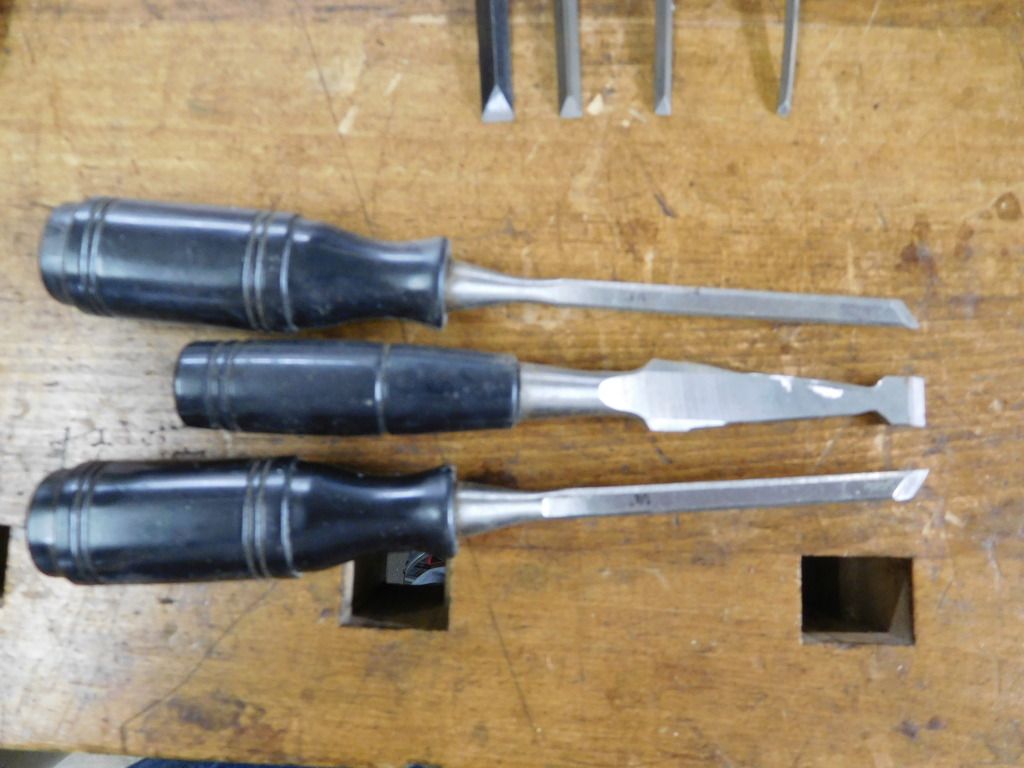
The next group is hand ground speciality chisels. Sorry for the fuzzy photo.
I bought two 1/4 chisels at Big Lots and ground them at 45 degrees. It was a slow process which required frequent dunking. Most tool steel for chisels changes its temper around 400 degrees. If you quench and see steam, you have exceeded 220. So take care and quench often. These are handy for cleaning out inside dovetail pockets--think drawer front. You need the pair to get at both sides. The chisel in the middle was a cheapie that I ground for a project. It was not too useful. What can I say? Not all holes you drill will produce a gusher.
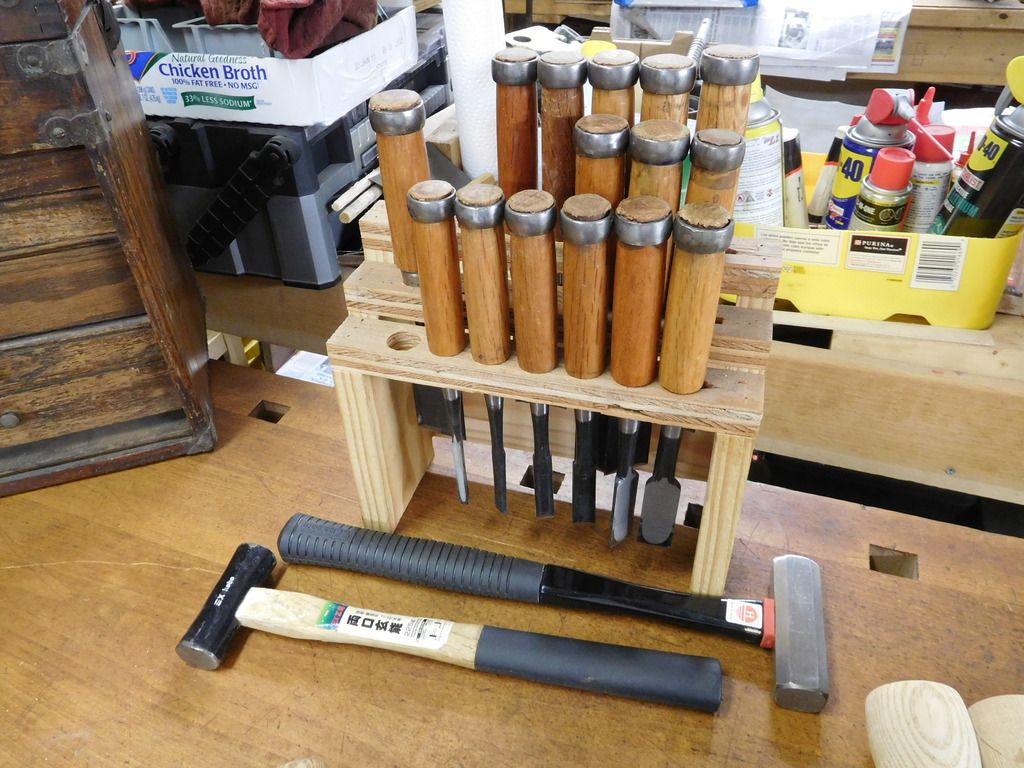
The next group includes a mortise chisel set and two 1/8 chisels I made.
One day while searching "handle lots" on that auction site, I hit the mother lode and ended up with a box of nice handles. They even have a hole drilled for the chisel tang. I opened it up a bit, slammed home the blade, and filled the sides with glue and toothpicks. These little 1/8 chisels get lots of use because, like a cute cheerleader, they can go anywhere. I made the mortice chisels because I could not find what I wanted. They are made from 1/2" bar stock and were heat treated by my source. Sizes are 1/2, 3/8, and 1/4. The handles were turned from ash to fit my big paws. I grabbed the blades and whacked the handles on my workbench to send them home. Whups--the sharp corners did some slicing and Jimmy did some bleeding that day.
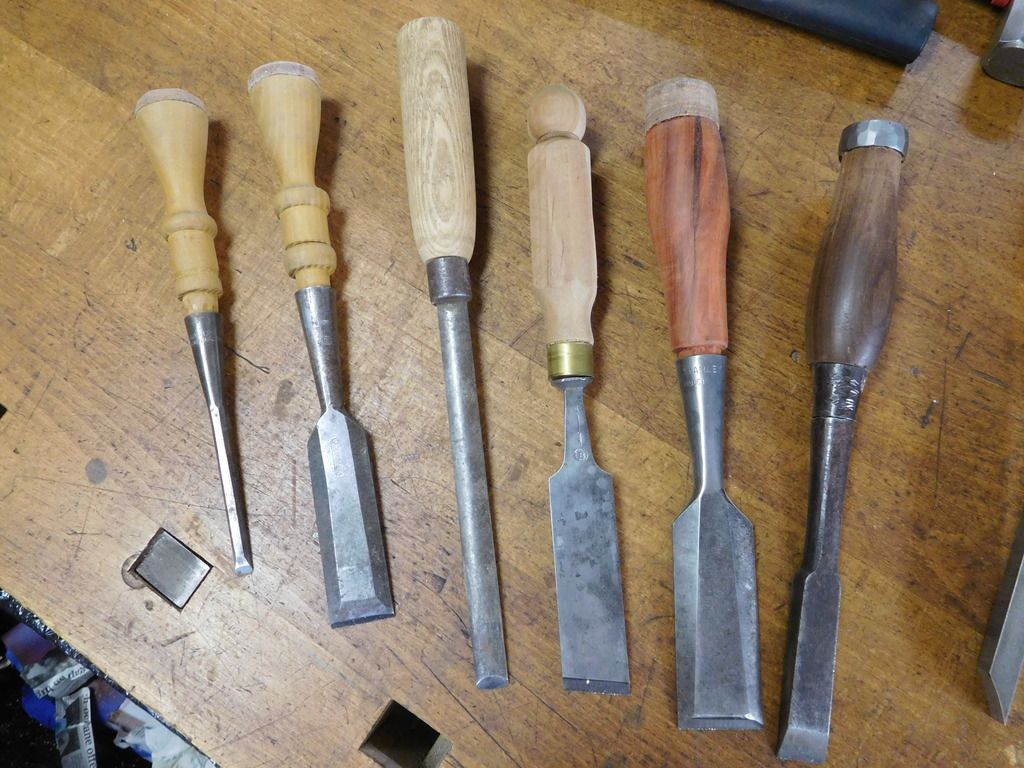
The next group of chisels are from Fancy Handle Town. I made these at various times for orphan chisels that I rehabilitated.
It's amazing how a little lathe experience upgrades your handling skills. I got really fancy and added leather tips to some of them. It was pretty easy to do. I turned a dowel on the end of the handle and fitted it with leather washers. Go to the auction site and look for parakeet toys.
Remember to be safe when using chisels. I like to use a mallet. One hand on the chisel and one hand on the mallet means NO hands available for sticks. Working like this usually requires a vise. WooHoo--more tools to buy.
Here is my 40+ yo mallet, wrapped in friction tape and duck tape. The tape muffles the sound and keeps the mallet from rebounding.