To avoid these ads, REGISTER NOW!

Woodworking 101--Tools and Tips

manwithtools

ALLIANCE MEMBER
Joined
Aug 24, 2015
Messages
13,756
Location
Lebanon, TN
Turn out the lights and close up the shop when you get tired.

This is excellent advise, I wish I had listed to that little voice in my head about 15 years ago. Probably would have saved me a broken thumb that day when I dropped a piece of wood on an (foolishly) unguarded table saw blade. The kick back caught my thumb and broke it bad enough to require metal pins and surgery.
 
To avoid these ads, REGISTER NOW!
OP
J

jimreed2160

Well-known member
Joined
Aug 7, 2016
Messages
3,589
Location
Tallahassee FL
Jet bandsaw

Here is a bandsaw tour. I acquired this saw new in 1999 when my last children came off the payroll. It has a 1 hp motor within the enclosed base. Wheel diameter is 14" and it has a riser kit installed.

DSCN1468.jpg


One day I rested my hand on the post and then realized that the blade was only a few inches away. :willy_nil

So I added a woodscrew as a blade guard and as a reminder of where NOT to put my hand. Over the years, it has acquired a miter gauge and a pair of ear muffs.

DSCN1469.jpg


Here is the miter gauge in action.

DSCN1477.jpg


I added the fence to this saw and really like it. I use it all the time for rip cuts. When I lower the blade for thin stock, sometimes the fence does not reach because the blocks are in the way. That is why I keep a scrap "fence extender" on the table.

DSCN1476.jpg


With the 6" riser block installed, this saw will cut stock that is 12" tall. That is very convenient for resawing figured stock.

DSCN1488.jpg


It will also cut stock up to 12" wide.

DSCN1490.jpg


I keep a wide Timberwolf blade on it for general use.

DSCN1478.jpg


I added a mobile base. It makes the saw a little tippy, but I really appreciate the mobility in my tight shop.

As I mentioned, I have used a BS for 50+ years. If I had only one motorized tool, it would be a BS. I have cut bones, firewood, timber and even lumber with my BS. There is hardly anything it will not cut for you. If you are a ww, you need one.

I have by necessity become quite a BS mechanic. These saws do require a little more fiddling than most tools. I will cover some of my favorite tips and tricks in subsequent posts.
 

turbowoodworker

Well-known member
Joined
Mar 18, 2012
Messages
3,529
Location
Apex NC
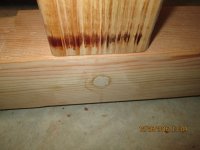
I was building a leg set for my outfeed table (pics later when complete) and the thought came to me about draw bored tenon joints.

M&T joints are arguably the strongest of all mechanical joints used in wood working but they are not foolproof. Some will dowel or pin the M&T to keep them together if glue fails (more common with old hide glue). We have all seen loose dowels in old chairs which is a combination of wood drying and glue failing (hopefully not from a poorly executed joint).

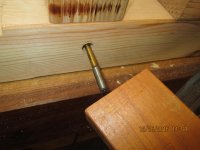
Draw bore tenon means the use of a dowel or pin to span the joint via a bored hole that is offset in the tenon. When a tapered peg is driven through the joint, it pulls the tenon into the mortise and keeps it tight.

In my pictures you can see a finished draw bored M&T. It is indistinguishable from any other pinned M&T. It is constructed by drilling across the mortise (not through to the other side but 3/4 to other side). Then the tenon is placed in the mortise and the drill bit is placed in the hole and tapped. This marks the tenon. On its removal from the mortise, you measure about 1/8 or 3/32" closer to the cheek and make a mark. Drilling on the mark offsets the hole from the one bored in the mortise.

Now on glue up, a tapered pin (I just whittle the end of a dowel a little on one side) is placed and driven hard into the bore. This draws the M&T tight, really tight. It acts as a little insurance if glue were to fail and is really fun to do.

I will use this joint often, especially for any shop furniture where hard use is expected. If used for a dining room table, which would be appropriate, just keep in mind that the dowel will be visible on on side of the foot or stretcher.
 

Attachments

  • IMG_8356.jpg
    IMG_8356.jpg
    138.2 KB · Views: 56
  • IMG_8341.jpg
    IMG_8341.jpg
    132.1 KB · Views: 57
  • IMG_8336.jpg
    IMG_8336.jpg
    140 KB · Views: 65
  • IMG_8340.jpg
    IMG_8340.jpg
    129.7 KB · Views: 57

turbowoodworker

Well-known member
Joined
Mar 18, 2012
Messages
3,529
Location
Apex NC
Jim,

I anxiously await your tips on the BS. I don't use mine as much as I would like because my biggest problem with it is blade wander. I would love to use it for tenon cheeks but find my cuts are never as straight as I would like. So I resort to the tenoning jig on the TS. Or I cut proud and finish alot with the shoulder plane.

Help please. I must be doing something wrong.
BTW I have your exact saw but newer (white color model and no riser block).
 
OP
J

jimreed2160

Well-known member
Joined
Aug 7, 2016
Messages
3,589
Location
Tallahassee FL
Bandsaw blade guides

BS blades are flexible and the saws have guides that keep the blade on target. Here is a picture of the upper blocks. They are on each side and limit lateral movement. The large wheel in the rear is a thruster and it keeps the blade from deflecting backward.

DSCN1474.jpg


Most quality saws have two complete sets of guides. One is on top and adjusts up and down to accept larger stock. The guide set on the bottom is fixed in place. With the saw off, adjust all of the guides so they are off the blade about the thickness of a dollar bill. As you can see in the above picture, the right hand guide is touching the blade and the left hand guide is too far away.

Most saws have adjustable and replaceable guide blocks. Some saws use durable metal guide blocks. They last a long time but they can heat up during use because of friction. Some ww make their own from woods like hard maple. This saw came with nylon blocks and I replaced them with a product called Band Rollers. I like them because they run cool and I can hear them "sing" when the blade deflects and touches them.

DSCN1475.jpg


Here is a picture of them properly adjusted.

DSCN1471.jpg


Here is a close up of the thrust bearing.

DSCN1480.jpg


It is a good idea to set up a PM (preventive maintenance) schedule for your saw to keep it working at its best. I have not PM'ed this BS in a while. Imagine my surprise when I removed the zero clearance throat plate and saw this.

DSCN1484.jpg


The thumbscrew for the left guide is MIA and the guide has vibrated to an extreme position. :confused: How/when did that happen??? No wonder the blade seemed a little iffy.

Luckily, I was able to go to screw depot and find a bolt that was 15/64" and 25 tpi. That one might not be a Home Depot stocked item.

DSCN1491.jpg


So that is our lesson on guide blocks and the importance of PM. Take care of your saw and it will reward you with nice and straight cuts.
 

manwithtools

ALLIANCE MEMBER
Joined
Aug 24, 2015
Messages
13,756
Location
Lebanon, TN
The biggest challenge with the 14" saws is achieving proper blade tension. I've got a Jet with the riser arrangement as well. 1/2" blade is about the biggest you can comfortably run on these. They are very versatile saws. I'd also recommend changing the tires to urethane ones. I use Timberwolf blades almost exclusively.

I made my own roller guide blocks from router bit pilot bearings in the days before you could buy them already made for these saws. They are very versatile saws. I'd also recommend changing the tires to urethane ones and use Timberwolf blades almost exclusively.
 
OP
J

jimreed2160

Well-known member
Joined
Aug 7, 2016
Messages
3,589
Location
Tallahassee FL
Bandsaw blade adjustment

The Jet has two wheels on the back for blade adjustment. The one on the top is for tension. Turning it tightens a spring and puts the blade under tension. My rule is to jack it up to max tension. More tension prevents blade deflection. Some users relieve the tension after use. I don't because of my lazy streak. Having the blade under constant tension does not cause me any issues.

DSCN1465.jpg


The lower adjustment wheel is for blade tracking. For the blade to track properly, both wheels need to be coplanar. The tracking wheel adjusts the top wheel to bring it into alignment. Use this when you change the blade.

Tracking alignment
Let off the tension and remove the old blade. Install the new one and apply slight tension. Move the wheels by hand to make sure the blade does not come off. Then turn the saw on with the front cover open. Adjust the tracking wheel until the blade moves to the center (crown) of the wheel. Add more tension, watch the tracking and adjust if necessary .

When the blade stays on the crown, tracking is done. Close up the doors and cut away.
 

manwithtools

ALLIANCE MEMBER
Joined
Aug 24, 2015
Messages
13,756
Location
Lebanon, TN
Jim,
Agreed on not loosening the tension, I've never done it and no issues for me. One thing I'll add to your tensioning and tracking post; I like to do nearly all the tracking adjustments with the saw off and turning the wheels by hand. I will ultimately fine tune the tracking with the saw running, but I like to make sure it's running very true on the crown before turning it on. I've had a blade pop of the wheels before and while not that dangerous, it will get your attention.
 

turbowoodworker

Well-known member
Joined
Mar 18, 2012
Messages
3,529
Location
Apex NC
For anyone who wondered why my screen name is TURBOwoodworker here is the reason.
For those who wonder why my screen name is turboWOODWORKER, well...
 

Attachments

  • IMG_8363.jpg
    IMG_8363.jpg
    141.5 KB · Views: 105

Zeke

Well-known member
Joined
Aug 13, 2009
Messages
17,176
Location
Long Beach CA, the sewer by the sea.
Nice car. I played around in the Porsche arena for some 7 different models over the years. But I'm not posting (boasting) to tell you guys that.

On the order of band saws, I saw a YT video about BS blade tracking. Instead of running the wider blades centered on the tire crown, this operator liked the blade's teeth closer to the crown, or backed up a bit on the tire. Says it's more stable for taller cuts. I think he allows for the set on the teeth to not be on the crown but only barely.

Makes some sense to me.
 

mtnwkr

Well-known member
Joined
Aug 4, 2013
Messages
237
Location
bremerton, wa
I watched this video upon the recommendation of many searched posts. Alex Snodgrass is supposed to be the Bandsaw Guru. I think he does an excellent job explaining the setup. I can cut a perfect straight line with the miter gauge with no blade drift. I'm running a Timberwolf 1/2" 3tpi "low tension" blade. It's set up per their "flutter" method of tensioning. I was concerned after reading all of the troubles people have properly setting up their saws but I am very pleased with the performance of this saw.

 
Last edited:
OP
J

jimreed2160

Well-known member
Joined
Aug 7, 2016
Messages
3,589
Location
Tallahassee FL
More on BS sawblade tracking

Well, maybe some of my practices are risky. The BS experts at Laguna should know best practices since they make bandsaws for a living. They say to track the blade on the crown because that is where max tension is. They agree that large blades with heavily set teeth may chew on the tire. But, hey, they can sell you some replacements. They also say to do tracking adjustments
With the saw unplugged.

So follow their safe instructions and spin the top wheel with your fingers as you adjust tracking. Nothing will ruin a nice pair of shop dungarees like a BS blade jumping the track. :scared:
 
OP
J

jimreed2160

Well-known member
Joined
Aug 7, 2016
Messages
3,589
Location
Tallahassee FL
Drives--Check your toolbin for one of these. It is an outfeed roller and is very handy when you rip a long board on your table saw.

DSCN1460.jpg


I keep a Crown Vic spare propped up on mine to keep it from moving.
 

Zeke

Well-known member
Joined
Aug 13, 2009
Messages
17,176
Location
Long Beach CA, the sewer by the sea.
I watched this video upon the recommendation of many searched posts. Alex Snodgrass is supposed to be the Bandsaw Guru. I think he does an excellent job explaining the setup. I can cut a perfect straight line with the miter gauge with no blade drift. I'm running a Timberwolf 1/2" 3tpi "low tension" blade. It's set up per their "flutter" method of tensioning. I was concerned after reading all of the troubles people have properly setting up their saws but I am very pleased with the performance of this saw.


That's the guy. Thanks.
 

cheechi

Well-known member
Joined
Feb 29, 2012
Messages
4,384
Location
Triad, NC
I have two of the 'tripod' non folding outfeed rollers from HF that I have abused over the years and knocked over a few thousand times. For the tradeoff of floor space they take up always compared to the fold up ones, they are more stable all things considered. They are all top heavy and therefore not super stable. Would like to try the ones with a bunch of ball bearings all in a row but I'm somewhat content with my rollers for now.

This week and last I have used them to stabilize in and outfeed on the table for a 6ft rip, on the router table for a 6ft roundover, and used one under something I had on the miter as it was an awkward spot the extension arm didn't work as well as the floor standing one.

I have found for small rip cuts on the table saw, use the rollers diagonal to the table. the near side left of the blade the far side near to in line with the fence, hard to describe and I don't have a photo on hand. Ripped a few 2" and 6" x 6ft and it did help stability compared to parallel to the table edge.
 
OP
J

jimreed2160

Well-known member
Joined
Aug 7, 2016
Messages
3,589
Location
Tallahassee FL
Jim,

I anxiously await your tips on the BS. I don't use mine as much as I would like because my biggest problem with it is blade wander. I would love to use it for tenon cheeks but find my cuts are never as straight as I would like. So I resort to the tenoning jig on the TS. Or I cut proud and finish alot with the shoulder plane.

Help please. I must be doing something wrong.
BTW I have your exact saw but newer (white color model and no riser block).

Wandering blade is the chief complaint of bandsaw users. Like I said, the BS is fiddly. I will start with how the blade is supposed to work.

A properly set up bs blade rides on the crown of the bs tires and is kept under tension so it is hard to deflect. Top and bottom blocks restrict lateral blade movement to the thickness of a dollar bill on each side. With a set up as described, the blade teeth cut and clear the kerf as the operator advances the wood. When things are working correctly a bandsaw will cut a straight line that needs little cleanup.

Problems with blade deflection:

1. Blade is dull. By far, the most common cause of for blade deflection is using a dull blade. The blade that comes with the saw is for demo only. Blades that cost less than $20 are worth much less. The solution is to stock up and use PREMIUM bandsaw blades. Replace these blades when they are dull and begin to wander. How often to replace? I have replaced blades at one week and at five years. It depends on the use. But if you have trouble tracking with a saw that is adjusted properly, you need to replace the blade.

2. Blade is dull. This cause deserves #1 and #2. Woodworkers by nature are cheapskates. This is not a slam--just an observation. Who else would make living room furniture out of abandoned wooden pallets? And good bandsaw blades are expensive. See where I am going with this? So if you want your bs to track well, dig into the cash stash and loosen some bills.

3. Feeding speed is too fast. The blade cuts and clears the kerf while in operation. If the feed rate is too fast, the blade it will force the blade to deflect--kinda like a baby when confronted by a spoonful of nasty green stuff. The bandsaw can eat only so quickly and it can be hard for a ww to judge how hard to push. The simple answer is to push until you see the blade deflect and then back off a bit. Let the saw tell you. I use band rollers on my saw and they "sing" when the blade touches them. I can tell immediately when the blade deflects by just listening for them. So slow down the feed and remember that resawing tall blocks requires much blade travel to move out the sawdust.

4. Tension adjustment is weak. A blade that is not under tension has a tendency to deflect. Tighten up the blade tension and you will lower deflection.

5. Adjuster guides aren't. I will repeat--bandsaws are fiddly. Check your saw guides often. Make sure they are properly adjusted so they can do their job. This includes the rear thruster. Properly adjusted blocks will limit deflection.

6. Power. Every saw has an operational duty range. Small saws cut small pieces and large saws cut large pieces. If you feed a big block of oak into your tabletop bs, expect trouble. Just because you have a riser block and can FEED an 11" hard maple timber does mean you can CUT same. Once you reach the operational limits of your bs, you will know it because the saw will not cut in a straight line. Either get a bigger saw or lower your project vision.

7. Misc. I have seen weird things cause problems. Rusty blades do not cut well because of friction. Often they will clean up in use. Pitch covered blades should be cleaned but not in OPERATION. Remove the blade. Clean it and the tires. Clogged sawdust can cause problems--esp when it gets on the tires. Keep your saw clean. Ditto with niblets of wood. If you have a standard throat, little pieces can fall through and get stuck on the lower guides.

So in summary. When you have trouble cutting with your bandsaw, change the blade. Use premium blades and have several in stock. PM and clean your saw periodically. Learn proper tension and clearance. Slow down your feed if problems occur. And when all else fails, change the blade. Your bandsaw will sing like a canary and you will be a rockstar ww. :rocker::rocker::rocker:
 

turbowoodworker

Well-known member
Joined
Mar 18, 2012
Messages
3,529
Location
Apex NC
Thanks for all the BS info, Jim.
I suspect I am guilty of being a cheapskatex4 but my guess is I'm feeding too fast as well.
I'll change blades (I have several new Timberwolf blades in box but too cheap to toss the old one!). Then I'll try some test cuts and get back to you. I may not have enough tension too.
 
OP
J

jimreed2160

Well-known member
Joined
Aug 7, 2016
Messages
3,589
Location
Tallahassee FL
Thanks for all the BS info, Jim.
I suspect I am guilty of being a cheapskatex4 but my guess is I'm feeding too fast as well.
I'll change blades (I have several new Timberwolf blades in box but too cheap to toss the old one!). Then I'll try some test cuts and get back to you. I may not have enough tension too.

Once you install A NEW BLADE and get everything adjusted, start a test cut on something easy like a 2x4. Feed slooooowly, watch and listen to the saw as you increase the feed. There is almost no penalty for feeding too slow. On tall harder woods, the friction might start a burn--but that is the only downside.

I start slowly and increase speed until the saw tells me it is happy. If you listen to the bs, it will talk to you.
 
To avoid these ads, REGISTER NOW!
OP
J

jimreed2160

Well-known member
Joined
Aug 7, 2016
Messages
3,589
Location
Tallahassee FL
Infill knob continued

When we last saw the knob, it was sitting in the plane and waiting for a fitting. I decided to "stuff" this one--that is, have it hanging over the sides. Well, the sides are not straight so I need to make a pattern.

DSCN1492.jpg


I cut out the pattern and traced it on the side of the knob.

DSCN1493.jpg


Now it is just a simple matter of removing some waste.

I am using my curved Japanese chisels.

DSCN1495.jpg


Whups!!! I got a little carried away.

DSCN1496.jpg


Here is a trick I have learned. When you are carving and inadvertently split out wood you need, just glue it back in place. Let's face it, a split is a perfect fit which will make an invisible glue line. Nobody will ever notice.

DSCN1497.jpg


And now through the wonders of my "wayforward machine" I will take you through the time warp to a time when the glue has dried so we can continue this fascinating journey.

As you can see, the tools are beginning to accumulate. I always think I have too many tools until I start something like this and use what seems to be half of the shop.

DSCN1498.jpg


This trial fit looks pretty good. Time for the other side.

DSCN1499.jpg


For this part of the project, I had to switch hammers and go light.

DSCN1500.jpg


I think everybody has a different system for removing waste. The good news is that almost all of them are correct. I start with little cuts. My objective is to break down the wood into small splinters. Large pieces can cause cracks but small pieces lower the risk of damage.

DSCN1501.jpg


The "death by a thousand cuts" continues and I am really appreciating the lighter hammer.

DSCN1502.jpg


It is taking shape.

DSCN1503.jpg


Here is a trial fit with cut outs on both sides.

DSCN1504.jpg


I need to bring the knob forward but the front is end grain. Looks like a job for a small shoulder plane.

DSCN1505.jpg


And here is the final fitting.

DSCN1506.jpg


Whew! I musta done at least 500 trial fits. This was a tedious process of cut, fit, cut, fit, rinse and repeat. But at least we have a fitted knob.

Of course, the workbench is a mess.

DSCN1507.jpg


Remember when we made the knob too large because we used a pattern that was too large? And remember when we made a rough cut on the rear? Well, it is time to fix that.

DSCN1510.jpg


So out comes the oscillating spindle sander.

DSCN1508.jpg


There is a noticeable lack of thumb space.

DSCN1512.jpg


So that took another 500 trial fits. But now it fits my thumb and hand just right.

Now another issue has popped up.

DSCN1513.jpg


Once again, I will exonerate the shop floor and blame engineering. :bitchslap

Looks like we need a patch.

DSCN1514.jpg


Things like this are pretty easy decisions. Do I want to see a gap or a patch? Since this wood will be stained pretty dark, I am guessing that a patch in this location will be almost invisible.

Before I glued up the patch, I sanded the knob with 220 grit sandpaper to get rid of the OSS marks. Once QA signs off on this one, it is going to the finishing department.
 
OP
J

jimreed2160

Well-known member
Joined
Aug 7, 2016
Messages
3,589
Location
Tallahassee FL
Not the good
not the bad
BUT

THE UGLY

I really had no business in the shop at 8pm, but a fellow ww texted about needing a plane, so I went out to check the boneyard. Of course, the patched knob was just sitting there with glue dry. And the patch looked like a big zit. Why not nip it off?
DSCN1514.jpg


Well, this is why.

DSCN1518.jpg


My tired ole brain misjudged solid geometry again.

DSCN1518.jpg


:bitchslap:

That knob front that was so carefully crafted now has a large defect in it. So now it is time to cut yet another patch.

This is just stoopid. :shocking:

DSCN1520.jpg


Time to get out of the shop.
 

mtnwkr

Well-known member
Joined
Aug 4, 2013
Messages
237
Location
bremerton, wa
Good job so far Jim! I'm loving reading along with your work, thank you for taking the time to post.
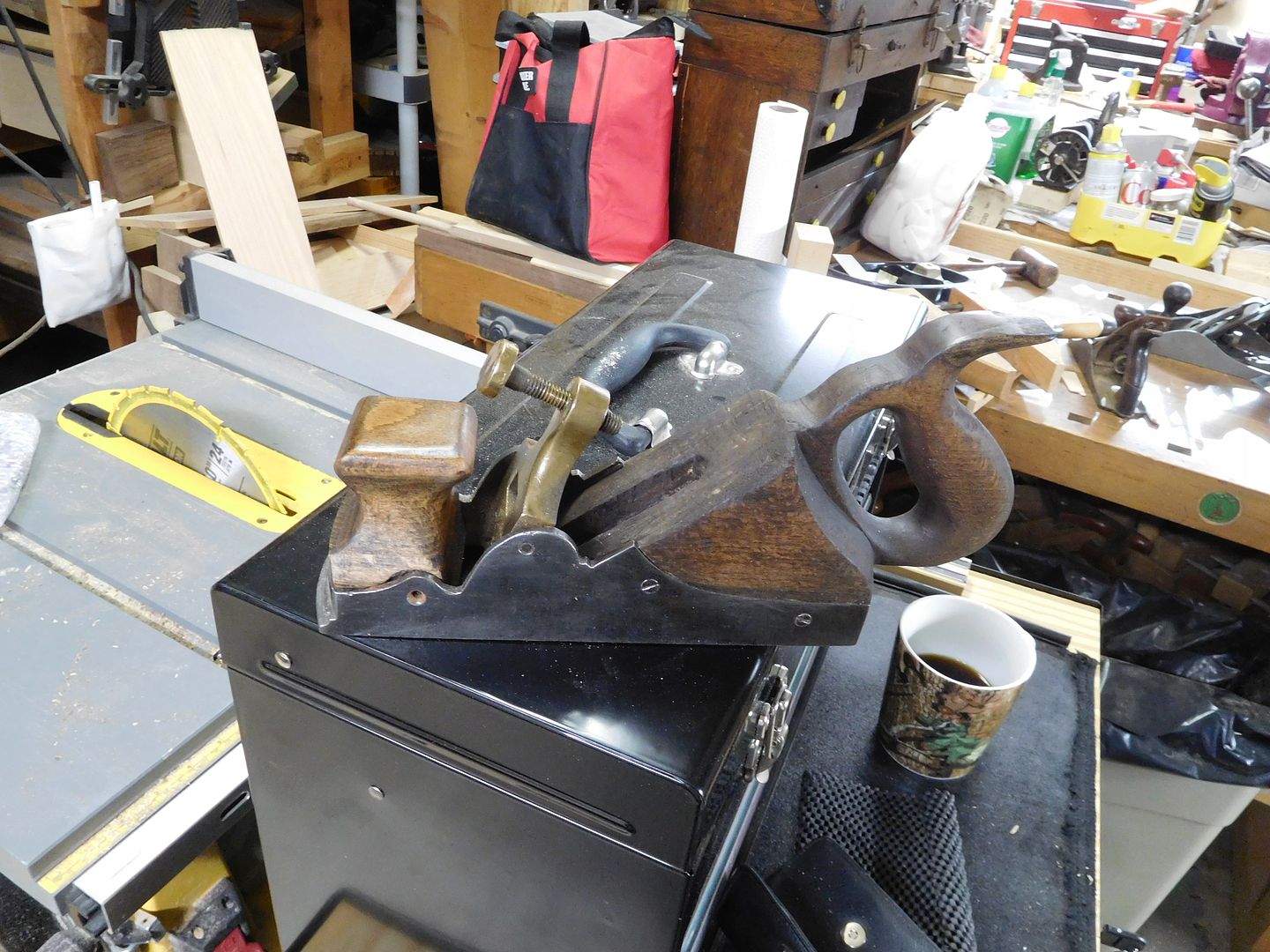
You motivated me to clean up this plane I had rusting on a shelf. I picked it up for $5 a while back. Just needed a bit of cleaning and repainted the handles. If you have a moment, a few tips on setting it up and proper use would be much appreciated!


32089790025_ae5189a521_b.jpg

31941292022_0751f4f479_b.jpg

31248445184_2e61b1ce4d_b.jpg
 
OP
J

jimreed2160

Well-known member
Joined
Aug 7, 2016
Messages
3,589
Location
Tallahassee FL
Mtn--Those newer Stanleys don't get a lot of street cred, but I have found them to be very good users. Here are a few tips:

1. Sharpen the blade so that it will shave hairs off your arm. Flatten the back. Use a 25 degree bevel for pine and other softwoods. Use a 30 degree bevel for hardwoods like walnut, cherry and oak. If you are using it for jointing, then it is ok as is. If you are using it for general use, you should consider feathering the corners to keep them from digging in. Use a gentle touch--a properly feathered corner is hard to see unless you hold the blade on a straightedge.

2. Set the cap iron about 1/16" from the end of the flat side and put the blade assembly in with the bevel down.

3. Adjust the lever cap screw (the one on the frog) just tight enough that you can fasten the lever cap and remove the finger cap using finger strength. It does not have to be hammer tight.

4. Use the lateral adjuster and make sure the blade presents equally on each side. Lower the blade until it hovers above the wood.

5. Put a knot free piece of construction lumber on your bench and dog it down. Run the plane down and move the adjuster wheel to advance the blade. Stop when it pulls up just a whisper of a shaving. Make a few passes to make sure the blade is level. You can lower it a bit if you want but lighter shavings are preferred. Skewing the plane about 10-15 degrees when you use it will make a smoother cut. It will also narrow the cut and make the plane easier to push.

Good luck making shavings.
 
OP
J

jimreed2160

Well-known member
Joined
Aug 7, 2016
Messages
3,589
Location
Tallahassee FL
McB--Thanks for the encouragement. This stuff is not photoshopped or edited. I am trying to keep it real because every operation does not go perfectly and beginning ww need to know how to recover from errors. Over time, recovery is just second nature. Heck, some of my best craftsmanship is fixing my mistakes. :bounce:
 

d.mcfarland

Well-known member
Joined
Jun 18, 2012
Messages
6,566
Location
Western PA
I just covered a project in the Watco spray lacquer. I'm planning on painting using craft paint over top of that. Once I paint, what can I use to cover again? Polyurethane?
 
OP
J

jimreed2160

Well-known member
Joined
Aug 7, 2016
Messages
3,589
Location
Tallahassee FL
I just covered a project in the Watco spray lacquer. I'm planning on painting using craft paint over top of that. Once I paint, what can I use to cover again? Polyurethane?

The chemistry of finishing is not my strong suite, but here is how I would proceed. Lacquer is pretty inert so paint over that should be ok. Check the paint instructions just in case to see if it has any cautions.

Covering paint is a little different. Check the paint instructions to see what you can cover it with. I like to stay in the same family of products--ie, Rustoleum clear over Rustoleum paint.

As a last resort, paint a chip and then clear coat it as planned. If it is going south, you should see some reaction.

Good luck with your project. Be sure to post some pictures for us.
 

Zeke

Well-known member
Joined
Aug 13, 2009
Messages
17,176
Location
Long Beach CA, the sewer by the sea.
I just covered a project in the Watco spray lacquer. I'm planning on painting using craft paint over top of that. Once I paint, what can I use to cover again? Polyurethane?

Yes that will be fine but it will be yellowish. Look for some water clear finish but not lacquer at this point. Mohawk sells a precatalyzed spray can varnish in WC, me thinks.
 
OP
J

jimreed2160

Well-known member
Joined
Aug 7, 2016
Messages
3,589
Location
Tallahassee FL
Infill knob continued

I learned my lesson using the bandsaw to cut off little chips, so I picked a more appropriate tool for the job.

DSCN1522.jpg


Every woodworker needs a coping saw. When I left home to seek my fortune, I started with a chisel and this coping saw. These saws cut amazingly fast.

Anyway, I sawed off the excess and started the tedious process of shaping.

DSCN1523.jpg


Here is the first trial fit.

DSCN1524.jpg


Looking pretty good.

DSCN1525.jpg


I rubbed it down with mineral spirits so it would not soak up stain. The beech sure is a nice color. Wish I could go natural.

DSCN1527.jpg


Here is a shot of the stain drying.

DSCN1529.jpg


I am glad to see this project moving along.
 

Toolfool

Well-known member
Joined
Aug 22, 2011
Messages
4,982
Location
Tallahassee, FL
McB--Thanks for the encouragement. This stuff is not photoshopped or edited. I am trying to keep it real because every operation does not go perfectly and beginning ww need to know how to recover from errors. Over time, recovery is just second nature. Heck, some of my best craftsmanship is fixing my mistakes. :bounce:

Great point, Jim. Things don't always go as planned, whether it's caused by a mistake or an unforeseen situation. The trick is being able to deal with it and move forward with the job. I have always thought my strongest quality is problem solving. I've been asked many times, "Where did you learn how to do that ?" and my reply is, "Many years of fixing screw-ups, mine and the guy who was here before me."
 

drivesitfar

Well-known member
Joined
Oct 23, 2013
Messages
36,007
Location
Pacific Northwest
JIM: in the past before this thread started a month ago i might have reached for another piece of wood instead of knowing i could fix an accident, blunder or wrong cut. thanks for the details on a great fix.

ALL: another GJ member just posted this lamination video over on my chair thread and even though i don't have time to make my chair out of this for my daughter's wedding i would like to make something out of my white oak 4x4's so i'll be on the lookout for a nice BIG BANDSAW now.


cheers
 
OP
J

jimreed2160

Well-known member
Joined
Aug 7, 2016
Messages
3,589
Location
Tallahassee FL
Stanley #77 Rod and Dowel Machine

There was a day when any self respecting woodworker got up in the morning with dowels on his brain. Yes, those little round sticks were held in high regard by joiners and other wood craftsmen everywhere. Nails were for carpenters, screws were for machinists, and biscuits, well, biscuits were for gravy. Real men used dowels by the yard and loved it.

Fast forward to our current days of Festool dominoes and biscuits and high tech glue where you will be hard pressed to find dowel construction in use. That is too bad because dowels can make strong and lasting joints. They were so popular that Stanley made a machine so the average ww could literally crank out his own. Meet the Stanley model #77 dowel machine. Offered from 1911 -- 1969, the machine had interchangeable dies, allowing it to produce dowels in diameters from 1/4" to 3/4".

DSCN1434.jpg


It shipped with proper mounting holes so the craftsman could mount the machine and use it on a stand or on a workbench as pictured. To make a dowel, the ww needed to prepare square stock exactly 1/8" larger than the required size. Because of the design, this stock could be of infinite length but the most practical working length is about 18-24 inches. The ww first installs the proper die for his desired size and rotates the feed wheel to the appropriate size and locks it into place.

DSCN1437.jpg


DSCN1435.jpg


When in use, the die rotates like a one way pencil sharpener and a single cutter shapes the wood. This action causes a strong rotational force on the square stock and requires the feed stabilizer.

DSCN1436.jpg


This means that the craftsman, or his assistant, needs to turn the crank furiously and get the die up to speed before advancing the wood. What then happens is a marvelous example of Edwardian gizmosity. Square stock is converted to round stock in rapid order.

The shavings don't so much fly as sprinkle to down to the bench.

DSCN1438.jpg


The reward for all of this action is a smooth dowel. Walnut makes an especially fine dowel.

DSCN1439.jpg


These things are still easy enough to find in the wild but chasing down a complete set of cutters will lighten your pockets considerably. WW of the day, like ww of our time, were and are a frugal lot. It turns out that the 3/8" die that the machine shipped with was the most popular size and that suited most users. The smaller 1/4" cutter was popular as were the 1/2" and 3/4" but the intermediate sizes can be difficult to find.

For pure fun in the workshop, this tool cannot be beat. The #77 demonstration is always the highlight of my shop tours. Most people cannot appreciate the scream of a router in action but they can appreciate the whirring of the little #77 as it cranks out a Harry Potter wand. Children especially seem to delight in the gismosity of the contraption. They will fight for the chance to turn the wheel. Grandchildren of almost any age could be enlisted as shop assistants and help a ww turn out several feet of good project rod before they became bored.

Although modern suppliers can furnish dowels in a variety of sizes and woodstocks, it is nice to be able to make your own with wood that you select. The larger sizes are nice for repairing and replacing antique towel rods on vintage furniture like washstands.

If you are looking for fun in the woodshop, get one of these things and crank away.
 

bj383ss

Well-known member
Joined
Sep 29, 2011
Messages
3,166
Location
TX
Jim that is an amazing tool. I had never seen one before. I would love to have one of those for all the dowels I need for model making. I just checked Ebay and the cheapest is over $300. What a cool machine though. Going to keep my eyes open for one now.

Bret
 
OP
J

jimreed2160

Well-known member
Joined
Aug 7, 2016
Messages
3,589
Location
Tallahassee FL
Shorts and cutoffs

No. I am not talking about Daisy Dukes. This is all about woodworking. Every ww should understand what cutoffs and shorts are. Let's start with cutoffs. They can come from a downstream manufacturing process or they can be left overs at the wood seller's shop. Some woods, like walnut, can be sold by the running foot. Maybe a customer bought only six feet of an eight foot board and walnut is too expensive to throw away. Many furniture manufacturers sell cutoffs. Furniture legs are usually 30-36" long. That gives you two legs from an 8ft stick with a nice leftover.

Use your own imagination as to how these things are created. The takeaway is that cutoffs exist and can be the source of great project wood for the ww. Check your local cabinet shops and millwork shops. Check the internet for these bargains.

Shorts
Most hardwood lumber is graded and sold with a 48" minimum length. So what happens to boards that are less than 48"? Why, they are sold as shorts, of course. You cannot build an entertainment center from shorts, but you can build many projects using shorts. Some woodsellers even market shorts. Check around for these bargains.

One day I was prowling the internet and found a bargain from a large woodseller. They were selling cutoffs by the pound!!! And these were really good cutoffs. Some of the boxes were domestic and some were exotics. I jumped on their offer and received six boxes like this one.

DSCN1537.jpg


Notice the weight. It is 69 lbs! The UPS dude almost had a stroke when he had to deliver six of these boxes. It was over 350 lbs of wood!

Here is a peek inside the exotics box. Much of this African hardwood is 8/4.

DSCN1538.jpg


And here is one of the other boxes. The piece on top is heavily figured maple.

DSCN1539.jpg


I have been drawing from this stash for over 20 years and still have about 300 lbs to go. It was one of my best scores ever. Look around and you may find something similar. Volume wood sellers often have lots of little stuff that they would like to get rid of. Be their friend and also help yourself out.
 

drivesitfar

Well-known member
Joined
Oct 23, 2013
Messages
36,007
Location
Pacific Northwest
Jim: i used to save hardwood and rare wood pieces and just ended up having to give them away or burn them cause i never had good projects to use them on. thanks for all the tutorials so i can actually use good scraps now and fix old quality tools.

that dowel turning sort of lathe is another tool i've NEVER SEEN before in the wild or in actual use so thanks again for sharing.

ALL: BJ is getting close to having his 3D router build done so check out his garage thread for updates.
 

Autonomous

Well-known member
Joined
Dec 26, 2015
Messages
66
BJ: That dowel make is a pretty cool tool, and a nice piece of history to own, but I'm betting the garage woodworker could make some fine dowels with a router table and some square cut stock. Just be certain to use push sticks and common safety practices
 

turbowoodworker

Well-known member
Joined
Mar 18, 2012
Messages
3,529
Location
Apex NC
Jim,

I used to love sifting through "shorts" at the Woodworkers' Source in AZ. They considered shorts as 60" or less and were deeply discounted.
My supplier now in NC for some reason has a few shorts but they do not discount them! No help there. Disappointed, because like you say, so many projects can be made with pieces under 48".

While that dowel maker is cool, I have never seen one in the wild. I rarely need long dowel pieces because my projects rarely call for them.
But if you need dowels for plugs in specific species, there are two other ways a ww can make them. The easiest is a plug cutter in a drill press. I use this the most as they are not expensive and come in many sizes and I most often use dowels as plugs or pins in M&T joints of a contrasting wood.

The old school way for longer dowels (under 12 inches) is very simple. You take a square stock and drive it through a piece of metal bar with progressively smaller holes. The bar stock is made by simply drilling several successively smaller holes, which can have a countersink to make the edge sharper. Drive with a mallet and shazaam, there's your dowel. Again this doesn't work for longer stock as you risk breaking it by hammering away. I have seen muzzle loading ramrods made this way from hickory.
 

kwoswalt99

Well-known member
Joined
Oct 24, 2015
Messages
701
Location
Detroit
Jim,

I used to love sifting through "shorts" at the Woodworkers' Source in AZ. They considered shorts as 60" or less and were deeply discounted.
My supplier now in NC for some reason has a few shorts but they do not discount them! No help there. Disappointed, because like you say, so many projects can be made with pieces under 48".

While that dowel maker is cool, I have never seen one in the wild. I rarely need long dowel pieces because my projects rarely call for them.
But if you need dowels for plugs in specific species, there are two other ways a ww can make them. The easiest is a plug cutter in a drill press. I use this the most as they are not expensive and come in many sizes and I most often use dowels as plugs or pins in M&T joints of a contrasting wood.

The old school way for longer dowels (under 12 inches) is very simple. You take a square stock and drive it through a piece of metal bar with progressively smaller holes. The bar stock is made by simply drilling several successively smaller holes, which can have a countersink to make the edge sharper. Drive with a mallet and shazaam, there's your dowel. Again this doesn't work for longer stock as you risk breaking it by hammering away. I have seen muzzle loading ramrods made this way from hickory.

For longer stock, you pull it through.
 

bj383ss

Well-known member
Joined
Sep 29, 2011
Messages
3,166
Location
TX
BJ: That dowel make is a pretty cool tool, and a nice piece of history to own, but I'm betting the garage woodworker could make some fine dowels with a router table and some square cut stock. Just be certain to use push sticks and common safety practices

This is true but doesn't always come out perfectly round. My way of doing right now is on the lathe. It can be a slow process.

Jim,

I used to love sifting through "shorts" at the Woodworkers' Source in AZ. They considered shorts as 60" or less and were deeply discounted.
My supplier now in NC for some reason has a few shorts but they do not discount them! No help there. Disappointed, because like you say, so many projects can be made with pieces under 48".

While that dowel maker is cool, I have never seen one in the wild. I rarely need long dowel pieces because my projects rarely call for them.
But if you need dowels for plugs in specific species, there are two other ways a ww can make them. The easiest is a plug cutter in a drill press. I use this the most as they are not expensive and come in many sizes and I most often use dowels as plugs or pins in M&T joints of a contrasting wood.

The old school way for longer dowels (under 12 inches) is very simple. You take a square stock and drive it through a piece of metal bar with progressively smaller holes. The bar stock is made by simply drilling several successively smaller holes, which can have a countersink to make the edge sharper. Drive with a mallet and shazaam, there's your dowel. Again this doesn't work for longer stock as you risk breaking it by hammering away. I have seen muzzle loading ramrods made this way from hickory.

I have made several different plates in attempt to make smaller dowels. Like 1/8" and smaller for model making. I haven't had much luck. I know Lee Valley sells a dowel maker but it is expensive as well.

I just thought this Stanley tool is much more elegant.

Bret
 
To avoid these ads, REGISTER NOW!
Top Bottom