To avoid these ads, REGISTER NOW!

Woodworking 101--Tools and Tips

To avoid these ads, REGISTER NOW!

R_einan

Well-known member
Joined
Aug 29, 2016
Messages
461
Location
Eastern WA
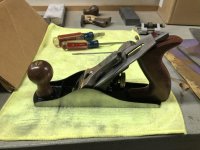
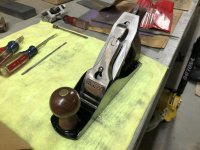
Made some headway on my plane restorations. The new knobs and totes came in and I finished initial flattening if the Stanley no. 3. The Siegley needs some more work before I am ready to spray them and finish polishing the sides and soles. Here are a couple in progress shots of the Stanley.

Well, this project got sidelined for quite awhile, too many other priorities. I finally got the no. 3 coated and reassembled. It’s as perfect as I can really make it.
 

Attachments

  • 2B0954BB-9C58-4F6D-B740-1517377786B6.jpg
    2B0954BB-9C58-4F6D-B740-1517377786B6.jpg
    132.7 KB · Views: 72
  • 1B1E654C-6F8A-43AB-BB59-184F3F3AE257.jpg
    1B1E654C-6F8A-43AB-BB59-184F3F3AE257.jpg
    148.3 KB · Views: 71
  • BD219F98-9381-4EFC-93E5-863F4428995A.jpg
    BD219F98-9381-4EFC-93E5-863F4428995A.jpg
    146.7 KB · Views: 68
  • B8F9189F-A016-47E4-9152-20A96A78FB8B.jpg
    B8F9189F-A016-47E4-9152-20A96A78FB8B.jpg
    87.2 KB · Views: 68

fartymarty

Well-known member
Joined
Nov 9, 2012
Messages
1,348
Location
Fort Worth
Well, this project got sidelined for quite awhile, too many other priorities. I finally got the no. 3 coated and reassembled. It’s as perfect as I can really make it.

That looks great R', but if you really want us to drool :drool: then you need to put a couple of onion skin like shavings along side of it in the photos. :bowdown:
 

Notgrownup

Well-known member
Joined
May 5, 2014
Messages
5,867
Location
Snow Hill NC
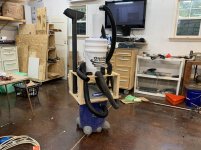
Got me a Dust deputy cyclone dust collection system, you’re supposed to screw it to the side of the shop vac but I didn’t want to drill holes in my shop vac...$99 at woodcraft, I love it..it’s a little top heavy but I know how to handle it.
 

Attachments

  • 167CDB1C-81B6-4070-B8C0-004A81985770.jpg
    167CDB1C-81B6-4070-B8C0-004A81985770.jpg
    154.6 KB · Views: 106

rrich1

Well-known member
Joined
Oct 7, 2015
Messages
793
Got me a Dust deputy cyclone dust collection system, you’re supposed to screw it to the side of the shop vac but I didn’t want to drill holes in my shop vac...$99 at woodcraft, I love it..it’s a little top heavy but I know how to handle it.
When I had mine going (a smaller metal vac) I made it side by side. This cut down on it being too heavy and also allowed it to fit underneath my table saw at the time. b1bfa05a3826203cb079ff8d130725d5.jpg

Sent from my Pixel 3 XL using Tapatalk
 

Attachments

  • b1bfa05a3826203cb079ff8d130725d5.jpg
    b1bfa05a3826203cb079ff8d130725d5.jpg
    526.2 KB · Views: 7

purplezr2

Well-known member
Joined
Jun 1, 2010
Messages
5,292
Location
Central MN
What is everyone using for assembly screws for cabinets etc, if not using pocket screws. I don’t have any local source and need to order online. ***** to not be able to fondle them first.
 

Notgrownup

Well-known member
Joined
May 5, 2014
Messages
5,867
Location
Snow Hill NC
When I had mine going (a smaller metal vac) I made it side by side. This cut down on it being too heavy and also allowed it to fit underneath my table saw at the time. b1bfa05a3826203cb079ff8d130725d5.jpg

Sent from my Pixel 3 XL using Tapatalk

Damnit, I should’ve thought about that, I guess I was concerned about the footprint size...I do have a smaller shop vac...
Thanks for the idea
 

R_einan

Well-known member
Joined
Aug 29, 2016
Messages
461
Location
Eastern WA
What is everyone using for assembly screws for cabinets etc, if not using pocket screws. I don’t have any local source and need to order online. ***** to not be able to fondle them first.

I use GRK or Spax torx drive cabinet screws for the occasional screw. I prefer to design the piece to avoid using fasteners as much as possible though.
 

riceaterSLC

Well-known member
Joined
Jun 23, 2011
Messages
89
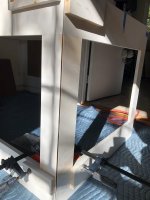
I'm installing wainscoting and have run into an issue with an outside corner miter. Below is the mockup of the two joining panels, they are not yet attached to the wall or pieced together.

I cut the miter using a track saw after than panels were assembled. There is a significant gap down the middle of the miter. I was originally planning on gluing the panels together then attaching to the wall, but I'm not sure my little miter spring clamps have enough pressure to hold the pieces together, or that the glue is even strong enough.

Does anyone have suggestions on how to fix this?
 

Attachments

  • 62353016727__E33150DC-2380-4D34-8353-E501561F4E35.jpg
    62353016727__E33150DC-2380-4D34-8353-E501561F4E35.jpg
    102.4 KB · Views: 136
  • IMG_1630.jpg
    IMG_1630.jpg
    73.1 KB · Views: 124

fartymarty

Well-known member
Joined
Nov 9, 2012
Messages
1,348
Location
Fort Worth
I'm installing wainscoting and have run into an issue with an outside corner miter. Below is the mockup of the two joining panels, they are not yet attached to the wall or pieced together.

I cut the miter using a track saw after than panels were assembled. There is a significant gap down the middle of the miter. I was originally planning on gluing the panels together then attaching to the wall, but I'm not sure my little miter spring clamps have enough pressure to hold the pieces together, or that the glue is even strong enough.

Does anyone have suggestions on how to fix this?

Re-cut the miter properly.

Well yes there is that option....but I think he is trying to save what he has.

I'm no expert woodworker, so I'm just telling you what I would try before starting over. To be clear starting over might be the best option, but it is one I would try to avoid if I could,.... 'cause I'm lazy. I would get a 45 degree chamfer bit on a router table and maybe a strip of tape on the table top near the bit and running parallel to the fence to raise the work up just a bit so that the bit cuts the back of the miter first and just sneak up on it removing a little bit each pass until it fits good (or good enough depending on how particular you are). If you have to "fudge something" (tech term, I like to throw in any response to make me look more knowledgeable) because the piece ends up a little shorter it is easier to hide or disguise it at the inside corner on the left of the first photo. For instance
you may need to add a thin strip of wood glued and sanded flush to the end of the left piece, but it probably wouldn't be noticed in the inside corner after painting.
.....or you could just ...
Re-cut the miter properly.
;):D
 

jh87

Well-known member
Joined
Dec 24, 2011
Messages
155
Location
Indiana
I'm installing wainscoting and have run into an issue with an outside corner miter. Below is the mockup of the two joining panels, they are not yet attached to the wall or pieced together.

I cut the miter using a track saw after than panels were assembled. There is a significant gap down the middle of the miter. I was originally planning on gluing the panels together then attaching to the wall, but I'm not sure my little miter spring clamps have enough pressure to hold the pieces together, or that the glue is even strong enough.

Does anyone have suggestions on how to fix this?

Do you have a biscuit joiner and clamps to go across the joint in both directions? The biscuits would keep the joint from sliding around and provide extra strength the clamps would then pull the joint together.
 

riceaterSLC

Well-known member
Joined
Jun 23, 2011
Messages
89
I'm no expert woodworker, so I'm just telling you what I would try before starting over. To be clear starting over might be the best option, but it is one I would try to avoid if I could,.... 'cause I'm lazy. I would get a 45 degree chamfer bit on a router table and maybe a strip of tape on the table top near the bit and running parallel to the fence to raise the work up just a bit so that the bit cuts the back of the miter first and just sneak up on it removing a little bit each pass until it fits good (or good enough depending on how particular you are). If you have to "fudge something" (tech term, I like to throw in any response to make me look more knowledgeable) because the piece ends up a little shorter it is easier to hide or disguise it at the inside corner on the left of the first photo. For instance
you may need to add a thin strip of wood glued and sanded flush to the end of the left piece, but it probably wouldn't be noticed in the inside corner after painting.
.....or you could just ... ;):D

thank you for the helpful response, i wouldn't have thought about doing it this way. so just to repeat what you said in a different way, "trim" some of the back side of the miter so that the rails line up with the styles? thanks again.
 

riceaterSLC

Well-known member
Joined
Jun 23, 2011
Messages
89
Do you have a biscuit joiner and clamps to go across the joint in both directions? The biscuits would keep the joint from sliding around and provide extra strength the clamps would then pull the joint together.

another great idea, thanks. i have a domino, and about a dozen of the clamps you see in the photo. i didn't think about using the domino, but i could use the smallest dominos and pull that joint closer. do you think the glue would hold that joint closed? thanks again for the tip.
 

jh87

Well-known member
Joined
Dec 24, 2011
Messages
155
Location
Indiana
another great idea, thanks. i have a domino, and about a dozen of the clamps you see in the photo. i didn't think about using the domino, but i could use the smallest dominos and pull that joint closer. do you think the glue would hold that joint closed? thanks again for the tip.

I think the glue would hold, most glues are stronger than the wood itself. If you go this route, it would be a good idea to do a dry run before applying glue. Depending on how large the gap is, the dominos could bottom out in their holes before the joint closes. The clamping pressure needed to close up the gap would give you the best idea if the pieces could be used as is or not. If you’re breaking out in a sweat, gritting your teeth, and grunting trying to pull the joint closed, it’s probably not going to work. Lol
 
To avoid these ads, REGISTER NOW!

jar944

Well-known member
Joined
Jul 26, 2010
Messages
5,905
Location
Northern VA
I would remake the corner with the stiles full length and either miterfold or lockmiter then add the rails afterwards.

Alternatively just see if tape in a miterfold setup would pull that corner together. I'm assuming the wood has a bow if it's that far off and you used a track saw.
 

riceaterSLC

Well-known member
Joined
Jun 23, 2011
Messages
89
I think the glue would hold, most glues are stronger than the wood itself. If you go this route, it would be a good idea to do a dry run before applying glue. Depending on how large the gap is, the dominos could bottom out in their holes before the joint closes. The clamping pressure needed to close up the gap would give you the best idea if the pieces could be used as is or not. If you’re breaking out in a sweat, gritting your teeth, and grunting trying to pull the joint closed, it’s probably not going to work. Lol

i have tons of scrap from other mistakes :D do workworking they said. it'll be fun they said.

I would remake the corner with the stiles full length and either miterfold or lockmiter then add the rails afterwards.

Alternatively just see if tape in a miterfold setup would pull that corner together. I'm assuming the wood has a bow if it's that far off and you used a track saw.

this may be what i do. yes, the face of the style is slightly bowed out from the rail, causing the gap. just googled miterfold and makes a lot of sense for this application. i have a 1x2 that'll cap the wainscot panel so the full length style seam won't even show. thanks for the tip!:beer:
 

fartymarty

Well-known member
Joined
Nov 9, 2012
Messages
1,348
Location
Fort Worth
yes, the face of the style is slightly bowed out from the rail, causing the gap. just googled miterfold and makes a lot of sense for this application. i have a 1x2 that'll cap the wainscot panel so the full length style seam won't even show. thanks for the tip!:beer:

In my initial response I had assumed that the gap was because the miter wasn't cut right and that it was hitting in the back and not that it was caused by the wood bowing. Looking closer at the photograph I can see light coming through so I guess that rules out the miter hitting in the back of the joint. If that is the case and it is just the wood bowing then perhaps you could cut some blocking (corner blocks) to back up the joint to hold it together when glued and clamped. Then notch out the (probably never to be seen again) drywall behind it for clearance.
 
Last edited:

Ray-CA

Well-known member
Joined
Jan 6, 2007
Messages
3,451
Location
San Diego CA
I just bought a set of 45-degree lock miter joint router bits. Anyone have an easy or best way to adjust and set these up for use?

Thanks,

Ray
 

Git

Well-known member
Joined
May 18, 2008
Messages
6,894
Location
S Cal
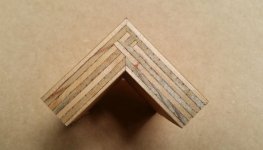
Lock Miters are pretty easy once you understand them. There are two adjustments, the height of the bit and where to position the fence.

Bit height is usually done first. You have two options, you can just eyeball it and try to align the boards you are working with so that the center of the board is pretty much centered on the two horizontal flats of the bit. This should get you close but is going to require making a bunch of test cuts. Roughly set your fence, mark UP on one of the boards and run both pieces through the cutter on the table, not up against the fence. Place the boards on a flat surface so the joint interlock, with the UP board UP and feel how flat/level the top of the two boards are. If the UP board is higher than the other board, raise the cutter up. If it is lower, lower the cutter. Rinse and repeat until they are both level

Fence Position - first make sure the fence is flat across and then place one of your boards up against the fence on edge. Take a straight edge, place it against the board and slowly move the fence in until the straight edge is just touching the cutter and then back it off just a hair. There is a relationship between the cutter height and fence position. If you raise or lower the cutter, the fence needs to be adjusted

attachment.php


The second way to find the proper bit height involves a little measuring and some math, but you only have to do it once, and it will help you quickly get real close no matter what thickness the wood your working with. You will need some sort of digital measuring device to measure how high your router bit is above the table

Basically, you want the center of the router bit to be at the same height as the center of the board you working with. The center of a 3/4" board is going to be around .375".

To find the center of your router bit, mount it in your router table and you want to measure the distance up to the two horizontal flats of the bit. The center of the bit is going to be between those two surfaces, so subtract the lower measurement from the higher measurement and then divide by two. This number is going to be what I call the 'offset'. I add that number to the center of the board number and that will give me the height that the top of the top cutter needs to be to align that cutter with the center of the board.

Sounds complicated but it really isn't. I drew up this diagram a while ago which may help you visualize it better. So this is for my Bosch bit, and I now know that the offset for this bit is .177". So All I have to do now is measure the thickness of my board, find the center and then add .177" to it which will be the height of the top of the top cutter.


In this diagram, on the right is a 3/4" board and you can see why you need to align the center of the board with the center of the bit and the math to do it

attachment.php


This is 3/4" MDO plywood
attachment.php
 

Attachments

  • Tri -  1241.jpg
    Tri - 1241.jpg
    99.6 KB · Views: 83
  • Tri -  1243.jpg
    Tri - 1243.jpg
    84.4 KB · Views: 743
  • Diagram.jpg
    Diagram.jpg
    92.2 KB · Views: 755
  • Tri -  1240.jpg
    Tri - 1240.jpg
    96.6 KB · Views: 73
  • Tri -  1244.jpg
    Tri - 1244.jpg
    128.9 KB · Views: 743

turbowoodworker

Well-known member
Joined
Mar 18, 2012
Messages
3,522
Location
Apex NC
I agree, good post. One tip I have found useful for lock miters as well as cope and stick paired bit sets. Once you have them set up perfectly, save your last test piece as a template for future setups. I keep them with the bits. Of course this only works if the materials are of identical thickness.
Thanks, Git, for posting.
 

rrich1

Well-known member
Joined
Oct 7, 2015
Messages
793
Got back to the chest of drawers. The drawer joinery is a half lap dovetail. Simple setup on the router table. First time using it. That part went fine. I then messed up on the spacing for the bottom. It was supposed to be 1/2" from the bottom but I made it 1/4". Luckily I had scraps left over from getting the drawers to fit. I refined the thickness on the drum sander. Cut the height down in half on the band saw and glued in the pieces to fill the dado. About a minute per piece to flush them up with a hand plane. I then recut the dado at the correct height. Dumb mistake that was easy to fix but took time to do. 65c531358a8e717d9c014f0760a4cbeb.jpg13abbbc030cb2b4e99db97ccb778c4e7.jpgfbbfd5e969e2e6c3e559a560a3c85593.jpgdc5b6723f16f710d6ab54bfe0a54480b.jpga3005222bcb100a40fa747d7d688a466.jpgc18a871d198b1ca6fc656c1372d9b17a.jpg

Sent from my Pixel 3 XL using Tapatalk
 

Attachments

  • c18a871d198b1ca6fc656c1372d9b17a.jpg
    c18a871d198b1ca6fc656c1372d9b17a.jpg
    472.6 KB · Views: 3
  • a3005222bcb100a40fa747d7d688a466.jpg
    a3005222bcb100a40fa747d7d688a466.jpg
    700.4 KB · Views: 3
  • dc5b6723f16f710d6ab54bfe0a54480b.jpg
    dc5b6723f16f710d6ab54bfe0a54480b.jpg
    507.9 KB · Views: 2
  • fbbfd5e969e2e6c3e559a560a3c85593.jpg
    fbbfd5e969e2e6c3e559a560a3c85593.jpg
    438.6 KB · Views: 2
  • 13abbbc030cb2b4e99db97ccb778c4e7.jpg
    13abbbc030cb2b4e99db97ccb778c4e7.jpg
    475 KB · Views: 1
  • 65c531358a8e717d9c014f0760a4cbeb.jpg
    65c531358a8e717d9c014f0760a4cbeb.jpg
    443.2 KB · Views: 1

pkpk

Well-known member
Joined
Aug 29, 2020
Messages
64
Location
Midwest
Hi all, happy I found this thread, I've already learned plenty just browsing through older posts here. And don't think the username means I'm any sort of pro... I am not!! Lol.

Does anyone have experience using heat lamps or small fan/heaters to help with staining and finishing in cold weather? Winter is creeping in here in Indiana and in my current living situation, my 'workshop' is an uninsulated garage. I'd like to do smaller projects like bandsaw boxes, some shelves and small end tables etc, using mostly oil-based stain (I've got some fast-dry types that are supposed to dry in an hour) and for finish (which I'm also pretty new at) I have Minwax polyurethane (and mineral spirits if a wipe-on mix works better?) and spray lacquer. Something that I could just put on a table and point at the project would be great...

From anyone who's done this, any advice, warnings and especially heat lamp recommendations would be much appreciated!
 

jar944

Well-known member
Joined
Jul 26, 2010
Messages
5,905
Location
Northern VA
Hi all, happy I found this thread, I've already learned plenty just browsing through older posts here. And don't think the username means I'm any sort of pro... I am not!! Lol.

Does anyone have experience using heat lamps or small fan/heaters to help with staining and finishing in cold weather? Winter is creeping in here in Indiana and in my current living situation, my 'workshop' is an uninsulated garage. I'd like to do smaller projects like bandsaw boxes, some shelves and small end tables etc, using mostly oil-based stain (I've got some fast-dry types that are supposed to dry in an hour) and for finish (which I'm also pretty new at) I have Minwax polyurethane (and mineral spirits if a wipe-on mix works better?) and spray lacquer. Something that I could just put on a table and point at the project would be great...

From anyone who's done this, any advice, warnings and especially heat lamp recommendations would be much appreciated!

I occasionally run a propane heater in my shop if it gets cold enough (but thats mostly for glue ups) ill spray lacquer down to the he high 30s/low 40s

I'd be very leery of hear lamps for fear of isolated overheating of the finish. Can you just bring the piece inside after finishing to dry?
 

topcok88

Well-known member
Joined
Jun 3, 2013
Messages
660
Its just azek pvc glue


You are giving my inspiration to wrap the columns on my porch. We currently have some ugly cylinders and would like to have square posts. Might have to try this technique.


Sent from my iPhone using Tapatalk
 

topcok88

Well-known member
Joined
Jun 3, 2013
Messages
660
Everyone here looks like they are making progress in the shop. I just want to get back to working in the shop. Still working on trim work and will be happy when this is done. Lots of miters... a711c2fae5624656f0f67f829efd8def.jpg
1e18395994dcc1a47eed619f24922843.jpg


Sent from my iPhone using Tapatalk
 

Attachments

  • a711c2fae5624656f0f67f829efd8def.jpg
    a711c2fae5624656f0f67f829efd8def.jpg
    56.7 KB · Views: 1
  • 1e18395994dcc1a47eed619f24922843.jpg
    1e18395994dcc1a47eed619f24922843.jpg
    69.6 KB · Views: 4
To avoid these ads, REGISTER NOW!
Top Bottom