To avoid these ads, REGISTER NOW!

Woodworking 101--Tools and Tips

56vette461

Well-known member
Joined
Jan 13, 2013
Messages
492
Location
Northern California
Hi guys,
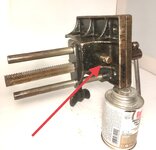
Its been a really long time since I posted here but I ran across a very unusual corner clamp or corner vise yesterday so I brought it home.

6 inches across the top and 4 inches down
It has a quick release function and now that I’ve cleaned and oiled it, it runs smoothly except that there seems to be no provision to tighten the front jaw once it is slid up snug to the workpiece. The front handle certainly seems like it should rotate to tighten things up but it doesn’t rotate at all.

I put an arrow into one of the pics to show the ratchet release pin. I bet there was originally some kind of handle attached to this pin. See the little hole near the end?

Have any of you guys ever seen or heard of this?

Maybe my vise is just broken. 😞

There are no maker marks on it except for a small “no. 800” stamped into the nose of the front handle.

I also posted in the main vise thread where I am the most active here on GJ. Here is a link.


AD13ABC3-B0B6-44ED-B540-35C992CF7169.jpegBAA19E70-E120-4D00-AB61-C55C69F7A6EE.jpeg2866C471-5C72-484E-A2EA-F87F8273ECFB.jpeg
One of the many uses was for the set up and preparation and cutting of door hinges and planning the door to finish width for the jamb. When mounted on a 2x6 topped saw horse the vice provided a steady rest for the work. Usually the carpenter would install a set of ell shaped hardwood inserts that clamped onto the door skin to prevent damage. The insets were usually made of birch hardwood. The door would be on edge on the floor with the top or bottom edge held in the vice jaws. In the days before power routers hinge insets were cut with chisels.
 
To avoid these ads, REGISTER NOW!

CRSINMICH

Well-known member
Joined
Aug 15, 2015
Messages
2,397
Location
Southeastern Michigan
Thanks for the input!

That would make sense for the metric vs imperial. So I won't be able to make a centered 3/8 Tenon style sash with this bit set, but could do an offset 3/8 tenon? I'm having a hard time thinking about how that would work. Seems I would have to cut 3/8 on the shallower side of the tenon, which would interfere with the moulding/rabbeting bit.
On a slightly different note, do you have any recommendations on sources I can do some more reading/learning about millwork and stuff like this? This is definitely not going to be the last project like this, and I am not too bright on some of this stuff, as you can tell.
It is hard to get your mind around interconnected parts that require a fair amount of precision. The intricacies are enough to throw you off. There should be plenty of resources online. One thing I would add to my previous recommendation about set-up blocks is to use backer blocks when you are routing the profiles. They help limit tear out.
 

seber

Well-known member
Joined
May 31, 2016
Messages
4,195
Location
Deep East Tx.
When I worked as a carpenter we had one of these for general use on the job site. Just a wood vise clamped to a saw horse. I never used one for a door but I suppose that might be a way to go. We just held the door between our legs to work on them.
 

jar944

Well-known member
Joined
Jul 26, 2010
Messages
5,908
Location
Northern VA
On a slightly different note, do you have any recommendations on sources I can do some more reading/learning about millwork and stuff like this? This is definitely not going to be the last project like this, and I am not too bright on some of this stuff, as you can tell.

What sort of millwork are you looking for information about? Then what sort of tooling do you have / plan to have. If you can get bu with just sectional drawings there are a few different options still in print (William a Radford, old house measured drawings) is good.
IMG_20180308_170038_711.jpg
20220113_173940.jpgIMG_20180308_170038_698.jpg

Ouy of print but possibly better is Clarence Martin's details of building construction
IMG_20211116_113825_488.jpgIMG_20211116_113825_511.jpgIMG_20211116_113825_590.jpgIMG_20211116_113825_655.jpgIMG_20211116_113825_716.jpg

Then there are the process books (to include George Ellis's fantastic modern practical joinery from 1905)
20220127_083257.jpg


If you meant more trim carpentry go to contractor talk and the finish carpentry forum. Read everything Justin Huisenga posted. The forum is basically dead but the content is still there. Alternatively just watch insider carpentry on YouTube, Spencer picked up a lot of that from Justin.
 
Last edited:

fartymarty

Well-known member
Joined
Nov 9, 2012
Messages
1,348
Location
Fort Worth
This is definitely not going to be the last project like this, and I am not too bright on some of this stuff, as you can tell.
Don't sell yourself short, you are way out ahead of me, and probably many others here that worry more about their online rep than I do mine.

Good for you and keep working at it. (y)
 

Woody1320

Well-known member
Joined
Sep 27, 2017
Messages
164
Location
Southeast Michigan
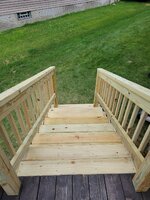
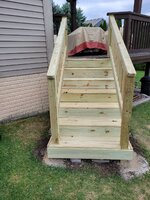
Well, finished both sets of deck stairs. It took just shy of three weeks from initial purchase of lumber to completion. It was a tough project, but I learned a ton along the way (and had some fun). The first set (with both handrails) taught me a ton. And I made adjustments for the second set. I also used a ton of tools in my arsenal, and they worked flawlessly. Saved a big hunk of change by doing it myself, which is doubly satisfying.
 

Attachments

  • 20220725_191040.jpg
    20220725_191040.jpg
    585.4 KB · Views: 34
  • 20220725_191056.jpg
    20220725_191056.jpg
    431.9 KB · Views: 31
  • 20220717_145616.jpg
    20220717_145616.jpg
    579.7 KB · Views: 31
  • 20220717_145709.jpg
    20220717_145709.jpg
    555.4 KB · Views: 31
  • 20220717_145604.jpg
    20220717_145604.jpg
    536.2 KB · Views: 30
  • 20220717_145556.jpg
    20220717_145556.jpg
    530.9 KB · Views: 35

HenryAZ

MEMBER EMERITUS
Joined
Sep 18, 2012
Messages
1,054
Location
South Congress AZ
What sort of millwork are you looking for information about?
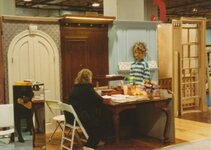
From times past, a picture of a one-off project I made for a home show at the DC Convention Center. On the right side of the picture is a bowed, triple hung window made of white ash. All three sash bypass each other. The glass is flat. We did not get any orders for that particular window, but we did get quite a few builder orders for (non-bowed) triple hung units.

HomeShow.jpg
 

bdbecker

ALLIANCE MEMBER
Joined
Nov 18, 2015
Messages
5,556
Location
Iowa
I posted this in the deals thread, but also figured this group might be interested... Lost Art Press is running a sale right now. The Anarchist series is included on the sale at a nice discount.


HenryAZ

MEMBER EMERITUS
Joined
Sep 18, 2012
Messages
1,054
Location
South Congress AZ
WEST epoxy laminated 1/16+" thick x 5" wide teak trim for a new head sink counter in my boat. Bend radius 6-5/8". Bending jig laminated from mostly 3/4" plywood using Titebond and staples.

IMG-1510.jpg
That reminds me of my experience bending helical staircase handrails. We would build a half drum, the radius being that of the rail/staircase, and the length being the floor-to-floor height. The drum consisted of plywood pieces cut to the radius, then slats screwed to the plywood forms lengthwise, leaving room between the slats for clamps. Then then rail was laminated from one corner to the opposite corner, across the drum. Afterwards, band sawing to size and profile working on the shaper. It has to be bent across the correct diagonal, to make it either a right-hand or left-hand helical rail.
 

turbowoodworker

Well-known member
Joined
Mar 18, 2012
Messages
3,529
Location
Apex NC
EZ, great job on that bending jig. I’ve seen that done over and over in Finewoodworking mag but never seen it done “in the wild”. I’ve always figured you know what you’re doing. Now there’s no doubt about. Great job. Would love to see some pics out of the jig and finished project. Rick
 

ez-duzit

Well-known member
Joined
Jun 24, 2013
Messages
5,096
Location
Marina del Rey
Fabricated and Formica'd the top and bottom of the sink counter assembly; cutout the sink hole. Then epoxied some glue blocks for attaching the teak edging. Carefully removed the teak edging from the bending form, surfaced its edges and sanded the excess epoxy.

IMG-1514.jpg
IMG-1515-1.jpg
IMG-1517.jpg
 

ez-duzit

Well-known member
Joined
Jun 24, 2013
Messages
5,096
Location
Marina del Rey
Because of work I only had time to shape the glue blocks and the top of the edge trim, and epoxy that to the counter top. There are no fasteners--only glue, which takes hours to cure. So the process cannot be rushed. The assembly will later be scribed in place, so the trim has been left long. The glue blocks were also left untrimmed (inside the sink cutout) to retain shape while gluing.


IMG-1519.jpg
 
To avoid these ads, REGISTER NOW!

RickP

Well-known member
Joined
Jan 15, 2013
Messages
1,549
Location
Annapolis, MD
After work today I fitted and glued up the bottom. I know. Pretty boring stuff. :)

IMG-1522-1.jpg
I'm really liking the photos of each step. Way beyond my skill level, but I've worked with West System enough to understand how you're fabricating it. But it looks like that beautiful curved teak will be hidden inside the cabinet under the sink?
 
Last edited:

ez-duzit

Well-known member
Joined
Jun 24, 2013
Messages
5,096
Location
Marina del Rey
R--thank you. The assembly shown (it is upside down in the last photo) will have a plain china bowl installed, and will sit on top of a lower cabinet which has a smaller footprint. So the entire teak edging will be exposed.
 

ez-duzit

Well-known member
Joined
Jun 24, 2013
Messages
5,096
Location
Marina del Rey
The teak will get satin varnish.

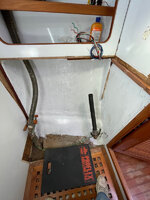
Here is a photo looking outboard at the area in which the sink/counter will be mounted. At the top you see the existing "medicine cabinet". Below this you are looking at the inside of the hull. To the right, you can see where the old sink/counter/cabinet has been removed. At the very bottom, to the left, was a platform on which the marine head (toilet) had been mounted. This was badly delaminated due to the presence of water from leaking plumbing, so will be replaced with a new platform.

The black hose on the right is the sink drain overboard through a bronze sea **** (valve). The black hose on the left is a water tank deck fill.

IMG-1525.jpg
 

RickP

Well-known member
Joined
Jan 15, 2013
Messages
1,549
Location
Annapolis, MD
R--thank you. The assembly shown (it is upside down in the last photo) will have a plain china bowl installed, and will sit on top of a lower cabinet which has a smaller footprint. So the entire teak edging will be exposed.
Gotcha -- now it makes sense. Thanks for the explanation.

Here is a photo looking outboard at the area in which the sink/counter will be mounted. At the top you see the existing "medicine cabinet". Below this you are looking at the inside of the hull. To the right, you can see where the old sink/counter/cabinet has been removed. At the very bottom, to the left, was a platform on which the marine head (toilet) had been mounted. This was badly delaminated due to the presence of water from leaking plumbing, so will be replaced with a new platform.
Isn't it amazing how much can be fit into such a small space on a boat? No wonder you're so good at custom cabinetry.

That curved teak looks really good -- it should be amazing once it's installed with the cabinet.
 

ez-duzit

Well-known member
Joined
Jun 24, 2013
Messages
5,096
Location
Marina del Rey
R--thank you.

After work today I removed the old counter support and installed (3) new cleats against which the new counter and cabinet will mount. Letting the epoxy glue cure overnight before making the pattern for the cabinet face.

IMG-1527-1.jpg
 

ez-duzit

Well-known member
Joined
Jun 24, 2013
Messages
5,096
Location
Marina del Rey
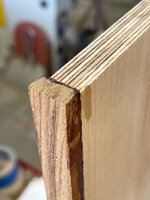
Next I made a pattern for the outboard cabinet face by hot-gluing door skin strips against the recently installed cleats. This allowed me to fabricate the 1/2" Baltic birch cabinet face in the shop. Making an allowance for the 1/4" x 1/2" solid teak edge banding, I cutout the door opening and made the door from this cutout piece.

Then the edge banding was epoxy-glued using 18-gauge brads to hold it in place.

Note: this cabinet face needs to be in place before the sink counter can be scribed and installed. The door in that face will serve as counter space when in the horizontal (open) position, as the sink "counter" is only large enough to mount the sink, faucet and soap dispenser.

IMG-1532.jpg
IMG-1529.jpg
IMG-1530.jpg
IMG-1531.jpg
IMG-1533.jpg
 

turbowoodworker

Well-known member
Joined
Mar 18, 2012
Messages
3,529
Location
Apex NC
Working in a boat and in a shop, different locations must pose interesting problems. I sometimes find myself running up and down stairs, to and from the shop retaking measurements or trimming, etc. Nice to see how you do it and do it smart.
Rick
 

ez-duzit

Well-known member
Joined
Jun 24, 2013
Messages
5,096
Location
Marina del Rey
t--thank you.

Today I trimmed the edge banding. This involved planing with a low angle block plane. Then block sanding flush with 60-grit. Also fitted the door to the opening and Formica'd one side of the door and ran out of Formica.

IMG-1536.jpg
IMG-1535.jpg
 

HenryAZ

MEMBER EMERITUS
Joined
Sep 18, 2012
Messages
1,054
Location
South Congress AZ
Today I trimmed the edge banding. This involved planing with a low angle block plane. Then block sanding flush with 60-grit.
I used to use a carbide 1" flush trimming router bit. It had a ball bearing on the end to control the depth of cut, leaving the edge banding about 1/32" proud for final sanding. The only caveat is grain direction. If you are going the "wrong" way, making several plunge cuts ahead keeps the grain from tearing out.
 

ez-duzit

Well-known member
Joined
Jun 24, 2013
Messages
5,096
Location
Marina del Rey
Formica'd the outboard cabinet panel and the other side of the door. The Formica does not run completely across the panel as that part will be hidden inside the back of the sink cabinet (and I was able to use an offcut). Using power plane, roughing plane and belt sander I relieved the backside bottom of the panel where it has to fit close to the hull. Further fitting will likely be necessary at the boat.

Trimmed the top of the door for hinge allowance and cut its ventilation slots by raising the table saw blade up into it. The protective film on the gloss Formica makes the cuts look ragged. This film won't be removed until final installation.

The Grohe soap dispenser came in, so I fitted that to the sink/counter assembly.

IMG-1542.jpg
IMG-1540.jpg
IMG-1541.jpg
IMG-1544.jpg
IMG-1545.jpg
IMG-1546.jpg
IMG-1543.jpg
 

RickP

Well-known member
Joined
Jan 15, 2013
Messages
1,549
Location
Annapolis, MD
The Grohe soap dispenser came in, so I fitted that to the sink/counter assembly.

IMG-1542.jpg
That cabinet is looking good. The team around the sink turned out really nice.

Those compound curves seem difficult to scribe perfectly against the hull.
WIll you caulk or install a small piece of trim over any small gaps at the edge?
 

ez-duzit

Well-known member
Joined
Jun 24, 2013
Messages
5,096
Location
Marina del Rey
That cabinet is looking good. The team around the sink turned out really nice.

Those compound curves seem difficult to scribe perfectly against the hull.
WIll you caulk or install a small piece of trim over any small gaps at the edge?
Thank you. There will be other pieces added after that panel is installed.
 

ez-duzit

Well-known member
Joined
Jun 24, 2013
Messages
5,096
Location
Marina del Rey
Work this week prevented me from making progress until today--got a little done. The existing upper cabinet has some twist in it; this became apparent when I did the dry fit of the lower panel. So I packed out the angled cleat on the right to be coplanar with the cleat on the left; just set a wedge in thickened epoxy and taped it to keep it from sliding while the epoxy cured. The positions of these cleats had been determined by simply extending a line from the upper cabinet face.

Installed a cleat to support the top of the lower panel. This is screwed and epoxied to the bottom of the upper cabinet.

Also did a rough sanding on the inner part of the hull. And repaired the aft bulkhead using epoxy filler so it will be ready to paint prior to installing the panel, as it would be virtually impossible to paint after installation.

IMG-1560.jpg
IMG-1561.jpg
 

RickP

Well-known member
Joined
Jan 15, 2013
Messages
1,549
Location
Annapolis, MD
On man, whenever I use that 5200 adhesive, it always ends up as a ****** mess all over my tools, hands, and the hull. It even seems to end up worse if I wear gloves. Your's actually looks pretty good!
 

ez-duzit

Well-known member
Joined
Jun 24, 2013
Messages
5,096
Location
Marina del Rey
On man, whenever I use that 5200 adhesive, it always ends up as a ****** mess all over my tools, hands, and the hull. It even seems to end up worse if I wear gloves. Your's actually looks pretty good!
Thanks. One of the difficulties when working with 5200 is that it really is too rnny--it sags badly. So there is a fine line when it comes to how much to apply. You don't want any voids, but the squeeze-out must be dealt with immediately. This is done with a putty knife, or similar device, and bits of paper towel. Though I didn't do it here, it is often helpful to mask the surfaces adjacent to the joint to minimize contamination (the Formica still has its protective film in place). The extra work is offset by excellent bonding characteristics.

Because the panel was pre-Formica'd, I could only install a few fasteners (primarily to locate the panel) where they would not show when the rest of the components have been installed. So I used a couple clamps to help hold the glue joints together.
 
To avoid these ads, REGISTER NOW!
Top Bottom