Dakotadadv8
Well-known member
- Joined
- May 30, 2021
- Messages
- 1,519
OP you may want to outsource the job. Good to have a good electrician in your network.

Can you run the conduit straight into the back of the generator inlet?conduit - OK I am planning on using two conduit bodies - one on each side of the wall with the back side protrusion going into the wall and a piece of 1/2 conduit connecting them. Does that make sense/is it legal? I would likely put some sealant on the back side to prevent water intrusion. If that works then all I need is an 1-1/8 masonary bit - yikes they are expensive
Rick
conduit - OK I am planning on using two conduit bodies - one on each side of the wall with the back side protrusion going into the wall and a piece of 1/2 conduit connecting them. Does that make sense/is it legal? I would likely put some sealant on the back side to prevent water intrusion. If that works then all I need is an 1-1/8 masonary bit - yikes they are expensive
Rick

Here is all you need to know about generator floating grounds and neutrals……… Take notes!Larry - I certainly appreciate your research and the time it took but I gotta say I don't get it.
Can you talk more about the "floating neutral" - not sure what that is and how it might affect me in terms of hook up.
I mostly understand the 120/240 volt selection. For my education -
1. if the selector switch is inadvertently left on 120 then the panel would receive only 120 and only one side of the panel would be active?
2. With the selector on 240 would the other 120 outlets on the generator also be active?
Rick
Is the open knock out on the bottom? If so, I'd just use a regular pop in cover. If on the side, I'd seal ithere is the prototype conduit run - everything is rough sized right now
Thanks to Dave this got a bit easier by using the back of the enclosure for the conduit entry. Now I have an open knock out - being an exterior application do I need a sealing cover or will a standard cover work.

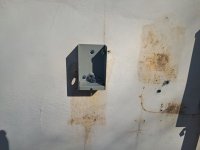
My local Home Depot does not sell 10ga by the foot. But they do sell 8gauge by the foot. So that's what I'd end up using.I was going to stop for today but decided to get back at it. I got everything cut to size and mounted inside and out - nothing glued yet. Also got the 30 amp breaker installed
Things left to do
1. Order wire any suggestions for wire by the foot in 4 colors?
2. Seal and glue conduit connections
3. Clean up all the junk from the outside coax cable / telephone wire removal
4. Fill unused holes in foundation wall
5. Install interlock when received
6. run wire and connect to panel and inlet receptacle
7. round up all the tools and put them away
Probably more I'm not thinking about
Show us the final. They'll let you know. There is no harder inspection to pass than the GJ electrical inspection. Seriously.What am I doing that's not to code?
That's fine.. If you want to be a little more cautious:the final test is does it work - IOW does the generator power the panel. My plan unless someone says NOPE)
1. turn main off
2, turn generator breaker on
2A. Turn all 240 circuits off
3. plug cord into generator
4. plug cord into inlet
5. turn generator on
6. check panel circuits to see if powered
Thoughts?
This.Do not start or stop the gen with the loads connected. Make sure they only see full voltage and 60hz.
Make sure the circuits are open before power up or power down. Most easily accomplished at the gen cb or interlock cb.
OP has NO 240V loads. Turning all circuit off before switching to generator power and then turning them back on afterwards is OPTIONAL. I would not worry about it, unless he has 4 or 5 refrigerators/freezers !Unless you have a very large generator you will want to turn on circuits one by one once the generator is online. The inrush of everything coming up at once is likely too much for the generator and it will trip.
#2A is not required, even if you have a 120V generator with L1 and L2 shorted together. (A 240V load would actually "see" 0V when L1 and L2 are shorted)1. turn main off
2, turn generator breaker on
2A. Turn all 240 circuits off
3. plug cord into generator
4. plug cord into inlet
5. turn generator on
6. check panel circuits to see if powered
The 20k Generac that I have, it's got a build-in spool up period at the ATS. I have thrown 120V loads on 3000-5000 watt gens, but it's best to get them up warmed up. If not, they bog, then go over RPM, but I've never had one trip. Once they are warm, throw the load at 'em!Unless you have a very large generator you will want to turn on circuits one by one once the generator is online. The inrush of everything coming up at once is likely too much for the generator and it will trip.
That's what I was thinking - my first focus will be the new wiring and its correctness. I think dcg9381 covered that pretty well but I will have a few questions.There's 3 different procedures needing to be ironed out.
dcg9381 is discussing first time commissioning.
Then there is the routine "day - day" switch over procedure as modified by the Wiz in post 258.
Also should have a procedure for switching back to grid power, cooling down/packing up/storing gen.
On my current and prior inverters, the only breaker I turn off before flipping on the interlocked one is the HVAC system that doesn't have a soft start since I can't run it anyway. Otherwise everything is left on. Can't think of anything high draw that would immediately activate anyway. And since the power would be out when switching to the generator, there would be no load.Inverter gen? Throw whatever at them whenever.. Frequency (RPM) don't matter.

CorrectNot much time today for this project but wanted to verify That I understood dcg9381's main breaker check and that the points for checking were correct.
2) Verify no power L1 / N, L2 /N, L1/L2
With the breaker ON I checked L1 to Neutral (120), L2 to neutral (120) and L1 to L2 (240).
If I turn main breaker OFF I should get zero at all three points (if they are the right points and I believe they are)
Rick
The proposed check is to execute detailed sequential steps, that if each step passes, the certainty of everything being correct when finally energized is 99.99% certain to give the intended results.Not much time today for this project but wanted to verify That I understood dcg9381's main breaker check and that the points for checking were correct.
Just to be clear - my understanding is that this check has nothing to do with what I have done but is more of a safety check that the main breaker is working as exoected?
Absolutely nothing to do with your work!Just to be clear - my understanding is that this check has nothing to do with what I have done but is more of a safety check that the main breaker is working as exoected?
That's correct.With the breaker ON I checked L1 to Neutral (120), L2 to neutral (120) and L1 to L2 (240).
Perfect!If I turn main breaker OFF I should get zero at all three points (if they are the right points and I believe they are)
DO NOT TRY TO MEASURE CONTINUITY FROM N TO L2. THIS SHOULD BE A VOLTAGE MEASUREMENTThanks mm08822 and dcg9381 - you both said what I was thinking but way more eloquently
5) Verify continuity L1 to generator inlet L1
6) Verify continuity L2 to generator inlet L2
7) Verify neutral continuity N to inlet L2 NO NO NO
I know how to check continuity but was struggling with how to get my meter leads to span the 7 or 8 feet between the panel and inlet. DUH - I have a power cord designed to plug into the inlet so plug the power cord female end into the inlet receptacle, bring the other end (male) to the panel and check continuity. That should demonstrate continuity from the panel, through the inlet and all the way to the generator.
Question on #7 - is that correct - N to L2 versus N to inlet neutral (white wire)?
Rick
FIFYShow us the final. They'll let you know. There is no harder inspection to pass than the GJ electrical inspection. Seriously.
That's fine.. If you want to be a little more cautious:
1) Turn main off
2) Verify no power L1 / N, L2 /N, L1/L2
3) Turn all other downstream breakers off
4) Turn interlock on.
5) Verify continuity L1 to generator inlet L1
6) Verify continuity L2 to generator inlet L2
7) Verify neutral continuity N to inlet N
8) plug generator in
9) Start generator
10) Verify power generator power L1 / N, L2 /N, L1/L2
11) Verify power frequency
12) Turn circuits on one at a time, verify with load on each
Most (>99%) electronics use "switch mode power supplies" to convert AC to DC. SMPS are NOT sensitive to voltage swings (swing, not spikes - many will accept voltages from 90VAC - 250VAC) or frequency. Clocks may still use the 60 Hz signal, but computer have their own references (crystal) and sync with international time standards.Its critical if you dont want to fry electronics
I completed the electrical checks today and everything looked good. When I checked the continuity from the panel to the male end of the power cord (female end inserted in the inlet receptacle) - I got a solid zero (continuity on my digital meter)
but I was getting stray readings when I checked the same power cord prong to panel ground, neutral and other hot.
This occurred with all of the power cord prongs. I am assuming these stray/erratic readings are a result of the electrons running around the panel and that I am OK.