To avoid these ads, REGISTER NOW!

Generator Selection and Install

Dakotadadv8

Well-known member
Joined
May 30, 2021
Messages
1,482
OP you may want to outsource the job. Good to have a good electrician in your network.
 
To avoid these ads, REGISTER NOW!

dave*99

Well-known member
Joined
May 5, 2009
Messages
4,246
Location
Coastal NJ
conduit - OK I am planning on using two conduit bodies - one on each side of the wall with the back side protrusion going into the wall and a piece of 1/2 conduit connecting them. Does that make sense/is it legal? I would likely put some sealant on the back side to prevent water intrusion. If that works then all I need is an 1-1/8 masonary bit - yikes they are expensive

Rick
Can you run the conduit straight into the back of the generator inlet?
 

wyliesdiesels

Well-known member
Joined
Aug 14, 2012
Messages
19,983
Location
Modesto, CA
conduit - OK I am planning on using two conduit bodies - one on each side of the wall with the back side protrusion going into the wall and a piece of 1/2 conduit connecting them. Does that make sense/is it legal? I would likely put some sealant on the back side to prevent water intrusion. If that works then all I need is an 1-1/8 masonary bit - yikes they are expensive

Rick

as long as the conduit body will not be buried inside the wall
 
OP
R

Rick_Br

Well-known member
Joined
Apr 8, 2014
Messages
407
Location
Winston Salem, NC
here is the prototype conduit run - everything is rough sized right now

Prototype Conduit.jpg

Thanks to Dave this got a bit easier by using the back of the enclosure for the conduit entry. Now I have an open knock out - being an exterior application do I need a sealing cover or will a standard cover work.
 

Chuckster in NJ

Well-known member
Joined
Jan 26, 2010
Messages
2,275
Location
Hunterdon County NJ
Larry - I certainly appreciate your research and the time it took but I gotta say I don't get it :).

Can you talk more about the "floating neutral" - not sure what that is and how it might affect me in terms of hook up.

I mostly understand the 120/240 volt selection. For my education -
1. if the selector switch is inadvertently left on 120 then the panel would receive only 120 and only one side of the panel would be active?
2. With the selector on 240 would the other 120 outlets on the generator also be active?

Rick
Here is all you need to know about generator floating grounds and neutrals……… Take notes!
 
Last edited:

mike93lx

ALLIANCE MEMBER
Joined
Dec 9, 2013
Messages
37,337
Location
Richmond, VA
here is the prototype conduit run - everything is rough sized right now

Prototype Conduit.jpg

Thanks to Dave this got a bit easier by using the back of the enclosure for the conduit entry. Now I have an open knock out - being an exterior application do I need a sealing cover or will a standard cover work.
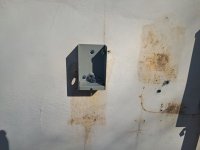
Is the open knock out on the bottom? If so, I'd just use a regular pop in cover. If on the side, I'd seal it
 
OP
R

Rick_Br

Well-known member
Joined
Apr 8, 2014
Messages
407
Location
Winston Salem, NC
I was going to stop for today but decided to get back at it. I got everything cut to size and mounted inside and out - nothing glued yet. Also got the 30 amp breaker installed

Inside Conduit.jpgOutside Conduit.jpg

Things left to do
1. Order wire any suggestions for wire by the foot in 4 colors?
2. Seal and glue conduit connections
3. Clean up all the junk from the outside coax cable / telephone wire removal
4. Fill unused holes in foundation wall
5. Install interlock when received
6. run wire and connect to panel and inlet receptacle
7. round up all the tools and put them away

Probably more I'm not thinking about
 

dave*99

Well-known member
Joined
May 5, 2009
Messages
4,246
Location
Coastal NJ
I was going to stop for today but decided to get back at it. I got everything cut to size and mounted inside and out - nothing glued yet. Also got the 30 amp breaker installed

Inside Conduit.jpgOutside Conduit.jpg

Things left to do
1. Order wire any suggestions for wire by the foot in 4 colors?
2. Seal and glue conduit connections
3. Clean up all the junk from the outside coax cable / telephone wire removal
4. Fill unused holes in foundation wall
5. Install interlock when received
6. run wire and connect to panel and inlet receptacle
7. round up all the tools and put them away

Probably more I'm not thinking about
My local Home Depot does not sell 10ga by the foot. But they do sell 8gauge by the foot. So that's what I'd end up using.
 
OP
R

Rick_Br

Well-known member
Joined
Apr 8, 2014
Messages
407
Location
Winston Salem, NC
So I got everything wired up (inlet, conduit, circuit breaker). I also got the interlock installed. I was a bit surprised about the interlock. Its basically two plates which sliding up/down to block either the generator or main from being on at the same time. I was thinking I would have to loosen screws to move the plate one way or the other - however the late is a loose sliding fit. It naturally (through gravity) slides down to block the generator breaker. Turning off the main allows you to move the plate up and then turning on the generator breaker keeps it up - preventing the main from being turned back on while the generator breaker is also on. All that has been tested and works fine.

S the final test is does it work - IOW does the generator power the panel. My plan unless someone says NOPE)
1. turn main off
2, turn generator breaker on
2A. Turn all 240 circuits off
3. plug cord into generator
4. plug cord into inlet
5. turn generator on
6. check panel circuits to see if powered

Thoughts?
 

dcg9381

Well-known member
Joined
Jun 20, 2018
Messages
11,627
Location
Austin, TX
What am I doing that's not to code?
Show us the final. They'll let you know. There is no harder inspection to pass than the GJ electrical inspection. Seriously.
the final test is does it work - IOW does the generator power the panel. My plan unless someone says NOPE)
1. turn main off
2, turn generator breaker on
2A. Turn all 240 circuits off
3. plug cord into generator
4. plug cord into inlet
5. turn generator on
6. check panel circuits to see if powered

Thoughts?
That's fine.. If you want to be a little more cautious:

1) Turn main off
2) Verify no power L1 / N, L2 /N, L1/L2
3) Turn all other downstream breakers off
4) Turn interlock on.
5) Verify continuity L1 to generator inlet L1
6) Verify continuity L2 to generator inlet L2
7) Verify neutral continuity N to inlet L2
8) plug generator in
9) Start generator
10) Verify power generator power L1 / N, L2 /N, L1/L2
11) Verify power frequency
12) Turn circuits on one at a time, verify with load on each
 

larry4406

Well-known member
Joined
Jan 27, 2006
Messages
18,942
Location
Northern Virginia
I would turn off all breakers.

Then once the generator is on and isolated, only then proceed.

Then rack the 120V breakers in one by one. Largest possible load first, then proceed in order of anticipated reduced loads.

Fridge 1, fridge 2, freezer, etc.
 

mm08822

Well-known member
Joined
Jan 13, 2012
Messages
5,841
Location
NJ
Do not start or stop the gen with the loads connected. Make sure they only see full voltage and 60hz.

Make sure the circuits are open before power up or power down. Most easily accomplished at the gen cb or interlock cb.
 

ripperd

Well-known member
Joined
Jul 2, 2014
Messages
2,041
Location
Twin Cities, MN
Do not start or stop the gen with the loads connected. Make sure they only see full voltage and 60hz.

Make sure the circuits are open before power up or power down. Most easily accomplished at the gen cb or interlock cb.
This.

Unless you have a very large generator you will want to turn on circuits one by one once the generator is online. The inrush of everything coming up at once is likely too much for the generator and it will trip.
 

theoldwizard1

Well-known member
Joined
Feb 22, 2011
Messages
43,073
Location
SE MI
Unless you have a very large generator you will want to turn on circuits one by one once the generator is online. The inrush of everything coming up at once is likely too much for the generator and it will trip.
OP has NO 240V loads. Turning all circuit off before switching to generator power and then turning them back on afterwards is OPTIONAL. I would not worry about it, unless he has 4 or 5 refrigerators/freezers !
 
Last edited:

theoldwizard1

Well-known member
Joined
Feb 22, 2011
Messages
43,073
Location
SE MI
1. turn main off
2, turn generator breaker on
2A. Turn all 240 circuits off
3. plug cord into generator
4. plug cord into inlet
5. turn generator on
6. check panel circuits to see if powered
#2A is not required, even if you have a 120V generator with L1 and L2 shorted together. (A 240V load would actually "see" 0V when L1 and L2 are shorted)

I would put #1 and #2 after #5. You want to be sure the generator is running nice and stable.
 

dcg9381

Well-known member
Joined
Jun 20, 2018
Messages
11,627
Location
Austin, TX
Unless you have a very large generator you will want to turn on circuits one by one once the generator is online. The inrush of everything coming up at once is likely too much for the generator and it will trip.
The 20k Generac that I have, it's got a build-in spool up period at the ATS. I have thrown 120V loads on 3000-5000 watt gens, but it's best to get them up warmed up. If not, they bog, then go over RPM, but I've never had one trip. Once they are warm, throw the load at 'em!

Inverter gen? Throw whatever at them whenever.. Frequency (RPM) don't matter.

Whatever you do, properly break in your generator up front.
 
Last edited:

mm08822

Well-known member
Joined
Jan 13, 2012
Messages
5,841
Location
NJ
There's 3 different procedures needing to be ironed out.

dcg9381 is discussing first time commissioning.
Then there is the routine "day - day" switch over procedure as modified by the Wiz in post 258.
Also should have a procedure for switching back to grid power, cooling down/packing up/storing gen.
 
To avoid these ads, REGISTER NOW!
OP
R

Rick_Br

Well-known member
Joined
Apr 8, 2014
Messages
407
Location
Winston Salem, NC
There's 3 different procedures needing to be ironed out.

dcg9381 is discussing first time commissioning.
Then there is the routine "day - day" switch over procedure as modified by the Wiz in post 258.
Also should have a procedure for switching back to grid power, cooling down/packing up/storing gen.
That's what I was thinking - my first focus will be the new wiring and its correctness. I think dcg9381 covered that pretty well but I will have a few questions.

Rick
 

mike93lx

ALLIANCE MEMBER
Joined
Dec 9, 2013
Messages
37,337
Location
Richmond, VA
Inverter gen? Throw whatever at them whenever.. Frequency (RPM) don't matter.
On my current and prior inverters, the only breaker I turn off before flipping on the interlocked one is the HVAC system that doesn't have a soft start since I can't run it anyway. Otherwise everything is left on. Can't think of anything high draw that would immediately activate anyway. And since the power would be out when switching to the generator, there would be no load.

At my last house, I hired out the panel replacement (Reliance controls main with an integrated transfer). The sparky had me fire up and connect rhe generator (7ish kw, non inverter) and he just flipped the main and genny breaker at the same time. Quick light flicker and everything kept chugging along.
 
OP
R

Rick_Br

Well-known member
Joined
Apr 8, 2014
Messages
407
Location
Winston Salem, NC
Not much time today for this project but wanted to verify That I understood dcg9381's main breaker check and that the points for checking were correct.

Just to be clear - my understanding is that this check has nothing to do with what I have done but is more of a safety check that the main breaker is working as exoected?

Panel Main - Modified L1 L2 N.jpg

2) Verify no power L1 / N, L2 /N, L1/L2

With the breaker ON I checked L1 to Neutral (120), L2 to neutral (120) and L1 to L2 (240).

If I turn main breaker OFF I should get zero at all three points (if they are the right points and I believe they are)

Rick
 
Last edited:

mike93lx

ALLIANCE MEMBER
Joined
Dec 9, 2013
Messages
37,337
Location
Richmond, VA
Not much time today for this project but wanted to verify That I understood dcg9381's main breaker check and that the points for checking were correct.

Panel Main - Modified L1 L2 N.jpg

2) Verify no power L1 / N, L2 /N, L1/L2

With the breaker ON I checked L1 to Neutral (120), L2 to neutral (120) and L1 to L2 (240).

If I turn main breaker OFF I should get zero at all three points (if they are the right points and I believe they are)

Rick
Correct
 

mm08822

Well-known member
Joined
Jan 13, 2012
Messages
5,841
Location
NJ
Not much time today for this project but wanted to verify That I understood dcg9381's main breaker check and that the points for checking were correct.

Just to be clear - my understanding is that this check has nothing to do with what I have done but is more of a safety check that the main breaker is working as exoected?
The proposed check is to execute detailed sequential steps, that if each step passes, the certainty of everything being correct when finally energized is 99.99% certain to give the intended results.

It is a prudent set of sequential steps that when executed (as stated) and passed, provide assurance to move to the next. If the results of a step failed, then there is need for pause to understand was the test performed properly, was hardware wired correctly or some other situation has been overlooked.

DCG's check is not a critique of your workmanship, just a good practice to make certain all is correct so no damage/injury occurs.
 

dcg9381

Well-known member
Joined
Jun 20, 2018
Messages
11,627
Location
Austin, TX
Just to be clear - my understanding is that this check has nothing to do with what I have done but is more of a safety check that the main breaker is working as exoected?
Absolutely nothing to do with your work!
I'm an engineer and I write procedures like "safe start" for systems all the time. It's probably OCD more than anything. Your method was fine too.

With the breaker ON I checked L1 to Neutral (120), L2 to neutral (120) and L1 to L2 (240).
That's correct.
If I turn main breaker OFF I should get zero at all three points (if they are the right points and I believe they are)
Perfect!
 
OP
R

Rick_Br

Well-known member
Joined
Apr 8, 2014
Messages
407
Location
Winston Salem, NC
Thanks mm08822 and dcg9381 - you both said what I was thinking but way more eloquently :)

5) Verify continuity L1 to generator inlet L1
6) Verify continuity L2 to generator inlet L2
7) Verify neutral continuity N to inlet L2


I know how to check continuity but was struggling with how to get my meter leads to span the 7 or 8 feet between the panel and inlet. DUH - I have a power cord designed to plug into the inlet so plug the power cord female end into the inlet receptacle, bring the other end (male) to the panel and check continuity. That should demonstrate continuity from the panel, through the inlet and all the way to the generator.

Question on #7 - is that correct - N to L2 versus N to inlet neutral (white wire)?

Rick
 

dave*99

Well-known member
Joined
May 5, 2009
Messages
4,246
Location
Coastal NJ
Thanks mm08822 and dcg9381 - you both said what I was thinking but way more eloquently :)

5) Verify continuity L1 to generator inlet L1
6) Verify continuity L2 to generator inlet L2
7) Verify neutral continuity N to inlet L2 NO NO NO


I know how to check continuity but was struggling with how to get my meter leads to span the 7 or 8 feet between the panel and inlet. DUH - I have a power cord designed to plug into the inlet so plug the power cord female end into the inlet receptacle, bring the other end (male) to the panel and check continuity. That should demonstrate continuity from the panel, through the inlet and all the way to the generator.

Question on #7 - is that correct - N to L2 versus N to inlet neutral (white wire)?

Rick
DO NOT TRY TO MEASURE CONTINUITY FROM N TO L2. THIS SHOULD BE A VOLTAGE MEASUREMENT

You should have continuity from N to inlet N
 

dave*99

Well-known member
Joined
May 5, 2009
Messages
4,246
Location
Coastal NJ
Show us the final. They'll let you know. There is no harder inspection to pass than the GJ electrical inspection. Seriously.

That's fine.. If you want to be a little more cautious:

1) Turn main off
2) Verify no power L1 / N, L2 /N, L1/L2
3) Turn all other downstream breakers off
4) Turn interlock on.
5) Verify continuity L1 to generator inlet L1
6) Verify continuity L2 to generator inlet L2
7) Verify neutral continuity N to inlet N
8) plug generator in
9) Start generator
10) Verify power generator power L1 / N, L2 /N, L1/L2
11) Verify power frequency
12) Turn circuits on one at a time, verify with load on each
FIFY
 

mm08822

Well-known member
Joined
Jan 13, 2012
Messages
5,841
Location
NJ
Hold ON!

The steps that were detailed are meant to be executed in order and not to do anything else in between one step to another.
If you are piece-mealing this procedure for time constraints, etc., then you always have to re-start at the beginning to have the proper initial conditions established for the following step.

OTHERWISE YOU MAY CREATE AN UNSAFE SITUATIO FOR YOURSELF OR EQUIPMENT.
 

mm08822

Well-known member
Joined
Jan 13, 2012
Messages
5,841
Location
NJ
Step 7 looks like a copy/paste typo....it should be:
5)Verify continuity L1 to generator inlet L1
6) Verify continuity L2 to generator inlet L2
7) Verify neutral continuity N to inlet L2 N

Steps 5,6,7 can only be done after sequentially passing steps 1,2,3,4 without having done anything differently in between, such as I checked 1,2,3 last night, turned power back for the night and now today I continue to do step 4 , starting at step 4. <<<<< NO, go back to step 1 and do as specificed.
 
OP
R

Rick_Br

Well-known member
Joined
Apr 8, 2014
Messages
407
Location
Winston Salem, NC
So the last test is frequency - my meter doesn't have a hertz setting. How critical is the frequency test - i hate to buy another meter
 

theoldwizard1

Well-known member
Joined
Feb 22, 2011
Messages
43,073
Location
SE MI
Its critical if you dont want to fry electronics
Most (>99%) electronics use "switch mode power supplies" to convert AC to DC. SMPS are NOT sensitive to voltage swings (swing, not spikes - many will accept voltages from 90VAC - 250VAC) or frequency. Clocks may still use the 60 Hz signal, but computer have their own references (crystal) and sync with international time standards.

Motors will not be as efficient if you are more than +/- 10% from 60 Hz or there is high harmonic distortion.
 
Last edited:

Mike65

Well-known member
Joined
Mar 7, 2007
Messages
3,015
Location
Horse Pasture, Va.
We have a Westinghouse WGen9500 tri fuel generator & a Gener link hookup. We also purchased a Gen Tent for the generator. According to our electrician it should power the heat or the A/C, the tankless water heater, the refrigerators & the freezer in a power outage. We have not needed it yet, but it is there just in case we need it.
 
OP
R

Rick_Br

Well-known member
Joined
Apr 8, 2014
Messages
407
Location
Winston Salem, NC
I completed the electrical checks today and everything looked good. When I checked the continuity from the panel to the male end of the power cord (female end inserted in the inlet receptacle) - I got a solid zero (continuity on my digital meter) but I was getting stray readings when I checked the same power cord prong to panel ground, neutral and other hot. This occurred with all of the power cord prongs. I am assuming these stray/erratic readings are a result of the electrons running around the panel and that I am OK. Feel free to dispute that :)

Now I am reviewing the generator controls and features
 

wyliesdiesels

Well-known member
Joined
Aug 14, 2012
Messages
19,983
Location
Modesto, CA
I completed the electrical checks today and everything looked good. When I checked the continuity from the panel to the male end of the power cord (female end inserted in the inlet receptacle) - I got a solid zero (continuity on my digital meter)

missing information here. you checked from what to what? need to be specific. saying from panel to power cord means nothing.

if you checked from the panel enclosure to the ground pin, yes you should get continuity (0 phms).....

but I was getting stray readings when I checked the same power cord prong to panel ground, neutral and other hot.

which prong? again, need to be specific here. Other hot on cord? you should not be getting any continuity between either hot and ground or neutral or the other hot.

but infinite ohms (no continuity) can appear differently on different meters. so what was the reading?

This occurred with all of the power cord prongs. I am assuming these stray/erratic readings are a result of the electrons running around the panel and that I am OK.

no dont assume that and there is no such thing as electrons running around the panel...
 
To avoid these ads, REGISTER NOW!
Top Bottom