To avoid these ads, REGISTER NOW!

Inside Doc's Shop...

To avoid these ads, REGISTER NOW!
OP
D

DocsMachine

Well-known member
Joined
Sep 16, 2006
Messages
1,848
I wouldn't call it a "system".... :)

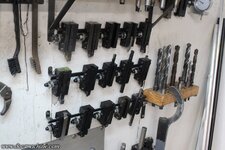
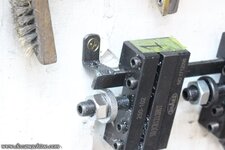
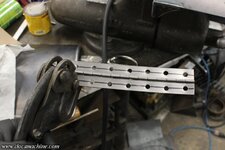
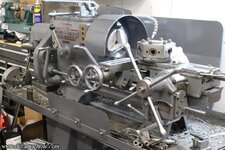
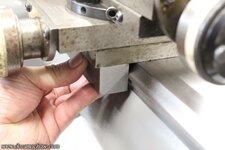
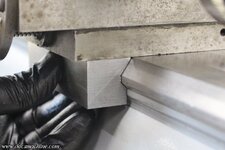
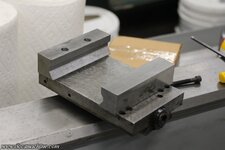
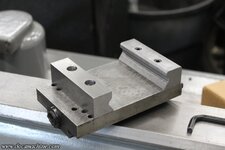
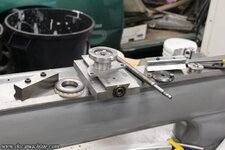
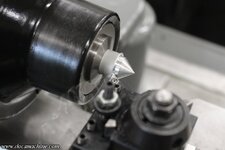
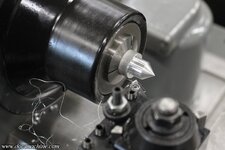
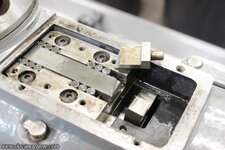
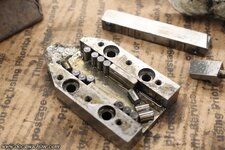
They're simple welded sections of 1/8" x 1/2" steel flatbar:

rax1.jpg

With the horizontal bar angled a bit to roughly match the tool block.

rax2.jpg

I made the first of these nearly 20 years ago, and currently have enough to store some fifty blocks, at two separate machines. I've had people fret about wear- a steel bar on a steel block- but I use these extensively, and have seen virtually no sign of wear. Even my shop-made blocks, which are unhardened mild steel, hardly even show a mark.

Doc.
 

Xti04

Well-known member
Joined
Nov 11, 2016
Messages
2,293
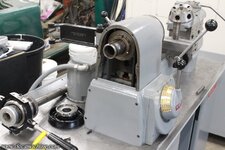
Lathe looks great. I like the original green makes me think of a 1970s fridge.... or the green toilet in my grandparents bathroom.
 

dutchgray

Well-known member
Joined
Sep 28, 2014
Messages
6,463
Location
Dorset. England.
I've had people fret about wear- a steel bar on a steel block- but I use these extensively, and have seen virtually no sign of wear. Even my shop-made blocks, which are unhardened mild steel, hardly even show a mark.

Doc.
Like most things people worry about a whole lot of nothing.
Wear would probably be worse using a softer material like plastic as it could embed abrasive particles, but even then it would be minimal.
But the blocks pretty much just rest on the bar, there is minimal sliding between the surfaces, most users would see more damage to the tool holders by being lazy and not cleaning the holders and tool post surfaces properly.
 
OP
D

DocsMachine

Well-known member
Joined
Sep 16, 2006
Messages
1,848
Sometimes I hate my brain. :)

I got an idea on how to make the 'dust cover' to go under the collet closer- an item I don't really need, that the machine works just fine without, and that I don't really have time for. But that rabid ferret in my head wouldn't let the idea go, so... of course I had to do it.

[sigh]

So, I stripped off the closer, and removed the back plate of the headstock.

rivett333.jpg

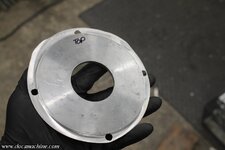
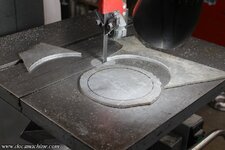
And found a scrap of 1/4" aluminum plate, used the cover to roughly mark a blank and bandsawed it out.

rivett334.jpg

That got chucked up in the freshly-cleaned lathe, the center trepanned out, and the OD thinned as best I could with that setup.

rivett335.jpg

I got the size right...

rivett336.jpg

... but it was getting too thin for a solid hold, so I needed to go a different route.

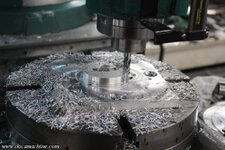
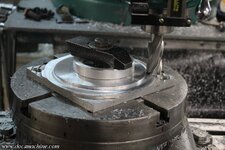
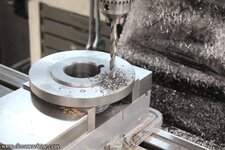
I plunked the rotary table on the also-freshly-cleaned mill, fitted my ratty old workplate, surfaced it, made and fitted a center plug, and turned that to size.

rivett337.jpg

After that, it was easy to thin down the flange to the proper depth with a nice sharp 4-flute.

rivett338.jpg

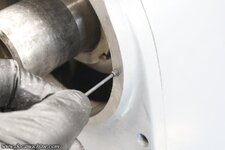
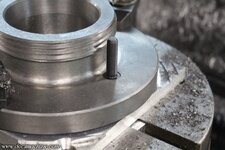
With that done, we needed mounting holes. The new plate would index to the round opening, so I just fitted short setscrews, slightly proud, to the four screw holes.

rivett339.jpg

And a light rap with a rubber mallet made a perfect mark for each one.

rivett340.jpg

The holes got drilled and countersunk, though not as cleanly as I'd have liked due to how thin and flexy the flange is- only about 50 thou. And, as I suspected, that also meant that the screws needed to be slightly less than 50 thou thick at the head.

rivett341.jpg

And she fits, and clears- though just barely- the closer handwheel.

rivett342.jpg

One thing I didn't anticipate was that the backplate's machined feature, isn't quite perfectly concentric with the spindle- which in retrospect makes sense, as they're separate castings and machined in separate operations.

Luckily, I'd made the spindle opening a little oversize, and despite being slightly offset, there's still clearance, and no rubbing.

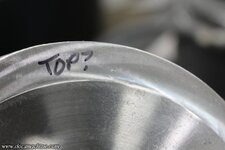
With everything mounted up, I scribed the outline of the casting- which isn't truly circular...

rivett343.jpg

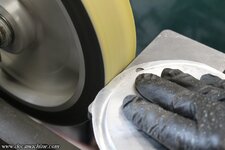
And used the bandsaw to remove the bulk of the extra material, then the belt grinder to finish the edge to the scribe line.

rivett344.jpg

A little filing, sanding and deburring, and she's basically done.

rivett345.jpg

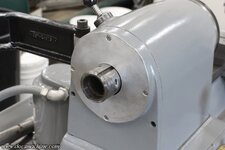
Installed....

rivett346.jpg

And with the closer back in place and up to full speed.

rivett347.jpg

No rubbing, no extra noise, I think it's good. And I can mark that little bit off the ol' mental checklist. :)

Doc.
 
OP
D

DocsMachine

Well-known member
Joined
Sep 16, 2006
Messages
1,848
Over the past several days, as time, opportunity and wherewithal permitted, I've been sneaking a few minutes here and there on fitting a 3-jaw chuck to this thing. I'd already had a new, but cheap, 5" 3-jaw, that I'd intended a couple of years ago to fit to an old electric motor as a poor-man's "speed lathe".

Then, of course, one of the Guild regulars pointed me toward that little Hardinge speed lathe, and I went that direction instead. :)

As I was looking for parts for this Rivett, I found an eBay seller that was offering unfinished backing plates for L-series spindles, and for a decent price. I'd picked one up over a month ago, and as the other major bits are winding down, I figured I'd tinker with that, a few minutes here and there.

I'd have liked to use the Rivett itself to make it, but I don't yet have the X/Y slides in, and those won't have power feed in any case.

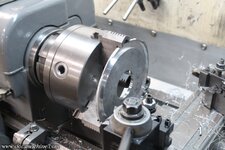
So, I plunked it on the Sheldon, which has the same L-00 spindle nose...

rivett348.jpg

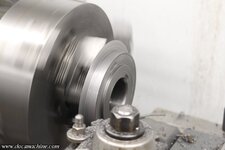
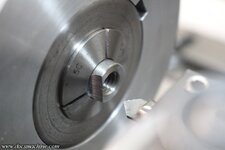
And simply turned a step in it, to the proper depth and diameter.

rivett349.jpg

Cast iron sure turns nice, but holy **** is it dirty. My wrists are rusty. :) (Raw iron landed in the cuffs of my gloves, and the sweat rusted them. I have "ring around the wrist". :D )

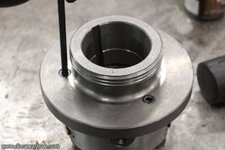
Anyway, once that was to size, U used the same setscrew trick as the dust cover, to mark one bolt hole:

rivett350.jpg

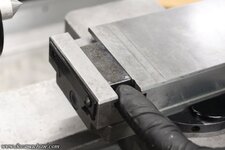
That simply got set up in the vise, lined up as close as I could, and drilled.

rivett351.jpg

I didn't trust that technique with a full bolt pattern, so I remounted the rotary table, clamped the backing plate down threads-up, and with a brass hammer, got it centered to the rotation of the table, within about half a thou.

rivett352.jpg

The drilling was easy- just three holes, so I lined up on the first one, then rotated the part 120 degrees each, to drill the other two. And, of course, I had to counterbore each one.

The heads of the bolts measured .512", but the closest I had was a 9/16" endmill- .5625". Instead I simply turned each bolt head down a few thou, to about .495":

rivett353.jpg

Which fit nice and snug like so:

rivett354.jpg

A quick test fit, and you can see how much larger the backing plate was- it was a touch oversized to cut-to-size for a 6" chuck, and this was just a 5".

rivett355.jpg

I marked the OD with a Sharpie, and since we had a lot of meat to hog off, I chucked it up in the big Springfield, and hogged the bejeebers out of it. :)

rivett356.jpg

The "flange" got left, since I butted the plate up against the chuck jaws. I set the carriage stop to leave about 20 thou, so I wouldn't hit the chuck with the cutter. When I was done, that edge broke off easily with some pliers.

With that done, I set it back up in the Sheldon, and finished the OD to dimension.

rivett357.jpg

You can see why I wanted to clean this machine the other day. :) (I actually had to clean iron dust off three times- as I said, I did all this a bit here and a bit there over several days.)
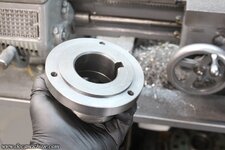
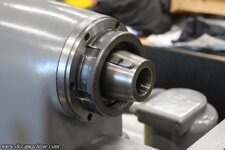
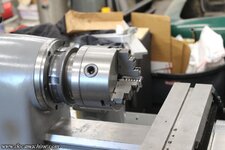
Chamfered, deburred and done!

rivett358.jpg

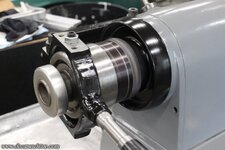
And now for the moment of truth. I re-fitted the locking collar pieces to the Rivett spindle...

rivett359.jpg

And there we are, set against a stunning backdrop of overfilled trash cans, our shiny new 3-jaw chuck.

rivett360.jpg

No idea when this thing ever had a chuck on it before, could have been decades at this point. Last two owners I'm aware of just used it as a collet machine- which I, too, will likely do 95% of the time.

Now, the proof: I chucked up a .5000" ground rod, and got out the .0005" indicator again.

rivett361.jpg

The results... weren't great. Which I expected- this was a cheap Asian-import, and the eBay seller- Shars- actually list these as having a .003" TIR (total indicated runout.) I actually got .005", and consistently at three different sizes- 1/2", 5/8" and two different 1" pieces.

One jaw was consistently "high", so I may try grinding the chuck slightly at some point.

Keeping in mind that 3-jaws are rarely consistent- the name-brand one on the Sheldon, a Polish-made Bison, is typically out about .002".

While I was, in fact, hoping for a little better, even .005" isn't all that bad. For more precise work, I can of course use the collets. For certain jobs- this is a turret lathe after all- if all the operations are done in one chucking, they'll still be concentric with each other. And, part of the reason I got this particular chuck, is that it accepts 2-piece jaws. Meaning I can bolt on aluminum or mild steel 'soft jaws', which can be turned in place, and to an exact size. Which, if done right, even with an imperfect chuck, can give collet-level accuracy.

In any case, not a bad few-days' work, and expands the utility of this machine quite a bit. :)

Doc.
 
OP
D

DocsMachine

Well-known member
Joined
Sep 16, 2006
Messages
1,848
A project I've been needing to do for well over a year now, is make a splash guard to go over the 3-jaw chuck on the Warner & Swasey turret lathe.

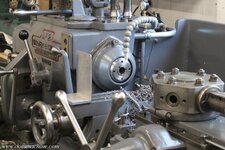
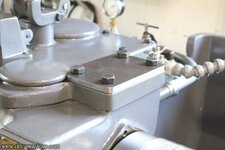
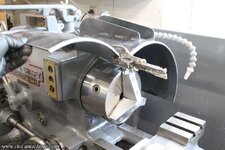
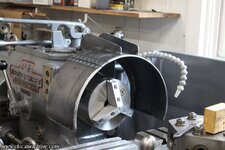
In normal operations, using the original collets, it's pretty well guarded:

splashy01.jpg

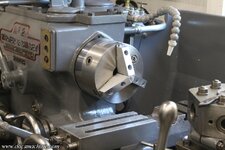
There's very little to 'sling' oil, and that 'cap' over the collet nose contains a lot of the mess. But, using a 3-jaw, with that flood cutting oil?

splashy02.jpg

... could and did get a lot splashier. :) That's a problem, as I've had work on the floor waiting for this machine, with the 3-jaw, but didn't want to make such a huge mess. I meant to try and do it last year, but it involves cutting, grinding and welding, so it has to be done outside. Grinding dust and weld spatter is not an ideal material to be getting all over a machine tool. :)

I also meant to jump right on this as soon as the weather got nice this year, but holy ****, did the summer get entirely away from me. Point in fact, this job and one other cut-and-weld project, were among several reasons I took the comic hiatus- our 37 minute long summer is rapidly winding down. And it's so much more pleasant to do this kind of thing when it's still warmish and sunny and I can have the doors open and listen to my music and all that. :)

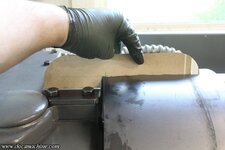
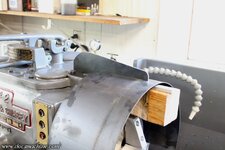
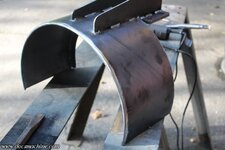
So, back in May or so, I picked up a piece of 14 ga. steel, and had a local fab shop roll it into a smooth curve for me.

splashy03.jpg

That mocked it up, but of course we'll need to mount it. Fortunately, there's a mounting pad right above the spindle, meant to fit things like additional tool and turret supports. (Such as in this photo; note the two big round bars above the turret. Those slide into the bushed support block above the chuck, providing additional stability and support for the heavy turret tooling. That lets those two positions in the turret take multiple cuts in one pass.)

So, I dug a piece of some 3/8" hot-rolled plate out of the scrap pile, and bandsawed off 'bout that much.

splashy04.jpg

This I measured and located, and drilled a bolt pattern to match the mounting pad.

splashy05.jpg

One corner of the plate interfered with one of the inspection hole covers...

splashy06.jpg

So that got bandsawed down, too, and the corners licked 'round.

splashy07.jpg

With the curved part mocked back up, I was able to fit a cardboard template...

splashy08.jpg

And transfer that to a piece of 3/32", also out of the scraps heap. (Shown in the background. :) )

splashy09.jpg

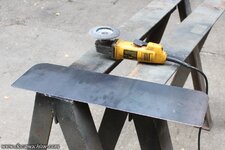
That also gets bandsawed out, taken for a ride through the belt-grinder, and generally fettled until it kind of looked like it was supposed to fit. If you squint.

splashy10.jpg

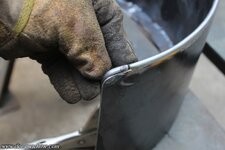
I absolutely was not going to try and tack it together in place- welding sparks are bad enough on a machine tool, but worse on one covered in cutting oil. :) So I laid down some witness lines and carefully tacked it, outside.
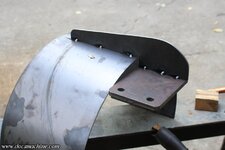
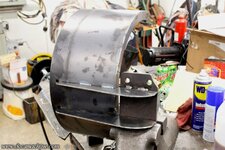
splashy11.jpg

I'll admit it took a couple tries 'til I was happy with it, but we got there in the end.

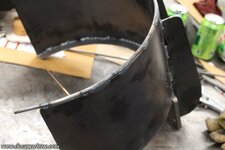
I then fabbed a second brace, and snipped, plazzed and ground the bejeebers out of three pieces of 16 ga. to form an inner flange. These I tacked outside, and then once I rolled everything back inside, I started working my way around with the TIG. (Which doesn't make spatter or smoke, so I have no issues with doing indoors.)

splashy12.jpg

I stopped about there, needing to finish up a few other things before the end of the day, and it was getting too hot to comfortably rest my hand on. In the morning, I'll finish up the welding, do a little grinding, and we can move on to the next steps.

Doc.
 
OP
D

DocsMachine

Well-known member
Joined
Sep 16, 2006
Messages
1,848
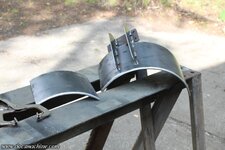
Didn't have much time today but I picked up some 1/4" round rod, and bent it to fit as the front lip of the cover:

splashy13.jpg

Partially to reinforce it, and partially to 'blunt' the leading edge, making it less likely to inflict a cut or something. Ones' hands will be around this thing a lot, swapping parts, brushing away swarf, using tools that have things like retract levers and whatnot, so making sharp bits less sharp is always worth the time. :)

After forming it into a reasonably smooth curve, I proceeded to TIG it to the edge, as well as finishing up the back flange from yesterday.

Then I took it outside, and smoothed down what I could, starting with hard-stone grinders, then flap wheels, then the usual DA sander.

splashy14.jpg

Aaand that was about all I had time for. :) I mocked it back up on the machine, and marked about where I'll be cutting the operator-facing side off, so I can add a hinge. That, of course, will be so I can get to the chuck with the chuck key. :)
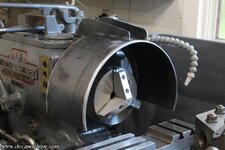
splashy15.jpg

Other than painting, the hinge is about all it still needs, though I want to add some touch-up welds here and there.

Doc.
 

teknikfrog

Well-known member
Joined
Apr 29, 2023
Messages
216
Noob question; I noticed that at one point you drilled a hole w/ an endmill.

When would you use a drill vs an endmill to drill a simple hole? Did you just grab what was closest or is there a pro/con to using an endmill?
 

zanyad

ALLIANCE MEMBER
Joined
Apr 26, 2018
Messages
2,756
Location
NE Ohio
Noob question; I noticed that at one point you drilled a hole w/ an endmill.

When would you use a drill vs an endmill to drill a simple hole? Did you just grab what was closest or is there a pro/con to using an endmill?
Endmills have to be center-cutting in order to use them as drills. Alternatively, use a regular drill to clear out the center of the hole where the endmill flutes don't meet, then follow up with the endmill for a (near-) flat bottom hole.

* - The end of an endmill will usually have clearance ground on the flutes, so using an endmill as a counterboring tool may leave a slightly crowned surface unless you use a CNC to circular interpolate.
 
OP
D

DocsMachine

Well-known member
Joined
Sep 16, 2006
Messages
1,848
Right. [cracks knuckles]

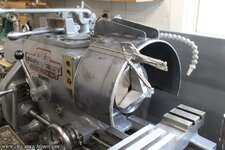
First thing I did today was slice the "flap" off at the aforementioned cut line.

splashy16.jpg

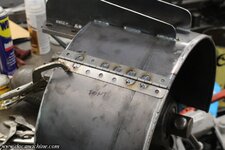
I then cut a section of the piano hinge, and mocked it up with some clamps.

splashy17.jpg

And, by blind lu... er, good planning, it looks like it'll work just fine.

splashy18.jpg

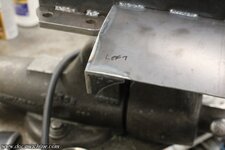
I dressed up the cut edges, and made these two "corner reinforcements" to weld into the back corner.

splashy19.jpg

That way, when the "flap" is closed, it's resting with two relatively wide flat sections against each other, and not trying to **** a thin sheetmetal edge against another thin sheetmetal edge.

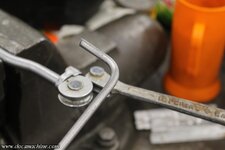
And, to finish off the bottom edge of the 'flap', I bent another chunk of the 1/4" rod in a tubing bender, to make a nice smooth radius...

splashy20.jpg

That got trimmed, fitted and tacked to the bottom edge, and eventually fully welded and dressed down.

splashy21.jpg

The section of piano hinge, I wanted more securely attached than just welding the edges, to I got out the Whitney punch and popped a series of 1/4" holes along both sides.

splashy22.jpg

After a little dressing, this got tacked on to both pieces...

splashy23.jpg

Tested....

splashy24.jpg

And then fully "rosette" welded, and dressed again. ("Dressed" being hit with the flappy abrasive wheel to smooth edges and corners.)

splashy25.jpg

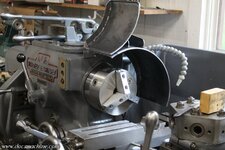
The flap works great! There's enough 'pressure' to hold it fairly solidly either open or closed, and as you can see, offers plenty of clearance for a chuck key.

splashy26.jpg

Just... don't look too close to the welds. :) I was having issues with the MIG.

Also note the back lower corner. Square is so last season. :) So I bent another bit of rod, and fitted that into place.

splashy27.jpg

I then hung it up, degreased it, primed it as usual, and by wild luck, found my old can of the same dark grey the rest of the machine was painted in.

splashy28.jpg

AND... knowing I was finally going to get the old paint back out, I remembered yet another thing I've been meaning to do to this machine for quite some time. I even picked up the metal for it over a year ago- possibly two- and it was still stashed behind the lathe. :)

This I got out, marked and sliced off the corners, and ground it smooth.

splashy29.jpg

I then spaced and drilled three holes, and filed them square.

splashy30.jpg

And this, too, got painted.

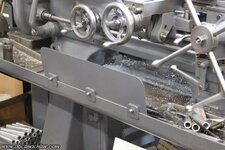
What is it? This will be a sort of "knee" splash guard. The drip tray is about level with my knee, and oil coming off the tool and cross slide tends to "splash" in the standing oil that collects in it. Altogether too much of which winds up on my pants. :)

I saw another Warner & Swasey No.2 a few years back, and it had a sheetmetal splashguard much like this, fitted at the front edge of the drip tray, specifically to block this sort of mess, and I've been meaning to add something similar to mine, ever since.

All I need to do now is make and paint some 'clamping' bars.

Doc.
 
OP
D

DocsMachine

Well-known member
Joined
Sep 16, 2006
Messages
1,848
I think I would have hinged the whole assembly at the 4-bolt mounting plate.

-Then it would have tilted towards the turret as it lifted, and given the size, almost certainly would interfere with any tooling in it. Also, keep in mind this is a splash guard to contain cutting oil. Flipping it upside down would probably itself cause some drippage and splashage. :)

And, this isn't exactly a unique idea. A "hinged flap" style of chuck guard like this is quite common on turrets- example 1, example 2, example 3, example 4, ad nauseum. :D

When would you use a drill vs an endmill to drill a simple hole? Did you just grab what was closest or is there a pro/con to using an endmill?

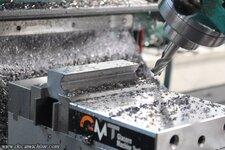
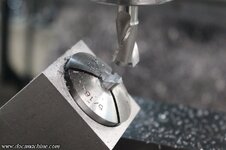
-If you mean when I was mounting the chuck, I wasn't drilling with the endmill, I was counterboring. Which is basically using the endmill as a "flat bottomed drill", but since the main hole was already bored, it was really only cutting on the periphery.

As noted, you wouldn't want to drill from solid with an endmill, but they work as a counterbore on an already-drilled hole quite well.

Doc.
 

teknikfrog

Well-known member
Joined
Apr 29, 2023
Messages
216
So if you want a clean flat-bottomed hole, start with a normal drill and then finish with a center-cutting endmill?

And otherwise, you'd never use an endmill to drill a hole?
 

zanyad

ALLIANCE MEMBER
Joined
Apr 26, 2018
Messages
2,756
Location
NE Ohio
Flat bottom drills are also a thing, but generally not a good idea in steel to use just that. Regular drill to remove most of the waste, then finish depth with the flat bottom drill is in my experience the generally accepted practice. Looks like OP has more experience/training than I do though.
 
OP
D

DocsMachine

Well-known member
Joined
Sep 16, 2006
Messages
1,848
Not much shop time today, save for simply putting a second coat on those two parts.

So I dug around in my camera cards, and found something from much earlier this year, that I'd been meaning to post after the whole marker is done.

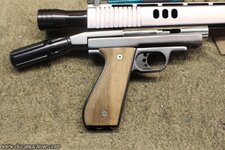
Customer sent in a Carter "Boxgun" stock-classer (a semi-rare paintball gun) and like many Carters, it has a "palm swell" grip. It accepts standard .45 style grip panels, but they don't really fit the profile.

cartergrips2-01.jpg

So, I made a cardboard pattern for the grip shape, and traced that to a small slab of Walnut.

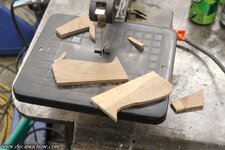
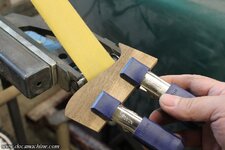
This I rough-sawed out with the jigsaw...

cartergrips2-02.jpg

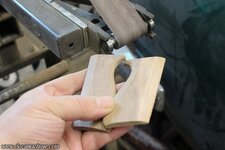
And shaped and smoothed the pair on the belt sander.

cartergrips2-03.jpg

It usually takes a few test-fits and tries to get the shape just right- and the patience to not go too far. :)

cartergrips2-04.jpg

With the outer shape done, we simply profile the edges to smooth up the overall fit.

cartergrips2-05.jpg

The holes are carefully marked, drilled and countersunk, and once fitted, a few minor touch-ups to the shape, and the curves get hand-sanded smooth.

cartergrips2-06.jpg

Then they're stained....

cartergrips2-07.jpg

And finally cleared, cured, sanded and cleared again:

cartergrips2-08.jpg

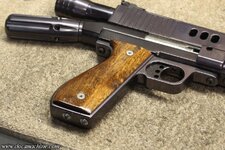
And once fully dry, Voilá!

cartergrips2-09.jpg

cartergrips2-10.jpg

Now if I can just get off my duff and get the anno batch done. :) (That's this coming weeks' task. :D )

Doc.
 
Last edited:
OP
D

DocsMachine

Well-known member
Joined
Sep 16, 2006
Messages
1,848
So if you want a clean flat-bottomed hole, start with a normal drill and then finish with a center-cutting endmill?

-Pretty much.

In the two cases, earlier, in one case- on the ring part- I drilled the holes close to the finish size, then chased them with an endmill. In that case, part of the reason for that was to get a smooth, on-size hole, which is easier to do with an endmill than a drill bit.

The the other case, the chuck backing plate, I drilled the hole, and then only partially bored with the endmill- a counterbore recess to accept the head of the allen bolt.

And otherwise, you'd never use an endmill to drill a hole?

-Correct, Endmills, even 'center cutting' ones, aren't meant to drill a hole from solid. I have done it, generally in aluminum, and taking some care, but really, drill first, then use the endmill to just clean up the hole.

AND... in any of these cases, only do this on a milling machine. The endmill does not "self center" like a drill bit, and if the part isn't rigidly held (vise, clamp, etc.) the endmill can grab randomly and fling the part.

Doc.
 

teknikfrog

Well-known member
Joined
Apr 29, 2023
Messages
216
Thanks for the schooling. I've got a mini mill and I get a ton of mileage out of it but mostly through trial and error, I've got no foundational machining knowledge so this is all very useful.
 
OP
D

DocsMachine

Well-known member
Joined
Sep 16, 2006
Messages
1,848
While I still have a large number of things pending, I have unfortunately been feeling somewhat under the weather since early Monday. Something I ate, I think, though I don't know what that might have been.

Therefore no real shop progress to speak of, though I had to make a mail-run to keep some customers happy. And in the inbound mail, I received this little gem:

rivett362.jpg

That's a relatively late-model Hardinge X/Y slide, which can turn this Rivett into a full plain-turning lathe, in addition to a turret lathe. Again, expanding the usefullness of the machine as much as possible.

It wasn't cheap, and of course like the cross-slide, I'll have to fab new mounts to make it work on the Rivett bed, but it's in great shape (though needs a good cleaning) and works very smoothly. I picked up another one of the little 0XA quickchange toolposts a couple of weeks ago, just as I did for the little speed lathe, and will make a similar mount for it.

Hopefully I can tinker with it later this week.

Doc.
 
To avoid these ads, REGISTER NOW!
OP
D

DocsMachine

Well-known member
Joined
Sep 16, 2006
Messages
1,848
After a week of semi-forced inactivity- hey, the bottle said "do not operate heavy machinery" :) - I've finally been able to get back to doing a little work.
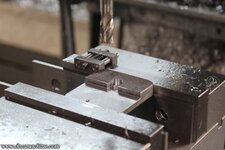
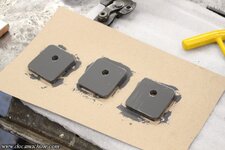
One thing I needed off the table is this splash guard- I'd cut the metal for the clamping tabs before I fell ill, so I was able to slap them into the mill, whittle a little here and there, and come up with three of these:

splashy32.jpg

These, as per usual routine, got degreased and painted....

splashy33.jpg

And once dried, the whole guard attaches to the lip of the drip tray like so:

splashy34.jpg

As you can see, it's placed to help keep the oil dripping down off the tooling, from splashing on my legs. :)

splashy35.jpg

I still need to get some longer bolts for the chuck shroud, but other than that, they're done. Looking forward to getting some of this other stuff off the tables, so I can tool this badboy up and give them both a proper workout. :)

Doc.
 
OP
D

DocsMachine

Well-known member
Joined
Sep 16, 2006
Messages
1,848
Getting back to the Rivett, too, after a week of enforced hiatus, one of the last things I need to do, now, is to mount that aforementioned X/Y slide.

I found a couple pieces of 1-1/8" square stock that looked like they'd work, and bandsawed a couple chunks to fit.

rivett363.jpg

Same game as the single slide, the angles are a bit wonky- 55 degrees at the top, and 45 at the bottom. So I was forced to tilt and retram the mill head a couple times. First the upper cut...

rivett364.jpg

The flat/clearance cut...

rivett365.jpg

A quick relief over in the other mill...

rivett366.jpg

And then after the last 45 degree cut, which allowed a little sneaking up" to the fit, said fit is damn near perfect:

rivett367.jpg

The rear block was easily drilled to accept the two original screw holes, but the spacing for the front one, as you can see, isn't going to work.

rivett368.jpg

That was about all I had the horsepower for, today, so after I've had a chance to pick up some more bolts and screws in the morning, I'll lay out, drill and tap a new set.

Doc.
 
OP
D

DocsMachine

Well-known member
Joined
Sep 16, 2006
Messages
1,848
Had a fairly productive day, though I wound up doing about three different things more or less at the same time, and so kept forgetting to take pictures. :) Here's what I got:

The 'front' bar, of course, got drilled and counterbored for the aformentioned mounting bolts, and the base casting of the slide drilled and tapped to match. After that, I marked the edges of the bars, and milled them to match the width of the casting.

rivett369.jpg

Still test-fitting the front block, but they both match up nicely.

rivett370.jpg

Now, I needed some way to have the whole assembly "clamp" to the bed. After some pondering, I decided to put some screws through the back block- so the front dial of the slides didn't get in the way of the wrench. So I spaced, drilled and tapped two 3/8"-24 holes...

rivett371.jpg

Turned a couple sections of 12L14* to match...

rivett372.jpg

(*Some rod salvaged out of an old printer. :D )

And then very carefully milled the ends of the two short "slugs" to match the bed profile.

rivett373.jpg

Like so:

rivett374.jpg

The two screws, of course, push those inward, locking to the bed rail. It's quite secure- actually more secure, in my opinion, than the original Hardinge method. And, keeping in mind that this is not a "heavy hogging" machine- it's intended for fine, precise work.

Anyway, even though the front block still needs some detail work, I wanted to finally clean up and reassemble the slide. I spent some time, therefore, with solvent, Scotchbrite, stones and a file, cleaning up the nicks and dings, tarnish and dried-on coolant residues.

rivett375.jpg

And slowly reassembling it all with fresh lube and grease.

rivett376.jpg

rivett377.jpg

rivett378.jpg

rivett379.jpg

... And done!

rivett380.jpg

Fully cleaned, deburred, lubed and reassembled. I'll probably still need to tweak the gib adjustments once I start using it, but that's to be expected.

The next step is to mount the little 0XA toolpost- and then I can actually, finally, make some chips! :)

Doc.
 
OP
D

DocsMachine

Well-known member
Joined
Sep 16, 2006
Messages
1,848
I know we're on the home stretch, as it were, but I still have a lot of other things on my plates these days.

But, spoiler alert! First Chips! :)

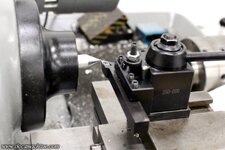
Ahem... As mentioned earlier, I had intended to mount an 0XA toolpost to the newly-installed cross slides.

(For the non-machinists reading this, these are a dovetailed toolholder, that take matching blocks which hold the actual cutting tool. The design makes it easy and quick to swap cutters, to closely adjust the tip height of a tool, etc. The 0XA posts are a size smaller than the older 'smallest size', the AXA- which have on both the Sheldon and the Logan. The 0XA is intended for even smaller lathes, like the popular Asian-import desktop machines.)

I had already fitted one to the little Hardinge speed lathe, and it's worked quite well so far. The trick I wanted to do here is to mount the Rivett's toolpost at the same relative height, so the tool blocks can be swapped between the two, without having to readjust each time. They're barely two paces apart from each other in the shop (basically face to face) and I already have most of a dozen blocks for the Hardinge.

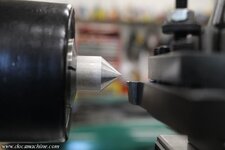
So, I turned a point on a scrap of aluminum rod, chucked it up in the Hardinge, and double-checked the tool height of one of the blocks. It was basically spot-on.

rivett381.jpg

Note the thin block spacer under the toolpost. That was to raise up the post, so that the tool block was about in the middle of its adjustment range. So that, depending on what tool one mounts in the block, it can still be raised or lowered to bring the cutting tip back to centered.

I moved the whole post, including that spacer, over to the Rivett to see how far we were off:

rivett382.jpg

Not bad. After a little measuring, it turns out we needed a spacer just a frog-hair under 1/2". Using a 0.5000" spacer block, you can see the tool tip is just a smidge high.

rivett383.jpg

'Smidge" is, of course a highly technical term. Only us long-time machinists know that one. It's of course bigger than a Barn and smaller than a Smoot. :)

So, I found a chunk of 1/2" plate, and another in 3/8", and bandsawed off 'bout that much.

rivett384.jpg

The 3/8" piece got milled down into a T-nut...

rivett385.jpg

And of course it fitted perfectly. :D

rivett386.jpg

Yes, the new tool post came with a "blank" T-nut piece, but it was already drilled and tapped for the center mounting stud. And with the spacer, that was going to be quite a bit short. As I can't easily thread for a metric pitch, I drilled the new nut for a 3/8"-16 post, made from a piece of allthread.

rivett387.jpg

The blue tape is to help resist splintering. Old woodworker's trick. :D

After that was fitted, I squared up the 1/2" block...

rivett388.jpg

Clearance drilled it for the mounting stud, and then cleaned up one side on the surface grinder.

rivett389.jpg

I had hoped that there was enough meat to be able to grind both sides, but once I got one side flat- it was an edge piece when originally rolled, and so was .005" to .006" high- it turned out that was pretty much the exactly correct dimension:

rivett390.jpg

With the center stud cut and faced to length, and a spare flange nut from the bins (the one that came with it was of course metric) the whole mess installs like so:

rivett391.jpg

I may still put a screw in between the spacer and the T-nut, to keep things aligned, and keep everything in place if/when I have to loosen and rotate the toolpost itself, but lo and behold, ladies and gentlemen. It's finally complete enough to actually use!

rivett392.jpg

rivett393.jpg

This thing ate up far too much of my summer, and altogether too much of my already rather limited capital. But, apart from some tweaking of the turret, and picking up some suitable turret tooling, she's finally usable!

(Can't say "done" yet- I still want a splash guard and tool storage, I'm probably still going to swap the wood collet tray with a thicker and higher-capacity one, etc. :) )

Doc.
 
OP
D

DocsMachine

Well-known member
Joined
Sep 16, 2006
Messages
1,848
I'm trying rather hard not to open this post with a string of invectives that could defoliate cats out to eighty paces.

I had 'rebuilt' the turret assembly at least a month ago, but it wasn't quite working right. I set it aside to give it a closer look later, while I finished up some other things. Since we're finally down to not much else besides minor-detail work on this machine, and since I finally got in some ER holders and collets to fit this turret, it was about time to see if I could figure out what I'd done wrong.

And somehow, this is what I'd done wrong:

rivett394.jpg

I'm honestly not sure when it happened, or, for that matter, exactly how I managed to do it. I suspect it was one of the times I as installing the unlock assembly from underneath- the smaller rectangular object at the right, that sticks up from underneath. Maybe wasn't quite seated in the slot when I tightened it down, I dunno.

The bar is the locking bolt for the turret. It's what holds the turret solidly in place after indexing, and without it, the turret is basically unusable. The part is, of course, also utterly irreplaceable. Rivett was closed out and scrapped back in the 70s, and this Model 60 is a comparatively rare model, made in limited numbers towards the end.

The only way to replace it, would have been to buy another complete Series 60- and they're less common than truth from a politician- and rob the turret off of it.

Or make one.

Many expletives were spoken. The nature of such expletives and the vehemence in which they were uttered, stripped some of the paint off my foundation, frosted all the glass within twenty yards, and earned me a posthumous letter from George Carlin saying "hey, tone it down a little, wouldya?"

Lacking a nearby pier to heave it from, I set it aside for a bit, until the seething rage of a thousand suns faded down to just twenty or thirty. It has now become time once again, as per long established protocol, to to a great deal of work to fix yet another one of my f**k-ups.

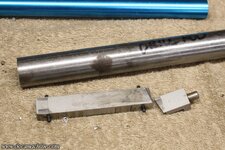
The part is fairly simple. It's a rectangular bar, with a notch for the locking lug, and a post on the end as a return spring guide. The biggest trick is that it's very hard- both for where the bolt nose locks into the turret, and also the tight-fitting side rollers that let it move forward and back, but not side-to-side.

rivett395.jpg

So, I dug through my supplies, and found a chunk of O1 'drill rod'. O1 is oil-hardening high-carbon steel, which should give me a a nice hard part once it's... well, hardened, but it's also fairly forgiving in heat-treat. (Low chance of cracking, minimal warping, etc.)

rivett396.jpg

I also have some D2, which is a bit more high performance in a tool steel, but it's also trickier to heat treat properly (I'd have to send it to a pro) and tougher to surface grind to final size. I'll save that for if this one doesn't work out.

After cutting a piece to length, I turned the spring-spud on one end...

rivett397.jpg

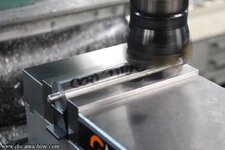
And proceeded to mill the rest down into a flat bar.

rivett398.jpg

rivett399.jpg

With a little care, I got it down to size- plus about 0.010" per side, or so.

rivett400.jpg

(That's the four-hundredth photo in this series, by the way. :) )

The extra material is so that, if it does warp a little from the heat-treating, or the surface carburizes from the heat, I can grind it back to shape and size. The finished surface has to be ground smooth anyway, and to very precise specs- there's basically no slop in those rollers- so the final step in any case will be a trip through the surface grinder.

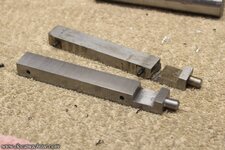
After that, I milled the notch for the locking lug...

rivett401.jpg

Milled it to length...

rivett402.jpg

And drilled it for the two travel-limiting pins.

rivett403.jpg

Shape wise, the only thing left to do is contour the nose to fit into the turret locking recesses, but I'll do that by hand, after the rest is ground to size.

rivett404.jpg

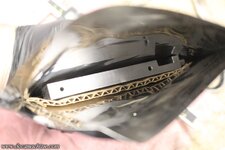
Now, the prep for the heat-treating. I'd ordered some 2-mil stainless steel heat-treating bags- specifically for this task- so I've got it set up in one of them, along with a piece of cardboard. The cardboard is a common knifemaker's trick- supposedly the cardboard burns, and uses up most of the oxygen in the bag, helping keep the surface of the part cleaner.

rivett405.jpg

The bag is crimped shut and ready to toss in the forge.

rivett406.jpg

It was raining this afternoon, plus I wanted some help- a "fire watch" of sorts :D - so hopefully we can heat-treat it tomorrow, and if successful, move on to fitting it.

Doc.
 

SilverJimmy

Well-known member
Joined
Apr 14, 2012
Messages
1,627
Location
Prescott/Flagstaff, AZ
Cool tip/info about the cardboard, make sense once you said it, but I wouldn’t have ever thought to do that! Good luck, amazing what those of us with opposing thumbs can accomplish when our backs are against the wall!
 
OP
D

DocsMachine

Well-known member
Joined
Sep 16, 2006
Messages
1,848
Before all the YouTubers started using inerted or atmosphere electric heat-treating furnaces (filled generally with argon, to reduce the carburization of the hot steel) that was, as I understood it (warning: Not a knifemaker :) ) the trick when using stainless wrap.

I'm told the bags I'm using- basically pre-folded stainless foil- have a 'coating' on the inside, that both absorbs the free oxygen and also helps keep the steel from sticking to the foil.

And, the piece is oversized by enough I should have enough meat to grind it back to shape, even if I heated it in open air, so the cardboard probably wasn't strictly necessary- but it was also easy enough, so why not? :)

Doc.
 
OP
D

DocsMachine

Well-known member
Joined
Sep 16, 2006
Messages
1,848
Today was a good day. :)

A neighbor volunteered his horseshoein' forge to do the heat-treating, and it worked admirably.

rivett407.jpg

There's the stainless packet in there, best could be reached with the cramped opening.

rivett408.jpg

(The bag 'inflated', which I should have expected, I'm sure partly due to the expanding air, but also the combustion of the cardboard.)

None of this was particularly scientific- no magnet to detect the curie point, no "soak time by thickness", etc. I just let it cook 'til I was reasonably sure the thing was heated all the way through, then pulled it out, snipped the bag open, and plunked it in the can of oil.

No photos of the process, hard to do both things at once. :) But here's the remains of the bag, including the ash of the cardboard...

rivett409.jpg

And here's the finished part.

rivett410.jpg

Did it work? Yes, I think so. A file can't cut it, so presumably it's in the ballpark of around 55 Rockwell C, give or take. The oil was more viscous than I'd probably have wanted, it's the remains of the old headstock oil I drained out of the Springfield a decade ago, and haven't yet taken to the recycling depot yet. (They don't actually recycle it- they burn it for wintertime heat. :) )

Anyway, I suspect the slow cool- it took nearly a full minute to get down to merely warm- probably gave it a hard outer layer and a softer inner- which is, actually, kind of desirable, if true. :D

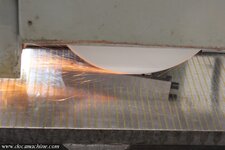
Once we had the hot gear put away, I swapped the wheel in the surface grinder, with a finer-grit and softer grade- paradoxially, you're supposed to use a softer rock on harder materials. I then stoned down some of the burrs on the bolt, so it'd sit flat on the magnetic chuck, and went to work.

rivett411.jpg

rivett412.jpg

rivett413.jpg

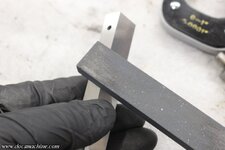
Redressed the wheel frequently, measured and remeasured constantly, took a couple of breaks so the part didn't get too hot, and eventually got it down to basically perfect. The thickness is within .00025", and the width is exactly the same as the original part, to the best of my ability to measure. :)

The corners were rather sharp, so I stoned those down, as well as hitting the corners of the notch with a Dremel and a pointy stone.

rivett414.jpg

For those that suggested the notch should have been given rounded corners to reduce the stress risers... I did. :) I'd used an endmill with a 40 or 50 thou radius at the corners- which very nearly matched the radius of the factory part.
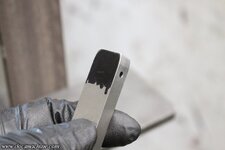
The final step was to manually shape a slight taper at the business end, so it can securely lock into the mating groove in the base of the turret. This I did on the belt grinder, with a fine grit belt, and touched up on the deburr wheel.

rivett415.jpg

And to finish off the piece, I cut and trimmed to length two pins out of 0.125" music wire:

rivett416.jpg

The pins basically just keep the guide rollers corralled, so there's no real force or strain on them. I'd hoped to have a slight press fit, but they were only just snug enough they needed to be tapped lightly in. To add a bit of security, I degreased everything, and gave 'em a liberal coat of red Loctite.

rivett417.jpg

And Voilá! A brand-new replacement Rivett turret bolt, very likely the first one that's been manufactured in over fifty years. :D

rivett418.jpg

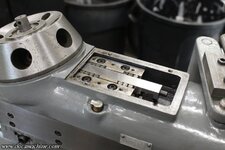
Now to install it, and see if I can get this dang turret working! First, the... bolt carrier tray? For want of a better term...

rivett419.jpg

Then the new bolt, the two spacers, and the fourteen rollers:

rivett420.jpg

And finally the cover plate.

rivett421.jpg

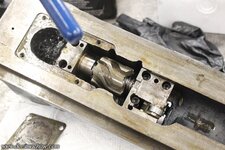
Now, the bolt appeared to be working just fine, but the thing still wouldn't index or operate properly. After some further investigation, a lot of fiddling and poking, and more cursing than is probably healthy, I finally lit on this:

rivett422.jpg

The thing with the zig-zag grooves is the indexing cam. It meets up with a stationary pin, and as you finish retracting the slide, it causes the turret to rotate one-sixth of a turn. The rotation caused by the hidden-in-grease bevel gears right under the blue T-handle. (And the roller at the lower right is what actuated the bolt.)

Anyway, if you look closely, the lowest (we're looking at the underside of the assembly) groove on the drum, doesn't quite line up with the clearance groove on the right-hand block. The gearing is effectively one tooth off.

After some finagling, since there appears to be only one 'correct' position for the gear and grooves, and the fact the whole assembly does not just lift right out easily, I got it lined up and back into place:

rivett423.jpg

And lo and behold, once it was all back together, it worked great! It indexes properly and locks solidly.

rivett424.jpg

At least, most of the time. For some reason, it occasionally- and randomly- locks up. Just after that photo was taken, which was after I'd indexed it six or eight times, I ran it 'round again, doing a full six cycles- and it locked up on the seventh.

It still slides back and forth, but it seems like the indexing mechanism is locked or jammed. I was tired of dealing with it for the night, so I closed up the shop and came in to post this for you lot. :)

I'll poke around on it some more this weekend- I still need to fit the badly-beat-up split cotters (the locks that hold the tools in each opening) and see if I can't figure out why the pin at the cap of the turret doesn't want to seat all the way. :)

Almost done, Ladies and Gents! Stand by!

Doc.
 
OP
D

DocsMachine

Well-known member
Joined
Sep 16, 2006
Messages
1,848
I have a suspicion on the turret issue: I haven't yet installed the rear stop rod assembly, which lets you set the cutting depth of each individual tool. That's also an overall travel stop, and I wonder if this is a case of running the ram too far forward.

I wasn't actually doing any work with it, of course, just cranking the handle back and forth. And maybe I ran it too far forward and part of the advancing mechanism got a little out of line?

Worth a look, anyway, and I'll have to at least partially dismantle the thing to get it back into gear in any case. When I do that, I'll reinstall the depth stop assembly, and with a little luck, that should restore 100% reliability.

In the meantime... I had a quick little job I've been saving for this machine, a delicate drilling job, that's just a little too fiddly for the big Warner & Swasey. And, since I could do it without needing to index the turret anyway, I figured why not? :)

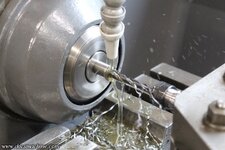
It's a recurring job that involves drilling some nominally-1/8" stainless rod out to a whopping 1/16". The big machine simply has too much leverage, and it's tough to 'feel' a drill that tiny, and the top speed for the spindle on the big monster is only 1400 RPM.

For this, I slipped the belt up to second-from-top speed, and drilled a fair batch of these at around 3K RPM.

rivett425.jpg

rivett426.jpg

rivett427.jpg

And I have to say, it worked great. The machine, even in the higher speeds, is amazingly smooth- probably the lowest-vibration machine I've used.

The one drawback so far- the previous owner warned me that switching the speed too fast could trip out the VFD. I didn't disbelieve him, though I have to admit I wasn't sure how that would work. (Considering the VFD only drives the motor that drives the generator- it's not connected to the spindle motor in any other fashion.)

Anyway, I did trip it once early on. No big, I just cycled the power and let the VFD reboot, and just tried to be sure to change the speeds a little slower after that.

I could see an advantage to running this thing off of something like a rotary converter, and being able to adjust the speeds more or less "at will" rather than having to do it comparatively slowly. Especially if/when it comes time to do some power tapping, with a releasing tapping head. In that case, once it releases, you stop the spindle and reverse it to 'unscrew' the tap. No particular issue with doing that slowly, but it'd be nice to not have to worry about tripping anything out.

Although, now that I think about it... I wonder if a braking resistor would help? I'm assuming that slowing the spindle motor rapidly somehow loads or drives the generator, which in turn overloads the AC motor just enough to trip the VFD protections? Would a braking resistor help that? Thoughts and insight welcome.

I'll learn more, of course, as the machine gets used more- and hopefully I can get the turret back into shape in the next day or two.

But hey, for now- it lives, it works and it's pretty dang good. :)

Doc.
 

dutchgray

Well-known member
Joined
Sep 28, 2014
Messages
6,463
Location
Dorset. England.
Braking resistor should help if it is tripping when you are slowing the spindle.
What happens is the rotating mass drives the motor, effectively turning it into a generator and the VFD has to get rid of that extra power, if it can't quickly enough the DC buss voltage in the VFD rises too high and it trips itself out to protect itself from damage.

A braking resistor allows the VFD to dump that extra power into heat when needed, but it will only use it when the VFD knows its braking, ie if you're controlling the speed with the VFD, if the speed changes are on the lathe via variator belt, gear changes or DC motor control then I don't think it would help.

You could possibly add braking to whatever control drives the spindle motor.
 
OP
D

DocsMachine

Well-known member
Joined
Sep 16, 2006
Messages
1,848
A braking resistor allows the VFD to dump that extra power into heat when needed, but it will only use it when the VFD knows its braking, ie if you're controlling the speed with the VFD[...]

-That was my conclusion as well.

This machine uses a Ward-Leonard style motor-generator drive. A 3-phase AC motor turns a DC generator, which in turn powers the DC spindle motor. The big speed control on the front is basically a large rheostat, and controls- as I understand it- the field strength of the generator. That directly controls the output from the generator, which smoothly varies the speed of the spindle motor.

It's very much like the old Monarch 10EE drives, and has been in use, one way or another, in things like elevators and escalators, for over a century.

My question is... how does it cause the VFD to 'trip out'? Does slowing the spindle down for some reason cause a heavy load on the generator, which in turn momentarily overloads the AC motor, causing the trip? Or is there more of an electrical interconnection that I'm unaware of? (I had assumed the AC circuit was completely separate and isolated from anything in the DC circuits.)

... Now that I think about it... the VFD was a comparatively recent addition, before I got it. Sometime in the last eight to ten years, I think. I need to double-check that, I wonder if it's undersized? Like for a 1HP motor, when the MG drive uses a 2HP. That would be likely to make it trip if heavily loaded... though I'd also be surprised if it could start the motor in the first place. Just spitballin'...

Additional insight welcomed.

Doc.
 

dutchgray

Well-known member
Joined
Sep 28, 2014
Messages
6,463
Location
Dorset. England.
If you try to rapidly slow the spindle, you end up with the spindle driving it's motor as a generator, which will motor the DC generator which will drive the AC motor as a generator and overload the VFD
It's the conservation of energy thing, the rotational energy in the spindle has to go somewhere and a VFD is much less capable of dealing with it than a grid tied 3 phase motor would be.
An oversized VFD would definitely help, because it would have more inbuilt capacity to deal with the back feed, but how big would be enough is probably only to be found by experimentation.

I would think if you could run on a suitably large rotary phase converter instead you'd have no problems with rapid deceleration.
 
OP
D

DocsMachine

Well-known member
Joined
Sep 16, 2006
Messages
1,848
I have a rotary, good to 7HP, I think? I have that for things like the surface grinder and the big turret. (Which has an odd two-speed "concurrent pole" motor, which would have made running on a VFD virtually impossible. :) )

It's entirely possible I could bypass the VFD (which, as I said, is a recent addition) and run this thing on the rotary. All I'd need is a suitable disconnect switch.

Kind of funny that, in that case, whenever I would be taking an actual cut, three motors would be running in order to do it. :)

On the VFD, the question is, if it's set up with a braking resistor, does it shunt any extra energy automatically, at any time, or does it only do it when it's "told" to, such as when it's intentionally bringing the motor to a stop?

I suspect it's the latter- it is, after all, a braking resistor, and you have to program the VFD to use it. Anyone know for sure?

Doc.
 

dutchgray

Well-known member
Joined
Sep 28, 2014
Messages
6,463
Location
Dorset. England.
I have a rotary, good to 7HP, I think? I have that for things like the surface grinder and the big turret. (Which has an odd two-speed "concurrent pole" motor, which would have made running on a VFD virtually impossible. :) )

It's entirely possible I could bypass the VFD (which, as I said, is a recent addition) and run this thing on the rotary. All I'd need is a suitable disconnect switch.

Kind of funny that, in that case, whenever I would be taking an actual cut, three motors would be running in order to do it. :)

On the VFD, the question is, if it's set up with a braking resistor, does it shunt any extra energy automatically, at any time, or does it only do it when it's "told" to, such as when it's intentionally bringing the motor to a stop?

I suspect it's the latter- it is, after all, a braking resistor, and you have to program the VFD to use it. Anyone know for sure?

Doc.
I suspect the latter as well, I haven't ever used a VFD with a breaking resistor, I only have 2 VFD's in use and only one which I use to vary running speed, on a pillar drill.
I would suspect the answer is probably buried deep in the VFD manual somewhere.

Multiple speed 3 phase motors are cool, near instant speed changes on the fly.
 

tool_scrounge

Well-known member
Joined
Jul 20, 2010
Messages
4,173
Location
Southern California
7hp rotary phase converter should be fine. If not, connect and turn on one of your other three phase machines at the same time and that machine’s motor will also act as an idler. That would at least help confirm if you need a bigger phase converter. Though I know some garage operations where that is standard procedure.
 
OP
D

DocsMachine

Well-known member
Joined
Sep 16, 2006
Messages
1,848
Final touches!

First, it seems that jogging the turret ram back and forth last night apparently jiggled that cam drum back into place, and so this morning it was healed. :) Cycled and indexed just fine.

So I reinstalled pretty much the very last piece of this whole puzzle- the adjustable stop-rod assembly that goes on the tail end of the turret.

rivett428.jpg

I also drove the aforementioned turret pin out, rotated the 'axle' 180 degrees, and it tapped right back in like it was meant to.

rivett429.jpg

And, while I still have to deburr and clean up the rest of the split cotters (the tool retention clamps for the other turret bores) and of course set up some more tooling... that, Ladies and Gentlemen, essentially finishes this project! She is done and fully usable!

In the middle of it's first payin' job- a total of over a hundred parts to be done, but one for which it's basically the best machine in the shop for it. :D

rivett430.jpg

(With the background roughly- but artistically :) - blurred out. Big difference from when it first arrived, eh?)

There's still some little detail bits, like replacing that wooden collet tray, that I still want to do, but for all intents and purposes, this project is done! :D

Doc.
 
OP
D

DocsMachine

Well-known member
Joined
Sep 16, 2006
Messages
1,848
Thanks to the advice from a number of people on the various boards, I went ahead and installed the braking resistor, to see if it solved the stalling issue. (Okay, it only stalled the once on me, but the previous owner dealt with that too, and I wanted to not have to worry about it.)

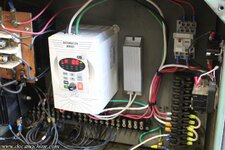
I had, as I said earlier, a 200-ohm resistor I'd bought several years ago to fit to the Nichols horizontal mill. That basically plugged right in to the AD VFD- hardly surprising since I also bought it from AD :) ...

rivett431.jpg

I didn't want to drill any holes just yet, so it's simply stuck there with double-sided tape. Yes, it could theoretically get warm enough to melt the tape, but I kind of doubt it'll get to that point.

Anyway, I then went digging through the manual to find out how to "enable" it. I was pretty sure I recalled reading in the manual that you had to enable one of the 'parameters' so the VFD 'knew' the resistor was in place, but there was no such instruction anywhere in the manual.

Presumably, then, it's simply used automatically, once it's installed. Which, of course, was the case- I tried the lathe after wiring the resistor, and played with both speed and direction 'at will'. I didn't yank the lever "as fast as it would go", but I certainly moved it as quickly as I felt was necessary- much faster than I'd been doing at the start of this first batch of parts.

I could hear the drive motor change pitch a little, but it kept plugging away, with no apparent issues or complaints. Even swapping it from a fair forward clip to hard reverse worked just fine.

So that little issue is solved, and makes the machine even more usable/user-friendly.

And, while I was in there, I finally installed the cable strain relief for the power cord, that I'd bought over a month ago:

rivett432.jpg

Only a few more things on the list! :D

Doc.
 
OP
D

DocsMachine

Well-known member
Joined
Sep 16, 2006
Messages
1,848
The very last little bit of functionality this thing needed, was the "split cotters", the clamping features to hold tools in the turret sockets.

I started out trying to "fix" the originals, which had been mangled and distorted by countless ham-handed operators over the last sixty years, who had of course tightened each of them like they were the bolts that keep the Eiffel Tower from tipping over.

After getting just two of them workable so I could run that first job, I decided I might as well just make new ones. I picked up a bar of 5/8" cold-rolled, and set up the big turret to drill it:

rivett433.jpg

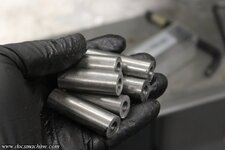
I'd drill, saw off the end, drill again, saw off the end, etc. until I had six pieces:

rivett434.jpg

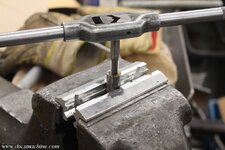
For just a few like this, it was easier to hand tap them in the Sheldon, rather than take the time to set up the releasing tapping head on the turret. The 3/8" coarse needs a little oomph to turn, and in the smaller lathe there's not enough clearance for a larger tap handle. So I'd start the tap in the lathe, which is an easy way of starting it straight, and then finished up with the big tap handle, with the part in the bench vise.

rivett435.jpg

Then, setting up a 5/8" collet in a square 5C block, and with a bit of careful measuring, I gingerly milled a notch in the side of each one.

rivett436.jpg

Using the same collet assembly, I then cut each one in half, through the center of the notch.

rivett437.jpg

Moving back over to the little Sheldon, I faced the cut end of each of the long halves...

rivett438.jpg

And switching over to the collet closer, I faced and deburred the cut end of the smaller ones, too.

rivett439.jpg

Taking one of the shortest of the long pieces, I drilled it out to clear the bolt, and test-fitted it to the turret. That let me know about how much I could trim them down.

rivett440.jpg

Like so:

rivett441.jpg

I could make it sit flush, but repeated tightening of the bolt could 'peen' the end of the cotter, which could make it difficult to remove or even adjust. Leaving it proud by roughly an eighth-inch means it's not a worry.

I added a depth stop to the collet assembly, and turned the other five down to that same length...

rivett442.jpg

And back over to the big turret to drill them through to clear the bolts.

rivett443.jpg

Finished and ready to install!

rivett444.jpg

But first, I ran a reamer- by hand- through the cotter channels...

rivett445.jpg

And then one through the tool sockets.

rivett446.jpg

Neither removed any real metal, just a couple of minor, annoying high points from small nicks or gouges.

After that, I wiped each one out with a little solvent and paper towels, and blew them clean.

And finally, after almost three months, fully tooled!

rivett447.jpg

Each one fits nicely, and holds solidly with fairly minimal torque.

And that, officially, makes it one-hundred-percent operational. There is no longer anything mechanical or electrical, keeping me from using any aspect of this. The closer works perfectly, the motor and spindle are quiet and powerful, the turret cycles with 100% reliability (unless you crank the handle too slowly- the grease I used is apparently sticky enough that if you "sneak" slowly to the next station, it doesn't always snap into locked position) and both tool slides are fully rebuilt.

I still need to do some work setting up more tooling, and getting a 'day to day' tool set collected for this thing (that is, dedicated allen wrenches and the like, so I don't have to hunt elsewhere for them) but that's all pretty typical stuff. The important part is, she's now 100% done and operational!

Doc.
 
To avoid these ads, REGISTER NOW!
Top Bottom